Table Of ContentAn index of accepted names and synonyms
R.R. Klopper
VT^armiTi^r
C. Hab'ashi
^
H.M. S^yn/
d^Wet
B.C.
J-M. Arnol^
^
Gautier
L.
G.F. Smith
Rv Spichiger
national
biodiversity
institute
Digitized by the Internet Archive
in 2016 with funding from
South African National Biodiversity Institute Libraries
https://archive.org/details/checklistfloweriOOrrkl
Cheeklist
of the
Flowering Plants
of
Sub-Saharan Africa
An index of accepted names and synonyms
R.R.Klopper
C.Chatelain
V.Banninger
C. Habashi
H.M.Steyn
B.C.deWet
T.H.Arnold
L.Gautier
G.F.Smith
R.Spichiger
2006
SouthernAfrican Botanical DiversityNetworkReportNo.42
flowering plants of Sub-Saharan Africa
Recommendedcitationformat
KLOPPER, R.R.,CHATELAIN, C„ BANNINGER,V., HABASHI,C„ STEYN, H.M., DEWET, B.C.,ARNOLD,T.H.,GAUTIER, L,SMITH,G.F.&
SPICHIGER, R. 2006. Checklistoftheflowering plants ofSub-Saharan Africa. An indexofaccepted names and synonyms!South
AfricanBotanicalDiversityNetworkReportNo.42.SABONET,Pretoria.
Producedandpublishedby
TheProjectCoordinator
SouthernAfrican Botanical DiversityNetwork
c/oSouthAfrican National BiodiversityInstitute(SANBI)
PrivateBag X101
Pretoria,0001
SouthAfrica
E-mail:[email protected]
Printed in 2006intheRepublicofSouthAfrica byCapturePress,Pretoira (-1-27) 12349-1802
ISBN 1-919976-27-2
©2006SABONET.All rights reserved.Nopartofthis publication maybereproducedortransmitted inanyformorbyanymeans
withoutpermission ofthecopyrightholder.
Textdesignandlayout:NadinevanWyk&Daleen Maree,SouthAfrican National BiodiversityInstitute,Pretoria
Coverdesign:SandraTurck,SouthAfrican National BiodiversityInstitute,Pretoria
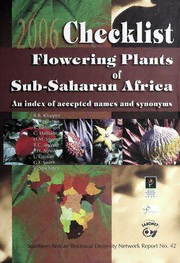
Front cover: Left to right: Mussaendaerythrophylla (CJBG),Aloeclaviflora (A.W. Klopper), Orbeasemota (A.W. Klopper), Protea
cynaroides(SANBI).
Backcover:Toptobottom:Ixoralaxiflora(CJBG),Mystacidiumcapense(A.W.Klopper),Cochlospermumplanchonii(CJBG).Leftto
right:Erythrinazeyheri(A.W.Klopper),Asteraceae(R.R.Klopper),Psychotriaspathacea(CJBG).
SABONETwebsite:www.sabonet.org.za
This report isajoint productofthe South African National Biodiversity Institute (SANBI), ConservatoireetJardin Botaniques de
la VilledeGeneve, Switzerland (CJBG) and theSouthern African Botanical Diversity Network(SABONET).Thesupportprovided
bythe Global Environment Facility (GEF) / United Nations Development Programme (UNDP) and the United States Agencyfor
International Development USAID)/WorldConservation Union-Regional Officeforsouthern Africa (lUCN-ROSA) (Plotno. 14818
Lebatlane Road, Gaborone West, Extension 6 Gaborone, Botswana) made this report possible under the terms of Grant No.
690-0283-A-00-5950. SABONET is a GEF Project implemented by UNDP and co-funded by USAID / lUCN-ROSA. The opinions
expressed herein are those ofthe authors and do not necessarily reflect the views of USAID, the GEF / UNDP, the SABONET
SteeringCommitteeorSABONETNationalWorkingGroups.
lUCN
TheWorldConservationUnion
Hl|ir GEF
;ir»»- TENTS ^^:
w:{%
Foreword w
Introduction v
Background v
Aim V
The merging process v
Nomenclatural Problems v
Spellingofnames v
Authorsofnames v
Taxonomic Problems vi
Familyconcept vi
Genericconcept vi
Infraspecificlevel vi
Outputs vi
Layout of the publication vii
Statistics vii
Acknowledgements x
References x
Statistics per family xi
Dicotyledons xi
Monocotyledons xvi
Dicotyledons
1
Monocotyledons 683
Index to families and genera 874
About SABONET
893
Other publications in this series 894
owerins plants of Sub-Saharan Africa
FOREWORD
Theclosingyearsofthe20thcenturywitnessedaglobalawakeningtothecriticalstateofhealthofplanetEarthandtoanticipated
high levels ofspecies extinctions and ecosystem collapse. Such awareness led to a series of international consultations, most
significantofwhichwasthe United NationsConferenceon Environmentand Development,convened in RiodeJaneiro in 1992.
TheConventiononBiologicalDiversity(CBD),signedinRio,hasbecomethecornerstoneofglobaleffortstodescribe,understand
andconservetheworld'sgreatrichnessofanimal,plantand micro-organism life,andtheecosystemsinwhichtheyarefound.
Recognising that much was still to be discovered and described despite several centuries of research into the diversity ofthe
world'sspecies,theCBDlaunchedtheGlobalTaxonomyInitiative(GTI)in 1998toaddressthe'taxonomicimpediment'toeffective
biodiversityconservation.The lackofcomprehensive biodiversitychecklistsfor mostcountriesand taxonomicgroups,and the
direstateoftaxonomyin mostdevelopingcountries,requireda newandenergeticapproachtotheproblem.
Simultaneous to the development ofthe CBD and GTI, a regional initiative was under development in southern Africa, which
culminated in the establishment ofthe Southern African Botanical Diversity Network (SABONET) in 1996. A prime objective of
SABONETwasthedevelopmentofplanttaxonomicexpertisethroughouttheregion,andthepublicationofnationalandregional
checklistsoftheflora.BuildingontheexpertisedevelopedwithinSouthAfricathroughthePRECISherbariumdatabase,SABONET
soon operated in 26 herbaria in 10 southern African countries, adding 450000databased herbarium specimenstothe 750000
already within PRECIS. It also resulted in the publication ofchecklists for the flora ofeach country, and to a wide diversity of
handbookson botanicalscienceandconservation intheregion.
SABONETwasessentiallyasouth-southsolutiontoAfrica'staxonomicimpediment,butatalltimeslinkswithnortherninstitutions
were maintained and strengthened. Through the vision of the initiators of the African Plant Checklist and Database Project
(APCD),GideonSmithin PretoriaandAdelaideStorkandJean-PierreLebruninGeneva,theresultsofmanydecadesoftaxonomic
synthesis,forsouthernandtropical Africa, haveproducedthepresentbenchmarkvolume.Thetenacityofpurposedisplayed by
theseworkers,and the many membersoftheAPCDteam which they builtsincethe bold conceptwasfirst proposed atAETFAT
1994,deservesthepraiseofallwhoworkonthefloraofAfrica.
We now have a comprehensive and critical checklist ofthe angiosperm flora of Africa south ofthe Sahara. The 50 136 listed
taxa give a robust statistic on the flora ofthis continent, and ofthe families and genera to which they belong. The checklist
providestheframeworkfortherapidlygrowinginformationsystemswhichdocumentthediversity,distribution,ecology,useand
conservationstatusofAfrica's rich plantlife, informationwhichwill soon befreelyaccessiblethroughtheinternet.
At a time of rapid technological advancement, this volume will probably be both the first, and last, hardcopy checklist ofthe
African flora. Within the next decade, the phenomenal advances in electronic publication, and in internet-based information
systemssuchastheAfrican PlantsInitiativedatabaseofdigitisedtypespecimensofall50000acceptedtaxaandtheirsynonyms
listed inthisvolume,will replaceclassical publicationsystems.ButformanyscholarsinAfrica,theutilityandaccessofa hardcopy
volume is still essential,and this bookwill providea resourceand inspirationtoworkersthroughoutthecontinentand beyond,
formanyyearstocome.
BrianJ Huntley
ChiefExecutiveOfficer
SouthAfrican National BiodiversityInstitute
Chair,SouthernAfrican Botanical DiversityNetwork
Kirstenbosch,December2005
Foreword
\lowerins plants of Sub-Saharan Africa
INTRODUCTION
Background Historique
The African Plant Checklist and Database project (APCD) is a Le projetAfrican PlantChecklistandDatabase (APCD) est issu
collaborationbetweentheSouthAfricanNationalBiodiversity d'unecollaborationentreleSouthAfricanNationalBiodiversity
Institute (SANBI) and Conservatoire et Jardin Botaniques Institute (SANBI) et les ConservatoireetJardin botaniquesdela
de la Ville de Geneve, Switzerland (CJBG). The project was Villede Geneve, Suisse (CJBG). II a ete congu lors du XlVeme
conceivedattheXIVthCongressoftheAssociationpourI'Etude congres de I'AssociationpourI'Etude Taxonomiquedela Flore
ToxonomiquedelaFlored'AfriqueTropicale(AETFAT)heldatthe d'Afrique Tropicale (AETFAT) a I'Universite Agronomique de
Wageningen Agricultural University in the Netherlands from Wageningen aux Pays-Bas, qui s'est tenu du 22 au 27 Aout
22-27 August 1994 (fora complete historyofthe project, see 1994 (pour un historique complet du projet, cf. Gautier etal.,
Gautiereta/.,in press). souspresse).
Aim Objectif
The aim ofthe project was to combine Lebutdeceprojetestdefusionnerdeux
twomajordatasets,namely: importantslotsdedonnees,a savoir:
1. FloraofSouthernAfrica(FSA)dataset 1. La Flora of Southern Africa (FSA)
(Germishuizen&Meyer2003)and (Germishuizen&Meyer2003)
2. Lebrun & Stork (1991, 1992, 1995, 2. L' Enumeration des plantes a fleurs
1997) Enumeration des plantes a d'Afrique tropicale (EPFAT) (Lebrun
fleurs d'Afrique tropicale (EPFAT) & Stork 1991, 1992, 1995, 1997) et
publications and their follow-up: leursuite: TropicalAfricanflowering
Tropical African flowering plants, plants, ecology and distribution
ecology and distribution (Lebrun (Lebrun & Stork 2003), qui couvre
& Stork 2003), covering Tropical I'Afriquetropicale.
Africa.
Le resultat de cette fusion represente
The result is the first-ever angiosperm la premiere liste complete des
checklist and database for Sub-Saharan angiospermes d'Afrique sub-
Africa. saharienne.
The merging process Le processus de fusion
Combining the two lists was not a straightforward process La mise en commun des deux listes n'a pas ete un processus
and several nomenclatural and taxonomic issues were raised simple eta mis en evidence de nombreux problemes d'ordre
bythemerging process. taxonomiqueetnomenclatural.
Nomenclatural Problems (these were mainly Problemes nomenclaturaux
problems of standardisation)
Orthographedesnoms
Spellingofnames
La plupart des divergences sur la fa^on d'orthographier les
Most ofthe spelling discrepancies could be solved either by nomsonteteresoluesparI'utilisationdestandardslargement
referringtoacommonlyacceptedstandardorbyconsultingthe reconnus, ou en consultant la diagnose originale du taxon.
original publication. Forgenera:IndexNominumGenericorum Pour les noms de genres, I'IndexNominum Genericorum (Farr
(Farretal. 1979, 1986)wasusedasthestandard. etal. 1979, 1986)aeteretenu.
Authorsofnames Auteursdesnoms
Forauthornamestheaccepted standard wasAuthorsofplant Pour les auteurs des noms, le standard adopte est Authors
names (Brummitt & Powell 1992). However, discrepancies ofplant names (Brummitt & Powell 1992). Neanmoins, des
betweenthetwolistsoften arose becauseofdifferentorigins disaccords entre les deux listes existent en raison des
ofthedata.Onceagain,comingbacktotheoriginalpublication origines differentes des donnees. Une fois encore, le retour
helped to solve these discrepancies. Although a mismatch in a la diagnose originale a permis de lever un certain nombre
publication authors could generally be solved by a simple decesdisaccords. Une grande partie d'entreeux ont pu etre
application ofthe nomenclaturalcode, mostofthe remaining simplementrisolusparI'applicationducodedenomenclature.
discrepanciesoriginatedfromtheinclusionof'ex'authorsand La plupartdes problimessubsistantssontlaconsiquencede
theirconfusionwith'in'authors,andtheirdifferentplacement I'inclusion des auteurs 'ex' et leur confusion avec les auteurs
in relation to the primary author of the taxon. As there is a 'in',ainsi que leurplacement par rapporta I'auteureffectifde
general tendency to omit these authors, the possibility of la publication.Etantdonniqu'ilexisteunetendanceginirale
doing this systematically should be considered in the future, aomettrecesauteurs,ilseraitvraisemblablementraisonnable
butonemustbeverycarefulnottodiscardtheprimaryauthor d'allerdansce sensa I'avenir,en prenanttoutefoisgardea ne
inerror. pasiliminerI'auteurrieldutaxon.
Introduction
vi flowering plants of Sub-Saharan Africa
Taxonomic Problems Problemes Taxonomiques
Familyconcept,attributionofgeneratofamilies Conceptfamilial,attributiondesgenresauxfamilies
There are some clear discrepancies as to family concepts II y a quelques discordances entre la circonscription des families
between FSA and EPFAT. However, families are principally a utilisee par la FSA et par I'EPFAT. Neanmoins, il est bon de se
practical means ofarranging binomials,and besides,theyare rappeler que les families ne sont qu'une maniere pratique
often subject to numerous changes, especially nowadays. In d'arranger les taxons et que, par ailleurs, leur circonscription est
thisrespect,theuseofastandardemergedasthesimplestway sujettead'incessantschangements,particulierementdenosjours.
ofhandlingthisproblem.Therefore,whenthefamilyconcepts En consequence, lorsque la conception familiale etait la meme
ofthe two datasets were similar,that view was followed, but dans lesdeuxlotsdedonnees,celle-ciaeteconservee.Encasde
wheretheconceptsdiffered,Brummitt(1992)wasfollowed. disaccord,c'estlaconceptiondeBrummit(1992)quiaetesuivie.
Generic concept, attribution of species to genera, syno- Conception generique, attribution des especes aux genres,
nyms synonymie
As both lists are critical (i.e. aiming to have only one current Les deux listes de depart etant critiques, c'est-a-dire ayant la
namepertaxon),thegenericconceptsadopted,aswellasthe pretentionden'avoirqu'un seui nom retenu pouruntaxon,les
taxonomictreatmentsfollowed,wereofprimary importance. conceptsgeneriquesadopteset lestraitementstaxonomiques
Since both lists depend on treatments that are often limited suivis sont de premiere importance. Les deux listes etant en
geographically,itwasclearthatin manycasestherewould be partiebaseessurdesrevisionsdeporteegeographiquelimitee,
nogeneral consensuson which namewascurrent,andwhich il etait certain que dans bien des cas il ne serait pas possible
wasa synonym.This problem is, ofcourse, n—ot specifictothe d'arriver a un consensus sur quel nom retenir et quel nom
merging of these two separate checklists it is general in mettreensynonyme.Ceproblemen'estbienentendupaslimite
botanyand is,forinstance,encountereddailywhencuratinga a ce genre de travail. II est par exemple le pain quotidien des
herbariumwithworldwidecollections. conservateursquigerentdesherbiersd'importancemondiale.
Thepresentworkdoesnotpretendtosolvethesediscrepancies, Lepresenttravail nepretend pasresoudrecesdisaccords,etles
and the outputs are designed to reflect both FSA and EPFAT produitsquienderiventontetecon<;usdemaniereapresenteren
taxonomicviewsin parallel.Inthisway,itshould helptopoint parallelelesvuesdesdeuxlotsdedonnees,mettantparlameme
outareasforfutureresearch intaxonomy. enevidencelesgroupesouuntravaildefondestnecessaire.
Infraspecificlevel Niveauinfraspecifique
Merging thetwo datasets hasalso revealed an immense area Lafusiondesdeuxlotsdedonneesaegalementmisenevidenceun
fordiscrepanciesattheinfraspecificlevel.Theseinclude: vastechampdedisaccordsauniveauinfraspicifique.Parexemple:
* Species that are subdivided into infraspecifics in one • Des espices divisies en taxons infraspicifiques dans un
dataset,butnotintheother. lotdedonniesetpasdansI'autre.
* Species that are subdivided at a different level, e.g. • Des espices divisies a des niveaux diffirents (variitis,
subspeciesvsvarieties. sous-especes,...).
* Infraspecificcascades. • Descascadesinfraspicifiques.
Once more, the outputs are designed to present both views, Ici encore, les produits de ce travail ont iti con^us pour
waiting for a future taxonomic treatment to solve these prisenter les deux vues dans I'attente de leur risolution par
issues. destraitementssystimatiquesfuturs.
Outputs Les produits
The first output is this hardcopy publication ofthe checklist. Le premier produit consiste en cette version imprimie de
This is a milestone in the project and will only be published la liste. Elle reprisente une itape dans le projet et ne sera
once. vraisemblablementpas reconduite.
Thesecondandlong-termoutputisasearchabledatabasethat Le deuxiime produit, en ivolution, est une base de donnies
is freely accessiblethrough the internet. Itwill be continually librementaccessibledepuisinternet.Celle-ciseracontinuellement
updated, regularly incorporating additions and corrections.
mise ajour, incorporant les additions et corrections au fur et a
Theelectronicversion ofthefinal merged database ishoused mesure de leur parution. La version ilectronique de cette base
at CJBG; www.ville-ge.ch/cib/bd/africa.There is also a linkto dedonniesesthibergieauxCJBGetonyaccedeparI'adresse
the database on the SANBI website: www.sanbi.org/frames/
infofram.htm suivante:www.ville-ge.ch/cib/bd/africa. Ilyaigalementun lien
. verscette basededonniesurlesitedu SANBI:www.sanbi.org/
frames/infofram.htm
.
Introduction