Table Of ContentExploring new
interpretations of
. past and place in
archaeology, folklore
and mythology
l\lo. 1 D June 1 gga E i!.SO
Exploring new
interpretations of
past and place in
archaeology, folklore
and mythology
Issue No.1 0 June 1 998 ISSN 1361-0058
Editor: Bob T rubshaw
Contents:
2 Cross Hill Close, Wymeswold,
Bob Tru bshaw
Loughborough, LE12 6VJ
Fairies and their kin 1
Telephone: 01509 880725
}eremy Harte
E-mail: [email protected]
Medieval fairies - now you see them, now you don't 2
Elizabeth Oak/and WW:W http:// ww.w gmtnet.co.uk/
indigo/edge/atehome.htm
Lost in Faery - wandering in the magical thorn
thickets of the mind 1 0
}eremy Harte Data Protection Act 1984.
Sex, drugs and circle dancing 14 Payment of subscription indicates that
subscribers agree to their names and addresses ..
}eremy Harte
being stored in a retrieval system for At the
Do elves have rights? 16
Edge correspondence purposes only.
David Tay/or
Spaces of transition - new light on the haunted house 22
David Clarke © 1998. All articles, illustratio�s and
Peakland spooklights 28 photographs are the joint copyright of the
author/artisVphotographer and the editor.
Vncredited articles and reviews by editor.
LETIERS 34
All rights reserved. No part of this publication
ABSTRACTS 35
may be reproduced in any form or by any
REVIEWS 37 means without prior permission in writing
from the editor.
The opinions expressed by contributors are not
Index to At the Edge issues 1 to 1 0 39
necessarily those held by the editor.
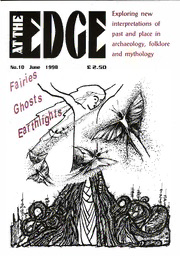
Cover illustration by Jacqui T ruman.
Printed in England by Addkey Print Ltd
�
=
�.
r:IJ
. ,..Q
=
:..
. � I•D
�
0
=·
An no 1670, not far from Cirencester, was an performed domestic tasks); and
apparition; being demanded whether a good spirit from the fairy damsel or White
or a bad? returned no answer, but disappeared Lady who was regarded as a
with a curious perfume and a most melodious benevolent guardian spirit or
twang. Mr W. Lilly believes it was a fairy. genius loci (Pemberton 1997).
. �· ··.: '' John Aubrey Further on the 'fringes' of such
lore were mermaids, water
· · I did not go to see the exhibition of Victorian fairy spirits and sundry giants and
paintings at the Royal Academy of Arts (-N"ov 1997 to Feb monsters. Broadly speaking,
1998). Nor, so far, have I seen Nick Willing's 1997 'adult these Middle English accounts
conform broadly to the
thriller' film entitled Photographing Fairies - not to be
Anglo-Saxon categories of elves,
confused with a different film starring Peter O'Toole that
dwarves and pucks ( Griffiths
was inspired by the so-called Cottingley fairies Edwardian
1996:47-54), so seem to
trick photographs. However, I am aware that all these
represent some continuity of
projects have led to something o( a glut of fairy fare in the
belief. Nevertheless, the roots
._.·£ . . . media. The Fairy League and the National Fairy of little folk are rather tangled.
-. . Appreciation Society (no, I kid you not!) both report The notable historian of
booming interest. So it seems entirely appropriate to medieval religion and magic,
devote a major part of this issue of At the Edge to looking Keith Thomas concludes that
.
� . , .. in m9� re detail at fairies and related phenomena. 'Ancestral spirits, ghosts,
sleeping heroes, fertility spirits
But this begs a few and pagan gods can all be
Fairy fundamentals
definitions - such as 'What are discerned in the heterogenous
fairies?' and 'What is the Up the airy mountain fairy lore of medieval England'
difference between fairies and Down the rushy glen (Thomas 1971: 724).
goblins, pixies, brownies, elves, We daren't go a-hunting Shakespeare's Titania and
gnomes, elementals and a whole For fear of little men Oberon are King and Queen of
host of other 'little folk'?' And, the blithe subjects of the fairy
as if the answers to these two William Allingham kingdom forming part ofthe
questions aren't tricky enough, The Fairies 1850 supernatural spectrum of A
'Yhat is the difference between Midsummer Night's Dream.
fairies (and their ilk) and a The English word 'fairy' Such benevolent fairies have
whol� range of other fleetingly comes to us, via the Old French become the current archetype
seen 'supernatural' events such faerie, from the Latinfata, and today's children are
as ghosts, will o'the wisps, meaning 'fate'. This means the brought up to think of fairies as
earthlights, or even - and the roots are with the classical diminutive beings of kindly
similarities are greater than you Greek Fates, who were believed disposition. However, accounts
might think - UFOs and 'alien to control the fate and destiny of of medieval fairies show them
abductions'? the human race. to have been neither small nor
·
In this article I will attempt Early fourteenth century particularly kindly. For many
to answer these three questions, English literature appears to people, fairies were spirits
although it might be better to distinguish fairies from dwarves against which they had to guard
say that I will be looking less at (goblin-like entities who lived in themselves by ritual
the differences between them burial mounds); from brownies precautions. By the Elizabethan
than drawing attention to the or hobgoblins (who lived in
close similarities. houses near the hearth and continued on page 3
At the Edge No.10 June 1998
Medieval Fairies: Now You See Them,
istic, such as the colour of the hags and the Aesir; and they
The origin of fairies
Green Children of Woolpit, or have the same role as the Aesir
is amongst the most
the small size of King Herla (a in name compounds - compare
discussed questions of
pygmaeus} who rides a goat. Aelfric and Osric. An Anglo
folklore. They have
The homunculus in an enigmatic Saxon vocabulary of 1100
been variously traced
encounter story from Thomas renders dryades etc. as types of
to nature spirits, the ·
dead, elementals, W alsingham was both elves. As Hilda Ellis Davidson
diminutive and dressed in red. showed in The Road to He/, the
pagan deities and so
The otherworldly race who Scandinavian elves are closely
on. In support of their
arguments, played with the boy Elidurus assimilated to the Vanir.
researchet·s have tut�ned to a had their own language ( a form By the thirteenth century, the
handful of medieval texts, of Greek} and their own, original context of Old English
and occasionally to the superior morals. There is belief had become lost, and
evidence of placenames. But nothing in these scattered people were using the word in
there is room for doubt references to suggest that the various ways. Lay amo n uses elf
whether these sources beings concerned are of the to translate the Romance fadas -
should be regarded as same type. Moreover, it would following a line of thought which
describing fairies at all. be an anachronism to separate was to lead to the elf-fairy
The fairy tradition in these accounts from contempor equivalence - but other people
literature begi�s in the 1380s, ary reports of diabolical had other ideas. Robert of
with Chaucer and Cower. In apparitions. All the medieval Gloucester, explaining what type
their eyes, the fairies are words for spirits were also of being it was that fathered
already a vanishing race, used, on occasion, for devils. Merlin, says that the sky is full of
partly frightening and partly The achievement of fairy spiritual beings called elves. Here
comic. The implication writers, from Chaucer to we are on the verge of the
(particularly in the preamble Shakespeare, was to expand the diabolical, as we are in Beowulf
to The Wife of Bath's Tale) is hints of an otherworld in the when the aelfs are of the seed of
that people used to believe in Breton courtly narratives until Cain.
fairies, but don't do so any almost all previous tales of Elves were found in literature,
more. However, the fairy supernatural encounter could but not in the landscape. They do
mythology as a consistent set be shoehorned into their not appear in southern English
of beliefs (dancing in rings, dominant discourse. Despite placenames: nor, indeed, do
living in hills, the rule of a Bob Trubshaw's suggestion in fairies -not until the eighteenth
queen, and so on) is itself the accompanying article that century. Instead their place is
created by the writers who 'Broadly speaking, these Middle taken by puca, which appears
claim to be recording its final English accounts conform to the describing the inhabitants of
echoes. Earlier evidence does Anglo-Saxon categories of elves, wells, pits, and barrows. It is
not describe these fairies. dwarfs and pucks, so seem to tempting to make the medieval
Instead it details encounters represent some continuity of pouke as identical with
with various supernatural belief there is no systematic Renaissance Puck, but this is to
beings who were, in mythology of fairies before fall into another retrospective
retrospect, treated as if they 1380. There are many reading. Even in Midsummer
had been citizens of fairyland. unrelated motifs - barrow Night's Dream, Puck has the
The otherworldly beings dwellers, tricksters, small appearance of being transferred
who appear in medieval people, household guardians - into fairyland, a little awkwardly,
chronicles are a varied lot. which we know in hindsight will from some quite separate
Some of them, such as the come together to define the tradition.
barrow revellers in William of fairy kingdom. But this identity The situation is different in
Newburgh and the maidens is simply not there in the northern England, where a elf is
found in a wood by Wild original references. common and puca is absent. This
Edric, are deliberately left Take a word like elf, which is also the region where elf was
unidentified; like the 'maiden Chaucer makes synonymous retained as the usual word for
in the moor' of the carol, their withfairy. In Old English the beings in the modern period, the
non-human status is indicated aelfs are one amongst many Romance fairy being rejected.
by allusion and not by direct otherworldly communities. The This may well be the result of
statement. Others are defined Charm for a Sudden Stitch puts Scandinavian influence - the fact
by a single strange character- them on the same footing as that a elf is liable to compound
At the Edge 2 No.1 0 June 1998
Now You Don't
with haugr rather than beorg
would suggest this.
Scandinavian influence is
certainly present in those
placenames which refer to
dwarfs. The Anglo-Saxons had
no concept of the dweorg as a
member of a small
supernatural race. The word is
always glossed as nanus,
pygmaeus, and means a short
human being. When we meet
with clearly mythological
dwarfs in North Country
placenames, it seems
reasonable to suspect Norse
influence, as Keightley
observed over a century ago.
In short, the origins of the
fairy mythology lie not in the
remote past, but at the court of
Richard II. The creative
synthesis which the poets made
out of English and French
traditions was developed in the
Tudor period to include
tricksters of the Robin
Goodfellow type as we�J as the
familiar spirits of cunning men,
and domestic spirits like the
brownie. As an English
language tradition, it was able
to dominate and then change
the native sidhe beliefs of As Jeremy Harte' s review of the recent Royal Academy of Arts
Ireland and the Highlands,
exhibition (see page 14) reveals, fairies have long been linked to
introducing alien notions such
erotic imagery. This candidate for Page 3 was encountered on the
as small size into their
narrative. By the nineteenth WWW although I regret not 'bookmarking' the location and
century, it was possible for therefore am not able to credit either the site or the artist.
Anglo-Saxon spirits like the
grima, scucca and thyrs who era, town dwellers seem to have sources, we must assume that
-
had lived out a quiet rural consigned such beliefs to the most of these were still current
existence as Church Grims, realms of childhood but there is as folk tales in the second half
Black Shucks and Hobthrusts - clear evidence that the country of the nineteenth century.
to find themselves people of the British Isles Also in 1911, W.Y. Evans
reinterpreted by folklorists (not continued to show an W entz published his better
the folk!) as minor figures in 'astonishing rev�rence' for the known book, The fairy{aith in
the fairy mythology. This fairies and dared not 'name Celtic countries. This took its
means that we can no longer them without honour' (Thomas place alongside Robert Kirk's
make out what they were like 1971: 726 citing John Penry's The secret common-wealth (first
originally. The fairy glamour of Three Treatises concerning published 1815 but written in
the fully developed tradition Wales c.1773). In 1911, 1691) and Thomas Keightley's
has tended to obscure our Jonathan Caredig Davies The fairy mythology (1828) as
understanding of the very published his Folk-lore of West the leading works of reference
disparate narratives of and mid-Wales. No less than 60 on fairy lore. Despite a
supernatural encounters which pages are devoted to detailed substantial volume of literature,
have been patched into it. accounts of fairy beliefs. the next major study of fairies
Although he is poor at citing his did not appear until 1959 when
At the Edge 3 No.1 0 June 1998
-Real encounters with little of experiences which are
people (1997) whose subtitle otherwise ignored or
betrays a far more denounced.
'phenomenological' approach. A different study of
This book surveys a wide range supernatural beliefs appeared a
of reports of fairy encounters few years later, when Gillian
and reveals a consistency to the Bennett's Traditions of belief
tales from both the Old and Women and the supernatural
New Worlds. was published in 1987. By
However, it would be wrong interviewing a number of
to suggest that Janet Bord has women in north-west England
been the first to approach about their beliefs in ghosts, the
accounts of supernatural after-life, and such like, Bennett
experiences as more than mere developed a technique for
folk lore. Back in the early getting beyond the superficial
1970s, David Hufford carried remarks and making a more
out exceptionally thorough objective assessment of how
research into Newfoundlanders' literally (or not) individuals
beliefs about the 'Old Hag' and believed in specific ideas.
other specific types of Although Bennett's interviews
nightmares; at this time the touched upon ghosts, the real
Canadian island of reason I draw attention to this
Newfoundland was isolated work is because it shows that an
from both the Old and New individual's belief I disbelief is
Worlds by a combination of not just 'on' or 'off, but rather
historical and geographical is more akin to part of a
factors, and frequently-adverse spectrum of belief on any one
weather. topic - and with complex
At that time many inter-relationships of beliefs on
Newfoundlanders were familiar more-or-less related topics.
with the Old Hag tradition and
The Lily Fairy by defined it as a dream 'where Qhosts
Luis Ricardo Faleru. you feel as if someone is holding
you down. You can do nothing Tush, tush. Their walking
Katherine Briggs' The Anatomy only cry out. People believe that spirits are mere imaginary
of Puck was published, which you will die if you are not fables.
lead in due course to her awakened.' (Hufford 1982: 2). C. Tourneur
better-known A dictionary of Hufford strenuously sifted such The Atheist's Tragedy iv, iii
fairies in 1976. dreams from a variety of other
nightmare experiences, As with fairies, ghosts have a
Fairies as phenomena including hypnagogic history that goes back at least
hallucinations and sleep as far as classical Greece;
The modern superstition is paralysis, and concluded that indeed the oldest-known ghost
that we're free of superstition. 'being hag ridden' (as the story appears in the earliest
Attributed to Frank Muir experience was generally known 'book' - the Epic of Gilgamesh.
as) was a distinct sleep Most of the dead in ancient
Ignoring various members of experience for which the Greece, such as those who died
the Theosophical Society (such 'primary evidence' came from in 'normal' conditions and had
as Geoffrey Hodson and Dora folk lore. funeral ceremonies properly
van Gelde r) and the founders of Hufford's work appeared in done on their behalf, were led
the Findhorn Community, who 1982 as The terror that comes by Hermes to cross the river
have written books recounting in the night and convincingly Styx in Charon's boat and then
what seem to be sincere showed that 'a significant pass into the realms of Hades.
experiences of encounters with proportion of traditional But some of the dead (such as
a whole host of fairies and supernatural belief is associated those who died untimely or
fairy-like folk, for most writers with accurate observations violent deaths, or where the
in the twentieth century fairies interpreted rationally.' I am not funeral ceremonies were not
have been approached as suggesting that the Old Hag has properly performed) remained
folk-lore -tales of 'superstition' any direct relationship to the trapped between two worlds,
with little or no credibility, and other 'supernatural' experiences and were attracted to the realm
in all probability diluted to be discussed in this article, but I of Hekate. They roamed with
suitable as children's bed time draw attention to Hufford's her during the night and were
stories. A key exception is Janet work as it clearly shows that to be seen at crossroads and
Bard's most recent book Fairies folk lore may contain accounts near their graves. However, the
At the Edge 4 No.1 0 June 1998
Greek word phasma or council house. Such house to UFOs. This is Paul
phantasma was a wider concept literally "belong to someone Devereux' s 'earth lights
than our 'ghost', as the invisible else" . . . There is a greater hypothesis' which was first
demons associated with Hekate likelihood of a failure of bonding argued in 1982, with a major
were called phasmata when between the occupant and the updates in 1989 and 1997
they appeared in the visible house.' David Taylor discusses (Devereux 1982; 1989; 1997b;
world, as were also some this in more detail in his article Devereux and Brookesmith
liminal 'undead' beings such as elsewhere in this issue. 1997)
Lamia (Gonzalez 1997). At this stage it perhaps In bare outline, Devereux's
As with fairies, ghosts and enough to simply question the earth lights hypothesis argues
boggarts are known by a variety cliches of modern day ghost that tectonic strain in rocks -
of names in the Anglo-Saxon tales. One more question to ask especially those near to active
era. 'In medieval England it was in passing is to what extent geological fault lines -can cause
fully accepted that dead men ghosts overlap with experiences anomalous light phenomena.
might sometimes return to apparently missing from Such phenomena have been
haunt the living' bluntly states Protestant cultures but (as recreated under laboratory
Thomas (1971: 701), noting readers of Fortean Times will conditions and there has been
that the Catholic Church be well aware) still common sufficient evidence to support
rationalised this belief by enough in Catholic countries - to his suggestions. For instance,
regarding such apparitions as wit, visions of saints and the 'tadpole-shaped' lights were
the souls of those trapped in Virgin Mary. However, John seen before an earthquake in
Purgatory. Early Protestant Palmer (1998) has recently Leicestershire on 11th February
preachers treated the belief in drawn attention to a chapel in 1957, and anomalous lights
ghosts as a Popish fraud. To ask Mortel, Holland, dedicated to appeared before the earthquake
someone in the sixteenth Our Lady of the Wandering centred on Mounts Bay in
century whether or not they Lights which, on the face of it, Cornwall of 10th November
believed in ghosts was akin to suggests that there was a 1996 (Devereux 1997a).
asking if they believed in difference between a will o'the According to a Japanese
transubstantiation or the papal wisp and a vision of the BVM. scientist, Yo shizo Kawaguchi
supremacy. Needless to say, ( 1996), many people reported
this clear-cut theo\ogical issue Earthl ights seeing red and blue lights ari
became greatly diluted in hour or tens of minutes before
subsequent centuries, 'Search the Truth when, the 1995 Kobe earthquake.
suggesting that popular belief in down the dark lane, David Clarke's article in this
ghosts was not easily passed off Spirits glide and Blue Lights issue of At the Edge provides
as a popish superstition. gleam.' evidence for both earth lights in
We should not assume that James Jennings the Pennines and also for a
previous generations believed in Poems consisting of the continuity with folk lore
ghosts in the same way that mysteries of the Mend ips etc predating any of this theorising.
modern day journalism still 1810 (cited in Quinn 1997b). A detailed study of folklore and
reports on 'haunted pubs' and anomalous lights around Bristol
the like. Ignoring the obvious There has been a previous ( Quinn 1997b) provides equally
'marketing ploys', the nature of attempt to link together various convincing independent data
modern ghosts simply conforms supernatural appartitions from linking 'earth lights' with, in this
too closely to a narrow range of ghosts through 'will o' the wisps' case, both fairy and ghost lore.
'idealised scripts', as Jeremy
Harte recently showed
�
convincingly for Civil War
Sail away to the strange
ghosts (Harte 1997b). David
Taylor's article in this issue of worlds of Magonia
At the Edge also reveals that
haunted houses need to be Interpreting contveimspioorananr dy
approached quite differently belief. UuFrObsa,nl egendfso,l klore,
from the assumptions of many fringsec iencaen dr eligicoonn,s piracy
'ghost hunters'. Preliminary ��� theoriceusl,t asn,d t hel imiotfs
ideas on a 'social history' of
humanb elief.
ghosts were put forward a
£5.00 forf ouri ssues.
decade ago by Peter Rogerson
Form orei nformatainodn
(1987), who observed that 'The
subscriptdieotna iwlrs,i tteo :
traditional Victorian haunted
JohnR immer( ATE)J,o hnD ee
house was the short-lease house
Cottag5e ,J amesT errace,
where the servants came with
the property. The archetypal MortlakCeh urchyarLdo,n don,
modern haunted house is the SW14 8HB, U.K.
At the Edge 5 No.1 0 June 1998
hippocampus, which Persinger has Terence McKenna (1992)
characterizes as the most described these imaginary
electrically unstable structures worlds as 'elf-infested spaces'.
in the human brain. By using Other researchers have
electrodes to stimulate the indicated that such experiences
temporal lobes, Persinger is are cross-cultural. Julia Phillips
able to induce a variety of (1998) reports that Australian
deeply disturbing mental Aborigines from New South
experiences (some readers may Wales recognise traditional
recall a BBC2 Horizon 'guardians of place' whose
programme from 28th descriptions tally closely with
November 1994 when the Susan her first-hand encounters with
Blakemore interviewed an 'archetypal' British elf or
Persinger and underwent fairy in 'old' south Wales.
temporal lobe stimulation). Kevin Callahan at University of
Such 'temporal lobe Minnesota claims Ojibwa
dissociation' generates stange indians of the American
visual and other sensations Midwest see 'little people' for
which the brain finds difficult to about thirty minutes during
'process' - subjects will often hallucinations induced by
describe the sensations as being atrophine-containing plants
like someone pulling at their from the Deadly Nightshade
limbs, or even as a sequence of family. Callahan also notes that
Illustration from Cicely Mary
events which resemble aspects those in the second stage of
Barker's Rower Fairies of the of so-called 'alien abduction' alcohol withdrawal (i.e. two to
Summer (Blackie, c.1920) - one of experiences. It seems three days after stopping
the author's own childhood reasonable to assume that the drinking) report similar
'encounters' with the modem 'alien abduction' experiences encounters with 'little people'
(usually obtained by hypnotising (Callahan 1995).
fairy archetype.
the subject [1]) are 'invented' More speculatively, Ralph
by the brain in a similar manner Metzner (1994: 286) has
Devereux also suggests that to the attempt to make sense of suggested that the obscure
poltergeist activity anrl ghosts, temporal lobe dissociation. A Scandinavian Aesir goddess,
especially the vague white shape recent issue of Fortean Times Bil, was once regarded as a
types, are another (No.108) includes a useful 'henbane fairy' -on the basis
manifestation of the same earth overview of temporal lobe that the proto-Germanic word
light phenomena. In Places of research and its relationship to bil originally meant 'vision,
Power (1990: 32-4) Devereux anomalous experiences. hallucination' and there was a
provides clear evidence for links Devereux and Persinger have herb known to the Gaulish
between fairy lore and collaborated to explore the Celts as Belinuntia. The use of
anomalous lights in Ireland and possibility that the anomalous henbane was well known to
Cornwall. He has also suggested energy seen as earthlights might Greek, early German and
that earth lights are capable of have sufficient electrical energy Anglo-Saxon writers; there is
triggering temporary brain to cause temporal lobe even evidence of henbane from
'disfunctions' (such as temporal dissociation. Perhaps more bronze age urns found in the
lobe dissociation), a topic to relevant to this article is the Alps (Graichen cited in
which I will now turn. recognition that many of the Metzner 1994: 286). This may
sensations induced by temporal just mean that the rainbow
Elf-infested spaces lobe stimulation are akin bridge leading to Asgard,
experiences with some types of Bilfrost, may also have been
Professor Michael Persinger psychoactive plants and drugs. originally linked to liminal
and his colleagues at Laurentian According to Or Horace Beach visionary states.
University in Canada have spent {1997), auditory hallucinations - Moving to modern times, I
many years researching 'sensed closely resembling experiences am intrigued that my
presence' phenomena generated in Persinger's grandmother, when in her
(otherwise termed 'ego-alien experimental subjects - are a early nineties and suffering
intrusions') from a common experience with high from the combined effects of
neurophysiological perspective. doses of psilocybin ('magic long-term crippling arthiritis
In the search for brain mushrooms')� As many readers (she could not stand unaided
correlates to the experience of will be aware, magic by then), failing eyesight, and
'presences', their studies have mushrooms and some other the relatively limited social
focused primarily on the deep psychoactives, such as DMT, stimulation of living in a old
temporal lobe structures of the also readily lead to visions of people's home where the fellow
brain, the amygdala and little people - not for nothing residents were almost all senile
At the Edge 6 No.1 0 June 1998
Sharing the same archetype?
Left: An early chapbook illustration shows
what may be meant to be 'little people'
dancing in a ring - note the prominent 'magic
mushroom' and the door into what appears to
be a hollow hill.
Above: Modem media has discovered the
(whereas my gran was not 94-7) shows that
potency of strange 'little people' dancing - and
senile, although beginning to the various tales
have slight problems with of being living inside a hollow hill.
short-term memory) began to 'abducted' to take
report seeing a 'little boy' who part in fairy parties inside issue of At the Edge bring
came into her room at various hollow hills have many together different viewpoints
times -often at night, when he similarities to the recent from David Clarke, Jeremy
would curl up in a chair or at literature relating to 'alien Harte, Elizabeth Oak land and
the foot of her bed. Needless to abductions'. The curious David Taylor. In differing ways
say, children were infrequent similarities between hollow hills they challenge many of the
visitors to the home and none and the interiors of Speilberg preconceptions which are
stayed overnight. like space craft so suggest that all-too-easily linked to fairies,
Taken together, there is a the 'pre-technological' age ghosts, anomalous lights -and
variety of evidence to suggest experience is a close match for even the nature of 'folklore'
that 'elf-infested spaces' are modern-day 'close encounters'. I evidence. I hope you, the
more common than rational cannot help but add that the readers, will also recognise
twentieth century thinking Teletubbies also live in a hollow that the ideas which are being
would normally accept. Could it hill. explored in these pages merely
be that, as with the Old Hag of For similar reasons Phil scratch the surface of these
Newfoundland, folk lore is Quinn's 'Toast to the recently inter-related phenomena.
providing us with direct departed fairy folk in the Bristol
evidence of subtle mental states region' (1997a) concludes that Acknowledgements
which we are too quick to 'it is not hard to wonder
dismiss as pure fantasy? whether the fairies have in fact Special thanks to Jermey
not left us but rather undergone Harte for extensive comments
Hollow hills and a change in identity more in on an earlier draft and for
keeping with an eclectic modern providing the discussion on
abductions world'. I would prefer to turn medieval fairies.
this around and suggest that The illustration on pages 4
I explore this suggestion certain 'altered states of is from the useful and
further I would like to delve into consciousness' have for informative WWW site for
the contentious wate1·s of 'close millennia regularly lead to Fairy Lore and Literature:
encounters' with aliens and visions of 'little people'; we now http://faeryland. tamu
alien spaceships. This is hardly might prefer to 'justify' those commerce.edu/-earendiV
a new suggestion - back in 1984 imaginary experiences in terms faeries/
Ian Cresswell examined the of 'alien abductions' or even the
subjective nature of 'close neurological-speak of 'temporal Note
encounters' and their similarity lobe dissociation', but in
to dream and trance states. previous centuries the same 1: It is beyond the scope of
Peter Rogerson (1988) picked range of experiences were this article to dismiss the
up on similar themes four years discussed in terms of fairies and heavily-promoted claims for
later. a host of names relating to alien abductions. A steady
In issue five of At the Edge, other diminutive beings - and series of articles in Magonia
Jeremy Harte (1997a) were kept alive in the copious (Rottmeyer 1988; Ellis 1991;
questioned the folk lore of folklore. Rogerson 1990; 1994; Goss
hollow hills. Janet Bord (1997: The main articles in this 1996; Rimmer 1997) have built
At the Edge 7 No.1 0 June 1998
BROOKESMITH, Peter, 1996, HUFFORD, David, 1982, The
'Do aliens dream of Jacobs' terror that comes in the night,
sheep?', Fortean Times No.83 University of Pennsylvania
p27-30. Press.
CALLAHAN, Kevin L., 1995, KAWAGUCHI, Yoshizo, 1996,
'Rock art and Iilliputian cited in 'Japanese earth lights',
hallucinations', TRACCE No.2 3rd Stone No.23 p5.
http :1/www. geocities. corn/ MCKENNA, Terence, 1992,
Athens/2996/trace2b. html#l il Food of the gods, Rider.
CRESSWELL, Ian, 1984, 'What METZNER, Ralph, 1994, The
dreams might come', Magonia well of remembrance,
No.16 p3-7. Shambhala.
DEVEREUX, Paul, 1982, PALMER, John, 1998, 'Our
Earthlights - Towards an Lady of the Wandering Lights',
understanding of the UFO 3rd Stone No.29 p19.
enigma, Turns tone. PEMBERTON, Margaret, 1997,
DEVEREUX, Paul, 1989, Earth 'The faeries of olde England',
lights revelation - UFOs and The Cauldron No.86 p11-13.
mystery lightform phenomena: PHILLIPS, Julia, 1998,
the Earth's secret energy force, 'Encounters with the little
Blandford. people', The Cauldron No.87
DEVEREUX, Paul, 1990, Places p21-22.
of power - Secret energies at QUINN, Phil, 1997a, 'A toast to
Illustration from Cicely Mary ancient sites: a guide to the recently-departed fairy faith
Barker's Rower Fairies of the observed or measured in the Bristol region', 3rd Stone
phenomena, Blandford. No.26 p 21-23.
Summer(Blackie, c.1920).
DEVEREUX, Paul, 1997 (a), QUINN, Phil, 1997b, 'The
'Welcome to the pisky party', Devil's eye: Earth lights in
up a well-argued case for both Fortean Times, No.96 p47. landscape and folklore', 3rd
'alien abductions' and 'ritual DEVEREUX, Paul, 1997 (b), Stone, No.28 p20-22.
abuse' allegations being the 'Everything you've always RIMMER, John, 'An organised
consequences of 'false wemory wanted to know about earth distortion of memory', Magonia
syndrome' induced by what lights', Fortean Times, No.103, No.60 p1
might be regarded as 'leading p26-31. ROGERSON, Peter,1987, 'And
questions' asked under DEVEREUX, Paul, and Peter the dogs began to howl',
hypnosis. A summary of this BROOKESMITH, 1997, UFOs Magonia No.27 p7-9.
work appeared in Fortean and UFOlogy - The first fifty ROGERSON, Peter, 1988, 'Off
Times (Brookesmith 1996). In years, Blandford. limits - Ufology and the
1997 Kevin McLure launched a DEVEREUX, Paul, and Peter deconstruction of reality',
newsletter entitled Abduction BROOKESMITH, 1998, 'The Magonia No.30 p6-8.
Watch that deals specifically great brain robbery', Forte an ROGERSON, Peter, 1990, 'On a
with 'the irrational muddle of Times No.107, p22-4. summer's day .. .', Magonia
faith and belief that typifies ELLIS, Bill, 1991, 'Flying No.37 p1-4.
[alien] abductions'. A clear saucers from hell', Magonia ROGERSON, Peter, 1994, 'Sex,
'deconstruction' of a ostensible No.40 p12-16. science and salvation', Magonia
alien abduction is reported by GONZALEZ, Alejandro, 1997, No.49 p13-17.
Devereux and Brookesmith e-mail to Folklore Discusion ROTIMEYER, Martin, 1988,
(1998). Group 27th Sept. 'Abduction - the boundary
GOSS, Michael, 1996, 'The deficit hypothesis', Magonia
Bibliography hypno-heist', Magonia No.57 No.32 p3-7.
p10-14. THOMAS, Keith, 1971,
BEACH, Horace, 1997, GRIFFITHS, Bill, 1996, Aspects Religion and the decline of
'Listening for the Logos: a study of Anglo-Saxon magic, magic, Weidenfeld and
of reports of audible voices at Anglo-Saxon Books. Nicolson; reprinted Penguin
high doses of psilocybin', MAPS HARTE, Jeremy, 1997a, 1991.
Vol. 7 No.l (Winter 1996-97); 'Hollow hills', At the Edge, No.5 VAN GELDER, Dora, 1977,
posted to MAPSFORUM e-mail p22-29. The real world of fairies,
list 16th July 1997. HARTE, Jeremy, 1997b, Theosophical Publishing House.
BORD, Janet, 1997, Fairies 'Cavaliers and. phantoms', 3rd WENTZ W.Y. Evans, 1911,
Real encounters with little Stone, No.26 p6-10. The fairy faith in Celtic
people, Michael O'Mara. HODSON, Geoffrey, 1925, countries, H. Frowde; reprinted
BRIGGS, Katherine, 1976, A Fairies at work and play, Lemma (New York) 1973.
dictionary of fairies, All en Lane. Theosophical Publishing House.
At the Edge 8 No.1 0 June 1998