Table Of Contentworld history / anthropology / pacific studies
(Continued from front fl ap) Anthropologists and world historians
make strange bedfellows. Although the
B
u latter frequently employ anthropological
s
Finally, he places the German experience Also in Perspectives on the Global Past ch methods in their descriptions of cross-
in the broader context of Euro-American m cultural exchanges, the former have raised
a
anthropology. n substantial reservations about global
n
Anthropology’s Global Histories will interest Creating the “New Man” approaches to history. Fearing loss of
students and scholars of anthropology, specifi city, anthropologists object to the
From Enlightenment Ideals to Socialist Realities
history, world history, and Pacifi c studies. effacing qualities of techniques employed by
Yinghong Cheng
world historians—this despite the fact that
2008, est. 248 pages A
Rainer F. Buschmann is associate n anthropology itself was a global, comparative
Cloth : 978-0-8248-3074-8 t
h
professor of history and founding faculty r enterprise in the nineteenth century.
o
member at California State University, p Rainer Buschmann here seeks to recover
The idea of eliminating undesirable elements from human nature to create o
Channel Islands. a “new man” has been part of moral and political thinking worldwide for lo some of anthropology’s global fl avor by
g
millennia. During the Enlightenment, European philosophers sought to y viewing its history in Oceania through the
’s
construct an ideological framework for reshaping human nature. But it was G notion of the ethnographic frontier—the
l furthermost limits of the anthropologically
only among the communist regimes of the twentieth century that such ideas o
b
known regions of the Pacifi c. The colony of
were actually put into practice on a nationwide scale. In this book Yinghong a
l
H German New Guinea (1884–1914) presents
Cheng examines three culturally diverse sociopolitical experiments—the
is an ideal example of just such a contact zone.
Soviet Union under Lenin and Stalin, China under Mao, and Cuba under t
o
Colonial administrators there were drawn to
Castro—in an attempt to better understand the origins and development of r
i
e
approaches partially inspired by anthropology.
the “new man.” s
Anthropologists and museum offi cials
exploited this interest by preparing large-scale
expeditions to German New Guinea.
Buschmann explores the resulting
interactions between German colonial
offi cials, resident ethnographic collectors,
Anthropology’s Global
and indigenous peoples, arguing that all
were instrumental in the formation of
anthropological theory. He shows how
Histories
changes in collecting aims and methods
helped shift ethnographic study away from
The Ethnographic Frontier in its focus on material artifacts to a broader
consideration of indigenous culture. He
University of German New Guinea, 1870–1935
also shows how ethnological collecting,
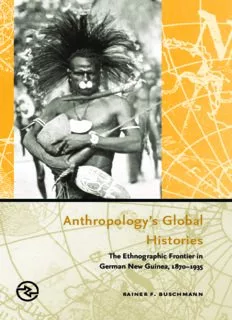
Jacket Art: Inhabitant of the Sepik region
offering artifacts for exchange (Courtesy Hawai‘i Press often a competitive affair, could become
Linden Museum Stuttgart) politicized and connect to national concerns.
Jacket design: April Leidig-Higgins Honolulu, Hawai‘i 96822-1888
rainer f. buschmann
(Continued on back fl ap)
BuschmannANTHROjacket.indd 1 7/16/09 1:26:03 PM
A ’ g h
nthropology s lobAl istories
Perspectives on the Global Past
Jerry H. Bentley and Anand A. Yang
SERIES EDITORS
Interactions: Transregional Perspectives on World History
Edited by Jerry H. Bentley, Renate Bridenthal, and Anand A. Yang
Contact and Exchange in the Ancient World
Edited by Victor H. Mair
Seascapes: Maritime Histories, Littoral Cultures, and Transoceanic Exchanges
Edited by Jerry H. Bentley, Renate Bridenthal, and Kären Wigen
Anthropology’s
Global Histories
The Ethnographic Frontier in
German New Guinea, 1870–1935
Rainer F. Buschmann
University of Hawai‘i Press
Honolulu
© 2009 University of Hawai‘i Press
All rights reserved
Printed in the United States of America
14 13 12 11 10 09 6 5 4 3 2 1
Library of Congress Cataloging-in-Publication Data
Buschmann, Rainer F.
Anthropology’s global histories : the ethnographic frontier in
German New Guinea, 1870–1935 / by Rainer F. Buschmann.
p. cm—(Perspectives on the global past)
Includes bibliographical references and index.
ISBN 978-0-8248-3184-4 (hard cover : alk. paper)
1. Anthropology—Papua New Guinea—History.
2. Anthropology—Research—Papua New Guinea—History.
I. Title.
GN671.N5B87 2009
301.023'953—dc22
2008029221
University of Hawai‘i Press books are printed on acid-free
paper and meet the guidelines for permanence and durability
of the Council on Library Resources.
Composited by Santos Barbasa Jr. of the University of Hawai‘i Press
Printed by The Maple-Vail Book Manufacturing Group
For my parents
Contents
Acknowledgments ix
Introduction: Toward a Global History of Anthropology 1
1 Berlin’s Monopoly 12
2 Commercializing the Ethnographic Frontier 29
3 Losing the Monopoly 50
4 Restructuring Ethnology and Imperialism 71
5 Albert Hahl and the Colonization of the
Ethnographic Frontier 97
6 Indigenous Reactions 118
7 The Ethnographic Frontier in German
Postcolonial Visions 137
Conclusion: Anthropology’s Global Histories in Oceania 154
Notes 171
Bibliography 209
Index 229
Acknowledgments
This work originated in the early 1990s, while I was finishing my master’s
degree in anthropology. The discipline of anthropology was deeply in the
throes of the so-called literary turn. In the midst of this intellectual confu-
sion, I enrolled in a fascinating seminar about the Trust Territory of the Pa-
cific Islands taught by Karen Peacock, the librarian of the Pacific Collection
at Hamilton Library at the University of Hawai‘i. She made the bold sug-
gestion to situate anthropology in a historical context. She further encour-
aged me to contact David Hanlon at the History department, who quickly
introduced me to the field of Pacific Islands history and highlighted its po-
tential to illuminate anthropological studies. He also pointed at the close
relationship of my study to world history and encouraged me to work closely
with Jerry Bentley. Drs. Bentley and Hanlon provided much-needed guid-
ance as I used a historical perspective to explore important issues in Ger-
man anthropology. Two other historians were also tremendously important
in shaping the work at hand: Herbert Ziegler, who assisted with his expertise
in German history, and David Chappell, whose input on Pacific imperial
history was of prime importance. This book also greatly benefited from Alan
Howard, who instructed me in my first approaches to ethnography.
Financial support for research and writing came from many sources. I
received a generous dissertation grant from the Dai Ho Chun Foundation
as well as two Trustees’ Scholarly Endeavors Program Grants at Hawai‘i
Pacific University and several faculty development grants at the California
State University Channel Islands (CSUCI), including a Martin V. Smith
Grant for Scholarly Excellence. A sabbatical leave (2006–2007) from CSU-
CI paved the way to bring the manuscript to conclusion.
Numerous individuals aided in the production of this book by support-
ing my quest for archival sources. Robert Welsch at the Field Museum of
Natural History in Chicago provided me with initial insights into the nature
of ethnographic collecting in New Guinea and continued to advise me as
the project moved further along. In Germany, it was the friendly staff at
the Linden Museum in Stuttgart that assisted me in my mission, especially
Ingrid Heermann, Ulrich Menter, and Dietrich Schleip. At the Berlin Eth-
nological Museum Markus Schindlbeck assisted with sources and publica-
ix
Description:Anthropologists and world historians make strange bedfellows. Although the latter frequently employ anthropological methods in their descriptions of cross-cultural exchanges, the former have raised substantial reservations about global approaches to history. Fearing loss of specificity, anthropologi