Table Of ContentVowel Harmony in Qiang: An Optimality Theoretic Account
Nate Sims
Indiana University
0. Introduction
Qiang is a Tibeto-Burman language spoken by approximately 110,000 people in the mountainous
region of northwest Sichuan, China. The data for this analysis comes from a descriptive grammar
(LaPolla & Huang, 2003) and an article on the vowel system by (Evans & Huang, 2007) 1. The Yadu
dialect of Qiang has a complex system of vowel harmony in which vowels across morpheme boundaries
agree in terms of the features: [low], [back], and [round]. This harmony does not apply to monomorphic
lexical items. There is an opacity effect caused by a counterfeeding interaction between [back] and
[round] harmony that will require a deviation from classic OT (Prince & Smolensky 1993-2004) and the
use of LCC (Smolensky, 1997).
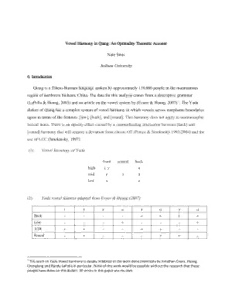
(1) Vowel Inventory of Yadu
front central back
high i, y u
mid ɛ ə ɔ
low a ɑ
(2) Yadu vowel features adapted from Evans & Huang (2007)
i y ɛ a ə u ɔ ɑ
Back - - - - + + + +
Low - - - + - - - +
ATR + + - - + + - -
Round - + - - - + + -
1 This work on Yadu Vowel harmony is deeply indebted to the work done previously by Jonathan Evans, Huang
Chenglong and Randy LaPolla in particular. None of this work would be possible without the research that these
people have done on this dialect. All errors in this paper are my own.
1. Back Harmony
The first and most basic of these vowel harmony processes is the [back] harmony process. In (3)
below we see examples how vowels can be either fronted or backed in order to agree with the
specification for [back] of the root vowel. Note that the vowel in the root does not change in either
instance.
(3) Affix vowels fronted or backed to agree with the root vowel.
a. /ɦɑ-waʁ/ [ɦa.'waʁ]
down-drive ‘drive downward’
b. /a-hɑ/ [ɑ.'hɑ]
one-bunch ‘a bunch’
To capture this process in OT a faithfulness constraint which militates against changing the features
of any root vowel, will be used. This constraint will be called ROOT-FAITH (Golston, 1996). The
constraint motivating the [back] harmony is an agreement constraint (Baković 2005), AGREE-[back], and
the antagonistic faithfulness constraint is ID-[back]. The formal definitions of these constrains are as
follows:
(4) ROOT-FAITH: Corresponding root vowels must be identical
AGREE-[back]: Vowels in adjacent syllables must agree with specification for [back]
ID-[back]: Vowels in the input must have the same specification for [back] as in the output.
Because both ROOT-FAITH and AGREE-[back] are never violated by an attested output candidate they
will be placed at the top of the hierarchy. ID-[back] is dominated by both these constraints as evidenced
by the fact that the winning candidate (a) in tableau (6) violates this constraint in order to satisfy
AGREE-[back]. The ranking for these constrains are:
(5) ROOT-FAITH, AGREE-[back] » ID-[back]
(6) Input: /ɦɑ-waʁ/ ROOT-FAITH AGREE-[back] ID-[back]
a. (cid:41) ɦa.'waʁ *
b. ɦɑ.'waʁ *!
c. ɦɑ.'wɑʁ *! *
The tableau above demonstrates this ranking as it shows how the winning candidate satisfies the
undominated constraints at the expense of violating the low ranked faithfulness constraint ID-[back].
2. Low Harmony
(7) [low] agreement
a. /ɦɑ-pʰu/ [ɦɔ.'pʰu]
down-flee ‘flee downward’
b. /a-pɛ/ [ɛ.'pɛ]
one-bowl ‘one bowl’
The [low] and [back] harmonies can interact so that a vowel such as /a/ can be backed and raised to
[ɔ] in order to agree with the root vowels specifications for [low] and front. This is demonstrated below
with the forms for ‘push downward’ and ‘one liter’.
(8) Interaction of [low] and [back] harmony
a. /ɦɑ-ɕtɕi/ [ɦɛ.'ɕtɕi]
down-push ‘push downward’
b. /a-pu/ [ɔ.'pu]
one-liter ‘one liter’
(9) Conditions for [low] and [back] harmony
Both [back] and [low] harmony apply in such a way that they do not change the affix’s
specification for ATR2.
2 In Qiang the highest vowels are [+ATR], the lowest vowels are [-ATR], and [ATR] is distinctive for vowels that are
neither low nor high.
The constraints that will be used for the [low] harmony are as follows:
(10) Constraints
ID-[ATR]: The value of [ATR] for an input segment must be identical in the output
correspondent
AGREE-[low]: Vowels in adjacent syllables must agree in specification for [low]
ID-[low]: The value of [low] in an input segment must be identical in the output
correspondent
ID-[ATR] is undominated and in the top tier. The fact that AGREE-[low] dominates ID-[low] can be
seen from the raising from /ɑ/ to [ɔ] as shown in tableau (12) below. However tableau (13) shows that
AGREE-[low] can be violated by a winning candidate. Thus the ranking of these constraints:
(11) Ranking
ID-[ATR] » AGREE-[low] » ID-[low]
(12)
Input: /ɦɑ-pʰu/ AGREE-[back] ID-[ATR] AGREE-[low] ID-[back] ID-[low]
a. (cid:41) ɦɔ.'pʰu *
b. ɦɑ.'pʰu *!
c. ɦu.'pʰu *! *
(13)
Input: /tə-waʁ/ AGREE-[back] ID-[ATR] AGREE-[low] ID-[back] ID-[low]
a. (cid:41) ti.'waʁ * *
b. ta.'waʁ *! * *
c. tɛ.waʁ *! * *
d. tə.'waʁ *! *
Having ID-[ATR] undominated prevents the ‘one fell swoop’ candidate (c) in tableau (12) and also
accounts for the raising of schwa to [i] before /a/ in tableau (13), an otherwise perplexing phenomenon.
So far the all of the constraints can be ranked accordingly:
(14) Interim constraint hierarchy
ROOT-FAITH, AGREE-[back], ID-[ATR] » AGREE-[low] » ID-[back], ID-[low]
3. Round Harmony
The rounding harmony in Yadu Qiang is the most interesting of the harmony processes as it involves
a derived environment blocking effect. The basic rounding process is shown in the data set below:
(15) Vowels across syllable boundaries agree in terms of [round]
a. /ʁwɑkʰu-pə/ [ʁwɑ.kʰu.pu]
sarcasm-do ‘to be sarcastic’
b. /tə-pʰu/ [tu.'pʰu]
up-flee ‘flee upward’
Above it is shown that schwa becomes the [u] as a result of rounding harmony. This data set also
illustrates that the harmony occurring is bidirectional and applies to both prefixes and suffixes alike.
The constraints used for describing round harmony are as follow:
(16) Constraints for rounding
AGREE-[round]: Vowels across syllable boundaries must agree with regards to [round]
ID-[round]: The value of [round] for an input segment must be identical to the output
correspondent
The ranking of these two constraints is straightforward; the markedness constraint must dominate the
antagonistic faithfulness constraint in order for the process to apply. This is shown in tableau (18)
(17) Ranking
AGREE-[round] » ID-[round]
(18)
Input: /tə-pʰu/ AGREE-[round] ID-[round]
a. (cid:41) tu.'pʰu *
b. tə.'pʰu *!
With these constraints we would expect that the high front rounded vowel /y/ would also trigger
vowel harmony but instead there is an underapplication of this harmony when schwa precedes /y/.
(19) Underapplication of [round] harmony
a. /ɕtɕə-tɕy/ [ɕtɕi.'tɕy]
seven-sentences ‘seven sentences’
The established ranking hierarchy so far cannot account for this phenomenon as shown below:
(20) Ranking paradox of this counterfeeding interaction
Input: /tə-phu/ AGREE- ID- AGREE- AGREE- ID- ID- ID-
[back] [ATR] [low] [round] [back] [low] [round]
a. (cid:41) tu.'phu *
b. tə.'phu *!
c. tɔ.'phu *! *
Input: /ɕtɕə.tɕy/ AGREE- ID- AGREE- AGREE- ID- ID- ID-
[back] [ATR] [low] [round] [back] [low] [round]
a. (cid:41) ɕtɕy.'tɕy * *
b. (cid:47) ɕtɕi.'tɕy *! *
c. ɕtɕə.'tɕy *! *
Tableaux (20) and (21) show this ranking paradox. In order of the first input to produce the correct
output, agree round must be ranked over id round. This same ranking however selects the incorrect
candidate as the winning candidate in for tableau (21). The attested candidate (b) is opaque because it
contains an unrounded vowel where a rounded vowel is expected. The transparent candidate (a) wins
out over the opaque candidate (b) because (a) does not violate Agree-[round].
This is a counterfeeding interaction because in a rule ordering framework, we would say that
backing counter-feeds rounding because it creates an environment in which rounding could apply but it
does so too late because rounding has already applied vacuously. Classic OT cannot account for this
interaction as demonstrated by the ranking paradox above, however local constraint conjunction
provides a straightforward solution to this problem. The LCC that will be used is a conjunction of ID-
[back] and ID-[round] with the domain for the constraint being the segment.
(21) Using Local Constraint Conjunction to solve this problem
ID-[[back] & [round]]S: One violation is assigned for a candidate that violates both ID-[back]
and ID-[round]. The domain for this constraint is the segment.
(22)
Input: /ɕtɕə.tɕy/ ID-[[back] & [round]]S AGREE-[round] ID-[back] ID-[round]
a.(cid:41) ɕtɕi.'tɕy * *
b. ɕtɕy.'tɕy *! * *
The tableau above shows that installing the LCC at the top of the hierarchy eliminates the
transparent candidate (b) and allows the attested opaque candidate (a) to win. Note that the LCC and
AGREE-[round] are not on the same tier because the LCC is never violated by a winning candidate
whereas AGREE-[round] can be violated as in candidate (a) of tableau (13). Lastly, the final ranking of
all of the constraints used is given below:
(23) Final ranking
AGREE-[back], ID-[ATR], ID [back & round]S
» AGREE-[low], AGREE-[round]
» ID-[back], ID-[low], ID-[round]
4. Further Directions:
Given that /i/(cid:198)[y]/___y is unattested, it is possible that the fact that /y/ does not cause rounding is not
a derived environment blocking effect but instead a grandfather effect militating against new [y] vowels
regardless of ID-[back]. If this were true then the best way to capture that generalization would be to
use comparative markedness. However, because there are no examples of an affix with an underlying /i/
adjacent to a root with the vowel /y/, this prediction would be making an empirical claim that at this
point cannot be justified.
5. Summary:
In conclusion, vowel in Qiang roots are faithful and do not change their segmental features from the
input to output. All affix vowels agree with roots in terms of [back]. Throughout the harmony processes,
the specification for [ATR] is always preserved in the affix. Affix vowels agree with roots with regards
to the feature [low] as allowed by ID-[ATR]. Also, Affix vowels agree with roots in terms of [round].
The counterfeeding interaction of fronting and rounding cannot be accounted for using classic OT,
however using a locally conjoined constraint can solve this ranking paradox. One of the advantages to
this OT analysis is that it is able to allow for the bi-directionality of these processes without needing to
specify the harmony as being regressive or progressive, as would be required using a derivational
theoretic framework.
6. References:
Baković, Eric. 2005. Antigemination, assimilation and the determination of identity. Phonology 22:279-
315
Evans, Jonathan, and Chenglong Huang. "A bottom-up approach to vowel systems." Cahiers de
Linguistique – Asie Orientale 36.2 (2007): 147-186. Print.
Golston, Chris. 1996. Direct optimality theory: Representation as pure markedness. Language
72:713-48
LaPolla, Randy J., and Chenglong Huang. A grammar of Qiang with annotated texts and glossary.
Berlin: Mouton de Gruyter, 2003. Print.
Smolensky, Paul. , 1997. Constraint interaction in generative grammar II: Local conjunction or random
rules in Universal Grammar. Paper presented to Hopkins Optimality Theory Workshop/Maryland
Mayfest ‘97. Baltimore, MD
Prince, Alan & Smolensky Paul. 1993-2004. Optimality Theory: Constraint Interaction in Generative
Grammar. Malden, Mass & Oxford:Blackwell.