Table Of ContentT r i b u t e to
A k i r a O k u b o
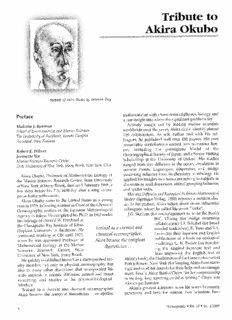
Portrait of Akira Okubo by Deborah Bray
mathematician with a keen sense of physics, biology, and
Preface
a rare insight into where the significant problems lay.
Actively sought out by leading marine scientists
Malcolm .J Bowman
worldwide over tile years, Akira could identify almost
School of Environmental and Marine Sciences
100 collaborators. As sole author and with his col-
The University of Auckland, Tamaki Campus
leagues, he published well over 150 papers. His own
Auckland, New Zealand
remarkable contributions earned him numerous hon-
ors, including the prestigious Medal of the
Robert .E Wilson
Oceanographical Society of Japan, and a Senior Visiting
Jeannette neY
Scholarship at the University of Oxford. His studies
Marine Sciences Research Center
ranged from dye diffusion in the ocean, circulation in
State University of New York, Stony Brook, New York, USA
oceanic fronts, Lagrangian dispersion, and midge
swarming behavior from its chemistry to ethology. He
Akira Okubo, Professor of Mathematical Ecology at
applied his insights into turbulent mixing to subjects as
the Marine Sciences Research Center, State University
disparate as seed dispersion, animal grouping behavior,
of New York at Stony Brook, died on I February 1996, a
few days before his 71st birthday after a long, coura- and spider webs.
His text Diffusion and lacigolocE Problems: Mathematical
geous battle with cancer.
Models (Springer-Verlag, 1980) remains a modern clas-
Akira Okubo came to the United States as a young
sic. In his preface, Akira talked about seven influential
man in 1959, following a career as Chief of the Chemical
colleagues, whom he called his seven "lucks":
Oceanography section of the Japanese Meteorological
J.G. Skellam (for encouragement to write the book);
Agency in Tokyo. He completed his Ph.D. in 1963 under
H.C. Chiang (for midge swarming
the tutelage of Donald W. Pritchard at
collaboration); J.R. Schubel (for broad
the Chesapeake Bay Institute of Johns
Trained as a chemist and minded leadership); K. Yano and S.A.
Hopkins University in Baltimore. He
chemical oceanographer, Levin (for their Japanese and English
continued working at CBI until 1975,
publications of a book on ecological
when he was appointed Professor of Akira became the compleat
modeling); G. N. Parker (for translat-
Mathematical Ecology at the Marine theoretician...
ing the original Japanese text and
Sciences Research Center, State
later improving the English text of
University of New York, Stony Brook.
Akira's book); the Hashimotos of the Hana restaurant of
He quickly established himself as a distinguished fac-
Port Jefferson, New York (for keeping Akira from starv-
ulty member, not only in physical oceanography, but
ing); and to all his friends for their help and encourage-
also in many other disciplines that incorporated his
ment. Finally Akira thanks Chiyo "for her companionship
wide interests in oceanic diffusion, animal and insect
in the long, long agonizing period of writing." Chiyo was
swarming, and studies at the physical-biological
Akira's pet hamster.
interface.
Akira's greatest attributes were his warm humanity,
Trained as a chemist and chemical oceanographer,
generosity and love for science. Few scientists have
Akira became the compleat theoretician - an applied
4 yhpargonaecO • .loV 21 • .oN 1/1999
touched as many other's lives and hearts. Through his Akira Okubo: A Man for All Seasons
own enthusiasm, his generosity with his time and ideas, and Many Disciplines
and his unselfish way of allowing others to take credit
for ideas that were originally his, he multiplied his
Donald W. Pritchard
influence amongst his colleagues and students many
Marine Sciences Research Center
times over.
State University of New York, Stony Brook, New York, USA
On 21-22 July 1995, the Okubo Symposium was held in
his honor at the Marine Sciences Research Center of the
Jerry R. Schubel
State University of New York, Stony Brook. The invited
New England Aquarium, Boston, Massachusetts, USA
speakers included Simon Levin (Princeton University),
and
Thomas Powell (University of California at Berkeley),
Former Dean and Director
John Steele (Woods Hole Oceanographic Institution),
Marine Sciences Research Center
Mimi Koehl (University of California at Berkeley), Trevor
State University of New York, Stony Brook, New York, USA
Platt (Bedford Institute of Oceanography), and Curtis
Ebbesmeyer (Evans-Hamilton, Inc.). Each speaker pre-
sented seminars on topics where Akira had made sub- Several other papers appearing in this volume are
stantial contributions, as well as paying him a personal tributes or describe personal experiences with this
tribute. Some of these participants have contributed to exceptional man, Akira Okubo. Our contribution is
this volume. Akira was profoundly grateful for the sym- distinct in that between the two of us, we were close to
posium and actively participated in it. By all accounts, Akira over his full career in the United States. This start-
the symposium was a great success. ed with his arrival at the Johns Hopkins University
Everyone who came into contact with Akira found (JHU) in 1959 and continued with his appointment at
their life immeasurably enriched; he became their sensei. the Marine Sciences Research Center of the State
We present this compilation of articles and stories as a University of New York at Stony Brook in 1975. We had
lasting tribute to a humble, gentle man called Akira the opportunity to watch Akira mature and grow as a
Okubo who touched our lives in profound ways. We research scholar, teacher, mentor, and colleague.
have tried to capture the essence of Akira's personality First, a little history. In the late fall of 1958 one of us
and his approach to science, his love of the inner struc- (DWP, then Director of the Chesapeake Bay Institute and
ture and innate beauty of the physical, biological, and Chairman of the Department of Oceanography at JHU),
ecological processes which define the natural world, received letters from the Japan Meteorological Agency
and his keen eye for the exquisite. We hope that this vol- (JMA) and the Japan Atomic Energy Agency (JAEA), ask-
ume is a fitting tribute to this great scientist, humanist, ing that the Department of Oceanography accept Akira
and lover of nature. Okubo, a chemical oceanographer and an employee of
the JMA, as a graduate student. Included with these let-
ters were copies of publications authored by Akira.
Among Akira's publications were two papers
describing the analysis of data collected in a field study
concerning the movement and diffusion of dye patches
released into the surface layers of the ocean, using rho-
damine-B dye as the tracer. These papers led to a special
interest in Akira's research. Akira and another former
student, Jim Carpenter, were both just completing their
development of improved procedures and instrumenta-
tion for measurement of fluorescence at very low con-
centrations of rhodamine dyes.
Following an exchange of correspondence and receipt
erugiF .1 nhoclaM namwoB gniyap etubirt ot of Akira's formal application, a problem developed in
arikA obukO ni yaM rof5991 sih noitapicitrap that the US Embassy in Tokyo refused to issue him a stu-
ni eht MSRC etaudarg sranimes over eht dent visa because he had failed the required oral English
suoiverp 02 .sraey
examination. Based on the earlier exchange of corre-
spondence, including letters written in Akira's charac-
We wish to thank all who have contributed to this
teristic handwriting, it was clear that Akira could write
volume in some way. And, thank you Akira for being a
and read English adequately. Akira was at the time a
treasured colleague and special friend to each of us.
relatively mature individual to be starting a graduate
student program, being 34 years old and only 3 years
younger than his advisor Donald Pritchard. Akira was
subsequently advised to have his agency obtain a visa
for him as a scientific visitor using any available proce-
Oceanography • Vol. 12 • No. 1/1999 5
dures, and the visa problem would be sorted out once he felt both awed and proud that Akira had come to JHU
arrived at JHU. Somehow, this somewhat illegal proce- to study turbulent diffusion in water and in just over
dure was pushed through the bureaucracy, and Akira two years had become the world's expert in this field.
arrived in Baltimore during the summer of .9591 The year 1963 marked two important events. First, in
It is not easy to describe Akira's scientific career in January, Akira received his Ph.D. The second was his
terms of a limited number of clear-cut categories. We publication of the first of a series of papers entitled
"Gleaning from a field of dye release
might consider that Akira had three
Akira began paging
experiments." This first of the series
distinct careers, with a few short-lived
through a small pocket dictionary, had the subtitle: "1. Chaos from the
side trips in between. Akira's first sci-
entific contribution, a paper "On the pretending not ot understand. beginning." This marked the first
indication that Akira realized the
heat of mixing of seawater," published It suddenly became clear at that
importance of chaos in oceanic diffu-
in 1951, was characteristic of eleven of
point that Akira really intended
sion, although it would not be until
the thirteen papers he wrote prior to
ot change his reerac orientation. the mid-1980's, during his third
coming to Baltimore. These eleven
career, that Akira actually applied
papers, extending over a nine year peri-
od, included descriptions of the chemical, physical and the emerging chaos theory to oceanic and atmospheric
biochemical properties of certain constituents of nearby turbulent diffusion.
ocean waters and their related biochemical processes. During the 21 year period 1960 through 1972, Akira
These publications represented Akira's output during produced 37 papers, all on the subject of the physics of
diffusion in the ocean. This 21 year interval constitutes
his first career as a chemical oceanographer.
As already mentioned, Akira had published two the period when Akira was active solely in his second
papers during the last few years of his employment by career. He continued to contribute significant new
the JMA in which an analysis of the diffusion of dye knowledge on the physical properties and processes of
patches introduced into the surface layers of the ocean turbulent diffusion in the ocean. This included theoret-
was presented. These two papers represented the first ical explanations for observations of the variations in
tentative entry into his second career as a physical the concentration distributions of natural and artificial-
oceanographer. Here Akira specialized in understand- ly introduced tracer materials under various geometric
ing the physics of oceanic diffusion and of the develop- constraints and/or various external driving forces.
In 1965 Akira published his first joint paper with
ment of clear, elegant theories.
When Akira first arrived at the JHU, he met with Harry Carter, starting a close association which lasted
Pritchard to discuss his graduate program of course for nearly 02 years (Figure .)2
work and thesis research. Despite the fact that, in letters
accompanying his application to JHU, Akira had
described his desire to concentrate his graduate study
on oceanic diffusion, he was still considered to be a
chemical oceanographer who had used his knowledge
of chemistry to select a dye well suited as a tracer for
oceanic diffusion. Akira was therefore asked if he had
met with Dave Carritt, the Department's senior chemi-
cal oceanographer. Akira began paging through a small
pocket dictionary, pretending not to understand. It sud-
denly became clear at that point that Akira really
intended to change his career orientation. Figure .2 Professors Emeriti Donald Pritchard (left) dna Harry
During the two year period 1960-1961, Akira worked Carter (2nd from right) share a joyous reunion with Akira Okubo
diligently and quietly as a student. He excelled in all of and Robert Wilson (right) no eht occasion of the Okubo
Symposium, July 1995, held at MSRC.
his course work, but he spent most of his time analyz-
ing data, collected for the most part by others, on the
temporal and spatial distribution of both natural and Sometime in 1971 Akira came into Pritchard's office
artificially introduced tracers in the surface layers of and announced that he wanted to become a biologist.
natural water bodies. With the exception of 1952 and Receiving an expression of surprise, Akira explained
,5591 during his first career as a chemical oceanograph- that he wanted to study the counteracting processes of
er, 1960 and 1961 were the only years in which Akira biological attraction and turbulent diffusion in insect
did not publish. In 1962 he showed that he had in fact swarms. It was explained to Akira that his research sup-
started his second career as a physical oceanographer port came from the Office of Naval Research (ONR) and
specializing in oceanic diffusion, with the publication of the Atomic Energy Commission (AEC) and that it
three papers in this new field. would be difficult to justify support from these sources
The first of these papers can be considered as a semi- for a shift to the study of terrestrial insects. It was sug-
nal contribution. Pritchard has often remarked that he gested that perhaps if Akira instead studied fish school-
6 Oceanogrophy • Vol. 12 • No. 1/1999
ing or zooplankton distributions, then financial support rated and at which he spent extended periods of time.
might be justified. Jerry Schubel moved to Stony Brook in 1974 as
Akira rejected this suggestion, saying that useful data Director of the Marine Sciences Research Center
on these coupled biological - physical phenomena were (MSRC). During those early years MSRC was quite
only available from studies of insect swarming. small but there was a commitment from the
Pritchard's concern was not assuaged by being informed University's administration to develop a center of excel-
that the midge species to which Akira would initially be lence. The focus was placed on the coastal ocean and on
applying his theories was named Anarete pritchardi Kim. developing scientific solutions to problems resulting
In spite of warnings of loss of support, Akira was not from society's multiple and conflicting uses of the
to be dissuaded. The first three papers he published in coastal zone. Akira was Schubel's first appointment to
1972 dealt with mathematical modeling of the swarm- the faculty of MSRC in 1975.
ing of small animals in motion. Thus began Akira's For the first time in his career in the United States,
third career. For our purpose here the short description Akira enjoyed the security of a "hard money" position.
"Mathematical Biology" will serve to identify the sub- With total freedom to pursue any interests he chose, he
jects encompassed by Akira's third thrived in his third career and became
Akira led because
career. a role model of a good professor for all
It is of interest to note that Akira did of the power of his ideas and his younger colleagues. Several of the
ultimately find sources of data from his ability to quietly get people administrators at the highest level of
the marine environment which could to work together the University wondered how Akira
be used in the development of models with his new interests fitted into the
to find solutions.
describing the counteraction of bio- model that had been proposed, but it
logical attraction and turbulent diffusion. Starting in soon became clear to everyone what a wonderful
1977, he published some 23 papers dealing with the resource he was!
interactions of physics and biology in the marine envi- From the outset, Akira was a key element in the strat-
ronment. egy to build MSRC as a multi-disciplinary center. His
Akira's first shift in careers, that of leaving behind his collegial and nurturing nature, his capacity to formulate
research as a chemical oceanographer to initiate complex problems of all kinds into tractable mathemat-
research as a physical oceanographer specializing in the ical forms, and his ability to find order in chaos, sim-
physics of turbulent diffusion, was marked by a sharp plicity in complexity and good in everyone, ensured his
break. After his arrival at JHU in late 1959, he never scientific leadership in the development of the MSRC
again wrote a paper that would be identified as chemi- community of scholars, practitioners, and students.
cal oceanography. He appeared to simply want to forget And what a leader he was! Akira led because of the
this phase of his life. power of his ideas and his ability to quietly get people
The period, beginning in 1992, which marked the to work together to find solutions. Akira was the ulti-
beginning of his third career was quite different. During mate collaborator. He was one of the "golden threads"
this time he never abandoned his interests in the that made MSRC such a productive learning communi-
physics of turbulent diffusion as he was simultaneous- ty. With his loss, important segments of the fabric
ly increasing his time and effort spent on studies of seemed to unravel; no one has quite been able to weave
mathematical biology. them back together. It will come, but some time must
Akira did not immediately develop his bent toward pass before the void is filled.
cooperative studies and his talents for helping others. Somewhere in heaven, we suspect that Akira is snail-
During his early years as a student and then as a staff ing and working to answer once and for all the age old
member at the Chesapeake Bay Institute, Akira was a question of "how many angels can dance on the head of
friendly but quiet individual whose interactions were a pin?"
not extensive. He gradually changed. At first his inter-
actions were limited to just a few individuals, notably
Seeing Double - Akira Okubo and the
Harry Carter and Don Pritchard, but they continued to
Midges Anarete pritchardi
develop as he worked with and helped a growing num-
ber of individuals, including Jerry Schubel. These inter-
actions can be traced by noting Akira's co-authors on Alan .J Elliott
his various publications during this period. Marine Science ,seirotarobaL University of selaW
Spanning three separate careers, Akira spent nearly ,lognaB Menai Bridge, United Kingdom
all of his professional life in the United States at two
institutions: the Johns Hopkins University's Chesapeake When I first travelled to The Johns Hopkins
Bay Institute and the State University of New York at University in Baltimore, Maryland, in 1972, it was to
Stony Brook's Marine Sciences Research Center. During join the Department of Earth and Planetary Sciences
these years he benefited from a rich and diverse network and work with Professor Owen Phillips for a period of
of individuals and institutions with whom he collabo- a year as a post doctoral fellow on problems related to
yhpargonaecO • .loV 21 • .oN 9991/1 7
surface waves. However, I was given an office -- not in light table. I think that it was quite a while before I got
the same building as most of the Department - but at to know him sufficiently well to enquire about his activ-
the far end of the campus in the building occupied by ities - and I then received an account of his midge
the Chesapeake Bay Institute (CBI). It was further sug- swarming analyses. The main points are now well
gested that I might take a good look at the Institute and known since this work is described in his extremely
see if there were any active research projects that looked readable book Diffusion and Ecological Problems:
interesting. Mathematical Models (Springer-Verlag, 1980).
As a consequence I found myself settled in an office In essence, a white sheet was placed on the ground in
on the ground floor of the CBI building, wedged in a corn field at midday and this attracted a swarm of
between Francis Bretherton and Ray Montgomery, with midges that hovered in a nearly horizontal patch at a
Don Pritchard's office located at the end of the corridor. height of about 5 cm above the ground. The midges,
Bretherton and Pritchard quickly convinced me to con- which only measured about 2 mm in length, were then
sider preparing a proposal for submission to the photographed by a high speed cine camera. Akira's
National Science Foundation (NSF) on the development industry at the light table led to individual midges
of depth-resolving estuarine models. The proposal was being identified on consecutive frames and their posi-
funded and led to the collection of current, sea level and tions determined in the x-y (horizontal) plane. The data
wind data over a year long period and revealed the set could then be analyzed to determine the velocity of
variability in the "classical" picture of the residual cir- individual insects and the statistics of the patch and the
culation within an estuary. Thus to my good fortune, by characteristics of the swarming behavior.
the end of my post-doctoral year, with the successful To digitize just one of these data sets must have been a
grant application to NSF, I was to spend a further three formidable task. But Akira had the tenacity to do them all
years in Baltimore, twice. This action was not entirely of his own choosing
The CBI building was a fine example of a stratified but was a consequence of serendipity. The analysis was
society. With the exception of myself the ground floor intended to be two-dimensional since the midges were
was generally filled by full professors and the status of known to swarm above the sheet. However, during his
the occupants on the other floors decreased as one analysis Akira was frequently puzzled by the manner in
moved upwards. The lowest members in the pecking which a single midge would suddenly separate into two
order (the graduate students, among whom were count- individuals. Conversely, two individuals sometimes
ed Alan Blumberg and Breck Owens) were grouped combined to form a single midge. When he realized why,
together on the fourth floor. The top floor also housed it was not good news: he had been plotting the shadows
the data processing group and contained a number of of the midges along with the positions of their bodies!
machines that were used to generate punched cards for The two merged (separated) whenever a midge landed
programming and data entry. These machines were also on (took off from) the white sheet. As a consequence his
connected to a couple of optical/mechanical devices data sets were worthless: bodies and shadows had been
that converted the data photographically stored in confused in the digitization of the cine images. At this
current meters into digital form. The current meter dig- stage I suspect that most of us would have given up and
itizers were manned by a rota of casual staff hired from moved onto a new and less tedious problem.
a local secretarial agency. But Akira was not like us. He realized that, by know-
The same room also contained in one corner a light ing the height and bearing of the sun at the time each
table at which a very quiet, slight gentleman was busi- film was exposed, he could use the shadow of a midge
ly examining images projected by a light source onto a to determine not only its x-y coordinates, but also its
grid of graph paper. This, I was to discover later, was height above the ground. He could therefore solve the
Akira Okubo, one of the finest physical oceanographers three-dimensional problem by redigitizing his films.
of his generation. It was typical of Akira's gentle per- The second reading of each film must have been signif-
sonality that I was not introduced to him on my first icantly more difficult than the first because not only did
days in the department but had to discover him infor- consecutive midge and shadow positions need to be
mally at coffee time (I can also remember with wry identified but each midge had to be put into a corre-
humor that the finest office in the building - the only spondence with its shadow - and the two sets (midges
one with a reclining leather chair - belonged to an and shadows) had to be kept separate.
administrator whose main actions involved handing a Such tasks occupied Akira during the months of 1972.
set of keys to new staff members. Akira was awarded no He left Johns Hopkins during 1973 and travelled to
such sumptuous office or leather chair; he was banished Seattle, Washington to work on problems related to the
to the badlands of the fourth floor where he did not ecology of deer. This probably marked his formal tran-
even have an office - just a table in a corner of the data sition from a physical oceanographer to a mathematical
preparation room). ecologist.
I spent many hours on the top floor during my first The last time that I saw Akira was during the summer
year at Johns Hopkins, punching data and programs
of 1990 when he spent some months at the Mathematical
onto cards, and Akira was always there bent over the
Institute of Oxford University and came to visit us for a
Oceanogrophy • LoV 12 • No. 1/1999
couple of days. He was researching the spread of the The working hypothesis was that the fluctuations in
grey squirrel in Britain and using it as a possible model chlorophyll concentration were under turbulent con-
for the spread of AIDS within a hypothetical human trol: the ideal result would be a Kolmogorov spectrum.
community. It was certainly one of the few times that In 1971, Akira Okubo spent several weeks visiting
our physical oceanography group has sat through a and working at the Bedford Institute. And so it hap-
seminar on a largely ecological problem- and enjoyed it. pened that he was present when the results from the
There was, several years ago, a sudden enthusiasm measurements described above were being analyzed.
for "multidisciplinary" studies within the UK. It was At that time, the computations required for a spectral
rumoured that the funding agencies would look more analysis were more of an adventure than might seem
favourably on applications that combined, for example, possible now. But eventually, a variance spectrum for
an analytical chemist with a benthic biologist with a chlorophyll was produced and plotted on the line print-
physical oceanographer. I was not convinced by the er. A cursory glance showed that it was linear on loga-
argument: neither was the funding agency, for when the rithmic axes.
applications were ranked the "multidisciplinary" ones As I carried the hard-won prize back from the com-
came near the bottom of the heap. This experience sug- puter room to my office, I met Akira in the corridor. He
gested to me that it is not groups that can be made to be looked at my output, took it from me, laid a ruler on it
multidisciplinary - but only very special individuals and penciled a rapid calculation of the slope.
who have a flair for such work. "It is minus five thirds," he said.
Akira was one of the finest examples of the multidis- We stared silently at the spectrum and at each other,
ciplinary scientist: a man with many talents and as if we had seen something that we were not meant to
immense physical insight. The Okubo oceanic diffusion see. As this drama was being played out, Akira and I
diagrams (graphs of the horizontal diffusivity versus were, perhaps, the only people in the world interested
length scale in the ocean) serve as a reminder of the in this problem. Later, it was to create a minor growth
legacy left to us by an extraordinary scientist. industry. To be able to discuss my results with a sym-
pathetic and competent colleague was invaluable for
me: it is a debt that can never be repaid.
Phytoplankton and Turbulence:
A Vignette REFERENCE
Platt, ,.T 1972: Local phytoplankton abundance and
Trevor Platt turbulence. Deep-Sea Res. ,I ,91 .781-381
Ocean Sciences Division, Bedford Institute of Oceanography
Dartmouth, Nova Scotia, Canada
Akira Okubo and the Theory of Blooms
In 1970, I made some measurements, using continu-
ous fluorometry, of the short-term variations in chloro-
Lawrence B. Slobodkin
phyll concentration at a fixed depth on an anchor
Department of Ecology and Evolution
station in the Gulf of St. Lawrence, Canada (Platt, 1972).
State University of New York, Stony Brook, New York, USA
The idea was to compute the variance spectrum in
wavenumber space to see if anything could be learned
A PERSONAL NOTE
about mechanisms responsible for the known hetero-
geneity in chlorophyll concentration at the scales acces- Akira Okubo was an elegant intellectual who became
sible to the measurements (from 10 to 1000 m, under the part of our lives because of a combination of Jerry
frozen field assumption). Schubel's scientific good taste in hiring him to the
Marine Sciences Research Center at Stony Brook and
the remnants of feudalism that still haunt Japanese uni-
versities. By studying in the United States in his youth
and working here for several years, Akira had stepped
irreversibly out of the Daimyo system - by which a
senior Japanese professor passes employment opportu-
nities on to his own students only. To reenter the system
is extremely difficult.
There are sometimes ways of getting around this -
Koichi Fujii, a former Stony Brook student, got a
professorship on his return to Japan but only after wait-
ing several years and only in a new university in which
erugiF .3 Akira Okubo dna roverT Platt ta eht obukO
,muisopmyS July 1995 held ta MSRC (photo yb Lita there were no Daimyo. It was our good fortune that
.)rotcorP Japan failed to take Akira back. Later, when he was
yhpargonaecO • Vol. 12 • .oN 1/1999 9
clearly internationally eminent, he was almost too close not an acronym for anything, but actually has at least
to retirement to be hired (the mandatory retirement age two disparate meanings. oT population geneticists, and
in Japanese public universities is 26 years). one large group of mathematical modelers, front theory
Akira never really became assimilated into the refers to the waves that are promulgated by certain
American culture. He followed a very personal code of kinds of reproductive processes.
behavior characterized by hard work, abstemious A new mutant initiated in a population dispersed on
habits and sensitive intelligence. His English was fluent a flat surface may spread through the population. Its
but not spontaneous. In conversation each sentence was frequency may prove highest near the edge of its range
a carefully prepared statement. He never drove a car. of dispersal - producing a front that moves through the
He said that two thousand pounds of metal was too population. Fronts of this kind also occur in terrestrial
dangerous a mass for one person to move about. His invasions, as in the squirrel populations invading
physical regimen was inventive - before going on vaca- England (which incidentally fascinated Akira).
tions he would increase the weight and distance he Another use of front theory, which is closer in spirit
carried on his bicycle to get into con- to the theory of red tides, is the corn-
dition for hikes and distance bicy- Fronts of this kind also occur mon observation that oceanic produc-
cling. in terrestrial invasions, tivity may show a local maximum at
He had affection for many people the contact line between two discrete
as in the squirrel populations
and many things. My personal sense water masses. The rationale is that
invading England (zohich
is of the loss of a lonely, sensitive and water masses differ in their chemistry,
irreplaceable friend. I wish the friend- inciden tally fascinated Akira). so that if one of the adjacent masses is
ship could have been even closer. He short in, say, phosphorus and the
played the Japanese chess game Shogi, but not Go. I other in, say, usable nitrogen, the contact zone between
play Go but not Shogi. I don't know if he found Shogi them, where mixing is occurring, will be a better place
players at Stony Brook, but I am sure I would have for phytoplankton than either water mass. Following
enjoyed a game with him. whale migrations has shown that their migratory pat-
terns follow fronts of this sort; if they did not food
A SCIENTIFIC CONNECTION
would be inadequate (Philip Dustan, personal commu-
nication, 1994).
My relation with Akira was colored by references in
his delightful and immensely readable book Diffusion The first kind of front theory supplies the opportuni-
dna ,yolocE Iaci :smelborP Mathematical slnelborP (Springer- ty for mathematical theories, while the second is not as
interesting to mathematicians.
Verlag, 1980) to of one of my early papers (Kierstead
My paper with Kierstead in its original form was of
and Slobodkin, 1952). The paper described a mathemat-
very little mathematical interest, although it became of
ical model which set the hydrographic limiting
greater biological interest when it had been enlarged
conditions for the growth of a plankton bloom (phyto-
and modified by Akira and others. It was built to
plankton, dinoflagellate or ciliate) in a chemically and
enhance understanding of a narrowly defined biologi-
physically suitable water mass, surrounded by water in
cal problem by ignoring what was then considered the
which growth is impossible. Quite simply - the size of a
normal approach to problems of phytoplankton. It
water mass which is just big enough to permit increase
substituted geometric and hydrodynamic properties for
of a plankton population is proportional to the square
biochemistry. This substitution made certain questions
root of the diffusion rate at the edges of the water mass
unanswerable in any detailed way but in return permit-
divided by the population's reproductive rate.
ted extremely practical conclusions about specific
The lower the diffusion rate and the higher the repro-
plankton blooms.
ductive rate, the smaller the minimum water mass size
required for a bloom. The idea was derived from critical Writing in a memorial volume to Akira Okubo
mass theory of nuclear chain reactions. The English provides an almost unique opportunity to expand on this
statistician, Skellam, simultaneously published a small distinction and its significance. It is not merely a review
book in which he described the spatial pattern of a of a problem that vanished decades ago, but rather is still
freely growing population (Skellam, 1951). The two current as can be seen in recent studies of brown tides in
systems were effectively equivalent. estuaries and front problems in the open sea.
THE SIGNIFICANCE OF KISS THE ORIGIN OF KISS
Since Akira managed only with difficulty to I finished my Ph.D. in 1951, having completed a lab-
pronounce my last name, he constructed the fine oratory study of Daphnia population dynamics. I was
acronym KISS standing for Kierstead, Slobodkin and immediately appointed Chief of Red Tide Investigation
Skellam as the name for this sort of model. Later this
for the SU Fish and Wildlife Service. I had never
became part of what may be called front theory.
cultured a phytoplankter (other than SallOm/ldtnnalhC
Front theory superficially means what it says and is
which I raised to feed to Daphnia) nor had I studied any
10
yhpargonaecO • LoV 12 • .oN 1/1999
biochemistry or plant physiology at all. I still believe analyze samples as quickly as they could be collected.
my appointment occurred because the mystery of the Therefore, an}, normal oceanographic laboratory had a
red tide was a matter of some public relations impor- vast collection of stored water samples waiting for
tance to the Fish and Wildlife Service and they had no ultimate analysis.
desire to see that mystery dispelled. The Red Tide Laboratory of the Fish and Wildlife
Prior to 1952, the traditional way to study any plank- Service was located in Sarasota on the west coast of
tonic organism was to identify it and if possible, Florida. It had been established in response to the pop-
characterize in what ways it was unique. For microor- ular outcry that accompanied the red tide outbreak of
ganisms, one proceeded to examine the organisms in 1947, which occurred in Miami on the east coast of
culture tubes, following the model of medical bacteriol- Florida. After the establishment of the laboratory, red
ogy. By altering physical and chemical circumstances tide outbreaks did occur on the Florida west coast - but
one could make the organisms grow, encyst, or die. In not with the same species that had been found in the
the case of pathogens of humans, the conditions which Miami bloom.
caused these alterations could be considered as indica- The laboratory had a research vessel approximately
tive of potential methods of curing patients infected twenty five meters long with a crew of three (including
with the organisms. one sea-cook), two chemists, a biologist and a secretary.
In limnology and oceanography, pathogenicity was I was 32 years old and the laboratory director had never
usually of less significance. Phytoplankton and water done any oceanographic research. Before I arrived, the}'
chemistry were studied from the standpoint of biologi- had established a pattern of cruising along the coast,
cal productivity. Photosynthetic micro-organisms lived collecting samples for chemical analysis and microscop-
in culture media which were generally simple com- ic examination of phytoplankton and zooplankton, plus
pared to the requirements of bacteria. It was of course storing them in a warehouse.
difficult enough to get the precise mixture of nutrient Microscopic examination of the water when there
chemicals, temperature, light regimen and trace was no active bloom showed none of the bloom organ-
elements (and as was later discovered, trace organics isms at all. Underlying the chemical analyses was the
and vitamins) to make a phytoplankter grow. tacit assumption that when chemical conditions of the
Nevertheless, skilled hard work could make it happen. water changed, they more or less closely approximated
Once the isolation, identification, and growth condi- the optimal culture conditions for one or more of tile
tions of a particular organism were established it was phytoplankters in that water which then increased in
quite reasonably hypothesized that when that phyto- abundance. The fact that when the bloom occurred, it
plankter was found in nature the same, or similar, was of an organism that was not present in the normal
conditions were being fulfilled in nature. sea water was interesting.
This investigative process provided fundamental Also, the nutrient concentrations of the normal sea-
information on physiology and biochemistry for many water were very low and did not change very much
organisms. It took on special meaning when concern was with time and certainly did not change in advance of
focused on blooms, such as red or brown tides. By exten- occurrences of blooms. It was known that chemical
sion from medical microbiology, it would seem that the enrichment of surface waters could occur by upwelling
organisms ought to grow in nature under the same con- of richer deep waters along continental shelves.
ditions that permitted them to be cultured in the labora- However, the continental shelf on the west coast of
tory, and conversely, altering conditions in nature so as to Florida was about one hundred and eight}, kilometers
make growth or survival impossible was presumably out to sea and there was no evidence that upwelling
one way of dealing with toxic and nuisance blooms. was significant I( believe that more recently some signs
While efforts in the laboratory focused on physiolog- of upwelled water reaching the coast have been found).
ical properties of the organisms, the overwhelming When red tides occurred, the total nitrogen and phos-
majority of field studies, at that time, consisted of what phorus in the water was orders of magnitude higher
were called surveys. The classic wisdom of biological than that found in non-red tide water.
oceanography, going back to the 19th century, stated When red tide organisms had been collected during
that pure water and sodium chloride were obviously the blooms, and attempts made to culture them in sea-
inadequate media for algal growth. Phytoplankton water, they died. No serious attempts were being made
required nutrient salts - usually called nutrients. It was at the Sarasota Laboratory to culture non-red tide
generally understood that there were probably a fair organisms.
number of these and they had to be present in the In short, the Florida red tides were being produced
correct concentrations. by organisms that did not occur in the plankton, in
Phosphorus as dissolved and particulate phosphate, water that did not normally exist, laden with nutrients
nitrogen as nitrate, nitrite and ammonia and dissolved that could not have arrived by upwelling.
oxygen and sodium chloride were the usual materials The situation was not encouraging, although the
analyzed in each sample of seawater. The state of ana- amenities were being observed by maintaining a sam-
lytic chemistry was such that it was impossible to piing program and keeping the warehouse full of as vet
yhpargonaecO • LoV 12 • .oN 1/1999 11
unanalyzed samples. The citizens of the town could see shown to be vitamin .21B Of course the abnormal, viz.,
that there was a busy laboratory on the main pier. bayou water has a reasonable amount of nutrients for
Congress knew that the "Mystery of the Red Tide" was the beginnings of the bloom, and once the first fish dies
the subject of research and a kind of stalemate had been phosphorus and nitrogen are abundant.
reached. During the next red tide we used the brand new sea-
The paradoxical nature of these red tides disappeared water conductivity sensors aboard the MV Alaska
when I focused on hydrography rather than water (which apparently spent its life in the Gulf of Mexico) to
chemistry. The argument of a preliminary theory of red cruise repeatedly through the edges of the colored
tides ran thus: water. Despite peculiarities of wiring and slight
malfunction, it was immediately obvious that the red
.1 If the red tide cannot occur in normal Gulf of Mexico tide was in a discrete water mass differentiated by its
water, it must be occurring in abnormal Gulf of salinity. Feeling vindicated, I immediately telephoned
Mexico water. my superiors in Washington. I enthusiastically an-
nounced to them that the mystery of the red tide had
.2 By definition abnormal water occurs in smaller been partially dispelled. They were not amused.
quantities than normal water and if the two kinds of I was told to stop this sort of theorizing, to concen-
water mixed, the red tide would be impossible. trate on the sample collecting cruises, phytoplankton
examination of Gulf water and on the creation of a syn-
.3 In the absence of solid barriers, sharp density thetic medium for raising the dinoflagellates. I was also
gradients resist the forces that mix water masses. I told not to publish. The following morning I took my
tentatively assumed that the abnormal water had a manuscripts of the two papers I was working on and
significantly different density from the normal. quit my first post-doctoral job.
While the general theory was qualitatively correct, it
.4 Temperature and salinity differences are the major was distressingly anecdotal and incomplete. I was
components of density differences between water thinking in terms of a small inoculum into an appropri-
masses in nature. Blooms should therefore be associ- ate bubble, which then had to survive for around twen-
ated with either high or low salinity water masses. ty days to permit bloom concentrations to develop. It
has since been demonstrated in Florida, the Gulf of
.5 Since Gulf of Mexico water is already of unusually Maine, Milford Harbor (Connecticut) and elsewhere,
high salinity, I guessed that the low salinity waters that many red tide dinoflagellates have an elaborate
would be significant in the Florida blooms. When system of alteration of generations which produces a
John Howell, the laboratory biologist and I examined heavy population of spores on the sea bottom. When a
the bayous inland from the shoreline, we found that chemically and physically appropriate water mass
the red tide dinoflagellates were normal inhabitants moves over the spore bed there can be a mass emer-
of the brackish pools. gence, very quickly producing a red tide.
There is now a vast literature on red tides, summa-
.6 The historical record, scientific literature during the rized in excellent symposium volumes (e.g., Taylor and
twentieth century and newspaper accounts during Seliger, 1979; Cosper, Bricelj and Carpenter, 1989) and
the nineteenth, showed that the red tides on the the symposia continue (e.g., Scottish Association for
coast of Florida were often associated with a recog- Marine Sciences, .)6991
nizable pattern in which a relatively dry period was
followed by very heavy rain, which was in turn fol- WHY WERE THE FISH AND
lowed by a wind and tide pattern which might be WILDLIFE OFFICIALS UNHAPPY?
expected to send a pool of brackish water, containing
Over the years I have been mildly resentful of what I
the dinoflagellates, into the Gulf (Slobodkin, 1952).
saw as the Fish and Wildlife people's lack of perspicac-
ity. Recently I have come to understand their problem a
Henry Stommel, a brilliant physical oceanographer little better. Aside from their mendacity in wanting to
who spent most of his career at the Woods Hole preserve "The Mystery" with minimum disturbance or
Oceanographic Institution, listened to the story and put effort, they also had a clear goal which my attitude did
me in touch with Henry Kierstead. Between us we not address. I was concerned with the paradoxical char-
developed a more formal model (Kierstead and acter of the red tides and therefore focused on how they
Slobodkin, 1953). might originate. The currently accepted story of the ori-
Luigi Provasoli, at the Haskins Laboratory in New gin of red tides is essentially as I have described it.
York, took our samples and mud from the bayous and Brown tides, now a chronic plague of Long Island's
succeeded in culturing the red tide organisms after Great South and Peconic Bays seem to need high salini-
diluting the seawater with approximately %01 fresh ty water, rather than low salinity but it still must occur
water. The essential ingredient in the mud was later in stable water masses. The basic expectation of an
12 Oceanography • Vol. 12 • No. 1/1999
isolated water mass producing a bloom stays pretty KISS THEORY IN THE CONTEXT
much the same.' OF ECOLOGICAL MODELING
There is an easily verified phenomenon in which a
The KISS theory entered the main stream of ecologi-
bottle of seawater or brackish water is loosely stop-
cal mathematics as Akira Okubo developed it from the
pered and kept at constant conditions for a fortnight. I
minimalistic formulations of Skellam, Kierstead and
believe that usually such a bottle will develop a bloom
Slobodkin (Akira affectionately called KISS the "Keep It
of something!
Simple Stupid" theory; a philosophy he carried into all
But, by analogy with medicine and with terrestrial
his research). Minimalistic theories typically deviate
agricultural pests, the research emphasis had, for the
from past theories by shifting the emphasis of research
last seventy years, been on "curing" the "sick" water by
to a new direction and sacrificing realistic details by
adcling something to the bloom to make the toxic organ-
focusing on just a few aspects of a particular problem
sms,'- vanish or become harmless. It has been seriously
(Slobodkin, .)4991
suggested many times that copper sulfate, which in
Specifically, as presented by Kierstead and
proper dilution kills algae in fish tanks without killing
Slobodkin, population growth is reduced to a single
the fish, might be added to red tide. Occasionally it has
number, a growth (cell division) rate assumed constant
even been suggested that large helicopters might stir
during the course of early bloom growth.
the water in a way that would make the red tide disap-
The rate of diffusion is also represented by a single
pear. Also, anti-fouling paints have also been suggested,
number without giving consideration
since they are successful at eliminat-
Akira affectionately to the very difficult problem of how
ing many plankton organisms. But
turbulent diffusion can be measured
paints are not mixed into the water called KISS the
and parameterized in particular
but form a toxic micro-layer on a hard peeK'" It Simple Stupid" theory;
cases. The size of the water mass is
substrate.
a philosophy he carried into taken as a linear dimension, regard-
I can imagine nothing short of alter-
all his research. less of its shape. Also, no mention is
ing water flow patterns that could
made of the initial distribution of
possibly prevent red tides. ~
organisms in the water mass. There was a mathemati-
I find it impossible to imagine any non-living sub-
cal analysis in Kierstead and Slobodkin's paper which
stance, however innocuous, that could be added in any
demonstrated that after sufficient time had elapsed, the
practical way to ameliorate the effects of an existing red
proportionality constant in the equation was of the
tide. The recent silly experiments on adding iron to the
order of pi (3.14) regardless of the shape of the water
ocean to control ~-OC concentrations in the atmosphere
mass or the initial distribution of the organisms.
demonstrated that this kind of thinking still persists.
The equation therefore was of extremely limited
Even such innocuous materials as milk, sugar or sand,
predictive use other than to alert investigators to the
if used in appropriate quantities to make a serious
apparent fact that some kind of discrete water mass is
difference to a water mass, would each present a major
involved and to give some estimate of the possible min-
environmental impact.
imal sizes of the water mass - of the order of hundreds
Does this imply that there is no possible remediation
of meters. It did not predict the occurrence of cysts in
for biological phenomena that occur on the scale of the
bloom organisms.
red tides (or for example, terrestrial phenomena such as
The result specifically said nothing about the pattern
the spread of squirrels, which was also studied by
of population growth in the bloom, or the physiological
Akira)?
changes that occurred during the bloom. Finally, the
What seems necessary is a procedure which is highly
water mass was tacitly assumed to have a clear outline,
specific for the organisms concerned, so that there is no
from the standpoint of the life or death of the organisms,
collateral impact, a procedure which can be designed to
even though the border was defined by turbulent diffu-
be applied as widespread as necessary to complete the
job, but which need not be introduced in massive initial
quantities. These criteria are just those that help define
J For example the New Y~rk Times fry September ,91 1996 (p.16) carried an
an excellent weapon in biological warfare (Rosebury,
account of a der tide near Port Aransas, Texas in which state biolossts
!)7491 ~
described it as a "typical der tide" with raill water and nutrients.h~rming a
Thus a viral or bacterial infective agent may be the water mass containing the tide.
only practical way to "cure" a red tide (Slobodkin, .)9891
The usual pattern of seashore development in which the shore is developed
in this context it is particularly gratifying that viral
~r houses, docks and bridges, will impede water flow and tend ot increase
infections of natural populations of brown tide organ- the h'cquency qf red tides.
isms have recently been found. These are contagious,
~ BiologicaI 'm~ipaw weapons may eb designed ot kill crops or livestock but !f
vary in virulence and may actually eventually serve as
they cra aimed at a human population they ideally od not kill but ,lelvly
a brown tide cure (Benmayor, .)6991 incapacitate temporarily. ,yA ents which destroy bloom organisms shotdd eb
lethal for those organisms and otherwise harmless.
Oceonogrophy • Vol. 12 • No. 1/1999 13
Description:Alan J. Elliott. Marine Science .. refers to the waves that are promulgated by certain kinds of .. William's and Wiliness, Baltimore. Skellam, J., 1951: