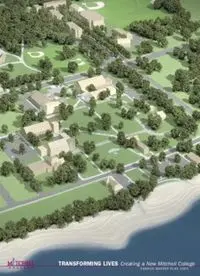
Table Of ContentTRANSFORMING LIVES Creating a New Mitchell College
CAMPUS MASTER PLAN 2005
“Mitchell College, a private, higher education
institution, provides a transforming educational
experience culminating in a bachelors or associates
degree. Within a diverse and student-centered
community and with an emphasis on holistic
student development, Mitchell College supports
individual learning differences, nurtures untapped
academic potential, and instills the professional
knowledge and skills needed for students to
contribute to an ever-changing world.”
- MITCHELL COLLEGE MISSION STATEMENT
INTRODUCTION
Transforming Lives, Mitchell College’s strategic plan, communicates the College’s priorities
and guides the decision-making process in support of it’s mission. The Mitchell College
Master Plan reinforces the priorities of the strategic plan through the physical campus envi-
ronment. Both planning processes have served as powerful tools for faculty, staff, students
and trustees to “provide direction, guidance and inspiration” for the College’s future.
The 65-acre campus, originally the New London estate of Alfred Mitchell, is located in a
distinctive natural setting bound by the banks of the Thames River and the varied ecology
of Mitchell Woods. The natural character of the land as well as two local roads divide the
campus into three districts, each reinforced by its uses. The waterfront campus, which
fronts on the Thames River, has rolling dunes leading to the beach and is the site of the
admissions office, which serves as the first stop for prospective students. Sloping terrain
framing grand views of the Thames River and open space surrounded by academic, admin-
istrative and the student center buildings characterize the main campus. Upper campus,
adjacent to Mitchell Woods, is a center of student life with several of the residence halls,
the gymnasium, and a variety of outdoor recreational and athletic spaces. Two additional
residential areas are located near the campus along Pequot Avenue, with notable water-
front views, and on Gardener Avenue.
With the transition from a two-year to a four-year institution and a new strategic plan, the
College retained the services of Sasaki Associates, a planning, landscape and architectural
firm, to create a master plan for the future of the campus. Working closely with the Master
Planning Committee, comprised of a broad representation of the College community, and
synthesizing the results of dozens of interviews, meetings and workshops with students,
faculty and staff, Sasaki Associates developed a plan that is both visionary and imple-
mentable. Mitchell College now has the opportunity to reassert its commitment to providing
a supportive learning/living environment by elevating the physical experience of the campus
to one that matches the transformative educational experience already in place.
C r e a t i n g a New M i t ch e l l Co l l e g e | Tr an s f o rm i ng L i v e s 1
CAMPUS PLAN
The master plan establishes a new physical identity for the
campus, addresses growth and functional needs, and updates
the overall image of the campus. The plan focuses the energy
of the campus at the front entrance on Montauk Avenue and
the central green. Each major program element has a presence
on the square: student life, academic life, and administration.
New façades on several of the existing buildings will create a
26
new image with the historic buildings and landscape setting,
establishing a unifying image for the College.
New buildings, additions and renovations define the campus:
• T he new Academic Success Center is sited at the main
17
entrance to the campus, creating visibility and accessibility
18
for the college community and visitors alike. The facility is
16
15
located adjacent to the Library and Information Technology
Center, forming the Academic Success Commons and
highlighting the cross-coordination between the departments. 14
12
13
• A new addition to the Clarke Center and renovations to
the existing structure form the Center for Student Life.
Centralized facilities make activities accessible to resident
and commuter students. The new Center for Student Life and
the Academic Success Commons define the entry court and
introduce the campus experience.
• T he addition to Nathan Hale Hall strengthens its presence on
the central green. Together with renovations to the existing
building, the updated spaces meet the classroom needs for
current and future enrollment.
27 11
• A new residence hall on the upper campus accommodates
the need for growth and the desire for contemporary housing
options. The location of the new structure and associated
landscape completes the residential quadrangle concept.
• T he purchase of Michael’s Dairy property allows the College
to strategically expand, creating a true gateway on Montauk
Avenue as well as a space to accommodate academic growth
and a business venture for students.
• L andscape improvements throughout the campus establish
identity, enhance the image and create hierarchy. An
amphitheater, boathouse, formal green and intimate
courtyards provide a variety of gathering spaces from the
residence halls to the waterfront.
2 Tr an s f o rm i ng L i v e s | C r e a t i n g a New M i t ch e l l Co l l e g e
MONTAUK AVENUE
1. ACADEMIC SUCCESS COMMONS
2. CENTER FOR STUDENT LIFE
21
3. UMBRELLA HOUSE
4. BOATHOUSE
20
5. MITCHELL HALL
6. HENRY HALL
7. THAMES ACADEMY
19 8. LIVING/LEARNING HOUSING
9. NATHAN HALE HALL
10. MONTAUK HOUSE
11. CHILDREN’S LEARNING CENTER
12. SIMPSON HALL
13. SAUNDERS HALL
14. MATTESON HALL
15. NEW RESIDENCE HALL
16. YARNALL ATHLETIC CENTER
17. MICHAEL’S DAIRY
18. MICHAEL’S DAIRY BARN
19. FAIRHAVEN
20. MOORINGS
21. HARBOR HOUSE
22. ENTRY COURT AND BEACON
23. MAIN CAMPUS GREEN
24. AMPHITHEATER
3 25. FUTURE BUILDING SITE
4
26. ATHLETIC FIELDS
27. MITCHELL WOODS
25 28. MITCHELL BEACH
2
5
28
23
24
22
6
1
8
9
10
7
C r e a t i n g a New M i t ch e l l Co l l e g e | Tr an s f o rm i ng L i v e s 3
PEQUOT AVENUE
MONTAUK AVENUE
PROGRAM
With a short-term goal of increasing the student body to 700 and a long-term goal of 800 to
1,000 students, the analysis revealed the need for the program elements identified below.
The program requires approximately 37,000 gross square feet of new space to meet the
requirements for the short-term goal of 700 full-time equivalent (FTE) students and an addi-
tional 14,000 gross square feet of new space to meet the requirements for the long-term
goal of up to 1,000 FTE students. Reusable and redesigned space in existing buildings
provides approximately an additional 18,000 gross square feet. Parking demand increases
to approximately 80 additional spaces for 700 FTE students, and another 200 spaces for
1,000 FTE students for a total of 660 spaces on campus.
PROGRAM
Academic Success Center Dining Space Expansion
Center for Student Life Classroom reorganization
Student fitness center Renovated space for Library
Conference and auditorium retrofit Boathouse/meeting space
Student offices and meeting space Thames Academy
Wellness Center expansion Relocated Facilities Building
Athletics renovation New housing for 180-300 beds
Improved labs Parking
PLANNING PRINCIPLES
Based on Sasaki’s understanding of the objectives established by the College, the physical
site analysis of the campus, interviews with several campus constituencies, and an analysis
of current space use and future needs, the master plan is built around five key planning
principles and design concepts. A detailed inventory and analysis of space, site context,
landscape, parking, circulation, and program is available in the technical appendix.
PRINCIPLE 1:
Create a Cohesive Campus Framework
Integrate the various landscapes and land uses from Mitchell
Woods to the Thames waterfront to create a unified campus envi-
ronment and organizational structure. Framework for a continu-
ous experience that unites the distinct elements of the upper,
main and waterfront campuses and creates opportunities for the
strategic siting of new structures and program elements.
4 Tr an s f o rm i ng L i v e s | C r e a t i n g a New M i t ch e l l Co l l e g e
PRINCIPLE 2:
Express the Mission at the Physical Forefront of the Campus
Reinforce the mission and strategic plan of the College by locating
activity centers at a central point on campus to emphasize holistic
student development. Create a visible learning/living environment
from the moment one arrives on campus. Channel the energy
generated at the academic areas of Bingham Hall and the Library,
and near the residence halls and recreational areas, by directing
it towards the heart of the campus.
PRINCIPLE 3:
Maximize Existing Resources
Build upon the existing assets already available on campus.
Integrate existing buildings, new structures and the landscape
through renovations and additions. Capitalize on the existing
sightlines from the entrance, while remaining true to the College’s
commitment to simplicity. Consider alternative uses of spaces to
adapt to the College’s goals for growth. Preserve the history of the
College, while looking toward the future.
PRINCIPLE 4:
Enhance Campus Identity and Image
Improve the overall image of the campus by creating an iconoclas-
tic campus entrance, modern and inspiring façades and distinctive
spaces throughout the campus. Orchestrate the visitor’s arrival
through the experience and understanding of special places and
unique transitions between the built environment and the land-
scape. Define and connect spaces so that each retains its own
identity, while contributing to the overall cohesive and distinctive
image of the College.
PRINCIPLE 5:
Create a Circulation Network to Improve the Campus Environment
Prioritize pedestrian movement throughout the campus by reduc-
ing pedestrian-vehicular conflicts in the core areas of the campus.
Relocate parking to the edge of campus and encourage walking.
Take measures to balance functional desires with the enhance-
ment of the visual quality of the campus. Augment the circulation
network with pedestrian-friendly amenities, architecture, common
wayfinding vocabulary and signage.
C r e a t i n g a New M i t ch e l l Co l l e g e | Tr an s f o rm i ng L i v e s 5
FRONT ENTRANCE AND CAMPUS GREEN
RESIDENTIAL QUAD WATERFRONT
RESIDENTIAL QUAD
WATERFRONT
FRONT ENTRANCE
AND CAMPUS GREEN
THE THREE MAIN CAMPUS DISTRICTS
6 Tr an s f o rm i ng L i v e s | C r e a t i n g a New M i t ch e l l Co l l e g e
PEQUOT AVENUE
MONTAUK AVENUE
FRONT ENTRANCE AND CAMPUS GREEN
PRINCIPLE 1:
Create a Cohesive Campus Framework
The master plan integrates various landscapes and land uses from Mitchell Woods to the
Thames waterfront to create a unified campus environment and organizational structure.
A series of open spaces establish the framework for a continuous experience, while stra-
tegic siting of key campus buildings and visual connections unite distinct elements of the
upper, main and waterfront campuses.
Residential Quad
WATERFRONT
A new residence hall built on the upper campus completes the residential quadrangle con-
cept with generous open spaces for pedestrian-oriented activities. The new courtyards cre-
ated between the upper campus residence halls provide space for students to congregate
in a car-free environment, while also providing a connection to the main campus through
Mitchell Woods or the tree-lined sidewalks of Debiasi Drive. Pathways through Mitchell
Woods provide a natural experience to and from recreational areas, the pond and the
Children’s Learning Center, with access to both the upper campus and Montauk Avenue.
Front Entrance and Campus Green
An enhanced streetscape provides a transition between the campus and the community.
Lowering the historic brick wall and using a historic iron fence allows views into campus
while delineating its edge. A formal entrance on Montauk Avenue flanked by the Center for
Student Life and the Academic Success Commons opens up to reveal views of the water-
front, the Thames River and a main campus green framed by new façades and historic
buildings. A series of walkways traverse the main campus, creating places to gather at
each junction and at the intersection with the surrounding buildings.
Waterfront Campus
Parking near Pequot Avenue is reorganized to allow for a more natural transition from the
main green to the waterfront campus and the beach. Hedges block the view of the parking
lot from the campus green and Pequot Avenue. Space along the dunes is preserved to
provide additional places for recreational and social gatherings.
C r e a t i n g a New M i t ch e l l Co l l e g e | Tr an s f o rm i ng L i v e s 7
nd nd
2 floor 2 floor
st st
1 floor 1 floor
ACADEMIC SUCCESS COMMONS
CENTER FOR STUDENT LIFE
CENTER FOR
STUDENT LIFE
MAIN
CAMPUS
GREEN
ACADEMIC
SUCCESS
COMMONS
THE ACADEMIC SUCCESS COMMONS AND THE CENTER FOR STUDENT LIFE LOCATED AT THE HEART OF THE CAMPUS
8 Tr an s f o rm i ng L i v e s | C r e a t i n g a New M i t ch e l l Co l l e g e
MONTAUK AVENUE