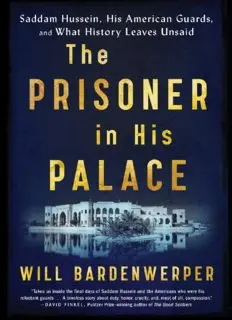
Table Of ContentMore Praise for The Prisoner in His Palace
“Bardenwerper’s examination of how soldiers, trained to focus on the inhumanity
of the enemy, struggle to frame and reframe that inhumanity is the focus of The
Prisoner in His Palace. The book’s action will pull you along like any great military
adventure, but bubbling underneath is an absorbing and sometimes heartbreaking
survey of young men grappling with a moral certitude that begins to shift below the
desert sands they’re standing on.”
—Tim Townsend, author of Mission at Nuremberg
“In the American imagination, Saddam Hussein functions as nothing more than a
two-dimensional despot, a monster who terrorized and gassed and desecrated his
own people. He was. He did. Will Bardenwerper’s The Prisoner in His Palace reveals
something else about Saddam, though, something less simple than that known
caricature and certainly more troubling: he was a human being, a human like all of
us, a human being with hopes and dreams and regrets that woke him in the dead of
night. Saddam wrote poetry and longed for his family and treated the American
soldiers tasked with guarding him during his trial with kindness and generosity of
spirit. This is a brave and piercing book.”
—Matt Gallagher, author of the novel Youngblood and Kaboom: Embracing
the Suck in a Savage Little War
“The Prisoner in His Palace finds humanity in a singularly inhuman figure, Saddam
Hussein. Through meticulous reporting and beautiful storytelling, Will
Bardenwerper has crafted a portrait that is both deeply moving and deeply
disturbing. This book challenges the tired constructs of ‘good versus evil’ that have
led us into so many ill-conceived wars.”
—Elliot Ackerman, author of Green on Blue
“An astonishing, riveting story that brings the reader face-to-face with the specter
of Saddam Hussein in captivity. As twelve young American guards spend their days
in the same room with this brutal gangster-killer, a chilling, Shakespearean portrait
emerges. Intriguingly, we meet a man who, while sometimes manipulative and
petty, is also avuncular, joking, charming, wistful, and physically affectionate.
There is even a scene of the Beast of Baghdad hugging an American soldier in a
moment of tenderness. This is an unforgettable, essential read.”
—William Doyle, author of A Soldier’s Dream: Captain Travis Patriquin and
the Awakening of Iraq and PT 109: An American Epic of War, Survival, and the
Destiny of John F. Kennedy
“A moving and perception-altering book that exposes how wrong we are in so
much of what we assume about war. In the fifteen years that America has been at
war we’ve imprisoned, injured, and killed thousands of foreign citizens. It’s time we
got to know some of them. Will Bardenwerper introduces us to a name we know
well, but a story about which we know little. Saddam Hussein’s execution was not
just about the death of a tyrant. It’s about the Americans who were tasked with
guarding him, interrogating him, and preparing him for his death. . . . Mr.
Bardenwerper forces us to turn our gaze not only on those we have killed but on
those who were there to see the task done.”
—Eric Fair, Pushcart Prize–winning essayist and author of the memoir
Consequence
“What an astonishing story. Through meticulous research and a keen eye for detail,
Bardenwerper does the near impossible: convinces the reader to empathize with
Saddam Hussein during his sad final days. The Prisoner in His Palace is a deeply
human book, and though we all know the ending, I couldn’t put it down.”
—Brian Castner, author of The Long Walk and All the Ways We Kill and Die
“Will Bardenwerper has written a bracing account of Saddam Hussein’s final
months through the eyes of those who guarded and interrogated him—eyes that are
uncomfortably opened to the complexity of evil. Reminiscent of twentieth-century
Nazi character portraits such as Gitta Sereny’s Into That Darkness, Bardenwerper’s
The Prisoner in His Palace will be many things to many people. To this writer and
combat veteran, it is an exhilarating, extraordinary, and damning look in the
mirror.”
—Adrian Bonenberger, author of Afghan Post
“The Prisoner in His Palace is an important contribution to the literature from
America’s 9/11 wars. Will Bardenwerper has written a concise and engrossing
account of the final days of Saddam Hussein. The stories of the American soldiers
who guarded the Iraqi leader serve as a sharp reminder of war’s complexities,
contradictions, and costs.”
—J. Kael Weston, author of The Mirror Test: America at War in Iraq and
Afghanistan
SCRIBNER
An Imprint of Simon & Schuster, Inc.
1230 Avenue of the Americas
New York, NY 10020
www.SimonandSchuster.com
Copyright © 2017 by Will Bardenwerper All rights reserved, including the right to reproduce this book or
portions thereof in any form whatsoever. For information, address Scribner Subsidiary Rights Department,
1230 Avenue of the Americas, New York, NY 10020.
First Scribner hardcover edition June 2017
SCRIBNER and design are registered trademarks of The Gale Group, Inc., used under license by Simon &
Schuster, Inc., the publisher of this work.
For information about special discounts for bulk purchases, please contact Simon & Schuster Special Sales at 1-
866-506-1949 or [email protected].
The Simon & Schuster Speakers Bureau can bring authors to your live event. For more information or to book
an event, contact the Simon & Schuster Speakers Bureau at 1-866-248-3049 or visit our website at
www.simonspeakers.com.
Jacket design by Jaya Miceli
Jacket photograph by Lee Craker Library of Congress Cataloging-in-Publication Data is available.
ISBN 978-1-5011-1783-1
ISBN 978-1-50111785-5 (ebook)
This book is dedicated to my parents, Walter and Patricia.
That afternoon there was a party of tourists at the Terrace and
looking down in the water among the empty beer cans and dead
barracudas a woman saw a great long white spine with a huge tail
at the end that lifted and swung with the tide while the east wind
blew a heavy steady sea outside the entrance to the harbor.
“What’s that?” she asked a waiter and pointed to the long
backbone of the great fish that was now just garbage waiting to go
out with the tide.
—Ernest Hemingway, The Old Man and the Sea
AUTHOR’S NOTE
The American soldiers who guarded Saddam Hussein in his last days, the self-
dubbed “Super Twelve,” were forbidden from keeping a journal, or from even
mentioning their mission in communications with loved ones back home, so there’s
no documentary evidence to confirm the exact date of some of the episodes
recounted here. The soldiers were, however, later interviewed by Army historians
as part of the Army’s oral history program. I was provided these interviews by
Michael Gordon in 2010 as I assisted him with research for his book The Endgame:
The Inside Story of the Struggle for Iraq, from George W. Bush to Barack Obama.
Consequently, in constructing this book’s chronology, I began with the
recollections the soldiers shared in these oral histories before conducting nearly
sixty hours of my own interviews with some of the soldiers. (Those interviews are
among the nearly one hundred I conducted with government officials—both U.S.
and Arab—as well as scholars, spies, lawyers, and others with unique insights.)
If a passage is enclosed in quotation marks, it means that I obtained it from an
interview or material published elsewhere.
Much of the dialogue in this book wasn’t recorded as it happened, and in these
instances the speaker’s words aren’t in quotation marks. The remarks do, however,
faithfully represent the recollections of people involved in the conversations and, in
the case of Saddam’s interrogation, declassified FBI accounts.
Throughout the book, in referencing source material, I’ve made some
grammatical changes for the sake of clarity and minor edits for brevity.
Though this book is a work of nonfiction, I have taken certain storytelling
liberties, particularly having to do with the order and arrangement of scenes. In so
doing, I’m confident that I’ve accurately captured the essence of what happened.
I researched and wrote about the events recounted in this book as a journalist.
Though I was serving as an infantry officer in Anbar Province, Iraq, when Saddam
was executed, I did not participate in or have firsthand knowledge of the events in
this account. Furthermore, none of the material in this book was derived from my
subsequent time working as a civilian in the Department of Defense.
One last thing: All the characters in this book are real. To protect privacy in
certain cases, though, I have used the following pseudonyms: Andre Jackson, Luke
Quarles, Tom Flanagan, Chris Battaglia, Art Perkins, Jeff Price, James Martin,
Tucker Dawson, Joseph, Amanda.