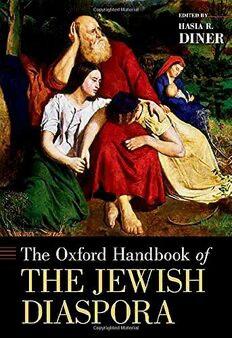
Table Of ContentThe Oxford Handbook of
T H E J E W I S H
DI A S P OR A
The Oxford Handbook of
THE JEWISH
DIASPORA
Edited by
HASIA R. DINER
1
1
Oxford University Press is a department of the University of Oxford. It furthers
the University’s objective of excellence in research, scholarship, and education
by publishing worldwide. Oxford is a registered trade mark of Oxford University
Press in the UK and certain other countries.
Published in the United States of America by Oxford University Press
198 Madison Avenue, New York, NY 10016, United States of America.
© Oxford University Press 2021
All rights reserved. No part of this publication may be reproduced, stored in
a retrieval system, or transmitted, in any form or by any means, without the
prior permission in writing of Oxford University Press, or as expressly permitted
by law, by license, or under terms agreed with the appropriate reproduction
rights organization. Inquiries concerning reproduction outside the scope of the
above should be sent to the Rights Department, Oxford University Press, at the
address above.
You must not circulate this work in any other form
and you must impose this same condition on any acquirer.
Library of Congress Cataloging-in-Publication Data
Names: Diner, Hasia R., editor.
Title: The Oxford handbook of the Jewish diaspora / edited by Hasia R. Diner.
Description: New York : Oxford University Press, [2021] |
Series: Oxford handbooks | Includes bibliographical references and index.
Identifiers: LCCN 2020054807 (print) | LCCN 2020054808 (ebook) |
ISBN 9780190240943 (hardback) | ISBN 9780197554807 (ebook) |
ISBN 9780197554814 (epub)
Subjects: LCSH: Jewish diaspora. | Jews—History. | Judaism—History.
Classification: LCC DS134 .O94 2021 (print) | LCC DS134 (ebook) |
DDC 909/.04924—dc23
LC record available at https://lccn.loc.gov/2020054807
LC ebook record available at https://lccn.loc.gov/2020054808
1 3 5 7 9 8 6 4 2
Printed by Sheridan Books, Inc., United States of America
Contents
Acknowledgments ix
Contributors xi
Introduction: The History of the History of the Jewish Diaspora 1
Hasia R. Diner
PART I DIASPORA AND
CANONICAL WORKS
1. Exile and Diaspora in the Bible 23
Adele Berlin
2. The Concept of Diaspora in Rabbinic Sources 39
Charlotte Elisheva Fonrobert
3. Turning to Jerusalem from the Exile: Jewish Liturgy’s
Engagement with the Diaspora 55
Ruth Langer
4. The Doctrine of Exile in Kabbalah 73
Sharon Flatto
5. The Jewish Diaspora in Christian Thinking 99
Joshua D. Garroway
PART II THE DIASPORA AND
JEWISH THOUGHT
6. Distinctiveness and Diaspora in Medieval and Early
Modern Jewish Thought 117
Michah Gottlieb
7. Diaspora in Modern Jewish Thought 137
Noam Pianko
vi contents
8. Zionism and the Negation of the Diaspora 151
David Engel
9. Celebrating the Diaspora: The Intellectual Defense 167
David Weinberg
10. “A Land for a People, Not a People for a Land”: The Territorial
Ideology, 1903–1957 183
Gur Alroey
PART III FOUR DIASPORA CENTERS
11. Babylonia: A Diaspora Center 203
Geoffrey Herman
12. Not Quite Exile, Not Quite Home: Spain as a Diaspora Center 217
Jane S. Gerber
13. Jews in the Polish-Lithuanian Commonwealth:
An Embedded Diaspora 231
Magda Teter
14. A New World Babylonia: The United States of America 253
Deborah Dash Moore
PART IV JEWISH DIASPORAS ACROSS
TIME AND SPACE
15. The Mediterranean Jewish Diaspora of Late Antiquity 279
Ross S. Kraemer
16. The Emergence of the Medieval Northern European Diaspora 309
Robert Chazan
17. Jews and Diaspora in the Medieval Islamic Middle East 323
Eve Krakowski
18. The Ashkenazic Diaspora of Early Modern Central Europe 345
Joshua Teplitsky
19. The Western Sephardic Diaspora 371
Miriam Bodian
contents vii
20. Diaspora as Nation: The Mediterranean Sephardim between
the Fifteenth and Twentieth Centuries 391
Jonathan Ray
21. Globalizing Diaspora: The Eastern European Jewish Mass
Migration and the Transformation of the Jewish Diaspora 409
Tobias Brinkmann
22. Did German Jews Remain German Jews Once They Left Their
Homeland? 431
Marion Kaplan
23. Holocaust Survivor Diaspora(s) 457
Laura Jockusch and Avinoam J. Patt
24. The Modern Diaspora of Jews from the Arab Middle
East and North Africa 487
Daniel J. Schroeter
25. Israel and the Diaspora to 1967 507
Ronald W. Zweig
26. The Jewish Israeli Diaspora 523
Steven J. Gold
27. Saving Soviet Jews and the Future of the Global
Jewish Diaspora 541
David Shneer
PART V THEMES ACROSS DIASPORAS
28. ‘Saving’ the Jews of the Diaspora: A History of
International Jewish Aid 563
Lisa Moses Leff and Nathan A. Kurz
29. Belonging Across the Diaspora: Global Jewish Organizations 587
David Slucki
30. Philanthropy and the Jewish Diaspora in the Nineteenth and
Twentieth Centuries 605
Zohar Segev
viii contents
31. Reporting the Diaspora: The Global Jewish Press 623
Yaron Tsur
32. Jewish Languages 643
Benjamin Hary
33. Liturgical Music in the Jewish Tradition 663
Mark Kligman
34. Jewish Food in the Diaspora 677
Ari Ariel
Index 687
Acknowledgments
All scholarship to some extent benefits from collaboration, but a book like this depends
upon it. Without the several dozen individuals, all with their own busy schedules and
ongoing projects who agreed to be part of this team, there would have been no Handbook
of the Jewish Diaspora. They came together to work for a common purpose and pro-
duced pieces which could stand on their own but as a whole make an important state-
ment about the centrality of the diaspora as an element in Jewish history and culture. As
such I want to acknowledge all of the scholars who contributed essays to this volume,
which I think will enrich the scholarly literature. The very long drawn-out process,
which took us all from the book’s first conceptualization to this moment of birth, did not
deter them from writing the pieces that follow. While everyone fretted about when and
if the book would ever see the light of day, all these writers, fine and dedicated scholars,
endured the uncertainty with grace, and I want to acknowledge them here for their
patience and the quality of their work. Many offered suggestions about including sub-
jects that I had not considered, and I have thanked them all privately.
Beyond the writers, I want to thank Nancy Toff, with whom I have worked before.
When she approached me about tackling this mighty subject, I was honored but
daunted. I appreciate the faith she had in my ability to conceptualize this enormous
topic, one which by definition has no boundaries. She helped see it through to the finish
line. A superb editor, she and her staff offered guidance on each step along the way.
A few individuals who did not write for the Handbook talked with me about its scope,
vision, and content, and I want to make reference to them, particularly Eugene Sheppard
and David Sorkin, who responded to any number of my questions about the scope of the
essays, the topics that had to be included, and the best scholars working in fields quite far
removed from my own.
Some funding for editorial assistance came from the Goldstein-Goren Center for
American Jewish History at New York University and its generosity sped up the process.
Finally, this book benefitted greatly from the steadfast and meticulous work of Eli
Diner, who should rightly be considered the managing editor of the Handbook. A pro-
fessional editor and writer, he provided such supreme care for the essays that indeed he
deserves to be listed as co-editor, an acknowledgment that far exceeds merely being
thanked.