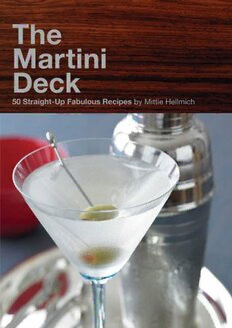
Table Of ContentThe Martini Deck
50 Straight-Up Fabulous Recipes by Mittie Hellmich
“Do not allow children to mix drinks. It is unseemly, and they
use too much vermouth.” —Steve Allen, American humorist
The illustrious and famous Martini, a symbol of pure
alchemy and glamour, is based on the perfect botanical
balance between the juniper berries in gin and the herbal
qualities of vermouth.
The Martini has always reflected the cultural influences
swirling around it. Many historical figures, artists, film
stars, and literary luminaries have had a hand in fueling
the lore about and tweaking the recipe for the “Silver
Bullet,” as the Martini is sometimes called.
These days, that same adventurous spirit has gone
beyond the fine fusion of gin perfumed with dry vermouth,
surpassing the classic definition of a Martini and evolving
into a new generation of drinks that encompass everything
from liqueur and juice-laced concoctions and herb-infused
spirits to just about anything served in a cocktail glass.
None of these is technically a Martini, of course, but
we won’t bother with semantics when they taste so good.
In this Martini deck, you’ll find a compilation of refined
cocktails plucked from the wide spectrum of Martinis
and chosen with a discerning palate. Included are
the perfected classics, popular modern versions, and
innovative hybrids, along with spirited infusions, to shake
or stir and enjoy.
History of the Martini
The origins of this famous cocktail are murky, and the
myths describing its moment of creation are legion.
According to one legend, “Professor” Jerry Thomas of
San Francisco’s Occidental Hotel created the drink for a
miner who was on his way to the town of Martinez (thus
the cocktail’s name), and another claims the drink is an
invention of the English in the late 1800s, named after the
Martini-Henry rifle. Yet another tale attributes the cocktail
to Martini de Arma de Traggi, a bartender at New York’s
Knickerbocker Hotel, who in 1910 modified a popular drink
called the Gin and French, made with London dry gin and
Noilly Prat dry vermouth, by stirring the ingredients with
lots of ice and straining it. But since many references to
the Martini predate this era, this story seems implausible.
Still, as cocktail legend has it, the Knickerbocker regulars
were responsible for changing the bartender’s original
lemon twist garnish to an olive.
We may never know the real story, but we do know that
the original ratio of equal parts London dry gin and Noilly
Prat dry French vermouth, tempered with a dash of orange
bitters, is not dry enough for modern tastes. Starting in
the 1930s, the proportions changed and the drink became
progressively drier, until it reached the absurdly dry
extreme of straight chilled gin by the 1950s. For purists,
however, no matter how dry a Martini is—even if the glass
is merely misted with Noily Prat or the olive is infused with
dry vermouth—it must have vermouth to be called a Martini.
Essential Bar Equipment
All you need to stir or shake fabulous cocktails are a
few essential bar tools that will also see you through
just about any mixological occasion. You’ll want a good
cocktail shaker with a built-in strainer and/or a glass
pitcher and stirring rod, a double-headed jigger/pony,
a sharp paring knife for cutting fruit and garnishes,
a good corkscrew and bottle opener, a handheld
citrus juicer (indispensable when you need more than a
little squeeze of fresh citrus juice), and a high-powered
blender that pulverizes ice. A few additional handy
bar tools, such as a cutting board for cutting fruit, an
easy-peel citrus stripper, a bar spoon, a bar towel,
and a few stylish cocktail picks, will round out your fully
functional home bar.
Presentation plays an important role in the cocktail
experience, and the iconic martini glass is traditional.
The familiar conical cup with the thin, elegant stem is
functional yet stylish, perfect for most shaken or stirred
cocktails, and it visually entices the palate with the promise
of refreshment. The classic cocktail glass, which is similar
to the martini glass, has a slightly more rounded bowl.
Your repertoire of glassware doesn’t have to be extensive.
A few fun variations of the cocktail glass will see you
beautifully through a multitude of drinks.
Components of a
Classic Martini
Gin is the quintessential juniper-perfumed ingredient
in the classic Martini. Although modern tastes tend
toward a London dry gin, a wide spectrum of gins with
subtle aromatic differences —from pungent Holland
gins to sweeter old-style gins and softer American dry
gins—is now available.
The other key element in the Martini is vermouth, an
aperitif wine typically flavored with various herbs, roots,
berries, flowers, and seeds. Dry and extra-dry vermouth
generally have a delicate, slightly nutty flavor, with a color
ranging from pale gold to colorless. Sweet vermouth has
a darker color and a sweeter flavor. The term “French” is a
classic cocktail term used when ordering a drink with dry
vermouth, such as a Gin and French. It harks back to a
time when the French made dry vermouth and the Italians
produced only sweet vermouth. These days both countries
produce both varieties.
Seemingly the antithesis of aromatic gin, vodka has its
own following among Martini drinkers and has become
the spirit of choice for many cocktails. With its clean, fresh,
neutral taste, it’s the perfect chameleon, lending itself to
lots of creative concoctions, including lush infusions with
essences of fruits and herbs.
Martini Mixology
Techniques
Once the cocktail glass is chilling in the freezer
and the drink’s garnish has been cut, it is time to stir
(or shake) your cocktail. Ahh, to shake or to stir. . . that
is the question. There is something evocatively classic
in the ritual of stirring a cocktail with ice—that tink-
ling sound of the cubes as they circle around in
a vortex, chilling the crystal-clear liquid and frosting
the pitcher. W. Somerset Maugham, a firm believer
that Martinis should never be shaken, poetically stated,
“Martinis should always be stirred, not shaken, so
that the molecules lie sensuously on top of each other.”
But purists such as Maugham are challenged by the
contemporary camp that follows James Bond, the
spy who made it oh-so-stylish to shake.
Stirring chills with minimum dilution while not disturbing
the spirit’s characteristic clarity and texture. The advantage
to vigorously shaking a Martini is the refreshing result
of shimmery shards of ice floating on the surface of the
drink. The ice cubes should ideally be made with distilled
water, to avoid imparting any unwanted flavor.
Mixing a
Superlative Martini
Start with a premium-quality gin and the traditional dry
vermouth, Noilly Prat (although any dry vermouth will
suffi ce). Store both the gin and the glasses in the freezer
for the ideal icy coldness. In a glass martini pitcher, gently
butfi rmly stir your liquid ingredients with a handful of ice
cubes, from the bottom up, until the glass turns frosty.
Strain into a chilled cocktail glass and garnish with either
an olive or a lemon peel twisted over the drink to diffuse
the oil from the rind.
For those who prefer a drier version, a lighter touch
with the dry vermouth is in order: Swirl ¼ ounce of dry
vermouth around the inside of a chilled cocktail glass,
discard the remaining liquid, and then strain the stirred
or shaken gin into the prepared glass.
Where gin Martini afi cionados may prefer to stir so as
not to bruise the gin, vodka Martini drinkers tend to agree
with James Bond, preferring them shaken for the frosty
advantage of fi ne slivers of ice, which somewhat dilute
the spirits.
Contents
Classic Martinis Deluxe Fruit & Herbal Martinis
01. Superlative Martini 26. Pomegranate Martini
02. Perfect Martini 27. Pink Martini
03. Dirty Martini 28. Pear Ginger Martini
04. Montgomery 29. Blueberry Mint Martini
05. Naked Martini 30. Rosemary Martini
06. Gibson 31. Strawberry Basil Martini
07. Martinez 32. Vanilla Citrus Martini
08. Gin and Sin 33. Mandarin Mango Mint
09. Fino Martini 34. Fig Leaf Fizz
10. Smoky Martini 35. Añejo Cilantro Martini
11. Picasso Martini
12. Vesper Martini Urbane Innovations
13. Vodka Martini 36. Black Martini
14. Negroni 37. Capri Cocktail
38. Orange Martini
New Classics 39. Mojito Martini
15. Apple Martini 40. Golden Lillet Martini
16. Cosmopolitan 41. Lychee Martini
17. Metropolitan 42. Suntory Martini
18. Lemon Drop 43. Key Lime Martini
19. Mandarin Orange Drop 44. Gold Martini
20. Chocolate Martini 45. French Kiss Martini
21. Espresso Martini 46. Pearl Diver Martini
22. Nutty Martini
23. French Martini Infusions
24. Palm Beach Special 47. Herb-Infused Vodka
25. Chelsea Sidecar 48. Berry-Infused Vodka
49. Ginger-Infused Vodka
50. Mango-Infused Vodka
CLASSIC MARTINIS
01 Superlative Martini
This is the classic Martini—perfectly dry, with the ratio
of gin to vermouth tailored for contemporary tastes.
For the ultimate Martini experience, it should be made
with a premium gin such as Bombay Sapphire and the
traditional dry vermouth, Noilly Prat. If you prefer, you
can shake the ingredients in a cocktail shaker to produce
a refreshing profusion of ice shards.
2 ounces gin
½ ounce dry vermouth
Lemon twist or green cocktail olive
Stir the gin and vermouth in a mixing glass with ice. Strain
into a chilled cocktail glass. Run the lemon peel around the
rim, twist it over the drink, and drop it in, or simply drop in
the olive.
Variations:
• For a dry Martini, reduce the dry vermouth to
¼ ounce.
• For an extra-dry (or very dry) Martini, reduce the
dry vermouth to ½ teaspoon or less.
• For a Buckeye, garnish with a black olive.
• For a Homestead, garnish with a slice of orange.
• For a Douglas, garnish with both lemon and
orange twists.