Table Of ContentProject Gutenberg's The Luck of Thirteen, by Jan Gordon
Cora J. Gordon
This eBook is for the use of anyone anywhere at no cost and with
almost no restrictions whatsoever. You may copy it, give it away or
re-use it under the terms of the Project Gutenberg License included
with this eBook or online at www.gutenberg.org
Title: The Luck of Thirteen
Wanderings and Flight through Montenegro and Serbia
Author: Jan Gordon
Cora J. Gordon
Release Date: December 12, 2005 [EBook #17291]
Language: English
Character set encoding: ISO-8859-1
*** START OF THIS PROJECT GUTENBERG EBOOK THE LUCK OF THIRTEEN ***
Produced by Marilynda Fraser-Cunliffe, Taavi Kalju and the
Online Distributed Proofreaders Europe at
http://dp.rastko.net. (This file was made using scans of
public domain works from the University of Michigan Digital
Libraries.)
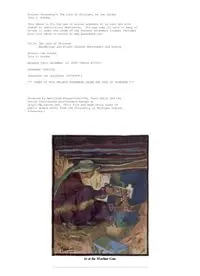
Jo at the Machine Gun.
THE LUCK OF THIRTEEN
WANDERINGS AND FLIGHT THROUGH MONTENEGRO AND
SERBIA
BY
MR. AND MRS. JAN GORDON
WITH PHOTOGRAPHS AND A MAP
TAIL PIECES BY CORA J. GORDON
COLOUR PLATES BY JAN GORDON
NEW YORK
E.P. DUTTON AND COMPANY
681 FIFTH AVENUE
1916
PRINTED BY
WILLIAM CLOWES AND SONS, LIMITED
LONDON AND BECCLES, ENGLAND
CONTENTS
CHAPTER
PAGE
Contents
v
List of Illustrations
vii
Introduction
1
II.
Nish and Salonika
10
III.
Off to Montenegro
20
IV.
Across the Frontier
31
V.
The Montenegrin Front on the Drina
47
VI.
Northern Montenegro
66
VII.
To Cettinje
85
VIII.
The Lake of Scutari
99
IX.
Scutari
105
X.
The Highway of Montenegro
122
XI.
Ipek, Dechani and a Harem
145
XII.
The Highway of Montenegro—II
169
XIII.
Uskub
182
XIV.
Mainly Retrospective
198
XV.
Some Pages from Mr. Gordon's Diary
213
XVI.
Last Days at Vrntze
227
XVII.
Kralievo
244
XVIII.
The Flight of Serbia
263
XIX.
Novi Bazar
284
XX.
The Unknown Road
299
XXI.
The Flea-Pit
315
XXII.
Andrievitza to Pod
328
XXIII.
Into Albania
341
Pg v
Pg vi
XXIV.
"One more Ribber to cross"
359
Index
377
LIST OF ILLUSTRATIONS
COLOURED PLATES
FACING PAGE
Jo at the Machine Gun
Frontispiece
The Ipek Pass in Winter
140
Retreating Ammunition Train
276
Albanian Mule-drivers Camping
354
HALF-TONE PLATES
Out-patients
4
Shoeing Bullocks
4
Peasant Women in Gala Costume, Nish
20
Serb Convalescents at Uzhitze
28
Serb and Montenegrin Officers on the Drina
58
A Concealed Gun Emplacement on the Drina
58
Peasant Women of the Mountains
76
A Village of North Montenegro
76
Jo and Mr. Suma in the Scutari Bazaar
110
Christian Women hiding from the Photographer
112
Scutari—Bazaar and Old Venetian Fortress
112
Disembarkation of a Turkish Bride
114
Governor Petrovitch and his Daughter in their State Barge
114
In the Bazaar of Ipek
162
Street Coffee Seller in Ipek
162
A Wine Market in Uskub
184
Big Gun passing through Krusevatz
194
In-patients
202
Broken Aeroplane in the Arsenal at Krag
220
Where the "Plane" fell
220
House near the Arsenal damaged by Bombs
220
Peasant Women leaving their Village
260
Serb Family by the Roadside
260
The Flight of Serbia
266
Unloading the Benedetto, San Giovanni di Medua
364
Route Map of the Authors' Wanderings
At end of text
THE LUCK OF THIRTEEN
INTRODUCTION
Pg vii
Pg viii
Pg 1
It is curious to follow anything right back to its inception, and to discover from what extraordinary causes results are
due. It is strange, for instance, to find that the luck of the thirteen began right back at the time when Jan, motoring back
from Uzhitze down the valley of the Morava, coming fastish round a corner, plumped right up to the axle in a slough of
clinging wet sandy mud. The car almost shrugged its shoulders as it settled down, and would have said, if cars could
speak, "Well, what are you going to do about that, eh?" It was about the 264th mud hole in which Jan's motor had
stuck, and we sat down to wait for the inevitable bullocks. But it was a Sunday and bullocks were few; the wait
became tedious, and in the intervals of thought which alternated with the intervals of exasperation, Jan realized that he
needed a holiday.
To be explicit. Jan was acting as engineer to Dr. Berry's Serbian Mission from the Royal Free Hospital:—Jan Gordon,
and Jo is his wife, Cora Josephine Gordon, artist, and V.A.D.
We had a six months of work behind us. We had seen the typhus, and had dodged the dreaded louse who carries the
infection, we had seen the typhus dwindle and die with the onrush of summer. We had helped to clean and prepare six
hospitals at Vrntze or Vrnjatchka Banja—whichever you prefer. We had helped Mr. Berry, the great surgeon, to
ventilate his hospitals by smashing the windows—one had been a child again for a moment. Jo had learned Serbian and
was assisting Dr. Helen Boyle, the Brighton mind specialist, to run a large and flourishing out-patient department to
which tuberculosis and diphtheria—two scourges of Serbia—came in their shoals. We had endeavoured to ward off
typhoid by initiating a sort of sanitary vigilance committee, having first sacked the chief of police: we had laid drains,
which the chief Serbian engineer said he would pull up as soon as we had gone away. We had helped in the plans of a
very necessary slaughter-house, which Mr. Berry was going to present to the town. There was an excuse for Jan's
desire. The English papers had been howling about the typhus months after the disease had been chased out by English,
French, and American doctors, who had disinfected the country till it reeked of formalin and sulphur; shoals of devoted
Englishwomen were still pouring over, generously ready to risk their lives in a danger which no longer existed. Our own
unit, which had dwindled to a comfortable—almost a family—number, with Mr. Berry as father, had been suddenly
enlarged by an addition of ten. These ten complicated things, they all naturally wanted work, and we had cornered all
the jobs.
So, after the fatigues of February, March, and April, and the heat of June, Jan quite decided on that Uzhitze mud patch
that a holiday would do little harm to himself, and good to everybody else. Then, however, came the problem of Jo. Jo
is a socialistic sort of a person with conservative instincts. She has the feminine ability to get her wheels on a rail and run
comfortably along till Jan appears like a big railway accident and throws the scenery about; but once the resolution
accomplished she pursues the idea with a determination and ferocity which leaves Jan far in the background.
Jo had her out-patient department. Every morning, wet or fine, crowds of picturesque peasants would gather about the
little side door of our hospital, women in blazing coloured hand-woven skirts, like Joseph's coat, children in
unimaginable rags, but with the inevitable belt tightly bound about their little stomachs, men covered with tuberculous
sores and so forth, on some days as many as a hundred. Jo, having finished breakfast, had then to assume a
commanding air, and to stamp down the steps into the crowd, sort out the probable diphtheria cases—this by long
practice,—forbid anybody to approach them under pain of instant disease, get the others into a vague theatre queue,
which they never kept, and then run back into the office to assist the doctor and to translate. All this, repeated daily,
was highly interesting of course, and so when Jan suggested the tour she "didn't want to do it."
But authority was on Jan's side. Jo had had a mild accident: a diphtheria patient fled to avoid being doctored, they often
did, and Jo had chased after her; she tripped, fell, drove her teeth through her lower lip, and for a moment was stunned.
When they caught the patient they found that it was the wrong person—but that is beside the subject. Dr. Boyle thought
that Jo had had a mild concussion and threw her weight at Jan's side. Dr. Berry was quite agreeable, and gave us a
commission to go to Salonika to start with and find a disinfector which had gone astray. Another interpreter was found,
so Jo took leave of her out-patients.
In Serbia it was necessary to get permission to move. Jan went to the major for the papers. There were crowds of
people on the major's steps, and Jan learned that all the peasants and loafers had been called in to certify, so that
nobody should avoid their military service. Later we parted, taking two knapsacks. Dr. Boyle and Miss Dickenson
were very generous, giving us large supplies of chocolate, Brand's essence, and corned beef for our travels, and we had
two boxes of "compressed luncheons," black horrible-looking gluey tabloids which claim to be soup, fish, meat,
vegetables and pudding in one swallow.
Pg 2
Pg 3
Pg 4
Pg 5
OUT-PATIENTS.
SHOEING BULLOCKS.
The Austrian prisoners bade us a sad farewell, but many friends accompanied us to the station, and the rotund major
and his rounder wife did us the like honour. Our major was a queer mixture: he was jolly because he was fat, and he
was stern because he had a beaky nose, and in any interview one had first to ascertain whether the stomach or the nose
held the upper hand, so to speak. With the wife one was always sure—she had a snub nose. On this occasion the
major furiously boxed the Austrian prisoner coachman's ears, telling us that he was the best he had ever had. The
unfortunate driver was a picture of rueful pleasure. The two plump dears stood waving four plump hands till we had
rumbled round the corner of the landscape.
In the train to Nish it was intensely hot. We had sixteen or seventeen fellow-passengers in our third-class wooden-
seated carriage—all the firsts had been removed, because they could not be disinfected—and the windows, with the
exception of two, had been screwed tightly down. Every time we stood up to look at the landscape somebody slipped
into our seat, and we were continually sitting down into unexpected laps. Expostulations, apologies, and so on.
Pg 6
Somebody had gnawed a piece from one of the wheels, and we lurched through the scenery with a banging metallic
clangour which made conversation difficult, in spite of which Jo astonished the natives by her colloquial and fluent
Serbian. We had an enormous director of a sanitary department and a plump wife, evidently risen, but fat people rise in
Serbia automatically like balloons. We had three meagre old gentlemen, one unshaven for a week, one whiskered since
twenty years with Piccadilly weepers like a stage butler; some ultra fashionable girls and men; and a dear old dumb
woman wearing three belts, who had been a former outpatient; and several sticky families of children.
The old gentlemen took a huge interest in Jo. They drew her out in Serbian, and at every sentence turned each to the
other and elevated their hands, ejaculating "kako!" (how!) in varying terms of admiration and flattery.
The American has not yet ousted the Turk from Serbia, and the bite from our wheel banged off the revolutions of our
sedate passing. Trsternik's church—modern but good taste—gleamed like a jewel in the sun against the dark hills. On
either hand were maize fields with stalks as tall as a man, their feathery tops veiling the intense green of the herbage with
a film, russet like cobwebs spun in the setting sun. There were plum orchards—for the manufacture of plum brandy—so
thick with fruit that there was more purple than green in the branches, and between the trunks showed square white
ruddy-roofed hovels with great squat tile-decked chimneys. Some of the houses were painted with decorations of bright
colours, vases of flowers or soldiers, and on one was a detachment of crudely drawn horsemen, dark on the white
walls, meant to represent the heroes of old Serbian poetry.
To Krusevatz the valley broadened, and the sinking sun tinted the widening maize-tops till the fields were great squares
of gold. We had no lights in the train, and presently dusk closed down, seeming to shut each up within his or her own
mind. The hills grew very dark and distant, and on the faint rising mist the trees seemed to stand about with their hands
in their pockets like vegetable Charlie Chaplins.
A junction, and a rush for tables at the little out-of-door restaurant. In the country from which we have just come all
seemed peace, but here in truth was war. Passing shadowy in the faint lights were soldiers; soldiers crouched in heaps in
the dark corners of the station; yet more soldiers and soldiers again huddled in great square box trucks or open
waggons waiting patiently for the train which was four or five hours late. There were women with them, wives or sisters
or daughters, with great heavy knapsacks and stolid unexpressive faces.
While we were dreaming of this romance of war, and of the coming romance of our own tour, a little man dumped
himself at our table, explained that he had a pain in his kidneys, and started an interminable story about his wife and a
dog. He was Jan's devoted admirer, and declared that Jan had performed a successful operation upon him, though Jan
is no surgeon, and had never set eyes upon the man before.
Georgevitch rescued us. Georgevitch was fat, tall, young and genial, and was military storekeeper at Vrntze. He was an
ideal storekeeper and looked the part, but he had been a comitaj. He had roamed the country with belts full of bombs
and holsters full of pistols, he and 189 others, with two loaves of bread per man and then "Ever Forwards." Of the 189
others only 22 were left, and one was a patient at our hospital where we called him the "Velika Dete" or "big child,"
because of his sensibility. With Georgevitch was a dark woman with keen sparkling eyes. Alone, this woman had run
the typhus barracks in Vrntze until the arrival of the English missions. She was a Montenegrin; no Serbian woman could
be found courageous enough to undertake the task. After struggling all the winter, she was taken ill about a fortnight
after the arrival of the English. The Red Cross Mission took care of her and she recovered.
We left our bore still talking about his wife and the dog, and fled to their table, where we chatted till our train arrived.
We found a coupé—a carriage with only one long seat—the exigencies of which compelled Jan to be all night with Jo's
boots on his face, and we so slept as well as we were able.
CHAPTER II
NISH AND SALONIKA
To our dismay a rare thing happened—our train was punctual, and we arrived in Nish at four o'clock. It was cold and
Pg 7
Pg 8
Pg 9
Pg 10
misty. The station was desolate and the town asleep. Around us in the courtyard ragged soldiers were lying with their
heads pillowed on brightly striped bags. A nice old woman who had asked Jo how old she was, what relation Jan was
to her, whether they had children, and where she had learnt Serbian, suddenly lost all her interest in us and hurried off
with voluble friends whose enormous plaits around their flat red caps betokened the respectable middle-class women.
Piccadilly weepers vanished and a depressed little quartet was left on the platform—our two selves, a lean
schoolmaster, and an egg-shaped man who never spoke a word. We found a clerk sitting in an office. He said we could
not leave our bags in his room, but as we made him own that we could not put them anywhere else he looked the other
way while we dropped them in the corner.
In the faint mist of the early morning the great overgrown village of one-storied houses seemed like a real town buried
up to its attics in fog. We found a café which was shut, and sat waiting on green chairs outside. Around us old men
were talking of the news in the papers. They said that Bulgaria was making territorial demands, and as the Balkan
governments covet land above all things they felt pessimistic as to whether Serbia would concede anything, and said,
shaking their heads, "It will be another Belgium."
We celebrated the opening of the café by ordering five Turkish coffees each, and the schoolmaster and we alternately
stood treat. Jo loaded up with aspirin to deaden a toothache which was worrying her.
We spent a cynical morning in interviews with people who were supposed to know about missing luggage. Both they
and we were aware that the first hospital which got a wandering packing-case froze on to it, and if inconvenient people
came to hunt for their property the dismayed and guilty ones hurriedly painted the case, saying to each other, "After all
it's in a good cause, and it's better than if it were stolen."
Then we went to see the powers who can say "no" to those who want to do pleasant things, and were handed an
amendment to a plea for a tour round Serbia, including the front, which we had sent to them and which had been
pigeon-holed for a month.
"But we don't want to see a lot of monasteries," said Jan, as he gazed at a little circle drawn round the over-visited part
of Serbia. The powers were adamant and seemed to think they had done very well for us. We went away sadly, for
monasteries had not been the idea at all.
Half an hour later we were pursuing an entirely different object. We had discovered that Sir Ralph Paget was housing
about £1000 worth of stores destined for Dr. Clemow's hospital—which was in Montenegro—and which needed an
escort. He was somewhat puzzled at our altruistic anxiety to take them off his hands, but was much relieved at the
thought that he could get rid of them.
We hurried to the station, rescued our knapsacks under the nose of a new official who looked very much surprised, and
boarded the English rest house near by. English people were sitting in deck chairs outside the papier-maché house
which stood surrounded by a couple of tents and a wooden kitchen in a field. Austrian prisoners were preparing lunch,
and we were introduced to Seemitch the dog.
Though young, Seemitch was fat and exhibited signs of a much-varied ancestry. The original Seemitch, an important
Serb with long gold teeth, was very indignant that a dog, and such a dog, should be called after him, so Sir Ralph
arranged that of the two other puppies one should be called after him and the other after Mr. Hardinge his secretary.
Thus the man Seemitch's dignity was restored.
At the station, to our great joy, we met two American doctors from Zaichar. One we had mourned for dead and were
astonished to see him, shadow-like, stiff-kneed, and sitting uncomfortably on a chair in the middle of the platform.
Months before he had pricked himself with a needle while operating on a gangrenous case, and had since lain
unconscious with blood-poisoning.
While we were cheering over his recovery, a little Frenchman slipped into our reserved compartment, which was only a
coupé, and had seized the window seat. Jan found him lubricating his mouth, already full of dinner, with wine from a
bottle. As he showed no signs of seeing reason from the male, Jo tried feminine indignation. "That seat is mine," she
snapped to his back-tilted head.
"Good. I exact nothing," he said, wiping his moustache upwards. She suggested that if any exacting was to be done she
possessed the exclusive rights.
"Quel pays," he answered. Jo thought he was casting aspersions on England and on her as the nearest representative,
and the air became distinctly peppery. The Frenchman hurriedly explained that he was alluding to Serbia, so they buried
the hatchet and became acquaintances.
Uskub, or Skoplje, and one hour to wait. All about the great plains the mountains were just growing ruddy with the
dawn, and we gulped boiling coffee at the station restaurant.
One of the American doctors seemed restless. Some one had told him it was advisable to keep an eye on the luggage.
Pg 11
Pg 12
Pg 13
Pg 14
They began to shunt the train, and soon he was stumbling about the sidings in a resolute attempt not to lose sight of the
luggage van. We sympathetically wished him good luck and walked past into the Turkish quarter, adopted by two dogs
which followed us all the way. We had a hurried glimpse of queer-shaped, many-coloured houses, trousered women,
and a general Turkishness.
We returned to find our American friend furious, full of the superior methods of luggage registration in the States.
We had beer with him at the frontier, delicious cool stuff with a mollifying influence. He told us he held the record for
one month's hernia operations in Serbia. We were later to meet his rival, a Canadian doctor, in Montenegro.
Locked in the train, we awaited the medical examination, and sat feeling self-consciously healthy. At last the Greek
doctor opened the door, glanced at a knapsack, and vanished. We were certified healthy.
It was a beautiful dark blue night when we arrived at Salonika. Crowds of people were dining at little tables which filled
the streets off the quay, in spite of the awful smells which came up from the harbour.
It is impossible to sleep late in Salonika. Soon after dawn children possess the town—bootblacks, paper-sellers,
perambulating drapers' shops; all children crying their wares noisily. The only commodity that the children don't peddle
is undertaken by mules laden with glass fronted cases hanging on each side and which are filled with meat.
We breakfasted in the street, revelling in the early morning and shooing away the children, who never gave us a
moment's grace. In self-defence we had our boots blacked, for the ambulating bootblack molests no longer the owner
of a well-polished pair of boots. It is queer to walk about in a town where one-third of the population is only pecuniarily
interested in the momentary appearance of feet and never look at a face, like the man with the muckrake with eyes
glued on life as it is led two inches from the ground.
When we had finished searching for disinfectors and dentists we wandered up the hill through the romantic streets. Jan
sketched busily, but toothache had rather sapped Jo's industry, and she generally found some large stone to sit on,
whence to contemplate.
An old woman's face, peering round the doorway, discovered her sitting on the doorstep, a Greek dustman gazing
stupidly at her.
In two minutes they were talking hard. The old woman was a Bulgarian, but they were able to understand each other.
What Jo told the old woman was translated to the dustman, and when Jan came up they were introduced each to the
other, the dustman with his broom bowing to the ground like some old-time court usher.
Once a Greek woman offered a chair to Jo. She was much embarrassed, as the only Greek words she had picked up
were "How much?" and "Yet another;" and as both seemed unsuitable she tried to put her gratitude into the width of her
smile.
We scrambled on ever afterwards through streets which were more like cliff climbs than roads. The sun grew red till all
Salonika lay at our feet a maze of magenta shadow. We sat down in an old Turkish cemetery, where we could watch
the old wall sliding down to plains of gold, where, falling into ruins, it lent its degraded stones for the construction of
Turkish hovels.
A kitten with paralysed hind legs crawled up to us and accepted a little rubbing. When dusk came we moved on,
marvelling at the inexhaustible picturesqueness of Salonika.
As we clambered down the breakneck paths, the priests were illuminating the minarets with hundreds of twinkling lights.
The next day was the Feast. Mahommedans were everywhere. By the women's trousers, which twinkled beneath the
shrouding veils, one could see that they were gorgeously dressed. Befezzed men were lounging and smoking in all the
café's.
In the evening once more we wandered up through the old Turkish quarter. We heard a curious noise like a hymn
played by bagpipes, rhythmically accompanied in syncopation by a very flabby drum. Round the corner came four jolly
niggers blowing pipes, and the drummer behind them. Very slim young men with bright sashes and light trousers were
twisting, posturing, and dancing joyfully. One of them threw to Jo the most graceful kiss she had ever seen.
We left Salonika in the morning, having been wakened by new sounds. Thousands of marching feet, songs. This was
puzzling.
In the train a young Greek told us that his nation had mobilized against the Bulgars, but that it was not very serious. He
said that there had been very friendly feeling in Greece for England, but that we had done our best to kill it.
"You see, monsieur," he explained, "your offer to give away our land. It is not yours to give. You say that does not
matter, but that colonies, great colonies in Africa will replace the small part of land that we may surrender. Kavalla is
more valuable to Grecian hearts than all Africa, for how could we desert our Grecian brothers and place them beneath
the rule of the Turk or Bulgar?"
On the train were more American doctors. One had just arrived, and was still full of enthusiasm for scenery and
sanitation. Also there was Princess —— surrounded by packing cases. Some months earlier she had visited our
Pg 15
Pg 16
Pg 17
Pg 18
hospitals in Vrntze and she had asked if one of our V.A.D.'s could be sent to her as housemaid. Seeing her in the
station, Jo involuntarily ran over in her mind, was she "sober, honest and obliging?"
The American doctors and we picnicked together. We ate bully beef and a huge water melon. The heat was awful. The
velvet seats seemed to invade one's body and come through at the other side. One of the doctors sat on the step of the
train, and Jo found him nodding and smiling as he dreamt. She rescued him before he fell off.
After twelve hours they left us. Uskub once more and an hour to wait. We sat behind trees in boxes on the platform and
ate omelet with a nice old Jew and his ten-year-old daughter, who already spoke five languages.
Then to sleep. We found our half coupé contained a second seat which could be pulled down, so we each had a bed.
At four in the morning we were awakened by the most awful imitation of a German band.
What had happened? We looked out. It was barely dawn, and a wretched little orchestra was grouped at the edge of
the tiny station. Every instrument was cracked and was tuned one-sixteenth tone different from its companions. What it
lacked in musical ability it made up in energy.
Why, oh, why at that hour, we never found out. Perhaps it was in honour of the Princess, poor lady!
CHAPTER III
OFF TO MONTENEGRO
Back to Nish in the rain, and Jo was wearing a cotton frock. There may be more dismal towns than this Nish, but I
have yet to see them, and this, although the great squares were packed with gaily coloured peasants—some feast, we
imagined—carts full of melons, melons on the ground, melons framing the faces of the greedy—cerise green-rind moons
projecting from either cheek. The Montenegrin consul was not at home, so off we went to the Foreign Office to give a
letter to Mr. Grouitch, who sent us to the Sanitary Department of the War Office (henceforth known as S.D.W.O.).
S.D.W.O. wouldn't move without a letter from "Sir Paget." We got the letter from "Sir Paget" and back to the
S.D.W.O., to find it shut in our faces, and to learn that it did not reopen till four.
Then came the matter of Jo's tooth. This abscess had been nagging all the time, it had vigorously tried to get between Jo
and the scenery. We had sought dentists in Salonika, rejecting one because his hall was too dirty, a second because she
(yes, a she) was practising on her father's certificates, the third, a little Spaniard, had red-hot pokered the gums thereof
and only annoyed it. But we had heard there was a Russian dentist in Nish, a very good one. The Russian dentist turned
out to be a girl, and tiny—she spoke no Serb, but Jo managed, by means of the second cousinship of the language, to
make out what she said in Russian.
Pg 19
Pg 20
Pg 21
PEASANT WOMEN IN GALA COSTUME—NISH.
"The tooth must come out," squeaked the small dentist.
"Can't you save it?" prayed Jo; "it's the best one I've got, and the one to which I send all the Serbian meat."
"It must come out," squeaked the Russ.
"Can't you save it?" prayed Jo.
"It must come out," reiterated the Russ.
"You're very small," said Jo, doubtfully.
This annoyed the dentist. She pushed unwilling Jo into a chair, produced a pair of pincers, and, oh, woe! she wrenched
to the north, she wrenched to the south, she wrenched to the east, and there was the tooth, nearly as big as the dentist
herself.
"I never can eat Serbian meat again," murmured Jo as she mopped her mouth.
After tea we returned to the S.D.W.O., and by means of our letter and our Englishness we got in front of all the
unfortunate people who had been waiting for hours, and received our passes, etc., immediately.
Sir Ralph Paget's storekeeper wouldn't work on Sunday, so we had also to rest, and we celebrated by staying in bed
late and going for a walk in the afternoon with an Englishman who was en route for Sofia. We came to a little village
where every house was surrounded by high walls made of wattle. The women soon crowded round, imagining Mr. B
—— a doctor. Jo pretended to translate, and gave advice for a girl with consumption, and an old woman whose hand
was stiff from typhus, and we had to give the money for the latter's unguent. For the consumptive she said, "Open the
windows, rest, and don't spit"; but that isn't a peasant's idea of doctoring: they want medicine or magic, one or the
other, which doesn't matter.
The train started "after eight" on Monday evening. The English boys at the Rest house were very good to us, adding to
our small stock of necessities a "Tommy's treasure," two mackintosh capes, and some oxo cubes. One youth said, "You
won't want to travel a second time on a Serbian luggage train"; then ruefully, "I've done it! The shunting, phew!"
A Serbian railway station is a public meeting-place; along the platform, but railed off from the train, is a restaurant which
is one of the favourite cafés of the town. It is such fun to the still childish Serbian mind to sit sipping beer or wine and
watch the trains run about, and hear the whistles. We had our supper amongst the gay crowd, and then pushed out into
the darkened goods station to find our travelling bedroom, for we were to sleep in the waggons—beds and mattresses
having been provided—and we had borrowed blankets from the Rest house.
Pg 22
Pg 23
We found our truck and climbed in. There were certainly beds enough, for there were thirty light iron folding bedsteads
piled up at one end. We chose two, and, not satisfied with the stacking of the others, Jan repiled them, with an eye on
what our friend had said about Serbian shunting. Even then Jo was not happy about them.
We sat on our beds, reading or staring out of our open door at the twinkle of the station lights, the moving flares of the
engines, and the fountains of sparks which rushed from their chimneys; listening to the chains of bumps which denoted a
shunting train. We heard another chain of bumps, which rattled rapidly towards us and suddenly—a most awful
CRASH. The candle went out, and we were flung from bed on to the floor. Our truck hurtled down the line at about
thirty miles an hour, and suddenly struck some solid object. Another wild crash, and the whole twenty-eight beds flung
themselves upon the place where we had been, and smashed our couches to the ground.
We have read stories of the Spanish Inquisition about rooms which grow smaller, and at last crush the unfortunate
victim to a jelly: we can now appreciate the feeling of the unfortunate victim aforesaid. There were piles of packing-
cases at either end of the van, and for the next hour, as we were hurtled up and down by the Serbian engine-driver, at
each crash these packing-cases crept nearer and nearer. The beds had fallen across the door, so it was impossible to
escape. When the lower cases had reached the beds they halted, but the upper ones still crept on towards us. In the
short, wild intervals of peace Jan tried to push the cases back and restore momentary stability. In addition to diminishing
room, we were flung about with every crash, landing on the corner of a packing-case, on the edge of an iron bedstead,
and with each crash the light went out. We will give not one jot of advantage to your prisoner in the Spanish Inquisition,
save that we escaped whereas he did not.
The engine-driver tired of the sport just in time to save our limbs, if not lives, and he dragged the train out of the station
into the dark.
At Krusevatch we halted for the next day. After a discussion with the station-master, who asked us to come down first
at six p.m., then at four, then at one, and lastly in two hours, at nine a.m. we strolled up towards the town. There was an
old beggar on the road, and he was cuddling a "goosla," or Serbian one-stringed fiddle, which sounds not unlike a hive
of bees in summer-time, and is played not with the tips of the fingers, as a violin, but with the fat part of the first phalanx.
As soon as he heard our footsteps he began to howl, and to saw at his miserable instrument; and as soon as he had
received our contribution he stopped suddenly. We were worth no more effort; but we admired his frankness.
Krusevatz market-place is like the setting of a Serbian opera. The houses are the kind of houses that occupy the back
scenery of opera, and in the middle is an abominable statue commemorating something, which is just in the bad taste
which would mar an opera setting. There was an old man wandering about with two knapsacks, one on his back and
one on his chest, and from the orifice of each peered out innumerable ducks' heads. We returned to the station at nine,
but were told that nothing could be done till one. So we went up to the churchyard, spread our mackintoshes, and got a
much-needed sleep. The church is very old, but isn't much to look at, and we, being no archæologists, would sooner
look at that of Trsternick, though it is modern.
We returned to the station to unload our trucks, for at this point the broad-gauge line ceases, and there is but a narrow-
gauge into the mountains. A band of Austrian prisoners were detailed to help us, and they at once recognized us, and
knew that we came from Vrntze. They were in a wretched condition: their clothes were torn, they said that they had no
change of underclothes, and were swarming with vermin, nor could they be cleaned, for they worked even on Sundays,
and had no time to wash their clothes. They begged us for soap, and asked us to send them a change of raiment from
Vrntze. We explained sadly that we were not going back just yet, but we could oblige them with the soap, for a case
had been broken open, and the waggon was strewn with bars. We also gave some to the engine-driver, as a bribe to
shunt us gently.
We imagined that the soap had burst because of the shunting, but in our second truck discovered that this same shunting
had been strangely selective. It had, for instance, opened a case of brandy, it had burst a box of tinned tongue, and
even opened some of the tins which were strewn in the truck. And yet the truck had been sealed, both doors. Several
cases of biscuits, too, had been abstracted, and all this must have happened under the very noses of the Englishmen
who had supervised the loading. Some of the prisoners said that they were starving, so we distributed our spare crusts
amongst them, and they ate them greedily enough.
In the fields by the railway were queer pallid green plants which puzzled us. They were like tall cabbages, and shone
with a curious ghostly intensity in the gloaming.
We dangled our feet over the side of our waggon watching the flitting scenery. At one point we passed a train in which
were other English people, who stared amazed at us and waved their hands as we disappeared. Dusk was down when
we passed Vrntze, and we reached the gorges of Ovchar in the dark. We thundered through tunnels and out over
hanging precipices, the river beneath us a faint band of greyish light in the blackness of the mountains.
Uzhitze in the morning at 4.30; it was cold and wet. Jan wanted to hurry off to the hotel, but Jo sensibly refused, and we
settled down till a decent hour.
The hotel was a huge room with a smaller yard; on the one side of the yard were the kitchens, etc., and on the other a
string of bedrooms. We then crossed the big square to the Nachanlik's (or mayor's) office.
Pg 24
Pg 25
Pg 26
Pg 27
Outside the mayor's office we found an old friend. He had been a patient in our hospital, and gangrene, following
typhus, had so poisoned his legs that both were amputated. He had been discharged the day before, and had travelled
up from Vrntze, some eight hours, in an open truck. The Serbian authorities had brought him from the station and had
propped him on a wooden bench outside the mayor's office, where he had remained all night, and where we found him.
He was a charming fellow, though very silent. Once when Jo had remarked upon this silence he had answered, "When a
man has no longer any legs it is fitting that he should be silent."
He was waiting for his father, who lived twelve hours away in the mountains. The old man came with a donkey, and
there was a most affecting meeting between the old father and his poor mutilated son. Tears flowed freely on either side,
for Serbs are still simple enough to be unashamed of emotion. The donkey had an ordinary saddle, on to which our
friend was hoisted. He balanced tentatively for a moment, then shook his head. A pack-saddle was substituted.
"It is hard," he said, "young enough, and yet like a useless bale of goods."
Twenty hours he had endured, and yet had twelve to go—thirty-two hours for a man without legs. This will show of
what some Serbs are made.
Within the office we found a professor whom we had met before, and who was acting as assistant mayor. We took him
to the station and estimated that thirty-two waggons would deal with our stuff.
SERB CONVALESCENTS AT UZHITZE.
Jo and Jan went for a stroll, Uzhitze, especially in the back streets, is like a Dürer etching—that one of the Prodigal
Son, for instance, all tiny, peaky-roofed houses. We took a siesta in the afternoon, but Jan was dragged out to talk to
our professor, who explained that it was impossible for the Serbian Government to find thirty-two ox-carts at once, so
the convoy must make two journeys. He also said that horses would be provided for us, and that we would take two or
three days to do the trip, but that the ox-waggons would be at least seven, which was death to our romantic dream of
toiling laboriously up almost inaccessible mountains at the head of straining ox-carts, sleeping by the roadside, brigands,
and all that.
We went down to the station, unloaded the truck and checked the numbers. A few were missing, but not so many as
we had expected.
A regiment of soldiers were called up; at a word of command they pounced upon our packing-cases and hurried them
off to a storehouse. The smaller cases were left to go on donkeys, two on either side.
The professor dined with us. He is an Anglophile, and was determined after the war to go to England in order to
discover the secret of her greatness. He had a theory that it lay in our educational laws, which he wanted to transplant
Pg 28
Pg 29
Pg 30
into Serbia wholesale. Jan thought not, and suggested that it might lie even deeper than that.
Next day was a Prazhnik, or feast day, and the great square was crowded with peasantry in their beautiful hand-woven
clothes. There were soldiers straight back from the lines chaffing and flirting with the pretty girls, and presently a group
began to dance the "Kola" about a man who played a pipe. It is not difficult to dance the Kola. You join hands till a ring
is formed, and then shuffle round and round. If you have aspirations to style you fling your legs about as much as space
will allow, and we noticed how much better the men danced than the girls, who were almost all very clumsy.
We were to be called at six, so went to bed early, and in spite of the odours from the yard slept soundly.
CHAPTER IV
ACROSS THE FRONTIER
We got up in good time, breakfasted, but there was no sign of horses. After waiting two hours a square man was
brought up to us by the waiter and introduced as our guide. The professor, who had promised to see us off, was
apparently clinging to his bed, for he did not come. Our guide was a taciturn, loose-limbed fellow, but had nice eyes
and a charming manner; he helped us on to our horses, and off we went. Jan was rather anxious at the start, for he had
done very little riding since childhood; but his horse was quiet, and soon he had persuaded himself that he was a
cavalier from birth. Jo was riding astride for the second time in her life.
We took the road to Zlatibor (golden hill). There was a heavy mist, the hills were just outlined in faint washes on the
fog, and as we mounted the zig-zag path, higher and higher, the town became small and fairylike beneath us; and a
soldiers' camp made a queer chessboard on the green of the valley. Jo's horse cast a shoe almost at the start, but the
guide said that it did not matter. We went on and ever up, our horses clambering like goats. The scenery was on the
whole very English, and not unlike the Devonshire side of Dartmoor.
Our guide took us a two mile detour to show us his house. Later we reached a tiny village with a queer church. We off-
saddled for a moment, and were welcomed by the inhabitants, who gave us Turkish coffee and plum brandy (rakia),
while in exchange we made them cigarettes of English tobacco. At sixteen kilometres we reached a larger village, where
we decided to lunch. We were astonished by the sudden appearance of a French doctor. He was delighted to see us,
more so when he found that we both spoke French, and invited us to coffee. We lunched with our guide at the local inn.
We ordered pig; indeed there was nothing else to order.
"How much?" said mine host.
"For three," answered we.
"But how much is that?" replied mine host. "You see, each man eats differently." So we ordered one kilo to go on with.
Half a pig was wrenched from a spit in front of the big fire, carried sizzling outside to the wood block, where the waiter
hewed it apart with the axe.
We had discovered peculiarities in our horses. They had conscientious objections to going abreast, and always walked
single file; this was owing to the narrowness of the mountain paths. Jo's horse, which somehow looked like Monkey
Brand, insisted on taking the second place, and would by no means go third. At last we reached the top of Zlatibor—
which gets its name from a peculiar golden cheese which it produces. The view is like that from the Cat and Fiddle in
Derbyshire, only bigger in scale, and from thence the ride began to be interminable. It grew darker, we walked down
the hills to ease our aching knees, and Jan decided that horse riding was no go.
Finally the guide decided that it was too late to reach Novi Varosh that night, and so the direction was altered. The road
grew stony and more stony. A bitter breeze came up with the evening. We came to a green valley, at the end of which
was a rocky gorge, down which ran the twistiest stream: it seemed as though it had been designed by a lump of mercury
on a wobbling plate. We turned from the gorge on to a hill so rocky that the path was only visible where former horse-
hoofs had stained the stones with red earth.
Pg 31
Pg 32
Pg 33
The village consisted of an enormous school, a little church, soldiers encamped round fires in the churchyard, and seven
or eight wooden hovels. Our guide stopped at the door of the dirtiest and rapped. A furtive woman's face peered out
into the gloom. We climbed painfully from our saddles, for we had been thirteen hours on the road.
"Beds?" said the guide to the woman.
"Good Lord!" thought we.
She shook her head dolefully and said, "Ima," which means "there is." Serbians nod for no. The woman slid out into the
night and passed to another building, climbed the stairs to a veranda and disappeared.
It grew colder, the guide was busy unharnessing the horses, so shivering we sought refuge in the dirty house, which was
not quite so bad within as we had feared. It was furnished with a long table and two benches only, and was lighted by a
small fire which was burning on a huge open hearth, and which gave no heat at all. The woman came back and led us to
the other house for supper, which was boiled eggs, and the guide generously shared his own bread with us, as we had
none. There was no water to drink, and Jo tried, not very successfully, to quench her thirst with rakia.
There were but two beds, and on inquiry finding that there was no place for the guide, we allotted one bed to him. On
our own bed the sheets had evidently not been changed since it was first made, and the pillow which once had been
white was a dark ironclad grey. We undid our mackintoshes and spread them over both counterpane and pillow. We
lay down clothed as we were, and by the time we had finished our preparations the guide was already snoring.
As soon as the light was turned out the whole room began to tick like ten agitated clocks, and all about us in the
darkness began strange noises of life: rats scampered in all directions and were finally hurdling over our heads. We had
taken some aspirin to ward off the stiffness of unaccustomed exercise, but we were sore, and the narrowness of the bed
forced us to lie on our backs; exhaustion, however, conquered all discomforts, and we slept. Jo awoke in the night and
yelped to find that the mackintosh had slipped and that her head was resting on the pillow.
We were up again at 5.30, and Vladimir, the guide, suggested that we should breakfast at Novi Varosh, four hours on;
but our stomachs were not of cast iron, and we clamoured for eggs. We got them, left Negbina—that was the name of
the village—about seven, and once more adventured on the road.
By eight we had passed the old Serbian frontier: the country was growing more interesting, like the foothills of the Tyrol;
on the streams were inefficient-looking old wooden mills, the water rushing madly down a slope and hitting a futile little
wheel which turned laboriously.
Novi Varosh, with roofs of weathered wood gleaming purplish amongst the trees, was a wonderful little town, and quite
unlike any other we had seen; clean without, and if the energy of its citizens at the village pump is a good sample, clean
within also, for Serbia. Here are Turks too: ladies in veil and trousers, and trousered kiddies with clothes of orange,
yellow and purple. Twice in the streets we were stopped by authority. Our lunch was well cooked, one can clearly see
this has not been Serbia for long, for the Serbs are the worst eaters in the world. Jo gave medical advice to a Serb, and
on once more.
On the road were travellers never ending in their variety, and one father was mounted with a pack behind him, and on
the top of the pack his little daughter clad in many coloured cottons, clasping him tight round the neck and peering
inquisitively from behind his ear.
About three p.m. we reached the Lim. The road climbs to a great height, and the peasants in their gay costumes were
reaping, some of the fields so steep that we wondered how they stood upon them; on the opposite cliff was an old
robber castle like a Rhine fortress.
The Serbian town of Prepolji introduced itself by six Turks lying by the roadside, then there were three Turkish families,
afterwards an assorted dozen of small girls in trousers, finally, an old man doddering along in a turban and a veiled
beggar woman, who demanded backsheesh. "Where are the Serbs?" we thought.
The Greek church looked as if it had been new built, so that the Serbs could claim Prepolji as a Christian town, and had
a biscuit tin roof not yet rusted.
Our hotel was like that where Mr. Pickwick first met Sam Weller, a large open court with a crazy wooden balcony at
the second story, and the bedrooms opening on to the balcony. When we opened our knapsacks to get out washing
materials, we found that the heat of the horse had melted all the chocolate in Jan's, and it had run over everything. It was
a mess, but chocolate was precious, and every piece had to be rescued. We had only been ten hours in the saddle, but
we descended stiffly, and were pounced on by a foolish looking man, with a head to which Jo took immediate offence.
This fellow attached himself to us during the whole of our stay, and was an intolerable nuisance; we nicknamed him
"glue pot," and only at our moment of departure discovered that he was the mayor who had been trying to do us
honour.
The next day was Sunday, and the village full of peasants. Stiff-legged and groaning a little within ourselves we walked
about the town making observations: Turkish soldiers, Turkish policemen, Turkish recruits, but all the peasants Serb.
The country costume is different from that of the north, the perpendicular stripe on the skirt has here given way to
horizontal bands of colour, and some women wear a sort of exaggerated ham frill about the waist. The men's waistcoats
Pg 34
Pg 35
Pg 36
Pg 37
Pg 38
were very ornate, and much embroidery was upon their coats.
An English nurse came into the town in the afternoon. She, a Russian girl, and an English orderly had driven from
Plevlie, en route to Uzhitze. Half-way along the wheel of their carriage had broken in pieces, so they finished the road
on foot. Curiously enough we had travelled from England to Malta with this lady, Sister Rawlins, on the same transport.
The Russian girl had been married only the day before to a Montenegrin officer, nephew of the Sirdar Voukotitch,
Commander-in-Chief of the North, and she was flying back to Russia to collect her goods and furniture.
Next day as we were sketching in the picturesque main street, from the distance came the sounds of a weird wailing,
drawing slowly closer and closer.
"Hurra," thought we—two minds with but a single, etc.,—"a funeral—magnificent. Just the...