Table Of ContentTHE LIFE OF MARPA
THE TRANSLATOR
SEEING ACCOMPLISHES ALL
Tsang Nyon Heruka
Translated from the Tibetan by the Nalanda Translation
Committee under the direction of Chogyam Trungpa
0
PRA)NA PRESS
BOULDER 1982
Nalanda Translation Committee
CHOGYA M TRUNGPA, DIRECTOR
lAMA UGYEN SHENPEN
LoPPON LODR6 DORJE HOLM
LARRY MERMELSTEIN, EXECUTIVE DIRECTOR
CATHRYN STEIN ABATO MARK NOWAKOWSKI
DAVID Cox REGINALD A. RAY
JR.
DANA DUDLEY jOHN ROCKWEll,
TONY DUFF SUSAN SCHULTZ
CHRISTINE KEYSER ROBERT VOGLER
SHERAP CHODZIN KOHN IVES WALDO
DEREK KOLLEENY ScOTT WELLENBACH
ROBIN KORNMAN GERRY WIENER
}UD LEVINSON
PRA}NA PRESS
Great Eastern Book Company
P.O. Box 271
Boulder, Colorado 80306
© 1982 by Chogyam Trungpa
9 8 7 6 ~ 4 3 2
First Edition
All rights reserved.
Printed in the United States of America.
An Imprint of Shambhala Publications, Inc.
UBRARY OF CoNGRESS CATALOGING IN PUBUCATION DATA
Gtsatl-Smyon He-ru-ka, 14 ~2-1 ~07.
The life of Marpa the translator.
(Biographies of the Ngeton lineage series)
Translation of: Mar-pa-rnam-thar.
I. Mar·pa Chos·kyi-blo-gros. 1012-1097.
2. Bka'-rgyud-pa lamas-China-Tibet-Biography.
1. Nalanda Translation Commiuee. II. Title. lll. Series
BQ7679.9.M377G7713 1982 294.3'923'0924 (B) 82·1.H83
ISBN 0-8777 3-763·0 (pbk.)
CONTENTS
Acknowledgments
IX
Preface XIV
Maps XVI
Introduction XlX
SEEING ACCOMPIJSHES All:
THE LIFE OF MARFA 1HE TRANSLATOR
PROLOGUE 1
CHAPTER I MARFA TAKES BIRTH AND LATER MEETS
WlTI-1 TilE HOLY DHARMA. 5
CHAPTER II MARFA TRAVELS TO INDIA THREE TJMI!5
AND UNDERGOES HARDSHIPS FOR TilE SAKE OF
TilE DHARMA. RECEIVING TilE HOLY DHARMA FROM
P~.QITAS AND SIDDHA GURUS, HE BRINGS IT
BACK TO llBET. 7
Marpa 's First journey to India 7
Marpa 's Second journey to India 49
Marpa 's Third journey to India 71
CHAPTER ill THE PRACflCE OF 1HE ORAL
INSfRUCflONS IS BORN IN MARPA'S HEART. 146
CHAPTER IV THROUGH MANIFESTING HIS
REAUZATION, MARFA BENEFITS SENTIENT
BEINGS AND TilE TEACHINGS. 156
CHAPTER V AFTER TEACHING 1HE VIEW AND
WORKING FOR 1HE BENEFIT OF SENTIENT BEINGS,
MARPA DISSOLVES INTO DHARMADHATU. 199
v
Contents
v1
AUTHOR'S COLOPHON 204
TRANSLATOR'S COLOPHON 205
Pronunciation Guide 207
List of Translations by Marpa Lots4wa 209
Glossary 211
Index 260
ILLUSTRATIONS
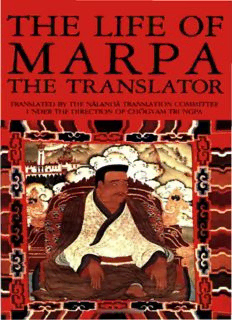
Front cover Marpa the Translator. Detail from a thangka
painted by Karshu Gonpo Dorje, from a series
of lineage thangkas at Rumtek Monastery in
Sikkim, India. Photograph used by the
gracious permission of the late His Holiness
the Sixteenth Gyalwa Karmapa, Rangjung
Rikpe Dorje.
Page 57 Dagmema, the wife of Marpa. Detail from the
above thangka by Karshu Gonpo Dorje.
Page 71 Kalacakra Monogram. The stylized monogram
of the Kalacakra manua, known as the All
Powerful Ten, consisting of the syllables HA
K-~ MALA VA RA YA-~.
Page 86 Hevajra, the principal yidam of Marpa. Detail
from the above thangka by Karshu Gonpo
Dorje.
Page 107 Vajrav4rahl Shnne at Phamthing. This shrine
building houses a large Vajravarahi statue,
which is said to have been located here since
the time of Marpa. Phamthing is presently
known as Parpheng, Nepal. Photograph cour
tesy of Timothy and Elizabeth Olmsted.
Page 157 Marpa the Translator. This is the entire above
mentioned thangka by Karshu Gonpo Dorje.
Marpa's principal yidam, Hevajra in consort
Vll
V111 Illustrations
with Nair:ltmya., is in the upper right. Directly
above Marpa is the Sekhar, built by Milarepa,
and above that is Marpa 's dharma center of
Trowo valley. On Marpa's left is his wife
Dagmema, and below her is his student
Ngokton. To the left, below, are Marpa's stu
dents Meton and Tsunon (bottom). Below, in
the middle, is the protecuess Vetali.
Page 268 Veta{f, an important maha.ka.li (protector of
the dharma) of the Kagyil lineage since the
time of Na.ropa and Marpa. Detail from the
above thangka by Karshu Gonpo Dorje.
ACKNOWLEDGMENTS
The Life ofM arpa the Translator is the first translation to appear
in the Biographies of the Ngeton Lineage Series. Ngeton (T: nges
don; S: nitartha) means "direct, true, or ultimate meaning." In the
Tibetan tradition, it refers specifically to the highest level of teach
ings given by Sakyamuni Buddha during his lifetime, in his vari
ous forms as teacher of hinayana, mahayana, and vajrayana Bud
dhism. Thus the teachers of the ngeton lineage are understood to
be those Tibetan masters who practiced, studied, realized, and
taught these ultimate teachings of the Buddha, thereby causing
the buddhadharma to flourish. The great eleventh-century Ti
betan teacher, Marpa of Lhotrak, was just such a master, and
embodied this ideal in his life in a direct, practical, and un
usually complete way. Moreover, he did so through his efforts to
"translate" (in both literal and figurative senses) the authentic
buddhadharma from India to Tibet. Since this series seeks to
funher just that same end, rendering the buddhadharma from
Tibetan into the Western idiom, it is panicularly appropriate
that The Life of Marpa is the fust biography of the present
senes.
In accordance with the longstanding Buddhist tradition of trans
lation, this work has been produced by a collaborative effon.
Within the Nalanda Translation Committee, a core group of
translators prepares a first draft, which is then carefully reviewed
with Lama Ugyen Shenpen, who is a native of East Tibet and well
studied in the English language and all facets of Tibetan Bud
dhism. Having thus prepared a second working draft, this is pre
sented to the director, Vajracarya the Venerable Chogyam
Trungpa, Rinpoche, and with him we repeat the meticulous read
ing of the entire text. The Vajracarya's accomplishment in both
Tibetan and English coupled with his own realization sparks a
1X
Acknowledgments
X
delightful feast of language and meaning. The text is then re
worked a number of times by the core group and other members
of the committee-revising, editing, and polishing the English.
Research into technical matters continues, and many portions of
the translation are often scrutinized again by the Vajracarya.
Following the early directives of the Buddha, we strive to trans
late into a modern idiom that is both accurate and useful for prac
titioner and scholar alike. Rather than straining often inadequate
and approximate English phraseology for key Buddhist terminol
ogy and concepts, we commonly render these in the ancient
lingua franca of Buddhist culture, classical Sanskrit. While this
demands more from particularly the nonscholarly reader, we
feel that only in this way is the precision, accuracy, and
brilliance of the teachings left uncompromised. Others may
criticize that the Sanskrit does not fully encompass the range of
meanings of the Tibetan term; this is often true. However, we
try to remedy this potential shoncoming by appending a glos
sary of such terms, indicating something of the rich and varied
meanings given to these words by the living Buddhist tradition
of Tibet. Much of the glossary to this volume was originally com
piled for The Rain of Wisdom; this has been adapted to accord
with the terminology found in this biography.
In preparing this translation of The life ofM arpa the Translator:
Seeing Accomplishes All (T: sgra-bsgyur mar-pa lo-tsa'i rnam
thar mthong-ba don-yod) two complete editions were used: a mod
ern handwritten text (Varanasi: E. Kalsang, 1970) and a repro
duction of a late nineteenth-century Tengyeling (T: bstan-rgyas
gling) edition entitled Bktz'-brgyud-pa Hagiographies, compiled
and edited by Khams-sprul Don-brgyud nyi-ma, Vol. 1 (Tashi
jong, India: Sungrab Nyamso Gyunphel Parkhang, Tibetan
Craft Community, 1972). In addition, two partial editions were
consulted: sections of the Kagyii Gurtso (T: bktz'-brgyud mgur
Description:Marpa the Translator, the eleventh-century farmer, scholar, and teacher, is one of the most renowned saints in Tibetan Buddhist history. In the West, Marpa is best known through his teacher, the Indian yogin Nâropa, and through his closest disciple, Milarepa. This lucid and moving translation of a