Table Of Contentannals of communism
Each volume in the series Annals of Communism will publish selected and
previously inaccessible documents from former Soviet state and party archives
in a narrative that develops a particular topic in the history of Soviet and in-
ternational communism. Separate English and Russian editions will be pre-
pared. Russian and Western scholars work together prepare the documents
for volume. Documents are chosen not for their support of any single inter-
pretation but for their particular historical importance or their general value
in deepening understanding and facilitating discussion. The volumes are de-
signed to be useful to students, scholars, and interested general readers.
executive editor of the annals of communism series
Jonathan Brent, Yale University Press
project manager
Vadim A. Staklo
american editorial committee
Ivo Banac, Yale University Jonathan Haslam, Cambridge
Zbigniew Brzezinski, Center for University
Strategic and International Studies Robert L. Jackson, Yale University
William Chase, University of Pitts- Czeslaw Milosz, University of Califor-
burgh nia, Berkeley
Victor Erlich, Yale University Norman Naimark, Stanford University
Friedrich I. Firsov, former head of the Gen. William Odom, Hudson Institute
Comintern research group at and Yale University
RGASPI Daniel Orlovsky, Southern Methodist
Sheila Fitzpatrick, University of Chicago University
Gregory Freeze, Brandeis University Mark Steinberg, University of Illinois,
John L. Gaddis, Yale University Urbana-Champaign
J. Arch Getty, University of California, Strobe Talbott, Brookings Institution
Los Angeles Mark Von Hagen, Columbia University
Piotr Wandycz, Yale University
russian editorial committee
K. M. Anderson, director, Russian V. P. Kozlov, director, Rosarkhiv
State Archive of Social and Political N. S. Lebedeva, Russian Academy of
History (RGASPI) Sciences
N. N. Bolkhovitinov, Russian Acad- S. V. Mironenko, director, State Ar-
emy of Sciences chive of the Russian Federation
A. O. Chubaryan, Russian Academy of (GARF)
Sciences O. V. Naumov, assistant director,
V. P. Danilov, Russian Academy of RGASPI
Sciences E. O. Pivovar, Moscow State University
A. A. Fursenko, secretary, Department V. V. Shelokhaev, president, Associa-
of History, Russian Academy of Sci- tion ROSSPEN
ences (head of the Russian Editorial Ye. A. Tyurina, director, Russian State
Committee) Archive of the Economy (RGAE)
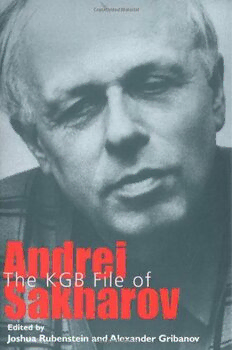
The KGB File of
Andrei Sakharov
Edited and annotated by
Joshua Rubenstein and Alexander Gribanov
With an introduction by Joshua Rubenstein
Documents translated by
Ella Shmulevich, Efrem Yankelevich, and Alla Zeide
Yale University Press
New Haven & London
This volume was prepared with the cooperation and support of
the Andrei Sakharov Archives and Human Rights Center at Bran-
deis University. The archive, now called the Andrei Sakharov
Archive, was transferred to the Houghton Library, Harvard Uni-
versity, in the summer of 2004. The documents and the pho-
tographs from the archive are reproduced by permission.
Introduction copyright © 2005by Joshua Rubenstein.
Copyright © 2005by Yale University.
All rights reserved.
This book may not be reproduced, in whole or in part, including illustrations,
in any form (beyond that copying permitted by Sections 107and 108of the U.S.
Copyright Law and except by reviewers for the public press), without written
permission from the publishers.
Designed by James J. Johnson and set in
Sabon Roman type by The Composing Room of Michigan, Inc.
Printed in the United States of America by Vail-Ballou Press.
Library of Congress Cataloging-in-Publication Data
The KGB file of Andrei Sakharov / edited by Joshua Rubenstein and Alexander Gribanov.
p. cm. — (Annals of Communism)
Includes bibliographical references and index.
ISBN 0-300-10681-5 (alk. paper)
1. Sakharov, Andrei, 1921– 2. Human rights workers—Soviet Union. 3. Dissenters—
Soviet Union. 4. Soviet Union. Komitet gosudarstvennoi bezopasnosti—Archives.
I. Rubenstein, Joshua. II. Gribanov, Alexander, 1945– III. Series.
JC599.S58K43 2005
323(cid:2).092—dc22
2005002061
A catalogue record for this book is available from the British Library.
The paper in this book meets the guidelines for permanence and
durability of the Committee on Production Guidelines for Book Longevity
of the Council on Library Resources.
10 9 8 7 6 5 4 3 2 1
Yale University Press gratefully acknowledges the financial sup-
port given for this publication by the Daphne Seybolt Culpeper
Foundation, the David Woods Kemper Memorial Foundation,
Joseph W. Donner, the Edward H. Andrews Foundation, the
Historical Research Foundation, the John M. Olin Foundation,
the Lynde and Harry Bradley Foundation, Jeremiah Milbank,
Roger Milliken, the Milton V. Brown Foundation, Lloyd H.
Smith, the William H. Donner Foundation, and Keith Young.
If a man speaks out, it does not mean that he hopes necessarily to
achieve something. He may hope for nothing but nonetheless speak
because he cannot remain silent.
andrei sakharov, 1973
Contents
Preface by Alexander Gribanov ix
Acknowledgments xv
Chronology xix
List of Abbreviations xxv
Introduction: Andrei Sakharov, the KGB, and the
Legacy of Soviet Dissent, by Joshua Rubenstein 1
chapter one Emergence of a Public Activist 86
chapter two Who’s Afraid of an Organized Opposition? 100
chapter three Counterattack: Disorganizing the Opposition 167
chapter four Bitter Air of Exile 240
chapter five New Rules of Engagement 315
Annotated List of KGB Documents 351
Glossary of Names 373
Selected Bibliography 385
Index 387
Illustrations follow page 166
Preface
More than four years after the death of Andrei Sakharov in December
1989, the Federal Counterintelligence Service (FCS) of the Russian
Federation gave his widow, Elena Bonner, a collection of sixty-four re-
ports from the Secretariat of the Committee of State Security (the no-
torious KGB, or Soviet secret police) to the Central Committee of the
Communist Party. The FCS had inherited domestic functions from
the KGB and also a considerable part (if not all) of the KGB archives.
The associates of Sergei Stepashin, who was director of the FCS from
March 3, 1994, until June 30, 1995, selected these documents and
handed copies to Elena Bonner at a conference in May 1994marking
the anniversary of Sakharov’s birth.
Bonner later obtained additional documents from the Archive of the
President of the Russian Federation (APRF), which inherited materials
from the Central Committee and its archives. Among the files from the
presidential archive are political reports from the KGB. Copies of
other KGB documents were provided by the Russian State Archive for
Social and Political History (RGASPI), which was at one time the Cen-
tral Party Archive. Several other documents appear through the cour-
tesy of the human rights activist and former prisoner of conscience
Vladimir Bukovsky, who obtained a copy of the files of the 1992Con-
stitutional Court trial of the Communist Party of the USSR. There is
ix