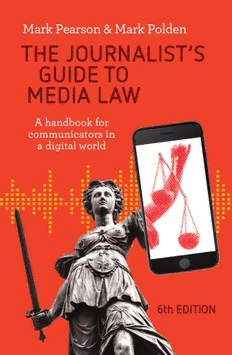
Table Of Content6TH EDITION
We are all journalists and publishers now: at the touch of a button we can send our
Mark Pearson & Mark Polden
words, sounds and images out to the world. No matter whether you’re a traditional GT
journalist, a blogger, a public relations practitioner or a social media editor, everything
UH
you publish or broadcast is subject to the law. But which law?
THE JOURNALIST’S
IE
D
This widely used practical guide to communication law is essential reading for
anyone who writes or broadcasts professionally, whether in journalism or strategic EJ
GUIDE TO
O
communication. It offers a mindful approach to assessing media law risks so
practitioners can navigate legal and ethical barriers to publishing in mainstream TU
and social media. O
MEDIA LAW
R
This sixth edition has been substantially revised to reflect recent developments in
MN
litigation, and the impact of national security laws and the rising gig economy where
graduates might work in the news media, PR, new media start-ups or as freelancers. EA
It covers defamation, contempt, confidentiality, privacy, trespass, intellectual property
DL A handbook for
and ethical regulation, as well as the special challenges of commenting on criminal
I
allegations and trials. Recent cases and examples from social media, journalism and IS communicators in
A
public relations are used to illustrate key points and new developments.
T
a digital world
Whether you work in a news room, in public relations or marketing, or blog from home, L’
S
make sure you have The Journalist’s Guide to Media Law at your side. A
W
&
P
‘Whether you’re an MSM editor or reporter, a blogger, a tweeter
E
P
or a personal brand, this book might save your bacon.’
A
O
— Jonathan Holmes, former ABC Media Watch host
R
L
S
‘The leading textbook from which most journos learned their law.’ D
O
— Margaret Simons, associate professor in journalism, Monash University E
N
N
6th EDITION
Cover design: Squirt Creative
Cover photos: Shutterstock; iStockphoto
MEDIA/LAW
spine: 37.364mm
MARK PEARSON (BA, DipEd, MLitt, LLM, PhD) is Professor of
Journalism and Social Media at Griffith University in Queensland,
where he is a member of the Griffith Centre for Social and Cultural
Research. He is author of Blogging and Tweeting Without Getting Sued
(Allen & Unwin, 2012) and co-editor of Mindful Journalism and News
Ethics in the Digital Era: A Buddhist Approach (with Shelton A. Gunaratne
and Sugath Senarath, Routledge, 2015), and Courts and the Media:
Challenges in the Era of Digital and Social Media (with Patrick Keyzer and
Jane Johnston, Halstead Press, 2012). He has worked as a journalist
with several media organisations, including The Australian. He blogs
from journlaw.com and tweets from @journlaw.
MARK POLDEN is a Sydney barrister. After ten years in the media
law practice group of a national law firm, and then as in-house counsel
for Fairfax Media for the best part of two decades, he now advises
and acts for Australian and international print, broadcast and online
media, film and television production houses and for private clients.
JGML_6e_Prelims.indd 1 7/11/18 11:31 am
JGML_6e_Prelims.indd 2 7/11/18 11:31 am
6th EDITION
Mark Pearson & Mark Polden
THE JOURNALIST’S
GUIDE TO
MEDIA LAW
A handbook for communicators
in a digital world
JGML_6e_Prelims.indd 3 7/11/18 11:31 am
This edition first published in 2019
Copyright © Mark Pearson and Mark Polden 2019
All rights reserved. No part of this book may be reproduced or transmitted in
any form or by any means, electronic or mechanical, including photocopying,
recording or by any information storage and retrieval system, without prior
permission in writing from the publisher. The Australian Copyright Act 1968
(the Act) allows a maximum of one chapter or 10 per cent of this book, whichever
is the greater, to be photocopied by any educational institution for its educational
purposes provided that the educational institution (or body that administers it) has
given a remuneration notice to the Copyright Agency (Australia) under the Act.
Allen & Unwin
83 Alexander Street
Crows Nest NSW 2065
Australia
Phone: (61 2) 8425 0100
Email: [email protected]
Web: www.allenandunwin.com
A catalogue record for this
book is available from the
National Library of Australia
ISBN 978 1 76029 784 8
Internal design by Squirt Creative
Index by Puddingburn
Set in 11/15 pt Legacy Serif ITC Std by Midland Typesetters, Australia
Printed and bound by The SOS Print + Media Group
10 9 8 7 6 5 4 3 2 1
JGML_6e_Prelims.indd 4 7/11/18 11:31 am
To my grandchildren—Oliver, Josie, Beatrice,
Charlie, Annabelle, Maddox, Harriet and Poppy.
May you be safe. May you be well.
May you be content.
Mark Pearson
To my family.
Mark Polden
JGML_6e_Prelims.indd 5 7/11/18 11:31 am
JGML_6e_Prelims.indd 6 7/11/18 11:31 am
CONTENTS
Preface to the sixth edition . . . . . . . . . . . . . . . . . . . . . . . . . . . . . . . . . . . . . . . . . . . ix
Acknowledgements . . . . . . . . . . . . . . . . . . . . . . . . . . . . . . . . . . . . . . . . . . . . . . . . . xiii
Abbreviations . . . . . . . . . . . . . . . . . . . . . . . . . . . . . . . . . . . . . . . . . . . . . . . . . . . . . . xv
PART 1 JOURNALISTS, COMMUNICATORS AND THE LEGAL
SYSTEM . . . . . . . . . . . . . . . . . . . . . . . . . . . . . . . . . . . . . . . . . . . . . 1
1 Media law in the Web 2 .0 era . . . . . . . . . . . . . . . . . . . . . . . . . . . . 3
2 Free expression and mindful practice . . . . . . . . . . . . . . . . . . . . . 28
3 Legal and regulatory systems and principles . . . . . . . . . . . . . . . 64
PART 2 ISSUES IN JUSTICE AND TRANSPARENCY . . . . . . . . . . . . . 97
4 Open justice and freedom of information . . . . . . . . . . . . . . . . . 99
5 Contempt of court . . . . . . . . . . . . . . . . . . . . . . . . . . . . . . . . . . . . . 134
6 Covering court . . . . . . . . . . . . . . . . . . . . . . . . . . . . . . . . . . . . . . . . 181
PART 3 THE MEDIA AND REPUTATIONS . . . . . . . . . . . . . . . . . . . . . . 217
7 Identifying defamation . . . . . . . . . . . . . . . . . . . . . . . . . . . . . . . . . 219
8 Defending defamation . . . . . . . . . . . . . . . . . . . . . . . . . . . . . . . . . 257
PART 4 SECRETS, TERROR AND DISCRIMINATION . . . . . . . . . . . . 309
9 Keeping secrets: Confidentiality and sources . . . . . . . . . . . . . . 311
10 Anti-terrorism and hate laws . . . . . . . . . . . . . . . . . . . . . . . . . . . 353
PART 5 KEY ISSUES FOR THE DIGITAL ERA . . . . . . . . . . . . . . . . . . 399
11 Intellectual property: Protecting your work and using
the work of others . . . . . . . . . . . . . . . . . . . . . . . . . . . . . . . . . . . . 401
12 Privacy . . . . . . . . . . . . . . . . . . . . . . . . . . . . . . . . . . . . . . . . . . . . . . 446
13 The law of public relations, freelancing and new media
entrepreneurship . . . . . . . . . . . . . . . . . . . . . . . . . . . . . . . . . . . . . . 487
Appendix 1: MEAA Journalist Code of Ethics . . . . . . . . . . . . . . . . . . . . . . . . . 527
Appendix 2: Australian Press Council Statement of General Principles . . .529
Appendix 3: Public Relations Institute of Australia (PRIA) Code of
Ethics . . . . . . . . . . . . . . . . . . . . . . . . . . . . . . . . . . . . . . . . . . . . . . . . 531
Index . . . . . . . . . . . . . . . . . . . . . . . . . . . . . . . . . . . . . . . . . . . . . . . . . . . . . . . . . . . . .533
JGML_6e_Prelims.indd 7 7/11/18 11:31 am
JGML_6e_Prelims.indd 8 7/11/18 11:31 am
PREFACE TO THE SIXTH EDITION
One of the most exciting aspects of media law is its dynamic and ever-
evolving nature. It is shaped by the changing nature of communication
careers, rapid developments in technologies and the social dynamics of
politics, economics and culture.
In no period of human history have such changes come about as
quickly as in these first two decades of the twenty-first century. We
have updated this book to reflect the many changes that have occurred
in media law and its interpretation since our last edition in 2015.
Our target audience has broadened with each edition as
technologies such as the internet and social media have combined
to transform journalism and its allied professional communication
careers, including public relations, strategic communication, social
media management, professional blogging and their many hybrids.
While the book is Australian in its orientation, media law is
now international in its application as the internet and its resultant
communication platforms leave Australian communicators and
their employers vulnerable to publishing laws across hundreds of
jurisdictions internationally. The book tries to offer a taste of such risks
faced by those working internationally, while still detailing the most
important restrictions and defences in Australia’s nine jurisdictions at
the national, state and territory levels.
Professional communicators are now working in the so-called ‘gig
economy’. Their contract work might see them working as a freelance
journalist on one assignment, as a media adviser in the next stage of
their career, or perhaps as a new media entrepreneur hosting public
comments on some innovative news platform. At a secondary level,
they are also in a ‘gig economy’ because their outputs can involve many
gigabytes of communication in an instant—presenting dangers for
those ignorant of the laws and regulations that might apply.
This edition retains the basic chapter structure of its predecessor,
but the content within those chapters has been revised to include
ix
JGML_6e_Prelims.indd 9 7/11/18 11:31 am