Table Of Content1
THE CORSAIR and LARA
edited by Peter Cochran
These two poems may make a pair: Byron’s note to that effect, at the start of Lara, leaves the
question to the reader. I have put them together to test the thesis. Quite apart from the
discrepancy between the heroine’s hair-colour (first pointed out by E.H.Coleridge) it seems to
me that the protagonists are different men, and that to see the later poem as a sequel to and
political development of the earlier, is not of much use in understanding either.
Lara is a man of uncontrollable violence, unlike Conrad, whose propensity towards
gentlemanly self-government is one of two qualities (the other being his military
incompetence) which militates against the convincing depiction of his buccaneer’s calling.
Conrad, offered rescue by Gulnare, almost turns it down – and is horrified when Gulnare
murders Seyd with a view to easing his escape. On the other hand, Lara, astride the fallen
Otho (Lara, 723-31) would happily finish him off.
Henry James has a dialogue in which it is
imagined what George Eliot’s Daniel
Deronda would do, once he got to the Holy
Land.1 The conclusion is that he’d drink lots
of tea. I’m working at an alternative ending
to Götterdämmerung, in which Brunnhilde
accompanies Siegfried on his Rheinfahrt,
sees through Gunther and Gutrune at once,
poisons Hagen, and gets bored with
Siegfried, who goes off to be a forest warden
while she settles down in bed with Loge,
because he’s clever and amusing.2 By the
same token, I think that Gulnare would
become irritated with Conrad, whose
passivity and lack of masculinity she’d find
trying. She’d resent, in retrospect, his poor
treatment of Medora, take Medora’s side (as
Teresa Guiccioli would take Annabella’s),
finish him off one night, and sail back to be
Queen of his pirate isle, in answer to an offer
made by his men (see The Corsair, 1677)
with whom she would sleep on a rota basis.
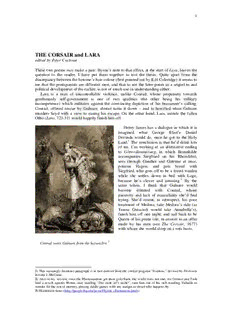
Conrad saves Gulnare from the haram fire.3
1: This seemingly facetious paragraph is in fact derived from the critical program “Ivanhoe,” devised by Professor
Jerome J. McGann.
2: Also in my version, once the Rheinmaidens get their gold back, the world does not end, for Donner and Froh
lead a revolt against Wotan, and, snarling “Das ende ist’s nicht!”, turn him out of the still-standing Valhalla to
wander for the rest of eternity, playing riddle-games with any midget or dwarf who happens by.
3: Illustration from <http://people.bu.edu/jwvail/byron_illustrations.html>
2
She would not, I think, returning with him
to his native Spain, dress as a page to satisfy
his quasi-pederastic whim, dye her naturally
auburn hair raven-black, and follow him
around mutely, conversing – when he felt like
it – in a Levantine language which only they
understood.
If the protagonist’s personality makes
The Corsair hard to deal with, the narrative
of Lara makes re-reading that poem an
annoyance. The eruption of Ezzelin into the
banquet is never explained (we’d like to
know the secret he has about Lara’s earlier
years) – Otho’s self-substitution at the
planned duel is unconvincing – the “serf”-
revolt is dragged in without preparation, to
keep things going – and the presumed
assassination of Ezzelin is tagged on, with a
huge and irrelevant prose-note to paper over
the crack. The questions asked are not
tantalising, just annoying examples of
Byron’s indifference. In a letter of January
1815 to Thomas Moore he wrote,
Kaled4
I have tired the rascals (i.e. the public) with my Harrys and Larrys, Pilgrims and Pirates. Nobody
but S<outhe>y has done any thing worth a slice of bookseller’s pudding; and he has not luck
enough to be found out in doing a good thing. Now, Tom, is thy time ...5
The note of fatigue and literary self-disgust seems genuine – you would not know that The
Corsair had sold 10,000 copies on the first day of its sale. However, despite what Byron says
in the first sentence of his dedication, the two best of the “Turkish Tales” – The Siege of
Corinth and Parisina – were still to come.
4: Illustration from <<http://people.bu.edu/jwvail/byron_illustrations.html>>.
5: BLJ IV 252-3.
3
The Corsair;
A TALE
“– I suoi pensieri in lui dormir non ponno.”
TASSO, Canto decimo, Gerusalemme Liberata.
TO
THOMAS MOORE, ESQ.
MY DEAR MOORE,
I dedicate to you the last production with which I shall trespass on public patience, and your
indulgence, for some years; and I own that I feel anxious to avail myself of this latest and
only opportunity of adorning my pages with a name, consecrated by unshaken public
principle, and the most undoubted and various talents. While Ireland ranks you amongst the
foremost of her patriots – while you stand alone the first of her bards in her estimation, and
Britain repeats and ratifies the decree – permit one, whose only regret, since our first
acquaintance, has been the years he had lost before it commenced, to add the humble, but
sincere suffrage of friendship, to the voice of more than one nation. It will at least prove to
you, that I have neither forgotten the gratification derived from your society, nor abandoned
the prospect of its renewal, whenever your leisure or inclination allows you to atone to your
friends for too long an absence. It is said among those friends, I trust truly, that you are
engaged in the composition of a poem6 whose scene will be laid in the East; none can do
those scenes such justice. The wrongs of your own country, the magnificent and fiery spirit of
her sons, the beauty and feeling of her daughters, may there be found; and Collins, when he
denominated his Oriental, his Irish Eclogues, was not aware how true, at least, was a part of
his parallel. Your imagination will create a warmer sun, and less clouded sky; but wildness,
tenderness, and originality are part of your national claim of oriental descent,7 to which you
have already thus far proved your title more clearly than the most zealous of your country’s
antiquarians. May I add a few words on a subject on which all men are supposed to be fluent,
and none agreeable? – Self. I have written much, and published more than enough to demand
a longer silence than I now meditate; but for some years to come it is my intention to tempt no
further the award of “Gods, men, nor columns.”8 In the present composition I have attempted
not the most difficult, but, perhaps, the best adapted measure to our language, the good old
and now neglected heroic couplet: – the stanza of Spenser9 is perhaps too slow and dignified
for narrative; though, I confess, it is the measure most after my own heart; and Scott alone, of
the present generation, has hitherto completely triumphed over the fatal facility of the of the
octo-syllabic verse; and this is not the least victory of his fertile and mighty genius. In blank
verse, Milton, Thomson, and our dramatists, are the beacons that shine along the deep, but
warn us from the rough and barren rock on which they are kindled. The heroic couplet is not
the most popular measure certainly; but as I do not deviate into the other from a wish to flatter
what is called public opinion, I shall quit it without further apology, and take my chance once
more with that versification, in which I have hitherto published nothing but compositions
whose former circulation is part of my present and will be of my future regret.10
6: Lalla Rookh. Its publication was to motivate B.’s realisation of his distaste for the Romantic movement.
7: Two philologists, Major (later General) Charles Vallancey (1721-1812) and Sir Laurence Parsons (later Earl of
Rosse: 1758-1841) were both Irish patriots. Parsons, M.P. for Dublin University, opposed the Union with England
in 1801. Their researches led them to the conclusion that the Irish had, via their contact with Carthage, a more
distinguished pedigree than the English. Parsons floated the idea that the Carthaginians were descended from the
Irish: Vallancey asserted a resemblance between Irish and Kalmuck, Algonquin, Egyptian, Persian, and
Hindustani. See Don Juan, VIII, stanza 23.
8: Horace, Ars Poetica, 372-3; quoted at HfH 588, or TVOJ 91, 8.
9: B. had written Childe Harold I and II in Spenserian stanzas.
10: B. refers to EBSR.
4
With regard to my story, and stories in general, I should have been glad to have rendered
my personages more perfect and amiable, if possible, inasmuch as I have been sometimes
criticised, and considered no less responsible for their deeds and qualities than if all had been
personal. Be it so – if I have deviated into the gloomy vanity of “drawing from self,” the
pictures are probably like, since they are unfavourable; and if not, those who know me are
undeceived, and those who do not, I have little interest in undeceiving. I have no particular
desire that any but my acquaintance should think the author better than the beings of his
imagining; but I cannot help a little surprise, and perhaps amusement, at some odd critical
exceptions in the present instance, when I see several bards (far more deserving, I allow) in
very reputable plight, and quite exempted from all participation in the faults of those heroes,
who, nevertheless, might be found with little more morality than “The Giaour,” and perhaps –
but no – I must admit Chile Harold to be a very repulsive personage; and as to his identity,
those who like it must give him whatever “alias” they please.
If, however, it were worth while to remove the impression, it might be of some service to
me, that the man who is alike the delight of his readers and his friends – the poet of all circles
– and the idol of his own, permits me here and elsewhere to subscribe myself,
most truly,
and affectionately,
his obedient servant,
BYRON
January 2, 1814.
5
The Corsair
CANTO THE FIRST
“ – – – – – – – – – – – – nessun maggior dolore,
Che ricordarsi del tempo felice
Nelle miseria, – – – – – – – – – – – –” DANTE.11
The time in this poem may seem too short for the occurrences, but the whole of the Ægean
isles are within a few hours sail of the continent, and the reader must be kind enough to take
the wind as I have often found it.12
1.
“O’ER the glad waters of the dark blue sea,
Our thoughts as boundless, and our souls as free,13
Far as the breeze can bear, the billows foam,
Survey our empire, and behold our home!
These are our realms, no limits to their sway – 5
Our flag the sceptre all who meet obey.
Ours the wild life in tumult still to range
From toil to rest, and joy in every change.
Oh, who can tell? not thou, luxurious slave!
Whose soul would sicken o’er the heaving wave; 10
Not thou, vain lord of wantonness and ease!
Whom slumber soothes not – pleasure cannot please –
Oh, who can tell, save he whose heart hath tried,
And danced in triumph o’er the waters wide,
The exulting sense – the pulse’s maddening play, 15
That thrills the wanderer of that trackless way?
That for itself can woo the approaching fight,
And turn what some deem danger to delight;
That seeks what cravens shun with more than zeal,
And where the feebler faint – can only feel – 20
Feel – to the rising bosom’s inmost core,
Its hope awaken and its spirit soar?
No dread of death – if with us die our foes –
Save that it seems even duller than repose;
Come when it will – we snatch the life of life – 25
When lost – what recks it – by disease or strife?
Let him who crawls enamoured of decay,
Cling to his couch, and sicken years away:
Heave his thick breath, and shake his palsied head;
Ours – the fresh turf; and not the feverish bed. 30
While gasp by gasp he faulters forth his soul,
Ours with one pang – one bound – escapes controul.
His corse may boast its urn and narrow cave,
And they who loathed his life may gild his grave –
Ours are the tears, though few, sincerely shed, 35
11: Inferno, V, 122-4; translated by B.: “The greatest of all woes / Is to recall to mind our happy days / In misery
…” (Francesca of Rimini, 25-7). Francesca speaks to Dante in the Circle of the Lustful. It is hard to see the
relevance of her words, in any of the three epigraphs, to the action of The Corsair.
12: In his eastern travels, B. skirted the Aegean twice.
13: B. opens with a hymn to the joy of the pirate’s life, reminiscent of the long speech of Selim at BoA, 633-972.
6
When Ocean shrouds and sepulchres our dead.
For us, even banquets fond regret supply
In the red cup that crowns our memory;
And the brief epitaph in danger’s day,
When those who win at length divide the prey, 40
And cry, Remembrance saddening o’er each brow,
How had the brave who fell exulted now!”
2.
Such were the notes that from the Pirate’s isle
Around the kindling watch-fire rang the while:
Such were the sounds that thrilled the rocks along, 45
And unto ears as rugged seemed a song!
In scattered groupes upon the golden sand,
They game – carouse – converse – or whet the brand;
Select the arms – to each his blade assign,
And careless eye the blood that dims its shine. 50
Repair the boat, replace the helm or oar,
While others straggling muse along the shore:
For the wild bird the busy springes set,
Or spread beneath the sun the dripping net:
Gaze where some distant sail a speck supplies 55
With all the thirsting eve of Enterprize:
Tell o’er the tales of many a night of toil,
And marvel where they next shall seize a spoil;
No matter where – their chief’s allotment this;
Theirs, to believe no prey nor plan amiss. 60
But who that CHIEF? his name on every shore
Is famed and feared – they ask and know no more.
With these he mingles not but to command –
Few are his words, but keen his eye and hand.
Ne’er seasons he with mirth their jovial mess, 65
But they forgive his silence for success.
Ne’er for his lip the purpling cup they fill,
That goblet passes him untasted still –
And for his fare – the rudest of his crew
Would that, in turn, have passed untasted too; 70
Earth’s coarsest bread, the garden’s homeliest roots,
And scarce the summer luxury of fruits,
His short repast in humbleness supply
With all a hermit’s board would scarce deny.
But while he shuns the grosser joys of sense, 75
His mind seems nourished by that abstinence.
“Steer to that shore!” – they sail. “Do this!” – ’tis done –
“Now form and follow me!”14 – the spoil is won.
Thus prompt his accents and his actions still,
And all obey and few enquire his will; 80
To such, brief answer and contemptuous eye
Convey reproof, nor further deign reply.
3.
14: Compare the Centurion at Matthew 8, 9: For I am a man under authority, having soldiers under me: and I say
to this man, Go, and he goeth; and to another, Come, and he cometh; and to my servant, Do this, and he doeth it.
7
“A sail! – sail!” – a promised prize to Hope!
Her nation – flag – how speaks the telescope?
No prize, alas! but yet a welcome sail; 85
The blood-red signal glitters in the gale.
Yes – she is ours – a home-returning bark –
Blow fair, thou breeze! – she anchors ere the dark.
Already doubled is the cape – our bay
Receives that prow which proudly spurns the spray. 90
How gloriously her gallant course she goes!
Her white wings flying – never from her foes –
She walks the waters like a thing of life,
And seems to dare the elements to strife –
Who would not brave the battle – fire – the wreck – 95
To move the monarch of her peopled deck?
4.
Hoarse o’er her side the rustling cable rings;
The sails are furled; and anchoring round she swings;
And gathering loiterers on the land discern
Her boat descending from the latticed stern. 100
’Tis manned – the oars keep concert to the strand,
Till grates her keel upon the shallow sand.
Hail to the welcome shout! – the friendly speech!
When hand grasps hand uniting on the beach;
The smile, the question, and the quick reply, 105
And the heart’s promise of festivity!
5.
The tidings spread, and gathering grows the crowd;
The hum of voices, and the laughter loud,
And woman’s gentler anxious tone is heard –
Friends’, husbands’, lovers’ names in each dear word; 110
“Oh! are they safe? we ask not of success –
But shall we see them? will their accents bless?
From where the battle roars, the billows chafe,
They doubtless boldly did – but who are safe?
Here let them haste to gladden and surprize, 115
And kiss the doubt from these delighted eyes!”
6.
“Where is our chief? for him we bear report –
And doubt that joy – which hails our coming – short,
Yet thus sincere, ’tis cheering, though so brief;
But, Juan! instant guide us to our chief – 120
Our greeting paid, we’ll feast on our return,
And all shall hear what each may wish to learn.”
Ascending slowly by the rock-hewn way,
To where his watch-tower beetles o’er the bay,
By bushy brake, and wild flowers blossoming, 125
And freshness breathing from each silver spring,
8
Whose scattered streams from granite basins burst,
Leap into life, and, sparkling, woo your thirst;
From crag to cliff they mount – Near yonder cave,
What lonely straggler looks along the wave? 130
In pensive posture leaning on the brand,
Not oft a resting-staff to that red hand?
“Tis he – ’tis Conrad – here, as wont, alone;
On – Juan! on – and make our purpose known.
The bark he views – and tell him we would greet 135
His ear with tidings he must quickly meet;
We dare not yet approach – thou know’st his mood
When strange or uninvited steps intrude.”
7.
Him Juan sought, and told of their intent –
He spake not, but a sign expressed assent. 140
These Juan calls – they come – to their salute
He bends him slightly, but his lips are mute.
“These letters, Chief, are from the Greek – the spy,
Who still proclaims our spoil or peril nigh;
Whate’er his tidings, we can well report, 145
Much that –” – “Peace, peace!” – he cuts their prating short.
Wondering they turn, abashed, while each to each
Conjecture whispers in his muttering speech;
They watch his glance with many a stealing look,
To gather how that eye the tidings took; 150
But, this as if he guessed, with head aside,
Perchance from some emotion – doubt, or pride,
He read the scroll – “My tablets, Juan – hark –
Where is Gonsalvo?”15
In the anchored bark.”
“There let him stay – to him this order bear. 155
Back to your duty – for my course prepare:
Myself this enterprize to-night will share.”
“To-night, Lord Conrad!”
“Ay! at set of sun;
The breeze will freshen when the day is done.
My corslet – cloak – one hour and we are gone. 160
Sling on thy bugle – see that free from rust
My carbine-lock springs worthy of my trust.
Be the edge sharpened of my boarding-brand,
And give its guard more room to fit my hand.
This let the Armourer with speed dispose; 165
Last time, it more fatigued my arm than foes;
Mark that the signal-gun be duly fired,
To tell us when the hour of stay’s expired.”
15: It is not clear why Conrad asks for Gonsalvo. See below, 578 n.
9
8.
They make obeisance, and retire in haste,
Too soon to seek again the watery waste; 170
Yet they repine not – so that Conrad guides;
And who dare question aught that he decides?
That man of loneliness and mystery,
Scarce seen to smile, and seldom heard to sigh –
Whose name appals the fiercest of his crew, 175
And tints each swarthy cheek with sallower hue;
Still sways their souls with that commanding art
That dazzles, leads, yet chills the vulgar heart.
What is that spell, that thus his lawless train
Confess and envy – yet oppose in vain? 180
What should it be, that thus their faith can bind?
The power of Thought – the magic of the Mind!
Linked with success, assumed and kept with skill,
That moulds another’s weakness to its will;
Wields with their hands, but, still to these unknown, 185
Makes even their mightiest deeds appear his own.
Such hath it been shall be – beneath the sun
The many still must labour for the one!
’Tis Nature’s doom – but let the wretch who toils
Accuse not – hate not – him who wears the spoils. 190
Oh! if he knew the weight of splendid chains,
How light the balance of his humbler pains!
9.
Unlike the heroes of each ancient race,
Demons in act, but Gods at least in face,
In Conrad’s form seems little to admire, 195
Though his dark eyebrow shades a glance of fire;
Robust but not Herculean – to the sight
No giant frame sets forth his common height;16
Yet, in the whole, who paused to look again,
Saw more than marks the crowd of vulgar men; 200
They gaze and marvel how – and still confess
That thus it is, but why they cannot guess.
Sun-bumt his cheek, his forehead high and pale –
The sable curls in wild profusion veil;
And oft perforce his rising lip reveals 205
The haughtier thought it curbs, but scarce conceals.
Though smooth his voice, and calm his general mien,
Still seems there something he would not have seen;
His features’ deepening lines and varying hue
At times attracted, yet perplexed the view, 210
As if within that murkiness of mind
Worked feelings fearful, and yet undefined;
Such might it be – that none could truly tell –
Too close enquiry his stern glance would quell.
There breathe but few whose aspect might defy 215
The full encounter of his searching eye;
16: Conrad has the figure of Edmund Kean.
10
He had the skill, when Cunning’s gaze would seek
To probe his heart and watch his changing cheek
At once the observer’s purpose to espy,
And on himself roll back his scrutiny, 220
Lest he to Conrad rather should betray
Some secret thought, than drag that chief’s to day.
There was a laughing Devil in his sneer,
That raised emotions both of rage and fear;
And where his frown of hatred darkly fell, 225
Hope withering fled – and Mercy sighed farewell!
10.
Slight are the outward signs of evil thought,
Within – within – ’twas there the spirit wrought!
Love shows all changes – Hate, Ambition, Guile,
Betray no further than the bitter smile; 230
The lip’s least curl, the lightest paleness thrown
Along the governed aspect, speak alone
Of deeper passions; and to judge their mien,
He, who would see, must be himself unseen.
Then – with the hurried tread, the upward eye, 235
The clenched hand, the pause of agony,
That listens, starting, lest the step too near
Approach intrusive on that mood of fear;
Then – with each feature working from the heart,
With feelings, loosed to strengthen – not depart – 240
That rise – convulse – contend – that freeze, or glow
Flush in the cheek, or damp upon the brow;
Then, Stranger! if thou canst, and tremblest not
Behold his soul – the rest that soothes his lot!
Mark – how that lone and blighted bosom sears 245
The scathing thought of execrated years!
Behold – but who hath seen, or e’er shall see,
Man as himself – the secret spirit free?
11.
Yet was not Conrad thus by Nature sent
To lead the guilty – guilt’s worse instrument – 250
His soul was changed, before his deeds had driven
Him forth to war with man and forfeit Heaven.
Warped by the world in Disappointment’s school,
In words too wise – in conduct there a fool –
Too firm to yield, and far too proud to stoop, 255
Doomed by his very virtues for a dupe,
He cursed those virtues as the cause of ill,
And not the traitors who betrayed him still;
Nor deemed that gifts bestowed on better men
Had left him joy, and means to give again. 260
Feared – shunned – belied – ere youth had lost her force,
He hated man too much to feel remorse,
And thought the voice of wrath a sacred call,
To pay the injuries of some on all.
He knew himself a villain – but he deemed 265
Description:Select the arms – to each his blade assign,. And careless eye .. As kindle high
to-night (but blow, thou breeze!) To warm . 19: CPW compares Paradise Lost, V,
321-48 (in fact 49), in which Eve prepares a meal for the Archangel. Raphael.