Table Of ContentChangeThis
Y Save to disk
2
Hide/Show menus
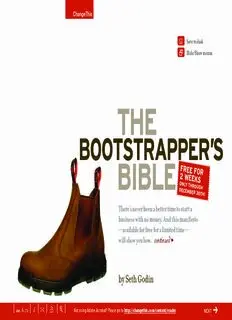
THE
BOOTSTRAPPER’S
BIBLE
FREE FOR
2 WEEKS
ONLY THROUGH
DECEMBER 30TH!
There’s never been a better time to start a
business with no money. And this manifesto
— available for free for a limited time —
will show you how. continued >
by Seth Godin
| | | | | |
iss. 6.01 i U X +
Not using Adobe Acrobat? Please go to http://changethis.com/content/reader
ChangeThis
1
This manifesto is based on The Bootstrapper’s Bible, a book
SECTION
I wrote a few years ago. What I’ve done is divided it into
short sections, so you can find the little kernel of insight
you need, when you need it. (I hope!)
The Joy of Small
What’s a Bootstrapper?
Well, since you bought this manifesto, chances are that you qualify! For me, a bootstrapper
isnʼt a particular demographic or even a certain financial situation. Instead, itʼs a state of mind.
Bootstrappers run billion-dollar companies, nonprofit organizations, and start-ups in their
basements. A bootstrapper is determined to build a business that pays for itself every day. In
many ways, itʼs easiest to define a bootstrapper by what she isnʼt: a money-raising bureaucrat
who specializes in using other peopleʼs money to take big risks in growing a business. Not that
thereʼs anything wrong with that…
You can use the information in this manifesto to make any company more focused, more ef-
ficient, and more grassroots. Throughout this manifesto, though, Iʼll be primarily addressing
the classic bootstrapper: entrepreneurs who are working their butts off to start a great busi-
ness from scratch with no (or almost no) money.
| | | | | |
iss. 6.01 i U X + 2/103
ChangeThis
At last count, there were several million bootstrappers in this country, with another few mil-
lion wannabes, just waiting for the opportunity. My goal is to give you enough insight and
confidence that youʼll get off the bench and make it happen.
The Bootstrapper’s Manifesto
TAPE THIS TO YOUR BATHROOM MIRROR AND
READ IT OUT LOUD EVERY NIGHT BEFORE YOU GO TO BED:
I am a bootstrapper. I have initiative and insight and guts, but not much money. I
will succeed because my efforts and my focus will defeat bigger and better-funded
competitors. I am fearless. I keep my focus on growing the business—not on politics,
career advancement, or other wasteful distractions.
I will leverage my skills to become the key to every department of my company, yet realize
that hiring experts can be the secret to my success. I will be a fervent and intelligent user
of technology, to conserve my two most precious assets: time and money.
My secret weapon is knowing how to cut through bureaucracy. My size makes me faster
and more nimble than any company could ever be.
I am a laser beam. Opportunities will try to cloud my focus, but I will not waver from my
stated goal and plan—until I change it. And I know that plans were made to be changed.
I’m in it for the long haul. Building a business that will last separates me from the
opportunist, and is an investment in my brand and my future. Surviving is succeeding, and
each day that goes by makes it easier still for me to reach my goals.
| | | | | |
iss. 6.01 i U X + 3/103
ChangeThis
I pledge to know more about my field than anyone else. I will read and learn and teach.
My greatest asset is the value I can add to my clients through my efforts.
I realize that treating people well on the way up will make it nicer for me on the way
back down. I will be scrupulously honest and overt in my dealings, and won’t use my
position as a fearless bootstrapper to gain unfair advantage. My reputation will follow
me wherever I go, and I will invest in it daily and protect it fiercely.
I am the underdog. I realize that others are rooting for me to succeed, and I will gratefully
accept their help when offered. I also understand the power of favors, and will offer them
and grant them whenever I can.
I have less to lose than most -- a fact I can turn into a significant competitive advantage.
I am a salesperson. Sooner or later, my income will depend on sales, and those sales
can be made only by me, not by an emissary, not by a rep. I will sell by helping others
get what they want, by identifying needs and filling them.
I am a guerrilla. I will be persistent, consistent, and willing to invest in the marketing of
myself and my business.
I will measure what I do, and won’t lie about it to myself or my spouse. I will set strict
financial goals and honestly evaluate my performance. I’ll set limits on time and money
and won’t exceed either.
Most of all, I’ll remember that the journey is the reward. I will learn and grow and enjoy
every single day.
| | | | | |
iss. 6.01 i U X + 4/103
ChangeThis
TRUE STORY 1:
I AM A LASER BEAM
The big call came just a few months after Michael Joaquin Grey and Matthew Brown had
started up their toy company. Would the two San Francisco bootstrappers like their product
included in the movie marketing blitz for The Lost World? Nope, said Grey and Brown, who
preferred to stick with their vision of gradually building a market for Zoob, their plastic DNA-
like building toy.
What the bootstrappers feared was a loss of identity. If they hooked up with the celluloid
dinosaurs, theyʼd be seen as just another Jurassic spinoff. On their own, they could create a
separate brand and not only avoid extinction but create their own world. Eventually, the two
even hope to have their own Zoob movies.
TRUE STORY 2:
THE BOOTSTRAPPER IS HERE FOR THE LONG HAUL
Jheri Redding started not one, but four companies. And when the renowned bootstrapper
died at 91 in 1998, all four—including the first, Jheri Redding Products, begun in 1956—were
still in operation. Howʼd he do it?
Redding created lasting businesses through the combination of a gift for spotting long-term
opportunity and his relentless drive to create significant competitive advantages in product
features and distribution clout. The Illinois farm boy became a cosmetologist during the
Great Depression because he saw hairdressers prospering and farmers failing. He soon
began experimenting with shampoo formulas and showed remarkable flair for innovation.
| | | | | |
iss. 6.01 i U X + 5/103
ChangeThis
Redding was the first to add vitamins and minerals to shampoos, the first to balance the
acidity of the formulas, and the first to urge hairdressers to supplement their haircutting
income by selling his products on the slow days of Monday, Tuesday, and Wednesday. The
first? Yes, and also the last. There arenʼt many like Jheri Redding, who also founded Redken
(1960), Jhirmack (1976), and Nexxus Products (1979).
Redding was…the first to urge hairdressers
supplement income
to their haircutting
selling his products slow days.
by on the
TRUE STORY 3:
I WILL KNOW MORE ABOUT MY FIELD THAN ANYONE ELSE
When Yves Chouinard starting scaling mountains, rock climbers used soft cast-iron pitons
that had to be discarded after a single use. Chouinard, who was as passionate about climb-
ing peaks as he was about his work as a blacksmith, designed a new piton of aircraft-quality
chrome-molybdenum steel. The tougher, reusable piton met climbersʼ needs much better
and became an instant success.
As piton sales climbed, Chouinard himself kept climbing too, as much or more than ever. He
recalls, “Every time I returned from the mountains, my head was spinning with ideas for im-
proving the carabiners, crampons, ice axes, and other tools of climbing.”
Itʼs been 40 years since the blacksmith-climber hammered out his first steel piton. Since
then, it and his many other designs have become the foundation for Patagonia Inc., a $100
| | | | | |
iss. 6.01 i U X + 6/103
ChangeThis
million outdoor apparel company based in Ventura, California. Although heʼs now a highly
successful businessman, Chouinard still climbs regularly, testing his companyʼs new products
while honing its most important tool: his own matchless knowledge of climbersʼ needs.
TRUE STORY 4:
I AM A SALESPERSON
Shereé Thomas had a personal question in mind when she called the customer service line of
the company that makes Breathe Right nasal strips. But when she found herself talking to the
companyʼs medical director, she went beyond her question and revved up a sales pitch for a
liquid she had invented that neutralizes the smell of cigarette smoke on clothes and hair.
A couple of switchboard clicks later, Thomas was on the line with the companyʼs president.
And three weeks after that, the company had signed a licensing agreement to invest $4
million to manufacture, market, and distribute Banish, the product Thomas mixed up in her
chemist-grandfatherʼs garage. Through the licensing deal, this Cedar Park, Texas, bootstrap-
per will rack up around six figures in annual royalty payments. Her investment in the sale: a
phone call to the companyʼs toll-free line—and a personal commitment never to stop selling.
TRUE STORY 5:
THE JOURNEY IS THE REWARD
Charles Foley was 18 when he told his mother he expected to invent things that would be used
everywhere. At 67, the inventor has 130 patents to his credit, including one for the venerable
party game Twister, which he invented in the 1960s and still sells today.
But Foley, of Charlotte, North Carolina, is still at the inventing game. He recently revived a
| | | | | |
iss. 6.01 i U X + 7/103
ChangeThis
discovery of his from the 1960s, an adhesive-removing liquid, and sold the rights to make
and market it to a company headed by his son. Heʼs also working on new designs for fishing
floats and a home security system.
Driven to search for success? Hardly. Foleyʼs just following his bootstrapping nature on a
journey thatʼs lasted a lifetime. “I was born with a gift,” he shrugs. “Ideas pop into my head.”
WHAT’S A BIG COMPANY GOT
THAT YOU HAVEN’T GOT?
Most of the companies you deal with every day, read about in the media, or learn about in
school are companies with hundreds or thousands of employees. They have an ongoing cash
flow and a proven business model. (Iʼll explain what that is in the next chapter.)
Because this is the way youʼve always seen business done, itʼs easy to imagine that the only
way to run a business is with secretaries and annual reports and lawyers and fancy offices.
Of course, this isnʼt true, but itʼs worth taking a look at the important distinctions between
what they do and what you do.
Just as playing table tennis is very different from playing Wimbledon tennis, bootstrapping
your own business is a world apart from running IBM. You need to understand the differ-
ences, and you need to understand how you can use your size to your advantage.
Traditional companies succeed for a number of reasons, but there are five key leverage
points that many of them capitalize on.
| | | | | |
iss. 6.01 i U X + 8/103
ChangeThis
1 DISTRIBUTION.
How is it that Random House publishes so many best-selling books, or Warner
Music so many hit records? Distribution is at the heart of how most businesses that sell to
consumers succeed. In a nutshell, if you canʼt get it in the store, it wonʼt sell.
Companies with a lot of different products can afford to hire a lot of salespeople. They can
spread their advertising across numerous products and they can offer retailers an efficient
way to fill their stores with goods.
Traditional retailers want the companies that sell them products to take risks. They want
guarantees that the products will sell. They want national advertising to drive consumers into
the store. They insist on co-op money, in which the manufacturer pays them to advertise the
product locally.
Thatʼs why Kelloggʼs cereals are consistently at the top of the market share list. Lots of small-
er companies can make a better cereal, and they can certainly sell it for less. But Kelloggʼs
is willing to pay a bribe (called a “shelving allowance”) to get plenty of space at the super-
market. Kelloggʼs airs commercials during Saturday morning TV shows. And Kelloggʼs has
hundreds of sales reps wandering the aisles of grocery stores around the country.
Kelloggʼs wins the market share battle in mass-market cereals because it succeeds at the last
and most important step: getting the product in front of the consumer.
2 ACCESS TO CAPITAL.
The big guys can borrow money. Lots of it. Itʼs no big deal for a car
company to raise $200 million to pay for a new line of cars. In industries where the expenses
for machinery, tooling, research and development, and marketing are high, big companies
with cheap money often prevail.
Microsoft, for example, took six or more years to turn Windows from a lame excuse of a
product into the market-busting operating system it is now. Year after year after year, it lost
| | | | | |
iss. 6.01 i U X + 9/103
ChangeThis
money marketing lousy versions of Windows. How could it afford to do this? By raising
money from the stock market at very low cost and hanging in.
Big companies have access to capital that a little guy canʼt hope to match. A hot
company like Yahoo! is able to raise money from the stock market with no personal
guarantees, no interest payments, no downside risk. And it can raise a lot. More
established companies can issue bonds or get lines of credit for billions of dollars. The
banks and investors that back these companies arenʼt looking for a monthly or even a
yearly return on their investment. Instead, theyʼre focusing on building profits a de-
cade from now. A bootstrapper could never afford to compete with this approach.
If a market can be bought with cash, a big company will do it.
3 BRAND EQUITY.
Why would you be more likely to try a new line of clothes from Nike
than from Joeʼs Sporting Goods Store? Because Nike has invested billions of dollars in
building a brand name, and youʼve learned to trust that name. Nike can leverage its
name when introducing new products.
Donʼt underestimate the power of the brand! Financial World magazine estimates that
the Marlboro name and logo are worth more than $2 billion. Any tobacco manufacturer
can make a similar cigarette. But only Phillip Morris gets to extract the profit that comes
from having more than 50 percent market share.
If the consumer of the product is likely to buy from an established brand name, the
big company has a huge advantage.
4 CUSTOMER RELATIONSHIPS.
Especially for companies that sell in the business-to-busi-
ness world, access to customers is a tremendous advantage. Time Warner collects nearly
one-third of all the advertising dollars spent on magazines in this country every year.
| | | | | |
iss. 6.01 i U X + 10/103