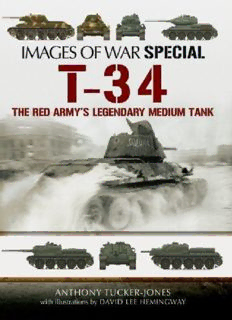
Table Of ContentFirst published in Great Britain in 2015 by
PEN & SWORD MILITARY
an imprint of
Pen & Sword Books Ltd,
47 Church Street,
Barnsley,
South Yorkshire
S70 2AS
Text copyright © Pen & Sword Books 2015
Photographs copyright © as credited 2015
ISBN: 978 178159 095 9
EPUB ISBN: 978 147385 446 8
PRC ISBN: 978 147385 458 1
The right of Anthony Tucker-Jones to be identified as Author of this Work
has been asserted by him in accordance with the Copyright, Designs and
Patents Act 1988.
A CIP record for this book is available from the British Library.
All rights reserved. No part of this book may be reproduced or transmitted
in any form or by any means, electronic or mechanical including
photocopying, recording or by any information storage and retrieval system,
without permission from the Publisher in writing.
Typeset by CHIC GRAPHICS
Printed and bound by Gutenberg Press
Pen & Sword Books Ltd incorporates the imprints of Pen & Sword
Archaeology, Atlas, Aviation, Battleground, Discovery, Family History, History,
Maritime, Military, Naval, Politics, Railways, Select, Social History, Transport,
True Crime, and Claymore Press, Frontline Books, Leo Cooper, Praetorian
Press, Remember When, Seaforth Publishing and Wharncliffe.
For a complete list of Pen & Sword titles please contact
Pen & Sword Books Limited
47 Church Street, Barnsley, South Yorkshire, S70 2AS, England
E-mail: [email protected]
Website: www.pen-and-sword.co.uk
Contents
Introduction: A War Winner
Acknowledgements
Prologue: Grievous Casualties
Chapter One
Birth of a War Winner – T-34/76
Chapter Two
A Winning Upgrade – T-34/85
Chapter Three
T-34 Variants
Chapter Four
Too Few Too Late
Chapter Five
Moscow Miracle
Chapter Six
T-34s in Ukraine
Chapter Seven
T-34s in White Russia
Chapter Eight
T-34s on the Seelow Heights
Chapter Nine
T-34 Tank Aces
Chapter Ten
T-34 Killers
Chapter Eleven
Cold War T-34s
Epilogue: Koshkin versus Kotin
Further Reading
Introduction
A War Winner
W
hen Pen & Sword approached me about producing a pictorial history
of the T-34 tank I immediately faced a dilemma: what is there to say
about this superb Soviet-designed tank that has not already been said many times
before? Then it struck me: the T-34 is the one weapon that truly won the Second
World War. A bold statement I grant you, but when one considers the vastness of
the Eastern Front the campaigns fought in France, Italy and North Africa and,
indeed, in the Far East were just sideshows when it came to armoured warfare.
Throughout the Second World War tank designs came and went, but the T-34
was the one constant from 1940 to 1945. After Hitler’s invasion of Russia the T-
34 became the spearhead of the Red Army’s blitzkrieg that took it from
Stalingrad and Kursk to the very heart of Berlin and victory over the Nazis.
Following the German invasion the Red Army floundered around, its forces in
disarray no matter how many counterattacks it launched. Fortunately, though, its
tank factories had been saved, which meant the T-34 began appearing in ever-
greater numbers. Then, at the end of 1942, the Red Army’s new tank armies,
equipped with the T-34, played a key role in shattering the German, Italian,
Hungarian and Romanian lines at Stalingrad. The following summer the T-34
sent Hitler’s panzers reeling at Kursk.
Designing a tank is a simple compromise between speed, weight, armour and
armament. Get the combination right and it gives you a winning edge; get it
wrong and it ends in disaster. Most early Soviet tanks opted for speed as they
were regarded as little more than armoured cavalry designed to charge through
the enemy’s lines in support of the infantry. The dominance of cavalry officers in
the Red Army after the Russian Civil War was largely responsible for this
mindset. At the same time the Red Army was struggling to learn the most
effective ways to employ their ever-growing numbers of tanks. In the summer of
1941 all of Russia’s light, medium and heavy tank designs proved an
unmitigated disaster in the face of Hitler’s panzers and superior German strategy.
Only after a very shaky start did one new tank catch the eye of the Red Army’s
generals – the T-34/76. It also caught the eye of the German generals.
While the T-34 had a number of innovative design advantages over its
competitors, one in particular stands out. The critical problem faced by the
British Churchill and Cromwell, the American Sherman and the German Panzer
Mk IV and Panther was that they could not be upgunned beyond a 76mm/77mm
calibre gun. The hulls of these tanks would simply not permit a larger turret and
therefore a larger anti-tank gun. This greatly limited their tank-killing
capabilities. The Allies never really overcame this shortcoming until the advent
of the Pershing tank armed with a 90mm gun and by then the war was all but
over. The Germans got round this limitation by producing higher-velocity 75mm
guns and the Tiger I and II armed with an 88mm gun, but the Tigers were only
made in relatively limited numbers.
In contrast, the squat hull of the T-34/76 enabled the Soviets to conduct a
significant enhancement by the simple expedient of fitting a much larger cast
turret that could house a much bigger gun – namely an 85mm high-velocity anti-
aircraft gun redesigned as an anti-tank weapon. The resulting T-34/85 may not
have given the Red Army battlefield dominance, but it certainly gave them
much-needed parity with the later panzers. This, coupled with the T-34’s vast
numbers, was a war-winning combination. The T-34’s design ensured that not
only was it easy to build but, just as importantly, it was easy to maintain on the
battlefield regardless of the weather.
While the Allies and the Germans enjoyed success with a range of tank
destroyers and assault guns, those T-34s converted to the assault gun role proved
far less satisfactory. The British and Americans armed some Shermans with
76mm and 77mm guns, but these were very few in number and did not make up
for the Sherman’s poor armour. Likewise the Sherman-based Achilles/Wolverine
tank destroyer faced the same problem. It was in trying to replicate the German
Sturmgeschütz or assault gun concept that the T-34 came a cropper, its tank-
destroyer variants proving little more than a stopgap until the heavy KV tank
chassis married to a 152mm howitzer produced a really invincible tank killer.
Only the T-34-based SU-100 tank destroyer provided the additional punch that
the T-34/85 lacked.
It was Soviet experiences in Spain that led indirectly to the T-34’s
development, which eventually gave them an important technological edge over
the Germans. In the wake of the Spanish Civil War many experts concluded that
the anti-tank gun was more effective than the tank, and the rudimentary
mechanised combat in Spain refuted the new theories about mechanised warfare.
They failed to take into account the unsuitable terrain, the poorly trained crews
and the relatively small numbers of tanks employed.
General Dimitri Pavlov, a Soviet tank specialist who served in Spain and was
one of the innovators of Soviet mechanisation during the early 1930s, had
observed the increased use and accuracy of anti-tank weapons. Both the BT-5
and T-26 suffered a gradual reduction in armour effectiveness and this led the
Soviet Union to ensure that its tanks not only were resistant to shell splinters and
small arms, but could also withstand direct hits from small-calibre artillery.
Ironically, Pavlov’s experiences in Spain would ultimately cost him his life,
for he drew the wrong conclusions about the deployment of armour. He
advocated the French doctrine whereby tanks were used in direct support of the
infantry. He felt that the doctrine of blitzkrieg by mass armour was not sound.
On returning to Russia in 1939, he argued in favour of disbanding the unwieldy
Soviet tank corps.
Just months before Hitler’s attack, senior Soviet commanders attended a key
conference followed by war games during December 1940 and January 1941.
There was then a gathering in the Kremlin, the last of its sort before the German
invasion. The aim was to assess the progress made by the armed forces
following the war with Finland and Hitler’s blitzkrieg victories in Europe. Some
commanders still advocated the horse over the tank and crucially Stalin, while he
defended the tank, made no executive decision about the future of the Soviet
armoured forces.
General Ia N. Fedorenko warned that there were ‘too few modern tanks and
that a number of tanks which were standard equipment in the Red Army were
already obsolete’. He argued that no time should be lost in increasing production
of the new T-34 and KV tanks and that funding should be redirected to this end.
Marshal Grigory Ivanovic Kulik, who favoured cavalry and artillery, was
dismissive and Stalin stood up and said that the balance was right. Crucially, the
chance to crank up T-34 production was lost. Nonetheless some 55,000 T-34s
were eventually built, representing 68 per cent of Soviet tank production during
the Second World War.
Acknowledgements
O
nce again I am deeply indebted to my good friend Preston Isaac, the
proprietor of the superb Cobbaton Combat Collection, who allowed me
to experience at first hand and photograph in minute detail his fully functioning
Model 1945 T-34/85. This enabled me to sample the privations and complete
lack of creature comforts endured by T-34 tank crews. The driving and fighting
compartments, as in all tanks, are little more than steel prison cells full of sharp-
edged hazards to catch out the unwary – the crews wore padded tanker’s helmets
for good reason. On top of this there is an unrelenting stink of diesel emanating
from the fuel tank and the engine, as well as grease and oil on every surface.
Add this to the inevitable odour of the unwashed crew and it must have been a
heady mixture.
Under way, the T-34 is a very noisy, roaring, clanking monster that belches
smoke and dispenses death and destruction in its path. It is certainly not a
creation to get too starry-eyed about. With the hatches battened down, one can
imagine the sense of sheer terror the crew must have endured every time an
enemy round clanged loudly on the outside of the hull. Relief that they were still
alive must have been followed by frantic activity as they fired back at their
tormentors as quickly as possible.
Photograph Sources*
My thanks to author, journalist and photographer Tina Orr Munro who kindly
assisted with the Cobbaton Combat Collection photo-shoot and provided the
very detailed exterior and interior technical shots. Also thanks to Scott Pick, who
assisted with images from his comprehensive Eastern Front Collection and
likewise Russian military expert Nik Cornish, who runs the first-class Stavka
picture library. The latter tracked down photographs of some of the more unusual
Description:It could be said that the T-34 was the tank that won the Second World War. In total 57,000 were produced between 1941 and 1945. Stalin’s tank factories outstripped Hitler’s by a factor of three to one, and production of the T-34 also exceeded that of the famed American M4 Sherman. Not only did t