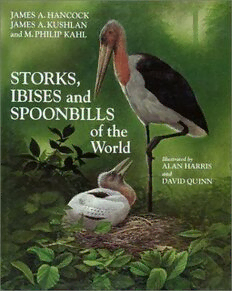
Table Of ContentSTORKS, IBISES
and SPOONBILLS
of the World
This page intentionally left blank
STORKS, IBISES
and SPOONBILLS
of the World
JAMES A. HANCOCK
JAMES A. KUSHLAN
and M. PHILIP KAHL
Illustrated by
ALAN HARRIS and DAVID QUINN
Published with the support of the Brehm Foundation
ACADEMIC PRESS
Harcourt Brace Jovanovich, Publishers
London * San Diego * New York * Boston * Sydney * Tokyo * Toronto
First published 1992 by Academic Press.
Digital editions published 2011 by Christopher Helm Publishers, an imprint of A&C Black Publishers Ltd, 36 Soho Square, London
W1D3QY
Copyright © 2001 text Academic Press Limited
Copyright © 2001 illustrations Alan Harris and David Quinn
ISBN (epub) 978-1-4081-3500-6
ISBN (e-pdf) 978-1-4081-3499-3
All rights reserved. No part of this publication may be reproduced or used in any form or by any means - photographic, electronic
or mechanical, including photocopying, recording, taping or information storage or retrieval systems — without permission of the
publishers.
Visit www.acblack.com/naturalhistory to find out more about our authors and their books. You will find extracts,
author interviews and our blog, and you can sign up for newsletters to be the first to hear about our
latest releases and special offers.
Contents
INTRODUCTION 1
CLASSIFICATION 5
CONSERVATION 15
COURTSHIP AND REPRODUCTION 20
FEEDING BEHAVIOUR AND ECOLOGY 29
SPECIES DESCRIPTIONS
American Wood Stork (Mycteria americana) 35
Milky Stork (Mycteria cinered) 43
Yellowbilled Stork (Mycteria ibis] 49
Painted Stork (Mycteria leucocephala] 53
Asian Openbill Stork (Anastomus oscitans) 59
African Openbill Stork (Anastomus lamelligerus) 63
Black Stork (Ciconia nigra) 69
Abdim's Stork (Ciconia abdimii) 75
Woollynecked Stork (Ciconia episcopus) 81
Storm's Stork (Ciconia stormi) 87
Maguari Stork (Ciconia maguari) 91
White Stork (Ciconia ciconia) 97
Oriental White Stork (Ciconia boyciana) 103
Blacknecked Stork (Ephippiorhynchus asiaticus) 109
Saddlebill Stork (Ephippiorhynchus senegalensis) 115
Jabiru Stork (Jabiru mycteria) 119
Lesser Adjutant Stork (Leptoptilos javanicus) 125
Greater Adjutant Stork (Leptoptilos dubius) 129
Marabou Stork (Leptoptilos crumenifems) 133
Shoebill (Balaeniceps rex) 139
American White Ibis (Eudocimus ruber) 147
Barefaced Ibis (Phimosus infuscatus) 157
Glossy Ibis (Plegadis falcinellus) 163
Whitefaced Ibis (Plegadis chihi) 169
Puna Ibis (Plegadis ridgwayi) 173
Sharptailed Ibis (Cercibis oxycerca) 111
Plumbeous Ibis (Harpiprion caerulescens) 179
Contents
Buffnecked Ibis (Theristicus caudatus) 183
Green Ibis (Mesembrinibis cayennensis) 189
Hadada Ibis (Bostrychia hagedasti) 193
Wattled Ibis (Bostrychia carunculatd) 197
Olive Ibis (Bostrychia olivacea) 199
Spotbreasted Ibis (Bostrychia rard) 203
Madagascar Crested Ibis (Lophotibis cristatd) 207
Sacred Ibis (Threskiornis aethiopicus] 211
Oriental White Ibis (Threskiornis melanocephalus} 217
Australian White Ibis (Threskiornis moluccd) 221
Strawnecked Ibis (Threskiornis spinicollis] 227
Waldrapp Ibis (Geronticus eremitd) 231
Bald Ibis (Geronticus calvus) 237
Black Ibis (Pseudibis papillosa) 241
Giant Ibis (Thaumatibis giganted) 245
Oriental Crested Ibis (Nipponia nippon) 249
Eurasian Spoonbill (Platalea leucorodid) 253
Royal Spoonbill (Platalea regia) 259
Blackfaced Spoonbill (Platalea minor) 263
African Spoonbill (Platalea alba) 267
Yellowbilled Spoonbill (Plataleaflavipes] 271
Roseate Spoonbill (Platalea ajajd) 275
APPENDIX 283
BIBLIOGRAPHY 329
INDEX 383
Introduction
TI here is no one word or concept that can describe fairly the diverse group of birds
numbered among the storks, the ibises and the spoonbills. Compared to the majority of
birds, they are among the larger and all have relatively long legs, necks and bills as
adaptations to their fundamental way of life—walking about in shallow water. However,
storks, ibises and spoonbills range in appearance from the elegant to the ungainly, in size
from the moderate to the huge, and in behaviour from the flamboyant to the secretive. Their large bills
may be massive or thin, straight or curved, tubular or flattened. Some species are found in large
spectacular assemblies and others in crepuscular isolation. Some of the species were once widespread
and common, but are now at or near to extinction. Others have always been rare, with limited ranges
and highly specialized ecological niches about which little is known. Each has its own mysteries yet to
be revealed, and each has its own claim on our fascination.
We have approached the task of preparing this book with some trepidation, not only because of its
magnitude but also because of the growing certainty that, unlike most heron species, an unacceptable
number of storks, ibises and spoonbills are facing extinction. Realization amongst the general public
that much of our avian population is becoming dangerously depleted in many, if not all, parts of the
world, has been slow to crystallize. Even amongst ornithologists, the true, and in many cases, horrifying
situation of these species is only now becoming apparent as information pours in from remote portions
of the globe. Information on rare storks, ibises and spoonbills is arriving at a rapid rate, and much of it
is not encouraging.
We have attempted to include as much of this up-to-date information on the changing status of the
species as possible. But again and again in preparing this book, we find ourselves emphasizing how
these birds are in competition with humans for space and resources. With the world's human
population expanding, the space left for large waterbirds has shrunk so rapidly in so few years that we
have barely yet come to grips with the devastation that has been wrought. Two particular scenarios
tend to repeat themselves among the species accounts. One is that of shy elusive species living as far
away from humans as they can in areas where they have had, until recent years, little contact with
people, but where they now find little habitat left. The other is of species which have lived in close
proximity to humans and have very often become dependent upon them for their very survival. An
example of the first scenario is Storm's Stork, about which we have learnt very little but which, because
of deforestation, might well have disappeared before we had fully realized that it existed at all. The
second group is epitomized by the Waldrapp Ibis which has been the recipient of every type of
persecution which humans are capable of inflicting.
Today we have reached a vital stage in the relationship between humans and large wading birds. The
task of conserving our environment and the birds within it can only be tackled if sufficient is known about
the needs of individual species within the increasingly hostile globe upon which we live. We hope that we
have managed to present as clear a picture as is possible of the precarious position of the various species of
storks, ibises and spoonbills around the world and, where possible, we have suggested appropriate action
to help their cause. A singular message from our review is: what is so desperately needed is protection and
management of the wetland habitats that are essential to most of the species we discuss.
We have endeavoured in this book to share with the reader our own fascination and concern for these
birds. We are fortunate to have been able to draw upon our own experience and that of our editors and
publisher to present what we hope is a readable and authentic account of most of what is known about
these species. We have been most fortunate, too, in obtaining the services of two highly talented and
dedicated artists, Alan Harris and David Quinn, who have provided portraits of each of the species
described. We hope this original artwork will contribute to both the enjoyment and usefulness of this
monograph.
2 Introduction
Figure 1. A Maguari Stork in full breeding plumage with Figure 2. A Glossy Ibis near its nest (southeastern Aus-
two nestlings approximately 2-3 weeks old (northeastern tralia).
Argentina).
In today's financial climate, meeting the expenses of having spent over 30 years studying the storks and more
production and publication of a book of this nature, contain- recently spoonbills and providing a fundamental perspective
ing original plates, is thwart with difficulties. Vital to the on their behaviour, ecology and taxonomy, the other, over 20
project was the support of the Brehm Fond and Mr Wolf W. years studying populations and communities of storks, ibises
Brehm. We also are quick to acknowledge the seminal and spoonbills on two continents, providing a comparative
contribution to the project made by Mr Charles Luthin, perspective on their ecology, habitat and conservation.
working on behalf of the Brehm Fond, Vogelpark Walsrode, To supplement our own observations we have consulted an
and the Specialist Group on Storks, Ibises, and Spoonbills. A abundant although very uneven literature in an attempt to
volume such as this would have been impossible to publish at synthesize what ornithologists before us have found about the
other than an astronomical price without this generous biology and conservation needs of these species. Much of this
support. literature is excellent; and, for present and future students,
We are fortunate to have been able to draw much of we hope the extensive, yet selected, bibliography in this book
our information and our insight from our own experience. will be an entrance into this literature. The bibliography is a
The authors have been privileged to travel extensively, collaborative effort, assembled by a team led by Dr Malcolm
observing these birds on each of the continents they inhabit. Coulter (see below). One caveat: we would urge caution and
Between us, we have seen in the wild all but 8 of the 49 selectivity in the use of this literature, some of which goes
species we discuss. Two of us have spent many years study- back many years. We have attempted to be selective and to
ing one of the sister groups of these birds, the herons present the conflicting views, but undoubtedly will have
(Ardeidae), having previously summarized our knowledge in erred in our judgement in those cases where facts we
a companion volume, The Herons Handbook (1984). Two of us gleaned from the literature are really quite debatable.
have spent many years studying the storks, spoonbills and We have also sought advice from a wide-ranging and
ibises themselves, the results of which have been published in knowledgeable host of experts. The response to our requests
numerous papers addressed to our scientific colleagues; one has been enormous, and we are deeply indebted to a very
Introduction 3
large number of collaborators both amateur and pro-
fessional who have been so supportive, encouraging and
generous in sharing their insight and understandings.
Some of our trepidation is also due to our certain knowl-
edge that no matter how thorough our own efforts, the
literature, or our correspondence, a book such as this will be
incomplete and in some areas will be proved incorrect. Our
limitations can, and undoubtedly will, be quickly recog-
nized. The available knowledge of the biology of these birds
is highly erratic. Some species are very well known, whilst
others have hardly been studied at all. Our species accounts
reflect this discrepancy. Over and over again we bring to the
readers' attention significant gaps in our knowledge about
the most basic aspects of biology. It is the nature of such a
work to summarize, synthesize, pose hypotheses, and en-
courage further study and testing of these hypotheses. We
hope this book will inspire others to fill in the important
gaps in the knowledge and to test some of the hypotheses we
propose, so that the business of conservation can continue
more effectively. If the book accomplishes an increased
interest and study, we will be satisfied to have accomplished
our primary goaL
Range maps are always troublesome. We are conscious of
their summary value but have found, like many authors
before us, that illustrating the ill-known and changing dis- Figure 3. A Eurasian Spoonbill head-scratching (north-
tribution of many species is well nigh impossible. We have, ern India).
therefore, sought to show general ranges of each species,
reserving for the text a more detailed description. Even here
presented will have brought together the sort of information
we have been handicapped by lack of precise information on
which will provide encouragement and a structure for future
the range of a surprisingly large number of species, about
which little is recorded, and not least by the often unreliable researchers and observers.
recordings by collectors of the past whose poorly labelled It is our hope, too, that the emphasis we have placed on
the dire need for conservation of many of these species, and the
specimens lack credibility.
Information on basic nesting behaviour is missing for wetland habitats on which they depend, will encourage res-
ponsible authorities to act on their behalf before it is too late.
some species; and, for many, information on colour changes
during courtship are lacking or conflicting. Soft-part colours
ACKNOWLEDGEMENTS
of museum specimens are especially unreliable guides. In
the field, information on courtship colours are seldom We are extremely grateful to all those who have, lent their
recorded in all phases of their development. Such knowledge assistance in the production of this book. As noted in the
as we have presented should be subjected to most careful Introduction, we especially acknowledge the support of Mr
further study by field-workers who are fortunate enough to Wolf W. Brehm, who has made it possible for original plates
come across them. Yet for species that change the colour of to be produced. We thank, too, our long-time colleague Mr
their skin during courtship, this information is vital. Charles Luthin, who nurtured the project, and because of
Voices and other noises are of importance to most of these whose efforts much of the information now available on the
species. Yet our understanding of their vocalizations is status of these species has been gathered by field-workers
primitive compared to that of other birds. However, in some throughout the world. We thank too the excellent artists,
cases the only reliable identification of a species that can be Messrs Alan Harris and David Quinn, for their outstanding
made is by voice. These are large birds, with mostly gruff contribution to the quality and usefulness of the book.
and non-melodic voices. We have rendered their calls in In actual production, we thank Dr Andrew Richford, our
English inventing such words as 'Cha-cha', or 'Hunk-hunk*. editor, Penny Robinson and Debra Kruse at Academic
These are recognizable by those who know them, but not Press for their considerable help. We also thank especially
necessarily by those who do not (in some cases, one simply Mrs Jane Ratliff and Mrs Bonnie Knight for their typing
had to be there). assistance and Mr Melvin Seid for bibliographic assistance.
With three authors combining their respective strengths We thank our colleagues who worked on the bibli-
and weaknesses, it is unfortunate that there has to be an ography. This was a collaboration lead by Dr Malcolm
order of authorship. Such an order does not imply the Coulter to assemble a bibliography for this group of species.
relative contribution of each. This was a true collaboration The present reference section is derived from the first edi-
of experiences and ideas. As an Anglo-American team, we tion of this bibliography, which is available on computer
express the hope that the individual and joint efforts here disk from Dr Coulter; the compilers of that bibliography are