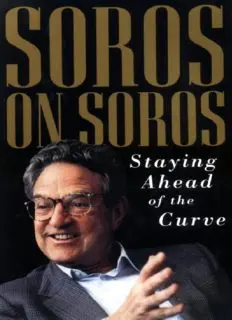
Table Of ContentStaying Ahead of the Curve
George Soros
with
Byron Wien and Krisztina Koenen
To all the people, in and out of my foundation network, who are working to
create an open society.
PREFACE
This book has its origin in an extended interview conducted by Krisztina
Koenen, a journalist working for the Frankfurter Allgemeine Zeitung and
published in German. Originally John Wiley & Sons wanted to publish an
English translation but I decided to embark on an entirely new version. I found
the interview format congenial and the project grew into a major undertaking.
The outcome is a summing up of my life's work: The first part deals with
my personal background and my career as a fund manager, in interviews
conducted by Byron Wien, an old friend who is the investment strategist for
Morgan Stanley. The second part deals with my political views and my career
as a philanthropist in interviews with Krisztina Koenen; and the concluding
part with the philosophy which guided me both in making and spending
money, again with Byron Wien. I reworked the material until it became like a
Socratic dialogue. I tried to explain who I am and what I stand for.
The philosophy is not about money, it is about the human condition. I have
used financial markets as a laboratory for testing my theories. I also got an
opportunity to put my ideas to the test in connection with the collapse of the
Soviet empire. I believe I have something important to say. It is also important
that I should be able to communicate it because my belief in what I call "open
society" does not make sense unless it is widely shared. As I finish the book, I
feel I have succeeded.
My editor, Myles Thompson, wanted to steer me towards an audience
interested in financial markets and I did not resist him unduly because I am
very interested in financial markets myself-especially at the present juncture
when dynamic disequilibria abound. But I am aiming at a wider audience. I
very much hope that those not interested in the financial markets will also find
the book worth reading.
I have shown the manuscript to the following people: Ken Anderson, Stan
Druckenmiller, Dan Eule, Arminio Fraga, Sue Frunzi, Gary Gladstein, Karen
Greenberg, Bohdan Hawrylyshyn, Julia Jurys, Ari Korpi-vaara, Annette
Laborey, Aryeh Neier, Bill Newton Smith, Istvan Rev, Nick Roditi, Susan
Weber Soros, Paul Soros, Jonathan Soros, Miklos Vasarhelyi, Bill Zabel, John
Zwaanstra.
I want to thank them for their comments but I take sole responsibility for the
contents of the book. I would like to thank Emily Loose for her editorial
assistance, as well as Frances Abouzeid, Sheila Otner, and Shawn Pattison for
their help.
GEORGE SOROS
July 1995
CONTENTS
PART ONE
Investing and Global Finance with Byron Wien
Chapter 1 The Investor 3
Life at the top with Warren Buffett • Strengths of Quantum Fund • Derivatives •
Leveraged to the hilt • Measuring risk • The first hedge fund • Intuition as an
investment tool • Soros as the insecurity analyst • The making of a money
manager • Going against the herd • Characteristics of good investors: character
and intelligence The messianic complex • Risk taking as the essential ingredient
• Formulating a thesis for investing • Different ways to skin a cat • Finding the
right management team for Quantum Fund Maintaining performance and
monitoring the thesis Damage control-correcting a loss • Disengaging from
active money management • Who really runs Quantum Fund? Netting $1 billion
on sterling • Losing big on yen Attracting the best talent
Chapter 2 The Guru in Training 25
Parents as personal influences • Tension as a driving force in life • Family
history Nazi persecution-the communist regime in Hungary • Assuming a false
identity to stay alive The journey to England • Other influences: his brother, Karl
Popper, Andrei Sakharov, Vaclav Havel, Bronislaw Geremek, Grigory
Yavlinsky • Soros as salesman • Working in the "box" • Getting to Wall Street •
International arbitrage The first big career breakthrough-trading European
securities • The Interest equalization tax-an end to trading European securities •
Impact of his philosophical ideas on investing and politics • The beginning of
Quantum Fund
Chapter 3 The Story of Quantum Fund 47
The early years of Quantum Fund-starting out with $12 million • Working with
Jim Rogers • Early investments • Breaking up the partnership • Dealing with a
life crisis Coming to terms with success Loosening the constraints Growing the
fund from $100 million to $400 million Taking the first big loss • Searching for
a management team • Dropping the guilt and hangups • The Real Time
Experiment explained-conducting a study to influence the results • The Alchemy
of Finance • The Plaza Accord Taking a hit on Black Monday • Building an
effective management team • Stanley Druckenmiller • The second worst year in
history • Quantum Fund today
Chapter 4 The Theory of Investing 65
A framework for investing-reflexivity • Far-from- equilbrium conditions •
Reflexivity defined • Boom/bust sequences • The boom/bust pattern explained •
The pattern applied to the Soviet Union and the U.S. banking system
Chapter 5 Theory in Action 79
Boom/bust applied to today's financial markets • The Sterling crisis as a pointed
example • How it happened • Breakdown of the Exchange Rate Mechanism
(ERM) • Thoughts on currency speculation • Another period of currency
volatility • Playing the Japanese market • Ministry of Finance (MOF)-the
kingpin of the power struggle • The U.S. market: good and getting better •
Thoughts on the Mexican currency crisis-Explaining the peso crash Argentina
and Brazil • Risk and reward in China • Today's weak dollar • Excessive
volatility with no constituency to deal with it Regulating derivatives
PART Two
Geopolitics, Philanthropy, and Global Change with Krisztina Koenen 109
Chapter 6 The Philanthropist 111
Giving away millions in Europe • The motivation behind the philanthropy • The
Open Society Fund Philanthropy with a policy purpose • A commitment to
South Africa • Supporting Eastern European dissidents Foundation reach into
Hungary • Balancing Foundation efforts and Quantum Fund activity •
Foundations in 25 countries • Notable successes and huge failures Adapting to
the changing political climate • The danger of becoming too strong • The Soros
Foundation of today Central European University • Conflicts of interest in
Eastern Europe • Redefining Foundation purpose
Chapter 7 The Stateless Statesman 151
The economic future of Eastern Europe • Optimism for Central Europe • The
Soviet demise • The future of Russia • Ukraine and Macedonia Poland as a
model for economic growth and social reform Observing the process of change •
The fate of Romania • Redesigning Western assistance programs • Changing the
course of history in Eastern Europe-marginally
Chapter 8 The Future of the United States and Open Society 177
Switching focus • Adjusting to the new world order • A disappointing response
to the crisis in Bosnia • An amended version of freedom • Open society versus
laissez faire • The coming disintegration of Europe • An identity crisis for the
U.S. • The failure of the United Nations and NATO • The role of the U.N. in
today's conflicts • A looming crisis • The collapse of international financial
markets • The meaning of money • Exploring the drug debate • Project on death
Having too much power
PART THREE
Philosophy with Byron Wien 207
Chapter 9 The Failed Philosopher 209
A belief in your own fallibility • Flawed mental constructs • Reflexivity •
Participants cannot act on the basis of knowledge • A new theory of truth •
Heisenberg's Uncertainty Principle • Uncertainty in human affairs Social science
as a false metaphor Near-equilibrium and far-from-equilibrium conditions • The
boundary lines Open and closed societies • No grand pattern of history Regime
change • Deficiency of values in open societies Fallibility as a basis for values
Chapter 10 The Power and the Myth 237
Finding a forum • Gaining access to the policy makers • George Soros as a Jew •
The power to move markets • Panned in the press • The adventure of ideas • An
actor on the stage of history Dealing with the complexity of world problems • A
last chance for self-revelation
Appendix Selected Writings by George Soros 251
Open and Closed Societies • Prospect for European Disintegration • Hedge
Funds and Dynamic Hedging
Index 323