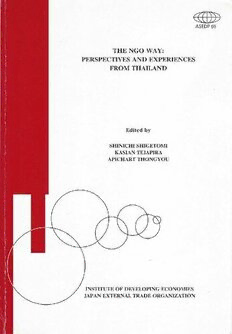
Table Of ContentTHE NGO WAY
_
PERSPECTIVES AND EXP 1ENCES
FROM THAHLAND
Qdited by
SHINICHI SHIGETOMI
KASIAN TEJAPIRA
|
APICHART THONGYOU
INSTITUTE OF DEVELOPING ECONOMIES
JAPAN EXTERNAL TRADE ORGANIZATION
CHIBA, ]APAN
institute of Developing Economies,
]apart External Trade Organization
3-2-2, Wakaba, Mlllama-ku, Chiba-shl,
Chiba 261-8545, Japan
A11 rights reserved. Published 2004
Printed in Bangkok, Thailand
I5BN4-258-55069-8 C3033
CONTENTS
Preface i
List of Contributors iv
Map of Thailand V
l. Introduction 1
Shinichi Shigetomi
2. The Emergence of NGO Movement in Thailand 21
and the Sarit Regime
Kalian Tejapira
3. Spaces and Performance of NGOs in Thailand: 39
Their Transformation in the Development Process
Shinichi Shigetomi
4. Funding for NGOs in Thailand: 61
The Politics of Money in the Nonprofit Sector
Garvin Chuzfima
5. The Thai Monarchy and Non-governmental Oganisations 99
Charita Chitbundid, Chaithawat Thufathon,
and Thanapol Eawsakul
6. Thai NGOs and Rural Development: 147
Formation, Growth, and Branching Out
Alic/wrt Thongyou
7. The Roles of NGOs in the Context of Urban Areas 183
Ma neerat Mitprasat
8. The Government - NGO Coordination of Environmental 211
Protection in Thailand
Weerawot Pooh
pissaro
9. NGOs on Children's and Women's Issues: With Special 249
Emphasis on the Fight Against Child Exploitation (FACE)
Sudarat Sereewat
10. The Thai NGO Movement on Health 271
Barztorn Orzdatn
11. NGOs as Political Actors in Thailand: Their Development and 289
Strategies in the Democratization and Human Rights Movements
Shirzichi Shigetomi
PREFACE
In 2000, one of the editors of this report (Shinichi Shigetomi) was collecting
data on the development of the NGO sector in Thailand, in order to contrib-
ute to a comparative study of State-NGO relationships in Asian countries.
Despite the fact that NGOs were widely accepted as important players in
Thai economic, social, and political development, their activities were not
well-documented. For example, in the field of rural development, which
attracted many voluntary workers until the mid~l980s, we do not have any
comprehensive reports about the development of NGOs.
Shigetoini, therefore, interviewed NGO activists and ex-activists, which
was indispensable with regard to filling in the gaps in information. The
interviewees talked about their exciting experiences in the 1970s and 1980s,
accounts of which had rarely appeared in the historiography of Thai
economic and political development. It would have been regrettable if their
memories had disappeared without any written record.
In 2001, Shigetomi was assigned by the Institute of Developing
Economies (IDE) to implement a joint research project with Thai scholars
in Thailand during the 2003 fiscal year (April 2003 - March 2004).
Shigetomi proposed the above NGO study. Although the actual period of
project implementation will be short (nine months from August 2003, since
Shigetomi is scheduled to stay in the United States until July), it seems
long enough to record the experiences of NGO workers.
Shigetoini contacted Apichart Thongyou, one of the pioneer NGO work-
ers in the rural development sector. Apichart had been one of Shigetolni's
interviewees in 2000 and the person whose exciting experiences stimulated
Shigetomi to come up with the above research idea. Apichart accepted the
proposal and persuaded some NGO workers and scholars to participate in
the study project.
Meanwhile, Shigetoini invited Kasian Tejapira, a political scientist at
Thammasat University, to join the project as well. Keiser is not a special~
ist in NGO issues. However, Shigetomi expected that he would contribute
by analyzing the political backgrounds of the NGO movements, since he
had been studying the leftist movements in Thailand. Kasian proposed
adding some chapters that discuss interesting topics related to NGOs, such
i
as NGO funding, the discourses of NGOs, and the relationship between the
monarchy and NGOs.
In this way, a rough draft of the study emerged as a mixture of chapters
describing the experiences of NGOs by sector and chapters analyzing
NGO~related topics. The members of the study team were a mixture of
NGO staff and scholars.
We have had six meetings over a period of nine months. The discus-
sion has been unexpectedly exciting. Each member presented what he
or she has been doing and is going to write in the final paper. Every
presentation was welcomed with many questions and comments. Kasian
actively moderated and stimulated the discussion. Some members carried
out field surveys in the provinces, even though they were quite busy with
their regular activities. In spite of the limited time available for the project
implementation, the participants worked with high motivation.
This research was possible because the National Research Council of
Thailand and the Faculty of Political Science at Thammasat'University
allowed Shigetomi to conduct his research in Thailand. The project has re-
ceived assistance from many individuals and organizations. This space is
too limited to mention all their names, but we would like to express
special thanks to Dr Chaiwat Satha-Anand (Thammasat University),
Dr Maniemai Thongyou (Khon Kaen University), Dr Anek Laothamatas
(Member of Parliament), NGO Coordinating Committee on Development,
and all the OD workers of the Northeast Rural Development Association
(NERDA). Mr Somphot Son boon and Ms Korakoch Sirichoke translated
some parts of this volume.
The JETRO Bangkok office provided the meeting place and other
facilities for this project. Jirapa Khunlub, a graduate of Thammasat
University, was helpful in assisting with research and editing. Lastly, we
appreciate the efficient editing and printing by Co-Local Co.,Ltd.
March, 2004
The Editors
11
LIST OF CONTRIBUTORS
Apichart Thongyou
Secretary General, Sawasdee Foundation, Thailand
Bar torn On dam
Chairman, Human Settlement Foundation, Thailand
Chaithawat Thulathon
Researcher, Fa Dian Kan Publishing, Thailand
Chanida Chitbundid
Graduate student, Faculty of Sociology and Anthropology
Thammasat University, Thailand
Garvin Chutima
Resource Mobilization Director, Thai Fund Foundation, Thailand
Kasian Tejapira
Associate Professor, Faculty of Political Science, Thammasat
University, Thailand
Maneerat Mitprasat
College of Politics and Governance, Mafias arakham University,
Thailand
Shinichi Shigetomi
Oversea Research Associate, Institute of Developing Economies,
JETRO, Japan
Visiting Scholar, Faculty of Political Science, Thammasat
University, Thailand
Sudarat Sereewat
Director, Fight Against Child Exploitation (FACE), Thailand
Thanapol Eawsakul
Researcher, Fa Dian Kan Publishing, Thailand
Weerawat Paphussaro
Director, NGO and Private Sector Collaboration, Department of
Environmental Quality Promotion, Ministry of Natural Resource
and Environment, Thailand
iv