Table Of ContentBEFORE THE
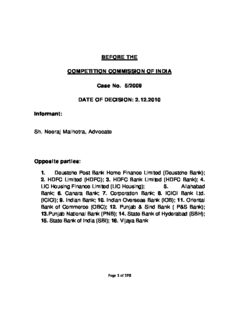
COMPETITION COMMISSION OF INDIA
Case No. 5/2009
DATE OF DECISION: 2.12.2010
Informant:
Sh. Neeraj Malhotra, Advocate
Opposite parties:
1. Deustche Post Bank Home Finance Limited (Deustche Bank);
2. HDFC Limited (HDFC); 3. HDFC Bank Limited (HDFC Bank); 4.
LIC Housing Finance Limited (LIC Housing); 5. Allahabad
Bank; 6. Canara Bank; 7. Corporation Bank; 8. ICICI Bank Ltd.
(ICICI); 9. Indian Bank; 10. Indian Overseas Bank (IOB); 11. Oriental
Bank of Commerce (OBC); 12. Punjab & Sind Bank ( P&S Bank);
13.Punjab National Bank (PNB); 14. State Bank of Hyderabad (SBH);
15. State Bank of India (SBI); 16. Vijaya Bank
Page 1 of 170
ORDER
The present information has been filed under section 19(1) (a)
of Competition Act, 2002(the Act) by informant Neeraj Malhotra,
against banking and non banking financial companies for the
levying of Prepayment Charges on the prepayment of amount of
home loan taken. The opposite parties are private and public
sector banking and non-banking financial institutions, engaged
in the business of offering different types of loans including
retail home loans, to the general public. Before examining the
various elements of the alleged violation of the provisions of the
Act , the findings of the Director General during investigation
and the contentions of the Opposite Parties, it is necessary to
look at the overall environment prevailing in the retail home loan
market.
BACKGROUND
Retail home loan market in India
1.1 Housing market in India took off mainly since the year 2001, as
evidenced by the growth in bank exposure to the sector. The rapid
growth in housing loan market has been supported by the growth in
the middle class population, favorable demographic structure, rising
Page 2 of 170
job opportunities in the metropolitan centers, emergence of a
number of second tier cities as upcoming business centers, IT and
ITES related boom and rise in disposable incomes. Furthermore,
attractive tax advantages for housing loans make them ideal
vehicles for tax planning for salary earners.
1.2 The real estate market has also grown rapidly recording
considerable annual price appreciation in recent past. The real
estate market has also been boosted by the proposal to permit 100
per cent FDI in the sector. For banks and other housing finance
institutions, the regulatory framework enabled expansion in house
loan portfolios given the helpful prescriptions on risk weights for
housing exposures and the benefits of compliance with the
regulatory targets mandated for priority sector lending. Besides,
housing loans growth by financial institutions has been assisted by
the comfort of relative safety of such assets given the tangible
nature of the primary security and the comfort obtained from The
Securitization and Reconstruction of Financial Assets and
Enforcement of Security Interests (SARFAESI) Act, 2002.
Page 3 of 170
1.3 One of the most significant factors that drove the growth of housing
market in India in the recent years was the easy availability of bank
finance at affordable interest rates owing to surplus liquidity with the
banking sector coupled with the softening of interest rate
environment on the back of lower inflationary expectations.
1.4 With the increase in the consumer demand and to fill the demand
supply gap, many financial institutions emerged providing lending
services at attractive interest rates. There are two different types of
lending institutions viz., Banks and Non Banking Financial
Companies (NBFC). The banks apart from lending can accept
deposits of current and savings accounts and fixed deposits,
whereas an NBFC can only accept fixed deposits and also lend.
1.5 There is no interest paid to the balances of current accounts and for
savings accounts the rate of interest paid is 3.5% p.a on a daily
balance basis. When there are sufficient balances in these
accounts the bank would not require to approach any other financial
institution for relending purposes. In addition to these current and
savings account (CASA) balances, if needed bank can source the
funds through fixed deposits for a short term of 15 days to as long
Page 4 of 170
as 10 years. The banks also raise funds from National Housing
Banking Finance and other financial institutions for relending
purposes.
1.6 NBFC source their funds primarily through other financial
institutions and fixed deposits. Since they don’t undertake the
business of CASA operations through which the cost of funds would
have been cheaper, the NBFC generally offers higher rate of
interest to the fixed deposit holders. Also the lending rates of the
NBFC are generally higher.
Home loan market composition:
1.7 The Indian home loan market is catered by many public sector and
private sector banks along with the Housing Finance Companies
(HFC). HFCs are the Non Banking Financial Companies. According
to the report of ICRA in their report dated June 17,2010
“Performance Review of Housing Finance Companies and Indian
Mortgage Finance Market for 2009-10 and Industry Outlook”, the
major players in the home loan market are HDFC with 17% (along
Page 5 of 170
with HDFC Bank), State Bank of India (SBI) 17%, ICICI Bank
13%(along with ICICI Home Finance), and LIC Housing Finance
(LIC HFL) with 8%, account for 55% of the total housing credit in
India (as of March 31, 2010). Apart from these big players, there
are some HFCs with relatively smaller credit portfolios operating in
their respective areas or serving niche customers. Small HFCs over
the past few years are growing their portfolio considerably.
1.8 Credit portfolio of the HFCs as well as scheduled commercial banks
year wise from 2004 is given below:
Mar-04 Mar-05 Mar-06 Mar-07 Mar-08 Mar-09 Mar-10
HFCs 3540 4680 5980 7340 9120 11050 13410
SCBs 8940 13470 18520 2310 25570 27240 29720
Total 12490 18150 24500 3044 34680 38290 43130
Rs. In crores
1.9 According to the ICRA report credit growth in the Indian mortgage
finance market improved to 12.6% in 2009-10 from 10% in the
previous fiscal drawing on several factors, including a healthier
operating environment, expectations of appreciation in property
Page 6 of 170
prices, and attractive interest rate schemes offered by banks and
housing finance companies (HFCs). Although housing loans remain
the main source of revenues for small HFCs, the proportion of other
loans in their loan book increased to 8% as on March 31, 2010 from
7% the previous fiscal.
Factors affecting non-price competition in retail home loan
market:
1.10 In this decade business of home loan market has grown rapidly with
many players forayed into this business. In this regulatory
environment where the interest rates are almost similar across the
banks adhering to the prudential norms of the central bank,
increasing the customer base by improving the service standards
became a practice. These can be said as non-price competitive
factors which are as under:
1) Providing the loan to the customer depending on the need of the
customer by providing an option for loan on either fixed or floating
rate of interest rates.
Page 7 of 170
2) The technical support provided to the borrower in choosing the home
w.r.t choosing the property in the desired market, making the
customer aware about the prevalent market prices and also assisting
in getting documents from the builder by checking its authenticity.
3) Depending on the risk appetite of the banks about its customers,
some of the guidelines are liberal to some credit worthy customers,
without asking for the guarantor or reducing the margin money for
availing the loan. This was help to many customers who are credit
worthy buyers but without any guarantor.
4) Helping the customer with door step service without asking him to
visit the branches for their procedural works. The busy customers
would be interested in this type of services.
Types of home loans:
1.11 There are two types of home loans. One is the fixed rate loan and
the other is the floating rate loan. In the fixed rate loan, whatever
interest is fixed on the start of loan is carried on for the complete
period. However, for the other the interest rate is not fixed and is
completely dependent upon the market forces. As the interest rate
goes up or comes down the burden is transferred to the person and
Page 8 of 170
the Equated Monthly Installment (EMI) fluctuate accordingly. Also
there can be an increase or decrease in the tenor of the loan
depending on the rise of the interest rates. In these fluctuating
market conditions banks are more interested in offering floating rate
than the fixed rate products.
Factors influencing interest rates:
1.12 Home loan interest rates are dependent largely on the monetary
policy of the RBI. The rate of interest would be influenced by the
increase/decrease in the repo rate, reverse repo, statutory liquidity
ratio (SLR) and cash reserve ratio (CRR). These terms are
explained below:
Cash Reserve Ratio(CRR):
1.13 Cash Reserve Ratio is the amount of mandatory funds that
commercial banks have to keep with RBI. It is always fixed as a
percentage of total deposits. These deposits are designed to satisfy
cash withdrawal demands of customers. CRR is also called the
Liquidity Ratio as it seeks to control money supply in the economy
Page 9 of 170
1.14 The higher the cash reserve (CRR) required, the lower the money
available for lending. The bank has to compulsorily keep a part of
the deposits of the customers’ accounts with the RBI. Hence this
reduces credit expansion by controlling the amount of money that
goes out by way of loans.
1.15 CRR can be used as a tool to bring down inflation which happens
due to excessive spending power. Spending power is augmented
by loans and if money that goes out as loans is controlled, inflation
can be tamed to some extent.
Statutory Liquidity Ratio (SLR):
1.16 SLR is the portion that banks need to invest in the form of cash,
gold or government approved securities (Bonds) before providing
credit to its customers. The quantum is specified as some
percentage of the total demand and time liabilities of the bank and
is set by the Reserve Bank of India.
1.17 Time liabilities are the fixed deposits of the customers with a bank
for a fixed tenor whereas demand liabilities are the fund balances
available in the saving and current accounts of the customers.
Page 10 of 170
Description:Opposite parties: 1. Deustche Post Bank Home Finance Limited (Deustche Bank);. 2. LIC Housing Finance Limited (LIC Housing);. 5. Allahabad. Bank; 6. Canara Bank; 7. Corporation Bank; 8. ICICI Bank Ltd. (ICICI); 9. Indian Bank; 10. practices in the nature of predatory or monopoly or oligopoly