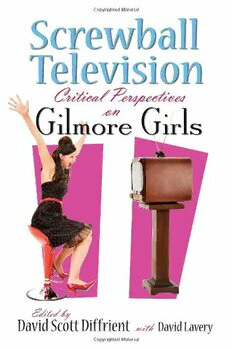
Table Of ContentScrewball Television
Television and Popular Culture
Robert J. Thompson, Series Editor
OTHER TITLES IN TELEVISION AND POPULAR CULTURE
Athena’s Daughters: Television’s New Women Warriors
FRANCES EARLY AND KATHLEEN KENNEDY, eds.
Critiquing the Sitcom: A Reader
JOANNE MORREALE, ed.
Gen X TV: “The Brady Bunch” to “Melrose Place”
ROB OWEN
Laughs, Luck . . . and Lucy: How I Came to Create
the Most Popular Sitcom of All Time
JESS OPPENHEIMER, with GREGG OPPENHEIMER
“Lou Grant”: The Making of TV’s Top Newspaper Drama
DOUGLASS K. DANIEL
Prime Time, Prime Movers: From “I Love Lucy”
to “L.A. Law”—America’s Greatest TV Shows
and the People Who Created Them
DAVID MARC and ROBERT J. THOMPSON
“Something on My Own”: Gertrude Berg and American
Broadcasting, 1929—1956
GLENN D. SMITH JR.
Teleliteracy: Taking Television Seriously
DAVID BIANCULLI
Television’s Second Golden Age: From “Hill Street Blues” to “ER”
ROBERT J. THOMPSON
“The West Wing”: The American Presidency as Television Drama
PETER C. ROLLINS and JOHN E. O’CONNOR, eds.
SSccrreewwbbaallll
TTeelleevviissiioonn
Critical Perspectives
on
G G
ilmore irls
Edited by
David Scott Diffrient David Lavery
with
SYRACUSE UNIVERSITY PRESS
Copyright © 2010 by Syracuse University Press
Syracuse, New York 13244-5290
All Rights Reserved
First Edition 2010
10 11 12 13 14 15 6 5 4 3 2 1
ISBN: 978-0-8156-3239-9
∞ The paper used in this publication meets the minimum requirements
of the American National Standard for Information Sciences—Permanence
of Paper for Printed Library Materials, ANSI Z39.48-1992.
For a listing of books published and distributed by Syracuse University Press,
visit our Web site at SyracuseUniversityPress.syr.edu.
Library of Congress Cataloging-in-Publication Data
Screwball television : critical perspectives on Gilmore girls / edited by
David Scott Diffrient with David Lavery. — 1st ed.
p. cm. — (Television and popular culture)
Includes bibliographical references and index.
ISBN 978-0-8156-3239-9 (cloth : alk. paper)
1. Gilmore girls (Television program) I. Diffrient, David Scott, 1972–
II. Lavery, David, 1949–
PN1992.77.G54S34 2010
791.45'72—dc22 2010000442
Manufactured in the United States of America
Contents
Contributors | ix
Introduction: “You’re about to Be Gilmored”
DAVID SCOTT DIFFRIENT | xv
Part One. Authorship, Genre, Literacy, Televisuality
1. “Impossible Girl”: Amy Sherman-Palladino and Television Creativity
DAVID LAVERY | 3
2. Branding the Family Drama: Genre Formations and Critical
Perspectives on Gilmore Girls
AMANDA R. KEELER | 19
3. Your Guide to the Girls: Gilmore-isms, Cultural Capital, and a
Different Kind of Quality TV
JUSTIN OWEN RAWLINS | 36
4. TV “Dramedy” and the Double-Sided “Liturgy” of Gilmore Girls
GIADA DA ROS | 57
Part Two. Real and Imagined Communities (in Town and Online)
5. The Gift of Gilmore Girls’ Gab: Fan Podcasts and the Task of
“Talking Back” to TV
DAVID SCOTT DIFFRIENT | 79
6. “I Will Try Harder to Merge the Worlds”: Expanding Narrative
and Navigating Spaces in Gilmore Girls
RADHA O’MEARA | 108
vi | Contents
7. “You’ve Always Been the Head Pilgrim Girl”: Stars Hollow as the
Embodiment of the American Dream
ALYSON R. BUCKMAN | 130
8. Town Meetings of the Imagination: Gilmore Girls
and Northern Exposure
JANE FEUER | 148
Part Three. Race, Class, Education, Profession
9. Escaping from Korea: Cultural Authenticity and Asian American
Identities in Gilmore Girls
HYE SEUNG CHUNG | 165
10. “The Thing That Reads a Lot”: Bibliophilia, College Life,
and Literary Culture in Gilmore Girls
ANNA VIOLA SBORGI | 186
11. Stars Hollow, Chilton, and the Politics of Education
in Gilmore Girls
MATTHEW C. NELSON | 202
12. “You Don’t Got It”: Becoming a Journalist in Gilmore Girls
ANGEL CASTAÑOS MARTÍNEZ, AMOR MUÑOZ BÉCARES,
AND SARAH CAITLIN LAVERY | 214
Part Four. Food, Addiction, Gender, Sexuality
13. Pass the Pop-Tarts: The Gilmore Girls’ Perpetual Hunger
SUSANNAH B. MINTZ AND LEAH E. MINTZ, M.D. | 235
14. “Nigella’s Deep-Frying a Snickers Bar!”: Addiction as a Social
Construct in Gilmore Girls
JOYCE GOGGIN | 257
15. Java Junkies Versus Balcony Buddies: Gilmore Girls, “Shipping,”
and Contemporary Sexuality
A. ROCHELLE MABRY | 283
Contents | vii
16. “But Luke and Lorelai Belong Together!”: Relationships, Social
Control, and Gilmore Girls
JIMMIE MANNING | 302
17. What a Girl Wants: Men and Masculinity in Gilmore Girls
LAURA NATHAN | 321
Appendix: Complete Episode List | 347
Works Cited | 353
Index | 365
Contributors
AMOR MUÑOZ BÉCARES earned a Ph.D. in journalism at Universi-
dad CEU Cardenal Herrera in Valencia and is professor of newspaper
design and magazine design at Universidad CEU Cardenal Herrera in
Valencia.
ALYSON R. BUCKMAN is associate professor of humanities and religious
studies at California State University, Sacramento, where she teaches
courses on fi lm, popular culture, and American culture. Her work has
appeared in journals and anthologies such as Modern Fiction Studies,
Exchanges, FEMSPEC, the Journal of American Culture, and Investi-
gating Firefl y and Serenity: Science Fiction on the Frontier (2008). She
also cochairs the Science Fiction and Fantasy Area of the Southwest/
Texas Popular Culture/American Culture Association. She believes that
french fries are a gateway food, wishes she could be ice cream queen,
and—like Rory—likes to carry a book with her always . . . just in case.
HYE SEUNG CHUNG is assistant professor of fi lm and media studies
in the Department of American Studies at the University of Hawaii at
Manoa. She is the author of Hollywood Asian: Philip Ahn and the Poli-
tics of Cross-Ethnic Performance (2006) as well as numerous articles
on Korean cinema and Asian American cultural identities. One of her
most recent essays, published in the collection Grace under Pressure
(2008), concerns Asian American identities and new images of multi-
culturalism in the television series Grey’s Anatomy. She is currently
writing a book on the fi lms of Kim Ki-duk for the University of Illi-
nois Press’s “Contemporary Film Directors” series.
ix