Table Of Content1
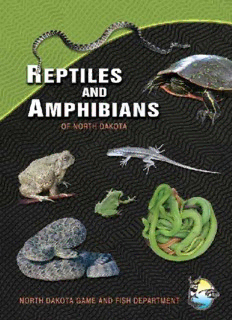
Cover photo credits:
Bullsnake: Chris Grondahl
Painted turtle: Matthew T. Smith
Woodhouse’s toad: Chris Grondahl
Sagebrush lizard: Sandra Johnson
Treefrog: Lorraine A. Manz
Rattlesnake: Chris Grondahl
Smooth green and red-bellied snakes: Matthew T. Smith
Reptiles and Amphibians of North Dakota
By Sandra Johnson
NORTH DAKOTA GAME AND FISH DEPARTMENT
A
cknowledgements
Originally published in North Dakota Outdoors,
July 1992 by Ted Hoberg and Cully Gause. Text
updated by Sandra Johnson. Thanks to Christo-
pher Smith, Robert Newman, Matthew T. Smith,
Chris Grondahl and Patrick Isakson for reviewing
text and distribution maps.
The design and printing of this publication
was funded by the North Dakota Game and Fish
Department.
Printed: August 2015
t c
Able of ontents
Introduction .........................................................................ii
Amphibians
Plains Spadefoot ........................................................................................2
Woodhouse’s Toad ...................................................................................4
Great Plains Toad ......................................................................................6
American Toad ..........................................................................................8
Canadian Toad .........................................................................................10
Gray Treefrog and Cope’s Gray Treefrog .............................................12
Northern Leopard Frog ...........................................................................14
Wood Frog ................................................................................................16
Boreal Chorus Frog ..................................................................................18
Tiger Salamander .....................................................................................20
Mudpuppy ................................................................................................22
Reptiles
Short-horned Lizard ................................................................................24
Sagebrush Lizard .....................................................................................26
Prairie Skink .............................................................................................28
Painted Turtle ...........................................................................................30
Smooth Softshell ......................................................................................32
Spiny Softshell ..........................................................................................34
False Map Turtle ......................................................................................36
Snapping Turtle ........................................................................................38
Common Gartersnake .............................................................................40
Plains Gartersnake ...................................................................................42
Red-bellied Snake ....................................................................................44
Smooth Green Snake ...............................................................................46
Plains Hog-nosed Snake ..........................................................................48
Gophersnake (Bullsnake) ........................................................................50
Racer ..........................................................................................................52
Prairie Rattlesnake ...................................................................................54
i
I
ntroductIon
Amphibians and reptiles live in all habitat types in North Dakota. They
may be close by, even if you don’t see them. Turtles and frogs swim on the
bottom of wetlands and rivers, lizards scurry into burrows, and snakes slip
away into tall grass. Although they may seem “creepy” to some people,
they are all quite harmless, unless provoked, which may cause them to
become aggressive in an attempt to defend themselves. In fact, amphib-
ians and reptiles are very beneficial to the environment, serving as prey for
other animals, and preying on critters sometimes undesirable to humans,
such as rodents.
North Dakota has about 28 species of amphibians and reptiles. Herpe-
tologists, or biologists who study these creatures, often discover small
differences in a species, and may change the name of a species, or decide
it should be two separate species. Depending on who you talk to, the exact
number of species, or herps as they are sometimes collectively called, may
vary. Regardless, North Dakota has very few species because of its cold
climate, compared to someplace warm like Texas, which boasts more than
225 species.
w A A ?
hAt re mphIbIAns
North Dakota’s amphibians are four-legged vertebrates that spend part of
their life in water and part on land. Frogs, toads and salamanders are am-
phibians. Females are typically larger than males. Most lay eggs in water,
which hatch into larvae and then undergo metamorphosis (i.e. lose their
gills and develop lungs) into adult stage. They are cold-blooded (ectother-
mic) and rely on the environment to regulate body temperature. Amphib-
ians survive North Dakota winters by
hibernating at the bottom of wetlands, N
O
lakes or rivers and may even occasion- HNS
O
ally swim around below the ice. Others A J
R
D
burrow deep into soil below the frost AN
S
line, or in cracks or crevices in logs or
rocks. Some amphibians may freeze,
except for the vital organs, which have a high concentration of glucose or
“antifreeze,” preventing the animal from dying.
w A r ?
hAt re eptIles
Reptiles are cold-blooded (ectothermic) vertebrates that lay eggs or give
live birth and have scales or scutes (i.e. a bony plate such as a turtle shell).
Lizards, turtles, snakes and even extinct dinosaurs are reptiles. Females
ii
are typically larger than males. Several species of reptiles may give birth to
live young versus laying eggs. Some lizards have a unique escape mechanism
as their tail breaks away when grabbed by a predator. While the predator is
amused with the twitching tail, the lizard escapes unharmed as the tail will
grow back over time. Incubation temperature determines the sex of turtles
(except for softshell turtles); high temperatures produce females and low
temperatures produce males. Snakes constantly flick their tongue to sense their
surroundings. Snakes have no external ear openings, but can pick up vibrations
through the ground. Snakes will continue to grow throughout their life and as
they grow, they shed their skin to allow for the increase in size.
r r
ulesAnd egulAtIons
Kids, and even many adults, get excited when they find a frog or salaman-
der, and sometimes even a snake, and think it would make a good pet. All
amphibians and reptiles are defined as wildlife and under management of the
state. Should that prevent a child from holding a toad while in nature? Certain-
ly not, however, the animal should be left in its natural habitat and not brought
home. A secondary reason for not bringing an animal home is because there are
a number of diseases and fungi on the rise in the United States that amphibians
and reptiles carry. Even if an animal appears healthy, it may have Salmonella,
or other unidentified diseases. Or, if you have legally purchased pets at home
and bring home a critter from the wild, place it in the same cage with infected
pets, then later release the wild animal, you will spread the disease to oth-
erwise healthy wildlife. Always wash your hands with soap and water after
handling any animal.
h u t g
owto se hIs uIde
This guide describes all amphibians and reptiles known to occur in North
Dakota. Any species you find in nature that is not in the guide should be re-
ported to the North Dakota Game and Fish Department. This includes poten-
tially harmful species such as the bullfrog, or pets that may have been released
by their owners, such as restrictor snakes. Never handle a snake if you are
unsure of what species it is.
• Snout to vent length: the distance from the tip of the nose to the vent or the
opening located on the underside of the
animal at the base of its tail.
• Head to tail length: the distance from the
tip of the head, or nose, to the tip of the HL
A
D
tail. ON
R
G
• Carapace length: the distance from the HRIS
C
front to the rear of the shell.
iii
A
mphIbIAns
p s
lAIns pAdefoot
(Spea bombifrons)
Snout to vent length: 2-3 inches
The plains spadefoot is the most easily recognized toad in North Dakota.
Its skin is smooth like that of a frog, and it has a distinct vertical pupil like
that of a cat. Its color varies from a light cream, to gray or brown, and may
have small orange spots. These toads inhabit dry grasslands, with sandy or
loose soil primarily south and west of the Missouri River, although some
scattered populations have been found in central and northern North Dako-
ta. Their back feet have a digging spur (spade) used to burrow into the soil.
They may burrow 3 feet or more underground until they hit a layer of moist
soil. Spadefoots are known as explosive breeders. During warm summer
months they emerge in the evening after a heavy rain to quickly breed in
shallow pools. Females lay 2,000 eggs, which hatch in 2-4 days and tadpoles
metamorphose into
toadlets (i.e. small toads)
within one month. By
morning, adults are back
underground awaiting
the next heavy rain.
Spadefoots eat a variety N
O
of small invertebrates. WILS
N
O
R
The digging spur ‘spade’ on hind foot.
fun fAct:
I'm the fAstest to turn
from A tAdpole Into A
frog ... 30 dAys!
Primary Range Secondary Range
2
N
O
WILS
N
O
R
N
O
WILS
N
O
R
HL
A
D
N
O
R
G
RIS
H
C
3
w ’ t
oodhouse s oAd
(Anaxyrus woodhousii)
Snout to vent length: 3-5 inches
Woodhouse’s toads are North Dakota’s largest toad. Its coloration varies
from green to light brown, with a distinctive light stripe down the middle
of its back. Their bellies are white to yellow and typically have no mark-
ings, but may have a single chest spot. The Woodhouse’s toad is most
abundant in southwestern and southern North Dakota, but may be found
statewide in grasslands, wetlands, floodplains and back yards. They are
commonly found at night near the base of yard lights where insects are
abundant. Females lay up to 25,000 eggs. Woodhouse’s toads are named af-
ter the 19th century explorer, surgeon and naturalist, Samuel Woodhouse.
These toads were formerly called Rocky Mountain toads.
H
MIT
S
W T.
E
H
ATT
M
fun fAct:
we lIke to leAve A
sIgn of our presence
under yArd lIghts
whIle you Are sleepIng
... toAd droppIngs!
Primary Range Secondary Range
4
Description:The plains spadefoot is the most easily recognized toad in North Dakota. Its skin is smooth handling or mistreating the snake. Less often it is the