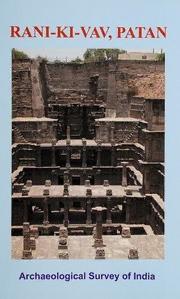
Table Of ContentRANI-KI-VAV, PATAN
Archaeological Survey of India
Digitized by the Internet Archive
in 2018 with funding from
Public.Resource.org
https://archive.org/details/ranikivavpatanOOmank
RANI-KI-VAV, PATAN
Kirit Mankodi
Published by the Director General
Archaeological Survey of India
Janpath, New Delhi-110011
2012
Published on the occasion of the celebrations of 150 years of the
Archaeological Survey of India
First edition : 2012
©
2012
ARCHAEOLOGICAL SURVEY OF INDIA
GOVERNMENT OF INDIA
Price : Rs. 30.00
Printed at Batra Art Press, A-41, Naraina Industrial Area, Ph-II, Delhi-110030
Ph. : +91-011-41417701, 02, 03
11
CONTENTS
Page
Illustrations iv
1. General Information.1
2. Stepped-well as an Architectural Form.3
Stepped Corridor.6
The Well.8
3. The Sculptures. 10
1. Two-fold division of sculptures.10
2. Vishnu’s twenty-four forms.10
3. Parvati’s penance. 11
4. The eight Vasus.12
5. Images in the niches.13
6. Images in the niches of the corridor.14
7. Images in the niches of the well.27
8. Sculptures on the upright posts.29
9. Detached sculptures.31
10. Queen Udayamati.32
4. Date, Authorship and Style.33
5. Rani-ki-Vav as Commemorative Monument.34
Glossary .35
Further Reading.36
in
ILLUSTRATIONS
1. Rani-ki-Vav, general view
2. Rani-ki-Vav, before conservation
3. Closer view of the step-well
4. Side wall of the reservoir
5. Geometrical and decorative patterns on the wall
6. View from the bottom of the well
7. Chart showing the positions of the sculptures
8. Balarama
9. Buddha
10. Kalki
11. Mahishasuramardini
12. Bhairava
13. Varaha
14. Vamana
15. Rama
16. Parvati performing penance
17. Ganesha with his consort
18. Vishnu sleeping on Shesha
19. Female figure
20. Female figure
21. Female mendicant
22. Naga Kanya
23. Nayika Karpuramanjari
24. Portrait of Queen Udayamati
IV
RANI-KI-VAV, PATAN
1. GENERAL INFORMATION
R
r r
ANI-KI-VAV (23° 5 N; 72° 1 E) LIES 2 KM TO THE
north-west of the historic town of Patan, a recently created
District headquarters of Gujarat and is situated 140 km north¬
west of Ahmedabad (Map). Patan is on the side of the River
Sarasvati, and was earlier known by its mediaeval name of
Anahillapura, Anahillavada, Anahilapataka, Analavata or
Naharwalah. It was a flourishing city and capital of the Solanki or
Chaulukya dynasty of Gujarat. The city is also famous for the
Sahasralinga talav (“reservoir adorned with one thousand lingas
of Shiva”) excavated during the Solanki period and for its traditional
Patola textile. There are many ancient monuments and structural
remains stiU extant in Patan which include fortifications with gates
and bastions, temples, tombs, mosques, tanks, step-wells, etc.
Amongst the step-wells, it is the Rani-ki-Vav which is the
most magnificent step-well not only in Gujarat but in the whole
country. Adorned with exquisitely carved sculptures arranged in
panelled niches, it is actually a temple-well. It is believed to have
been constructed by Queen Udayamati, the consort of Bhimadeva
I of Solanki dynasty, most likely in the late eleventh century. Rani-
ki-Vav is sited beside the ancient fortification wall, ridges of which
RANI-KI-VAV, PATAN
can still be seen running close to embankments of the Sahasralinga
Talav, earlier known as ‘Durlabh Sarovar ’ that was later repaired
and renovated under the command of the most illustrious Solanki
king, Siddharaja Jayasimha.
Rani-ki-Vav opens daily for the visitors from sun-rise to
sun-set. There are rules, available with local offices, for shooting/
filming and taking photographs of the monument. The photographs
are also available for sale at the office of Director General of
Archaeological Survey of India, Janpath, New Delhi-110011 and
Superintending Archaeologist, Archaeological Survey of India,
Vadodara Circle, Vadodara (Gujarat). Currently entry fee for the
site is Rs. 5/- for Indians and Rs. 100/- for foreigners, respectively.
No entry fee is charged from children below 15 years.
2
2. STEPPED-WELL AS AN
ARCHITECTURAL EORM
T
he whole of the western india has scanty
rainfall and generally sandy soil; therefore, the water level
sinks far below the ground in the dry season, requiring wells to be
dug to a great depth. The stepped-well is a well which is provided
with an underground flight of steps leading down to the level of
the water. The earliest step-weUs were small and plain, but gradually
the step-well evolved as an underground architectural form, with
a well at the end of a long flight of steps marked by pillared pavilions
of multiple storeys. Step-wells were usually excavated close to
the rivers. Since the creation of reservoirs, lakes, wells and other
watering places was considered as a meritorious act in India,
especially to commemorate the dead, innumerable stepped-wells
were excavated in Gujarat and Rajasthan in the course of
centuries. In the barren landscape of Western India, these
subterranean structures with their ornate interiors make a startling
impact on the visitor who chances upon them. The stepped-well
is truly India’s unique contribution to the architectural wealth of
the world.
Rani-ki-Vav, “the Queen’s Step-Well” (PL 1), was built in
the last decades of the eleventh century by Queen Udayamati as a
memorial to her husband Bhimadeva I of the Chaulukya or Solanki
3
RANI-Kl-VAV, PATAN
dynasty. Measuring more than sixty-five metres in length, it is among
the largest in Gujarat, and in terms of its sculptures which number
several hundred, surpasses all other examples. At some time in
the past, the lower parts of the monument were silted up, the
uppermost parts alone were visible, but they were in ruins; the
pillars, beams and other fallen parts were carried away in the
nineteenth century to be used in building another step-well nearby,
known as Barot Vav. Then only the two extremities of Rani-ki-
Vav, the free standing pair of columns at the eastern end and the
raised wall of the well in the west, which were on higher ground
than the step-well itself, remained visible (PI.2). In the last few
decades the Archaeological Survey of India has conserved Rani-
ki-Vav after removing all the sand that had choked it up.
Rani-ki-Vav faces the east, and possesses all the
components of a developed stepped-well. At ground level a free
standing stmcture on two columns with an elaborate superstructure
known as a torana was built as a kind of ceremonial entrance.
Beyond the torana commences a stepped-corridor (that leads all
the way down to the well at the far end); this stepped-corridor is
marked at intervals by landings where multi-storeyed pavilions
were built; at the end of the corridor there is a reservoir, beyond
wliich is the well. The reservoir collects the surplus water from the
well. The length of the monument, measured at ground level from
the torana to the far side of the well, is sixty-five metres, or two
hundred and thirteen feet. The four pavilions which demarcate the
stages along the descent had two, four, six and seven storeys
respectively, the roof of the uppemiost storey of each pavilion
reaching up to the ground level; the depth of the well was twenty-
nine metres or one hundred feet.
4