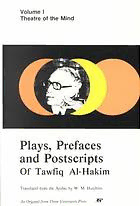
Table Of ContentVolume I
Theatre of the Mind
Plays, Prefaces
and Postscripts
Of Tawflq Al-Hakim
Translated from the Arabic by W. M. Hutchins
An Original from Three Continents Press
P
lays
P
refaces
&
P
ostscripts
of
T -H
aw fiq al akim
Volume One
Theater of the Mind
Translated From The Arabic
By
William M. Hutchins
UNESCO Collection of Representative Works
This volume has been accepted in the
Contemporary Arab Authors Series of the
UNESCO Collection of Representative
Works.
0 William Hutchins 1981
First Edition/Three Continents Press, Inc. Washington, D. C.
Plays, Prefaces & Postscripts of Tawfiq al-Hakim, in two volumes
Volume One: Theater of the Mind
ISBN: 0-89410-148-X
ISBN: 0-89410-134-X (Paperback)
LC No: 80-80887
No part of this publication may be reproduced or transmitted in any form or by any
means, electronic or mechanical, including photocopy, recording or any information
storage and retrieval system now known or to be invented, without permission in
writing from the publisher, except by a reviewer who wishes to quote brief passages in
connection with a review written for inclusion in a magazine, newspaper or broadcast.
All rights for the performance of the works are held by the author.
For information, inquire of the publisher:
Three Continents Press, Inc.
1346 Connecticut Avenue, N. W., Suite 1131 zfin
Washington, D. C. 20036
Cover Design by Tom Gladden
The photograph of the earth was supplied by the National Aeronautics and Space
Administration from the night of Apollo 17 [AS17-148-22725(H)J.
Photographs of Tawfiq ai-Hakim were supplied by the Office of Public Information,
UNESCO.
Angel: How beautiful the Earth would be if man here were able to see, to
love, to let compassion flow from his soul like the water of this brook.
Angels’ Prayer
First Moon Creature: We also gaze at your beautiful planet . . .
Second Creature: There it is: a large sapphire in a handkerchief.
Third Creature: A blue sapphire in the palm of the clouds.
Fourth Creature: It fills us with fear . . . and admiration.
Poet on the Moon
C
ontents
Volume One
Theater of the Mind
Introduction 3
The Wisdom of Solomon (1943) 19
King Oedipus (1949) 81
Shahrazad (1934) 131
Princess Sunshine (1965) 173
Angels’Prayer (1941) 253
Preface and Postscript to The Wisdom of Solomon 271
Introduction to King Oedipus 273
Reply to A. de Marignac on the French Translation
of King Oedipus 291
Man’s Fate (1941) 295
Preface to Princess Sunshine 297
Alternate Ending for Princess Sunshine 299
Introduction to The Diverse Theater ( 1956) 303
Photograph of Tawfiq al-Hakim/v
NASA Photograph of Earth from the Moon/vi
Introduction
A One-Man Egyptian Theater Tradition
Tawfiq al-Hakim’s prolific literary career has already lasted more than half a
century. Today he is considered the leading dramatist of Egypt and the rest of the
Arab world. In his comments about his work he has described himself as an Easterner
and therefore a spiritual playwright, a social critic and therefore a reformist
playwright, and a pioneer and therefore a diverse playwright. This introduction
attempts to test these points with reference to the eleven plays selected for
presentation here in English translation. It is hoped to identify in this way some of the
themes and characteristics which give the plays of Tawfiq al-Hakim their diverse
unity.
Al-Hakim has written in the preface to his play “King Oedipus” that since he is an
Easterner he still retains some measure of his religious sense. He has given man’s
spiritual and material aspects equal attention. He has rejected mere superstition. In
short, he is a modem Muslim who is a playwright. This fact reveals itself in a number
of ways. Some of his plays are of Islamic inspiration. His work “Muhammad” (1936)
is a documentary pageant recounting the Prophet’s life. It is almost a Muslim passion
play. Ahl al-Kahf (“The Sleepers of Ephesus,” 1933) is based on a Qur’anic sura.
The heroes are Christians who awake in a cave after three centuries of miraculous
sleep to find themselves transformed into saints. When their attempts to re-establish
their emotional ties to the world fail, they return to the cave to die. A central portion of
the play is a tragic romance between one of the saints and the look-alike great great
grandniece of the saint’s long deceased true love. From Qur’anic material al-Hakim
has created a love story. Whether consciously or not, he has followed Gibbon’s
suggestion that the legend of the Seven Sleepers “would furnish the pleasing subject of
a philosophical romance.”2
“The Wisdom of Solomon” is also a philosophical love story based on the Qur’an.
In the preface he says he used the Qur’an, the Bible and the Thousand and One
Nights “to create a picture in my mind . . . Nothing more and nothing less.” With the
exception then of his “Muhammad,” he has used Qur’anic stories as a starting point,
not an end.
Some of Tawfiq al-Hakim’s plays have distinctly Islamic features, cultural or
religious. As-Sultan al-Hafir (1960, “The Sultan’s Dilemma,” translated by Denys
Johnson-Davies)3 has a medieval Islamic setting. Its plot hinges on the medieval
Mamluk system of government by a military slave elite. His “Shahrazad” takes up
where the Thousand and One Nights left off and examines the prospects for wedded
bliss of Shahrazad and King Shahriyar. The play is full of images from the literature
of the Islamic mystics: the beloved who represents the Beloved, God; the suppliant
lover ignored by the beloved and the destruction caused by the love; the lover as a
moth and the beloved a candle; the executioner; the tavern and its patrons and flight
from the material body; the mirror of the soul;4 water which is a colorless clarity but
the source of a hundred thousand colors.5
4 Tawfiq al-Hakim
When Shahrazad is seen by a pool of water in a marble basin, the young vizier
asks what secrets her eyes, “clear as this water” conceal. Shahriyar also exclaims,
“How much this clear water frightens me! Woe to anyone who plunges into clear
water ..." Shahriyar compares Shahrazad to Nature and complains that both are
veiled by clarity. It is reported that Muhammad said that everything or that all
creation is made from water.6 If water is the substance of everything and Shahrazad is
like water, she is identifiable with Nature. She compares herself at times to a mirror in
which others see themselves. In this respect she is a perfect mystic saint and so in turn
a reflection or manifestation of God.7
It is arguable that “Shahrazad” is more an outgrowth of these Islamic mystic
images than of the Thousand and One Nights. The latter work may have a mystical
character, of course. In either case, al-Hakim begins his own explanation of the play
with a quotation not from a Muslim mystic but from the Belgian author Maurice
Maeterlinck (1862-1949).8
Among other parallels in al-Hakim’s play with the literature and tradition of
Islamic mysticism is the Queen of Sheba’s attempt in the “Wisdom of Solomon” to
revive her beloved with her tears like a true Sufi lover. Oedipus weeps tears of blood
for his beloved Jocasta. In “Princess Sunshine,” the dervish-like Moonlight provides
the princess with a short course in Sufi ethics. The play also includes the mystical
concept of the perfect man.9
Some of Tawfiq al-Hakim’s plays are Islamic by omission rather than by
inspiration or imagery. He cites the example of the great philosopher al-Farabi who
was inspired by the difficulty of Greek philosophy to rethink it and thereby create an
Islamic philosophy. Al-Hakim asks why an earlier Arab author did not take
“Oedipus” and remove the difficult aspects of Greek mythology and pagan belief to
present it either stripped to its naked human element or cloaked with “a diaphanous
gown of Islamic belief.” In his own adaptation of the play he has, he says, divested
“the story of some of the superstitious beliefs that the Arab or Islamic mentality
would scorn.” The sphinx, for example, has been demoted to a lion made the subject
of a fiction by Teiresias. The Greek gods are united in a single supreme being.
Oedipus is provided with a character flaw—curiosity—and Teiresias made a villain to
keep the play from conflicting with modem Islamic notions of God’s justice. The
tragedy could not have been caused by divine malice. The formula is that man acts out
his free will but does that, unknown to himself, within the framework of the divine will.
Oedipus’ doubt of the accuracy of a particular oracle has been changed to a
general questioning of divine revelation. The Priest accuses Oedipus of making divine
revelation “a subject for scrutiny and exploration.” Thus al-Hakim has introduced to
the play the perennial Islamic controversy between reason and revelation, between
philosophy and theology. In the process he has made Oedipus a philosopher king.
Teiresias borrows a question from medieval theology when he asks about God’s
knowledge of particulars: What did God know and when did he know it? In this way,
in a relatively subtle manner, al-Hakim has transformed the Greek play into an
Islamic one.
Thornton Wilder wrote of his plays in The Angel that Troubled the Waters that
almost all of them “are religious, but religious in that dilute fashion that is a believer’s
concession to a contemporary standard of good manners ... ”10 This statement seems
to capture the sincere yet tasteful religious character of Tawfiq al-Hakim’s plays. The
whimsically devout tone of al-Hakim’s “Angels’ Prayer” has much in common with
Introduction 5
that of Wilder’s “Now the Servant’s Name was Malchus,” in which Jesus
commiserates in Heaven with Malchus over the problems of being mentioned in the
Bible, or of “Hast Thou considered my Servant Job?” which is a conversation
between Satan, Christ and Judas as Christ ascends followed by Judas.
Al-Hakim’s religious interests have extended to the Bible. Bible quotations are
found in “The Wisdom of Solomon” and “Angels’ Prayer.” He has gone beyond the
Bible, which is within bounds acceptable to Islam, to the Egyptian goddess Isis, who
is clearly not one of the approved Muslim sources of divine guidance. If he has written
a “Muhammad,” he has also written an “Isis” (1955). He referred to the goddess in
his novel ‘Awdat ar-Ruh (“Return of the Spirit,” 1933)11 and in “Shahrazad.” The
heroines of both these works are Isis figures as is Prisca in the “Sleepers of
Ephesus.”12
It is arguable that in “Isis” the ancient legend is used as a vehicle for al-Hakim’s
ideas about the role of women in society. Osiris too is more a hero-scientist than a
god-king. “Return of the Spirit” is a novel that attempts to portray the rebirth of the
essential Egyptian personality, and so reference to Isis on its title page is logical. Al-
Hakim’s Shahrazad resembles Isis more convincingly than the young girl in “Return
of the Spirit,” and the play centers on Shahriyar’s futile quest to learn Shahrazad’s
true identity. It has been said of Isis that some of her worshippers “were wholly
unable to satisfy their minds as to her true identity.”13 In the Golden Ass of Apuleius
the hero addresses a prayer to the goddess: “I beseech you, by whatever name, in
whatever aspect, with whatever ceremonies you deign to be invoked . . . ”14 How
relieved Shahriyar would have been had Shahrazad answered him: “I am Nature, the
universal Mother, mistress of all the elements, primordial child of time, sovereign of
all things spiritual, queen of the dead.”15 What seems an Islamic play then has a
strong undertow going another way. Shahriyar, the moth, is consumed not only by his
love for the candle-like beloved but by a need to know who she is. This desire to know
the ultimate truth was also the undoing of Oedipus.
In short, the spiritual dimension of al-Hakim’s plays transcends sectarian
divisions. He speaks rather of a religious feeling by which he understands, “man’s
sense that he is not alone in existence.” Man perceives that he has free will but that it
is free within the framework of an external, Heavenly will.16 Man’s efforts are a
struggle with forces beyond his grasp. For man’s power and knowledge there are limits
which man must test, even though he knows his efforts will be met by Heaven’s
mockery. Life then is a kind of prison. Al-Hakim in fact called his autobiography Sijn
al-‘Umr (“The Prison of Life,” 171964). Shahriyar in “Shahrazad” compares himself
to a liquid which even though poured from container to container is always confined.
The Treasury Inspector and his aide in “Princess Sunshine” turn themselves in for
punishment. They say that their guilt has become a mobile prison for them. In
“Voyage to Tomorrow” the convicts are released from a prison of stone only to be
launched into the even more confining prison of space. In the “Sleepers of Ephesus”
the saints struggle against their fate of being three hundred years too late. In “Fate of
a Cockroach” the valiant struggle of an Ubu-Roi style king of the cockroaches to
climb out of a slippery bathtub inspires the submissive husband to rebel against the
demands of his educated and pushy wife by delaying her bath. He loses. In “King
Oedipus,” Teiresias has struggled to impose his will on Thebes: to have the people
choose their own king on the grounds of service not descent. He acts but finds he has
exposed himself to divine mockery. The fisherman in the “Wisdom of Solomon”