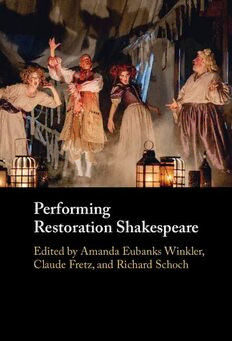
Table Of ContentPERFORMING RESTORATION
SHAKESPEARE
Performing Restoration Shakespeare embraces the performative and
musical qualities of Restoration Shakespeare (1660–1714), drawing
on the expertise of theatre historians, musicologists, literary critics,
and – importantly – theatre and music practitioners. The volume
advances methodological debates in theatre studies and musicology
by advocating an alternative to performance practices aimed at reviv
ing ‘original’ styles or conventions, adopting a dialectical process that
situates past performances within their historical and aesthetic con
texts, and then using that understanding to transform them into new
performances for new audiences. By deploying these methodologies,
the volume invites scholars from different disciplines to understand
Restoration Shakespeare on its own terms, discarding inhibiting
preconceptions that Restoration Shakespeare debased Shakespeare’s
precursor texts. It also equips scholars and practitioners in theatre
and music with new – and much needed – methods for studying and
reviving past performances of any kind, not just Shakespearean ones.
Amanda Eubanks Winkler, Professor of Music History and
Cultures at Syracuse University, is a cultural historian and musi
cologist specializing in British music and drama. She was the Co
Investigator for the AHRC research project ‘Performing Restoration
Shakespeare’. Her most recent book is Music, Dance, and Drama in
Early Modern English Schools (Cambridge University Press, 2020).
Claude Fretz is Associate Professor of Shakespeare and Early
Modern English Literature at Sun Yatsen University (China). He
is also Fellow of the research centre ‘European DreamCultures’ at
Saarland University (Germany). He is the author of Dreams, Sleep,
and Shakespeare’s Genres (2020), and he has published various journal
articles and book chapters on Shakespeare, early modern literature,
representations of dreams and sleep in the Renaissance, modern the
atre practice, and Restoration drama.
Richard Schoch is Professor of Drama at Queen’s University
Belfast, where he was Principal Investigator for the research project
‘Performing Restoration Shakespeare’. His most recent books are A Short
History of Shakespeare in Performance (2021) and Writing the History of
the British Stage (2016), both published by Cambridge University Press.
Published online by Cambridge University Press
Published online by Cambridge University Press
PER FOR MING
R ESTOR ATION
SH AK ESPEAR E
edited by
AMANDA EUBANKS WINKLER
Syracuse University
CLAUDE FRETZ
Sun Yatsen University
RICHARD SCHOCH
Queen’s University Belfast
Published online by Cambridge University Press
Shaftesbury Road, Cambridge cb2 8ea, United Kingdom
One Liberty Plaza, 20th Floor, New York, ny 10006, usa
477 Williamstown Road, Port Melbourne, vic 3207, Australia
314–321, 3rd Floor, Plot 3, Splendor Forum, Jasola District Centre,
New Delhi – 110025, India
103 Penang Road, #05–06/07, Visioncrest Commercial, Singapore 238467
Cambridge University Press is part of Cambridge University Press & Assessment,
a department of the University of Cambridge.
We share the University’s mission to contribute to society through the pursuit of
education, learning and research at the highest international levels of excellence.
www.cambridge.org
Information on this title: www.cambridge.org/9781009241205
doi: 10.1017/9781009241212
© Cambridge University Press & Assessment 2023
This publication is in copyright. Subject to statutory exception and to the provisions
of relevant collective licensing agreements, no reproduction of any part may take
place without the written permission of Cambridge University Press & Assessment.
First published 2023
A catalogue record for this publication is available from the British Library.
A CataloginginPublication Data record for this book is available from the Library of Congress.
isbn 9781009241205 Hardback
Cambridge University Press & Assessment has no responsibility for the persistence
or accuracy of URLs for external or thirdparty internet websites referred to in this
publication and does not guarantee that any content on such websites is, or will
remain, accurate or appropriate.
Published online by Cambridge University Press
Contents
List of Figures page vii
List of Tables ix
List of Music Examples x
Notes on Contributors xi
Foreword xvii
Joseph Roach
Acknowledgements xxi
List of Abbreviations xxiii
Introduction: New Shakespeare for a New Era 1
Amanda Eubanks Winkler, Claude Fretz, and Richard Schoch
1 From Boards to Books: The Circulation of Shakespearean
Songs in Manuscript and Print during the Interregnum 15
Sarah Ledwidge
2 Heroic Shakespeare at Lincoln’s Inn Fields 38
Stephen Watkins
3 More than a Song and Dance? Identifying Matthew Locke’s
Incidental Music for Macbeth 61
Silas Wollston
4 CrossDressing in Restoration Shakespeare: Twelfth
Night and The Tempest 79
Fiona Ritchie
5 Performing Restoration Shakespeare in
the Eighteenth Century 97
James HarrimanSmith
v
Published online by Cambridge University Press
vi Contents
6 An Actor’s Perspective on Restoration Shakespeare 118
Louis Butelli
7 Staging Restoration Shakespeare with Restoration Music 132
Robert Eisenstein
8 Davenant’s Lady Macduff and the Subversion of Normative
Femininity in TwentyFirstCentury Performance 142
Sara Reimers
9 Facts as Ideas: The Theatricalisation of Scholarship 163
Kate Eastwood Norris
10 Syncopated Time: Staging the Restoration Tempest 180
Amanda Eubanks Winkler and Richard Schoch
Bibliography 199
Index 211
Published online by Cambridge University Press
Figures
0.1 Sir William Davenant (1606–1668) by William Faithorne,
after John Greenhill, published 1672. Reproduced courtesy
of the Folger Shakespeare Library, Washington, DC, under
a Creative Commons AttributionShareAlike 4.0
International License. page 3
0.2 William Dolle, engraving of scenes at Dorset Garden
Theatre, in Elkanah Settle’s The Empress of Morocco
(1673). Reproduced courtesy of the Folger Shakespeare
Library, Washington, DC, under a Creative Commons
AttributionShareAlike 4.0 International License. 6
5.1 The History of King Lear, A Tragedy: As it is now acted at the
King’s Theatres. Revived, with Alterations, by N. Tate
(London: Hitch et al., 1756), 29. Reproduced courtesy
of the British Library Board. 98
5.2 The History of King Lear: As it is performed at The Theatre
Royal in Covent Garden (London: R. Baldwin and
T. Becket, 1768), 34. Reproduced courtesy of the Folger
Shakespeare Library, Washington, DC, under a Creative
Commons AttributionShareAlike 4.0 International License. 106
6.1 The witches (Emily Noël, Rachael Montgomery,
Ethan Watermeier) and Duncan (Louis Butelli) in the
Folger Theatre’s 2018 production of Sir William Davenant’s
Macbeth. Reproduced courtesy of the Folger Theatre and
the research project ‘Performing Restoration Shakespeare’,
led by Queen’s University Belfast and funded by the
Arts and Humanities Research Council (AHRC) in
the United Kingdom. 119
vii
Published online by Cambridge University Press
viii List of Figures
6.2 Duncan’s murder in the Folger Theatre’s 2018 production of
Sir William Davenant’s Macbeth. Reproduced courtesy
of the Folger Theatre and the research project ‘Performing
Restoration Shakespeare’, led by Queen’s University Belfast
and funded by the Arts and Humanities Research Council
(AHRC) in the United Kingdom. 128
6.3 Ian Merrill Peakes as Macbeth in the Folger Theatre’s 2018
production of Sir William Davenant’s Macbeth. Reproduced
courtesy of Folger Theatre and the research project ‘Performing
Restoration Shakespeare’, led by Queen’s University Belfast
and funded by the Arts and Humanities Research Council
(AHRC) in the United Kingdom. 129
7.1 The witches (Emily Noël, Rachael Montgomery, Ethan
Watermeier) in the Folger Theatre’s 2018 production of Sir
William Davenant’s Macbeth. Reproduced courtesy of Folger
Theatre and the research project ‘Performing Restoration
Shakespeare’, led by Queen’s University Belfast and funded
by the Arts and Humanities Research Council (AHRC) in the
United Kingdom. 138
8.1 Karen Peakes as Lady Macduff and Owen Peakes as
Fleance in the Folger Theatre’s 2018 production of
Sir William Davenant’s Macbeth. Reproduced courtesy
of Folger Theatre and the research project ‘Performing
Restoration Shakespeare’, led by Queen’s University Belfast
and funded by the Arts and Humanities Research Council
(AHRC) in the United Kingdom. 148
9.1 Kate Eastwood Norris as Lady Macbeth in Folger
Theatre’s 2018 production of Sir William Davenant’s
Macbeth. Reproduced courtesy of the Folger Theatre and
the research project ‘Performing Restoration Shakespeare’,
led by Queen’s University Belfast and funded by the Arts and
Humanities Research Council (AHRC) in the
United Kingdom. 165
Published online by Cambridge University Press
Tables
1.1 Shakespeare song sources, 1630–1660 page 17
3.1 Locke’s violinband music 64
ix
Published online by Cambridge University Press