Table Of ContentLocal Development Framework for Burnley
Padiham Area Action Plan
Heritage Appraisal
Padiham
‘Heritage is all around us. We live our lives, whether consciously or not,
against a rich backdrop formed by historic buildings, landscapes and other
physical survivals of our past. But the historic environment is more than just
a matter of material remains. It is central to how we see ourselves and to our
identity as individuals, communities and as a nation. It is a physical record of
what our country is, how it came to be, its successes and failures. It is a
collective memory containing an infinity of stories. England’s history is a
gradual accumulation of movement and arrivals, new stories attaching
themselves to old. Urban and rural landscapes reflect this layering of
experience and develop their own distinct characteristics. Building materials
and styles can define and bind regions, localities and communities just as
potently as ethnic background, dialect or sporting loyalties. Historic
landscapes or iconic buildings can become a focus of community identity
and pride and proclaim that identity and pride to the wider world. At a more
local level a historic church or park can help define a neighbourhood and
create a sense of local cohesion. Once lost, these defining features cannot
be replaced.’
The Government’s statement: The Historic Environment: A Force for Our
Future (DCMS/DTLR 2001)
Acknowledgment
Burnley Borough Council would like to acknowledge the historical advice
and assistance given by Margaret Jones, Molly Haines, Mike Rothwell and
Duncan Armstrong in the production of the Padiham Heritage Appraisal.
If you would like this information translated please contact the Translation Services
at the Town Hall, Manchester Road, Burnley, BB11 1JA Tel. No. 01282 832656.
Available in large print on request
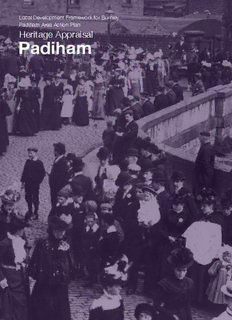
Front cover illustration: Lancashire Library photograph
Procession across Padiham Bridge before its widening in 1904.
1.0 Introduction 7.0 Character Area 5
1.1 Housing Market Renewal 2 7.1 Introduction 70
and Area Action Plans 7.2 Area Development 70
1.2 Heritage Appraisals 2 7.3 Pre 1919 Housing 70
7.4 Late 20th Century Housing 74
7.5 Industrial Buildings 74
2.0 Development of Padiham 7.6 Commercial Buildings and Shops 78
2.1 Physical Context and Location 4 7.7 Churches 81
7.8 Schools 81
2.2 Geology and Topography 4
7.9 Landmarks, Views and Green Spaces 82
2.3 Townscape 4
2.4 Historic Development 5
8.0 Character Area 6
3.0 Character Area 1 8.1 Introduction 84
8.2 Movement and Key Routes 84
3.1 Introduction 10
8.3 Industry 88
3.2 Housing Development 10
8.4 Residential Area: Housing, 89
3.3 Industrial Buildings 15
Shops and Public House
3.4 Commercial Buildings and Shops 16
8.5 Public Buildings 93
3.5 Public Houses and Inns 19
3.6 Clubs and Community Buildings 24 8.6 Landmarks, Views and Green Spaces 95
3.7 Churches 25
3.8 Schools 27
9.0 Character Area 7
3.9 Public Buildings 29
3.10 Landmarks, Views, Green Spaces 30 9.1 Introduction 96
and Trees 9.2 Movement and Key Routes 96
9.3 Former Municipal Buildings 96
9.4 Industrial Buildings 97
4.0 Character Area 2 9.5 Landmarks, Views and Green Spaces 98
4.1 Introduction 32
4.2 Area Development 32
10.0 Heritage Appraisal
4.3 Housing 32
4.4 Industry 36 10.1 Heritage and Future Regeneration 100
4.5 Landmarks, Views, Green Spaces 37
and Trees
Appendix A – Protected Features
Listed Buildings 102
5.0 Character Area 3 Conservation Area 102
5.1 Introduction 40 Locally Listed Buildings 102
5.2 Area Development 40 Tree Preservation Orders 103
5.3 Industry 40 Definitive Footpaths 103
5.4 Housing 46
Appendix B – References
5.5 Commercial Buildings 49
5.6 Schools 50 Published works 104
5.7 Churches 51 List of published references 104
5.8 Landmarks, Views, Green Spaces 51 Census 105
and Trees Building Control Records 106
Cartographic Evidence 106
List of maps 106
6.0 Character Area 4 Photographs 106
6.1 Introduction 52 Websites 106
6.2 Movement and Key Routes 53
6.3 Housing 56
6.4 Shops and Public Houses 64 Appendix C – Glossary of Terms 107
6.5 Churches and Schools 67
6.6 Landmarks, Views, 68
Green Spaces and Trees Plans
Plan A Area Action Plan Boundary,
Character Areas & Protected Features
Plan B Extent of Urban Development 1844
Plan C Ordnance Survey Map 1890
Plan D Ordnance Survey Map 1910
Plan E Ordnance Survey Map 1930
Plan F Heritage Appraisal
Produced by Burnley Borough Council
Planning Services
[t] 01282 425011 [x] 2541 / 2544
www.burnley.gov.uk/planning [email protected]
March 2007 Design by ‘The Graphics Unit’ [t] 01282 425011 [x] 2652
oneintroduction
1.1 Housing Market Renewal
1.1.1 Housing Market Renewal is the Government’s new approach to tackling low housing
demand and abandonment in the North of England and the Midlands. Nine sub-regional Market
Restructuring Pathfinder Projects have been created to bring about market renewal and tackle
associated high levels of crime and social exclusion. The East Lancashire Pathfinder includes
parts of Blackburn, Hyndburn, Burnley, Pendle and Rossendale.
1.1.2 Within Burnley Borough Council’s Pathfinder intervention area, Area Action Plans
(AAPs) are being prepared to guide the regeneration of areas which are considered to be
suffering from the worst deprivation and housing market failure.
1.1.3 It is important that this regeneration is informed by an understanding of the past. This
Heritage Appraisal has been undertaken in order to ensure that Padiham’s heritage is taken
into account in future housing market renewal and regeneration programmes.
1.2 Heritage Appraisals
1.2.1 The Importance of Heritage
Heritage encompasses not just buildings and streets but also gardens, parks, monuments,
industrial complexes, waterways and roads, archaeological sites and open landscapes. It is
estimated that only 5% of this resource is protected by statutory legislation. Our heritage also
includes languages, stories, traditions and foods. An awareness of heritage gives people and
places an identity and significance. It gives localities their distinctive character and marks their
individuality as neighbourhoods and as part of the wider town.
1.2.2 The Purpose of Heritage Appraisals
Elements of the borough’s historic environment are recognized as nationally or locally
important and are protected by law through statutory designation such as Listed Buildings
and Conservation Areas. However, the particular local historic character of a place is not
always marked by any of these formal designations, even though it is appreciated and well
known to local people. Heritage Appraisals are a method of recognising this special quality and
are now becoming an established approach in Conservation Planning.
1.2.3 Heritage Appraisals are being undertaken as part of the Area Action Plan (AAP)
process to ensure that regeneration proposals are informed by a sound understanding of the
heritage importance of the AAP areas and proper regard to their historic character and local
distinctiveness. The appraisals will show how seemingly mundane, normal or everyday historic
elements can contribute significantly to the overall quality and character of places or may be
interesting in their own right. Opportunities to retain or enhance the local character will be
identified through this process.
1.2.4 Heritage Appraisals offer an understanding as to how the historical evolution of
the AAP areas has shaped their present day character and the distinctive qualities of the
neighbourhoods. It is intended to use this understanding to guide regeneration proposals so
that they acknowledge and build on that character. Heritage Appraisals recognise that change
is desirable, but urge that it should respect, rather than detract from, the existing environment.
2 heritage appraisal
1.2.5 Heritage Appraisals provide an assessment of the elements which give the
neighbourhoods their distinctive character. These elements include:
• Historical development and associations
• Pattern of street layouts and historic transport routes – rail and road
• Activity and vitality of land-uses
• Building materials, styles and architectural detailing
• Quality and relationship of buildings
• Prominent landmarks, vistas and panoramas
• Setting and topography
• Trees, parks and open spaces
1.2.6 These elements may make a positive contribution or they may, in some instances,
detract from the area.
1.2.7 Heritage Appraisals will aim to:
• Assess the origins and development of areas to provide a good understanding of
the historic environment of the neighbourhoods and its role in modern life and local
communities.
• Define and evaluate the qualities which create the distinct character of areas, their
heritage resources and the contribution they make to the quality of the townscape.
• Identify opportunities to retain, strengthen and enhance local character and identity.
• Inform the redevelopment and/or renovation of areas in order to strengthen distinctive
local character and identity.
1.2.8 This approach reflects the importance of local character in the definition of sense of
place as emphasised in English Heritage’s policy statement The Power of Place (2001).
Rose Queen procession, Church Street, Padiham, 1908
(Lancashire Library photograph)
heritage appraisal 3
twothe development of padiham
2.1 Physical Context and Location
2.1.1 Padiham is one of a number of closely neighbouring settlements, which lie along the
valley of the River Calder and its tributaries. Padiham historically occupied an area on the
northern banks of the Calder with its historic centre lying 5 km west of Burnley. It expanded
across the river during the second half of the 19th century and currently forms part of the
modern parish of West Burnley.
2.2 Geology and Topography
2.2.1 The geology, topography and natural features of the area have influenced the
development and character of Padiham. The underlying solid geology of the area consists of
Lower Westphalian Coal Measures of the Carboniferous era, which contributed to the early
industrial exploitation of the area. The drift cover consists primarily of glacial till deposits.
The hills to the north and the higher land to the south of the town are formed of Carboniferous
sandstone (Mitchell et al, 2004, p. 9).
2.3 Townscape
2.3.1 Padiham’s townscape and identity are linked to the part it played in the textile
revolution. Although Padiham did not expand as rapidly as Burnley during this period, its
development has created a rich and unique historic environment. The transport routes (road
and rail), warehouses, bridges, mills, weaving sheds and chimneys, housing, schools and
shops associated with the industrial revolution still dominate Padiham’s townscape today
providing a visual illustration of the connection between the past and the present.
4 heritage appraisal
2.4 Historic Development
2.4.1 The name Padiham suggests its origin is derived from ‘Padda,’ a person’s name, and
the ‘ingham’ suffix. This suffix often denotes Anglo Saxon origin and may refer to the territory of
an Anglian kinship group (Mitchell et al, 2004, p17). Bennett has suggested that Padiham was
referred to as ‘Padingham’ in 1292, and ‘Padynngeham’ in 1311 (Bennett, 1946, p36).
2.4.2 Although Padiham is not mentioned in the Domesday Book, it was almost certainly
established as a small settlement on land overlooking the River Calder by 1068 (Glenn, 1989).
After the Norman conquest of 1066, the English feudal system was reorganised, and land
redistributed to Norman followers. The area of land in which Padiham was situated became
known as the Honor of Clitheroe with Clitheroe Castle as its administrative centre.
2.4.3 The Honor was divided into seven manors during the 12th century. These were
Ightenhill, Colne, Accrington, Tottington, Chatburn, Worston and Pendleton. Each manor was
made up of a number of vills (settlements). The Manor of Ightenhill was composed of the vills
of Burnley (and) Habergham, Padiham, Briercliffe with Extwistle, Little Marsden, Cliviger and
Worsthorne (Bennett, 1946, p56).
2.4.4 In 1258 the inhabitants of Padiham consisted of 8 cottars (often the poorer members
of society), 25 villeins (customary tenants), 9 or 10 tenants at will and 1 free tenant (a person
who is free from labour service to the Lord of the Manor). The Shuttleworth family appears to
have settled at Gawthorpe about 1389 (Bennett, 1946, p139).
2.4.5 Padiham probably grew because of its position at the crossing of the River Calder for
roads joining medieval settlements of Blackburn, Burnley, Clitheroe and Whalley (Mitchell et
al, 2004, p1). Before a chantry chapel was built in the mid 15th century, the main reason for
development of the settlement was probably the corn mill, first mentioned in 1253 (Victorian
County History of Lancashire, Vol 6, 1911). The layout of the later settlement probably lay
along a road running up the hill from the bridge over the River Calder towards St. Leonard’s
Church. A triangular area of open land was situated to the southeast of the church representing
the centre of the settlement (Plan B). This probably formed the early market area (Mitchell et
al, 2004, p17). The Honor became the property of the crown from c.1399–1660 and during this
time Padiham contained a church, market, fair, shops and alehouses.
2.4.6 Bennett has stated that the following roads and lanes were mentioned in Padiham in
1526, ‘one between Schole Bank and the Watergate of Padiham Hey (the old bridge near the
former Bridge End Mill), a second between Cross Bank and Townwall Bank, a third between
Hargove and the village and a fourth between Padiham and Tuacregate’ (Bennett, 1947, p249).
The introduction of the Highways Act in 1555 formally laid out the responsibility of parishes
and townships to maintain the roads within their boundaries and to appoint a Surveyor of the
Highways to oversee the work of those compelled to maintain and repair the roads (Glenn,
1990).
2.4.7 During the 16th & 17th centuries a new system of local government was imposed. It
was based on geographical areas of townships or parish rather than the manor (Glenn, 1989).
Padiham fell under the Parish of Whalley, which was further divided into townships with smaller
settlements attaching themselves to a mother township. The parishes and townships then
appointed officers to supervise local government. Padiham became the mother township for
Simonstone, Hapton and Heyhouses (Glenn, 1989).
2.4.8 During the early part of the 16th century the farming landscape began to change as
arable land, open pastures and wastes were enclosed. Although much of the population was
still concentrated within the settlement of Padiham itself, it is quite likely that new farms and
properties developed in the township as a result of the enclosures, which made the process of
agriculture more efficient. Farming remained the principal occupation but it is likely that almost
all the population of Padiham would have had an interest in textile work (domestic system) as
the woollen trade had become well established before 1600. In 1569 there were at least three
clothiers operating in the township (Mitchell et al, 2004, p. 1).
heritage appraisal 5
2.4.9 The 17th century saw the coal industry flourishing, although mining activity had first
been recorded in the vicinity of Padiham in 1434. Padiham colliery seems to have been in
existence by the mid 17th century (Mitchell et al, 2004, p.1). Other evidence of post medieval
industry includes smiths, milling, glazing, clothiers and shoemakers, indicating a diverse
economy (Glenn, 1989).
2.4.10 Padiham continued to develop in much the same way as Burnley during the 17th
century as both were trying to establish themselves as locally important markets. By 1650 the
population of Padiham comprised 232 families or 1,106 souls, whilst Burnley was thought to
have a population of 1,500 (Bennett, 1947, p250 & Bennett, 1949, p39).
2.4.11 By the 18th century the ‘King’s Highways’ or main roads that had connected towns
and markets from before and during the medieval period were no longer able to sustain the
increased load of traffic (Bennett, 1949, p.147). New roads, which were known as Turnpike
Trust Roads were constructed under an Act of Parliament during the 18th century. This enabled
private companies to purchase the necessary land and pay for surveyors, engineers, and
workmen as well as providing road-making equipment. These companies then collected a toll
from the users of the roads. In 1754, a private Act of Parliament permitted the building of a
new road to connect Blackburn, Burnley, Colne, Addingham and Cocking End. From Blackburn
the new turnpike followed the route of the present Church Street, Burnley Road and Padiham
Road, entering Burnley from Westgate (Bennett, 1949, p148 & Plan B).
2.4.12 At the time of the first census in 1801 there were 385 houses in Padiham with 417
families living in them (Haines & Jones, 1994, p1). The large estates of Huntroyde, located to
the north, and Gawthorpe to the east probably restricted the expansion of the settlement (www.
lancashire.gov.uk/oldmap).
2.4.13 The early 19th century saw the textile industry largely replace agriculture as spinning
and weaving in cottages became more important than work on the land. Although the
inhabitants of Padiham considered it to be a town by the late 18th century, largely on the basis
that it had an established market, outsiders regarded it as a village. This was not because of its
size but rather its lack of urban attributes, such as textile mills for example (Mitchell et al, 2004,
p21).
2.4.14 A Select Vestry was set up to administer local government to the town during the
early 1800s. Before its establishment there was no one to deal with health and sanitation or the
dark and muddy streets of the new housing developments, which were outside the jurisdiction
of the Surveyor of the Highways. The Vestry was able to pass bye-laws to deal with issues
such as sanitation and poor relief (Glenn & WEA, 1986, pp.7 & 9).
2.4.15 By the end of the 18th century there were one or two small spinning mills in the town
along with cotton handloom weavers’ cottages (Rothwell, 2005, p.4). By c.1800, handloom
weaving of cotton seems to have been the chief form of employment in the town. In the 1820s
the township officers estimated that there were 1241 looms between a population of 3060 or
691 families (Glenn & WEA, 1986, p.9). By 1841 Census records show that over 50% of the
population who gave their employment details were working in the textile industry, though
not necessarily in Padiham itself. However, the limited extent of cotton mill development was
viewed as one of the main reasons for the distress of the town’s people. In the early 19th
century Whittaker described Padiham as ‘the poorest village in Lancashire having for years
been dependent for its support almost entirely on handloom weaving, and of the coarsest and
worst paid fabrics’ (Mitchell et al, 2004, p.20). According to Bennett the wages of handloom
weavers around 1830 were ‘barely sufficient to maintain life’ (Bennett, 1949, p.239).
2.4.16 The late development of cotton mills in Padiham was due in part to its lack of rail
and canal links and its position between two landed estates whose landowners were not in
a position to sell land until after the mid 19th century. However, the growth of the population
between 1831 and 1861 from 3529 to 6914 can be attributed to the increased amount of
manufacturing industry in the town (Mitchell et al, 2004, p.25).
6 heritage appraisal
2.4.17 The Ordnance Survey (OS) map of 1844 shows the pre industrial settlement of
Padiham still lying within a confined area to the north of the river, comprising much of the
present day Conservation Area. Elements of the modern day street pattern are visible and
include Church Street, West and East Streets, Mill Street, Moor Lane and Grove Lane amongst
others (Plans A & B).
2.4.18 The extent of the industrial development up
until the mid 19th century included a small number of
gasometers and cotton factories including Old Mill in
Factory Lane (1807), Grove Mill (1830s) Smithygate
Mill (1834-5), Bridge End Mill (1836) and Claybank
Mill (used for powerlooms in 1848) (Rothwell, 2005).
Old Mill and Grove Mill survive today. Padiham Quarry
provided sandstone, rubble and ashlar and it is likely
that it supplied the local building material. Numerous
small coal pits lay to the north east of this quarry and
a colliery which was sunk in 1815 was to the south of
the river at Bankcroft (see Plan B).
Padiham Corn Mill was situated on the site of 59-64
Burnley Road (Lancashire Library Photograph).
2.4.19 In 1873 the Padiham and Hapton Local
Board was formed to oversee the increased amount
of new development within the town. From the 1860s
the town began to spread to the east and formed an
area of ‘gridiron’ terraced streets to house the local
workforce around Padiham Quarry and Grove Mill.
Better quality housing developed to the west and
south of Blackburn Road, but the most extensive
development was south of Padiham Bridge. This
mainly consisted of ‘gridiron’ terraced housing and
Padiham on the North Lancashire Loop (Marshall
mill buildings, built in anticipation of, and following,
1970).
the opening of the Padiham branch railway. This line,
also known as the Great Harwood or North Lancashire
Loop, was built between 1870 and 1877 and was
opened by the Lancashire and Yorkshire Railway in
stages forming an alternative route from Rosegrove to Blackburn.
2.4.20 By 1891 the population increased to almost 10,000 people living in 2,194 houses
(Haines & Jones, 1994, p.1). The 1890 OS map shows Padiham’s rapid expansion and, in
particular, the intense development of mills between Wyre St/Lune St and those following the
course of Green Brook, which were developed between 1850 and 1910. These mills include
Enterprise & Industry, Commercial, Wellington, Britannia, Riverside, Albert, and Jubilee
amongst others (Plan C).
2.4.21 The Padiham Urban District Council (PUDC) took over the administration of the
town in 1894 and the effects of their decisions are still visible today. A series of Public Health
Acts prompted the PUDC to work on the sewering, paving, flagging, channelling, and kerbing
of Padiham’s streets. The newly formed Building, Highway and Sewerage Committee was
concerned with new reservoirs, gas works, streets, schools, clubs, mills and stables amongst
many other projects. This Committee would have also overseen the development of new
housing, ensuring that it met Padiham’s bye-laws for minimum standards and density (Plan C).
2.4.22 By 1900 there were 22 cotton mills operating in Padiham, the majority of which were used
for weaving (Mitchell et al, 2004, p.26). This concentration of mills led to the development of ancillary
industries including engineering. The turn of the 20th century also saw the continued development of
the town, notably the infilling of terraced housing to the south of Padiham Bridge around Thompson
Street and Victoria Road, and the continued expansion of mill buildings.
heritage appraisal 7
2.4.23 Following a Government Act in 1909 the PUDC began to demolish a number of
properties within the town which were declared to be unfit for human habitation, whilst others
were brought up to a more modern standard. The PUDC was forced to find a solution to the
resulting housing shortage, a situation made worse when Padiham’s population peaked in
1911 at 13,637 (Haines & Jones, 1994, pp.35-6). After the First World War it was recognised
that hundreds of new homes were needed in the town and the PUDC prepared schemes,
resulting in the construction of Council built properties around Dryden Street. Further clearance
of properties during the inter war period saw the construction of further social housing around
Berkeley Crescent on the Garden Street estate and later properties developed on the Slade
Lane estate during the 1940/50s.
2.4.24 Since the 1950s building in the town has been limited to minor in-filling. Later
developments include the private housing estates at Waterside Mews, Hawthorn Fold (both
built on the sites of cleared mill buildings), and Town Hill Bank. As the town has not been
subject to large-scale change it has retained much of its architectural integrity.
2.4.25 Padiham can be divided into several distinctive character areas, which illustrate the
numerous stages of development within the town (Plan A).
Character Area 1: Padiham Conservation Area. Set on a bluff overlooking the River Calder, it
contains much of the town’s pre industrial development, including many statutorily and locally
listed buildings.
Character Area 2: Post war social and private housing estates of low density built to meet the
changing housing demands of the town during the 20th century.
Character Area 3: Industrial area of high density, stone built mills and housing constructed
between 1850 and 1910.
Character Area 4: Residential area of high density stone terraced housing built between 1860
and 1910 contained mainly within the boundaries of Burnley Road and the disused railway line.
Character Area 5: Area of high density terraced housing interspersed with mill buildings and
small pockets of new residential development, which probably developed as a result of the
railway.
Character Area 6: An area defined by the looping River Calder and the disused railway line,
it includes a large recreational area and a limited amount of late nineteenth century terraced
housing, former shops and public buildings which developed as a gateway to Padiham Station.
Character Area 7: A small corridor at the southern end of Park Road comprising mainly light
industrial and municipal uses. Bounded by the River Calder and allotments.
8 heritage appraisal
Description:Padiham exhibited many of the problems associated with rapid expansion. There was no way of dealing with the sewage which went into the river by stone drains and the