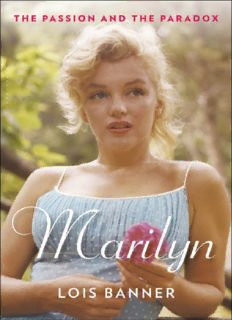
Table Of ContentMarilyn
The Passion and the Paradox
Lois Banner
Contents
Prologue: Let Us Now Praise Famous Women
Part I: The Matrix, 1926–1946
Chapter 1: Mothers, 1926–1933
Chapter 2: Trauma, 1933–1938
Chapter 3: Transcendence: Ana and Jim, 1938–1944
Chapter 4: Photographers and Producers, 1944–1946
Part II: Hollywood, 1946–1955
Chapter 5: Storming the Citadel, 1946–1951
Chapter 6: Marilyn Ascending, 1951–1954
Chapter 7: Breakaway, 1954–1955
Part III: Entr’acte: A Woman for All Seasons
Chapter 8: The Meaning of Marilyn
Part IV: New York, 1955–1960
Chapter 9: New York, 1955–1956
Chapter 10: Arthur, 1956–1959
Chapter 11: The Misfits, 1959–1960
Part V: Return to Hollywood, 1961–1962
Chapter 12: Denouement, 1961–1962
Chapter 13: Defiance and Death
Afterword
Photo Section
Acknowledgments
Manuscript Collections Consulted and List of Abbreviations
List of Interviewees
Notes
A Note on the Author
By the Same Author
To: Stacy Eubank, Mark Anderson, and
Greg Schreiner, with thanks and love.
Marilyn on subway grate; photo shoot for The Seven Year Itch, September 15, 1954. Photo by Sam Shaw.
Prologue
Let Us Now Praise Famous Women1
In one of the most famous photos of the twentieth century, Marilyn Monroe
stands on a subway grate, trying to hold her skirt down as a gust of wind blows it
up, exposing her underpants. The photo was taken in New York on September
15, 1954, in a photo shoot during the filming of The Seven Year Itch, which stars
Marilyn as a model and dog-faced Tom Ewell as a middled-aged editor of
raunchy books who is tired of his seven-year marriage and yearns for an affair
with a sexy “girl.” In the scene being shot, they leave a movie theater after
seeing The Creature from the Black Lagoon, a 1954 film about a prehistoric Gil-
man on the Amazon River who kills several members of the expedition sent to
capture him. It’s a hot summer night, and Marilyn stands over the grate to cool
off. A subway passing underneath supposedly produces the wind, which was
actually caused by a wind machine under the grate.2
In her white dress, white underpants, white high-heel sling-backs, and white
earrings, Marilyn is a vision in white, suggesting innocence and purity. Yet she
exudes sexuality and transcends it; poses for the male gaze and confronts it. Her
billowing skirt resembles wings. She might be a guardian angel from the
Christian tradition, an Aphrodite from the classical tradition, or a Nike
proclaiming victory in poetry or war, like the Winged Victory of Samothrace in
the Louvre Museum, with the wind blowing back Victory’s wings and chiton.
She might be an elegant ballerina on her toes or a working girl standing on the
Coney Island fun house ramp, where air gusts blew up the skirts of the women
on the ramp. Sam Shaw, who took the famed photo, derived Marilyn’s pose
from that setting, though the effect had long been used on the burlesque stage
and in pin-up photos to titillate men.3 Above all, The Seven Year Itch photo
reveals Marilyn’s complexities: her passion and her paradoxical nature, central
themes of this book.
The photo shoot was a publicity stunt, one of the greatest in the history of
film. Its time and location were published in New York newspapers; it attracted
a crowd of over a hundred male photographers and 1,500 male spectators, even
though it was held in the middle of the night to avoid daytime crowds. Klieg
lights lit the scene; spectators climbed to the roofs of buildings to get a good
view; photographers elbowed their way through the crowd to stake out the best
locations. Sam Shaw, the stills photographer for the movie, took the famous
photo, but the other photographers there shot hundreds of variations. So great
was the interest in all things Marilyn that barricades were put up, and police
were on hand to contain the crowd.
Billy Wilder, the film’s director, did fourteen takes—pausing between them
to let the photographers shoot. Every time Marilyn’s skirt blew up, the crowd
roared, especially those up front, who could see a dark blotch of pubic hair
through her underpants, even though she had put on two pairs of pants to
conceal it. The draconian 1934 Motion Picture Production Code, enforced by the
Production Board, forbade such a display. Any blotch of public hair in photos
from the shoot had to be airbrushed out.
Yet the scene in the shoot is naughty, with the phallic subway train, its blast
of air, and Marilyn’s erotic stance. Yet she is in control. She is the “woman on
top,” drawing from the metaphor for women’s power that runs through Euro-
American history. She poses for the male gaze, but she is an unruly woman—the
Mere Folle of medieval Carnivale; the white witch with supernatural powers; the
burlesque star in “an upside-down world of enormous, powerful women and
powerless, victimized men.” In the photo Marilyn is so gorgeous, so glamorous,
so incandescent—as her third husband, the writer Arthur Miller, described her—
that she seems every inch a star, glorying in her success.4 She can now defy the
people who had mistreated her: her father and mother, who abandoned her;
foster parents who abused her; Hollywood patriarchs who regarded her as their
toy; even Joe DiMaggio, then her husband, who physically abused her. Present
at the shoot, he stalked off in a fury when her skirt billowed up and revealed her
underpants. She had, indeed, dramatized her childhood dream of walking naked
over a church congregation, lying on their backs, eyes wide open, looking up at
her. It’s a powerful dream of exposure—and of a Marilyn in control.
But she holds down her skirt in the photo, suggesting modesty. In her only
discussion of the shoot—in a 1962 interview—she stated that she wasn’t
thinking about sex when she posed, only about having a good time. It was the
spectators, she claimed, who sexualized her. “At first it was all innocent and
fun,” Marilyn said, “but when Billy Wilder kept shooting the scene over and
over again the crowd of men kept on applauding and shouting, ‘More, more
Marilyn—let’s see more.” Then Billy bought the camera in close, focusing on
her crotch. “What was supposed to be a fun scene turned into a sex scene.”
“With her wry humor, Marilyn added “I hope all those extra takes are not for
your Hollywood friends to enjoy at a private party.”5
We are not accustomed to seeing Marilyn Monroe as being on top in any but the
most superficial way. We view her as irreparably damaged, too victimized to
have played much of a role either in launching her career or reinventing herself
on the silver screen. Nothing could be farther from the truth. The Marilyn that
emerges in Marilyn: The Passion and the Paradox is a woman who made herself
into a star, conquering numerous disabilities in the process, creating a life more
dramatic than any role she played in films. Her disabilities were many. She
suffered from dyslexia and from a stutter more severe than anyone has realized.
She was plagued throughout her life by dreams of monsters and witches,
horrible dreams that contributed to her constant insomnia and that I am the first
to describe. She was bipolar and often disassociated from reality. She endured
terrible pain during menstruation because she had endometriosis, a hormonal
condition that causes tissue like growths throughout the abdominal cavity. She
broke out in rashes and hives and eventually came down with chronic colitis,
enduring abdominal pain and nausea.
She surmounted all this, in addition to the well-known problems of her
childhood—a mother in a mental institution, a father she never knew, and
moving between foster homes and an orphanage. Playwright Clifford Odets
stated that “she always traveled with a dark companion.” People who saw “the
gorgeous substrata of her life could not even imagine on what subsoil her roots
were feeding.”6 Then there were the drugs she took to cope, once she entered
Hollywood and had to endure its pressures: she especially took barbiturates to
calm her down; amphetamines to give her energy.
Significant among my discoveries about Marilyn are her lesbian inclinations.
She had affairs with many eminent men—baseball great Joe DiMaggio,
playwright Arthur Miller, director Elia Kazan, actor Marlon Brando, singer
Frank Sinatra, the Kennedy brothers—and she married DiMaggio and Miller.
Yet she desired women, had affairs with them, and worried that she might be
lesbian by nature. How could she be the world’s heterosexual sex goddess and
desire women? How could she have the world’s most perfect body on the
outside and have such internal imperfections as endometriosis and colitis? Why
was she unable to bear a child? The adult Marilyn was haunted by these
questions.
Yet in her career she exhibited a rare genius. Publicists marveled at her
ability to generate publicity; makeup artists saluted her skill at their craft;
photographers rated her one of the greatest models of their age. She studied with
top acting, singing, and movement teachers to create her era’s greatest dumb-
blonde clown. Voluptuous and soft-voiced, the Marilyn we know exemplified
1950s femininity. Yet she mocked it with her wiggling walk, jiggling breasts,
and puckered mouth. She could tone her blonde bombshell image down, project
sadness in her eyes, and, like all great clowns, play her figure on the edge
between comedy and tragedy.
There were many Marilyns, not just one. Revealing and analyzing her
multiple personas is a major contribution of mine to Marilyn scholarship. As a
pin-up model early in her career she posed for her era’s most famous pin-up
photo—a nude that became the centerfold for the first issue of Playboy in
December 1953. By mid-career she created a new glamour look that combined
the allure of the pin-up with the aloof, mature sensuality of a glamour star of the
1930s like Greta Garbo. Another Marilyn had a talent for drama, evident in films
like Clash by Night (1952) and Bus Stop (1956) and in her poses for celebrity
photographers like Milton Greene and Eve Arnold. “Marilyn Monroe,” her most
famous alter ego, was one among many.
Marilyn was nothing if not complicated and in ways that has never been
revealed. She was shy and insecure, lacking self-confidence. But she was tough
and determined. She had an ironic and sometimes ribald wit, engaging in puns
and wordplay. She could swear like a trooper. She loved to play practical jokes.
I have discovered that she could be an eccentric who followed her own irrational
logic. She sometimes was a party girl who did “crazy, naughty, sexy things,”
including engaging in promiscuous sex, displaying what we now call “sex
addiction.”7 In her paradoxical manner, however, she covered untoward
behavior with a mask of good intentions, justifying her promiscuity through
advocating a free-love philosophy, which connected friendship to sex. That
philosophy circulated sub rosa among the avant-garde throughout the twentieth
century. In another guise she was a trickster who assumed aliases, wore
disguises, and lived her life as though it was a spy story, with secret friends and
a secret apartment in New York. “I’m so many people,” she told British
journalist W. J. Weatherby, “I used to think I was going crazy, until I discovered
some people I admired were like that, too.”8
A spiritual Marilyn, never before revealed, studied mystical texts. A radical
Marilyn pioneered the sexual revolution that erupted in the 1960s, appreciated
her roots in the working class, and honored the men who made her a star through
their fan mail—“the ordinary people, the working class, those who struggled
through wars and the Depression.” She opposed McCarthyite oppression and
supported racial equality. In a play on the term “black face,” Bruno Bernhard
wrote that the intellectual, radical Marilyn was hiding under “black lace.”9
Unlike all Marilyn biographers, except Gloria Steinem, I argue that the sexual
abuse she endured as a child was formative in molding her adult character. We
now know that such abuse can produce lesbianism, sex addiction, exhibitionism,
and an angry, frightened adult. It can fragment a personality, producing, in
Marilyn’s case, multiple alters, of which she was aware. However dominant,
“Marilyn Monroe” was only one persona among many that emerged from and
were created by the original Norma Jeane Baker before her name was changed
to Marilyn Monroe. That happened when Norma Jeane signed a contract with
Twentieth Century–Fox in August 1946 and began her ascent to stardom.
The 1950s was a paradoxical era. Americans were exuberant over victory in
World War Two and the booming consumer economy, while they were
frightened by the Cold War with the Soviet Union and the threat of nuclear
destruction, and paranoid about homosexuality and internal communism in the
United States. Marilyn’s comic style soothed the nation’s fears, while reflecting
the 1950s “populuxe” style in design, which spoofed consumption and laughed
at fears through a populist version of luxury. When she put on her Betty Boop
character, whom I call Lorelei Lee, she was populuxe to the hilt.
Her innocent eroticism and joy made her the ultimate playmate for men in a
postwar age worried about male feminization, as warriors became husbands with
the end of the war. Beyond feminization lay homosexuality, demonized in the
1950s as a perversion that threatened everyone. In her films Marilyn often plays
against an impotent man whom she restores to potency by praising his
gentleness as necessary to true masculinity, as she does for Tom Ewell in The
Seven Year Itch. In real life she often chose powerful older men as partners,
overlooking their domineering ways in her quest for a father, falling into sado-
masochistic behavior patterns again and again.
As an exemplar of her age, she relates to 1950s rock ‘n’ roll musicians and
beat poets that were forerunners to 1960s rebels, as did actors like Montgomery
Clift and Marlon Brando, who were both identified with new, rebellious acting
styles. From that perspective, joined with her support for sexual freedom, she
was a rebel pointing to the radicalism and sexual rebellion of the 1960s.
I was drawn to writing about Marilyn because no one like me—an academic
scholar, feminist biographer, and historian of gender—had studied her. I was
also intrigued by similarities between my childhood and hers. I grew up in the
1940s in Inglewood, California, a Los Angeles satellite city only a few miles
from Hawthorne, where Marilyn spent her first seven years. Her Hawthorne
family was fundamentalist Christian; so was my childhood family. Blonde and
Description:Like her art, Marilyn Monroe was rooted in paradox: She was a powerful star and a childlike waif; a joyful, irreverent party girl with a deeply spiritual side; a superb friend and a narcissist; a dumb blonde and an intellectual. No previous biographer has recognized � much less attempted to analyz