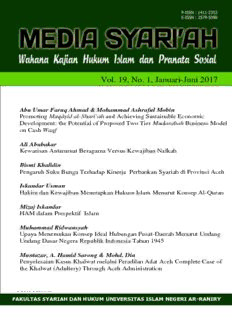
Table Of ContentVol. 19, No. 1, Januari-Juni 2017
Abu Umar Faruq Ahmad & Mohammad Ashraful Mobin
Promoting Maqāṣid al-Shari`ah and Achieving Sustainable Economic
Dev elopment: the Potential of Proposed Two Tier Mudarabah Business Model
on Cash Waqf
Ali Abubakar
Kew arisan Antarumat Beragama Versus Kewajiban Nafkah
Bismi Khalidin
Pen garuh Suku Bunga Terhadap Kinerja Perbankan Syariah di Provinsi Aceh
Iskandar Usman
Hakim dan Kewajiban Menerapkan Hukum Islam Menurut Konsep Al-Quran
Mizaj Iskandar
HAM dalam Prespektif Islam
Muhammad Ridwansyah
Upaya Menemukan Konsep Ideal Hubungan Pusat-Daerah Menurut Undang
Und ang Dasar Negera Republik Indonesia Tahun 1945
Muntazar, A. Hamid Sarong & Mohd. Din
Penyelesaian Kasus Khalwat melalui Peradilan Adat Aceh Complete Case of
the Khalwat (Adultery) Through Aceh Administration
NAMA PENULIS
FAJUKDUULLT AS SYARIAH DAN HUKUM UNIVERSITAS ISLAM NEGERI AR-RANIRY
MEDIA SYARI’AH
MEDIA SYARI’AH
Wahana Kajian Hukum Islam Pranata Sosial
Vol. 19, No. 1, 2017
EDITOR-IN-CHIEF
Ihdi Karim Makinara
EDITORS
Agustin Hanafi
Ali Abubakar
Analiansyah
Bismi Khalidin
Jamhir
Mijaz Iskandar
Mursyid
Mutiara Fahmi
INTERNATIONAL EDITORIAL BOARD
A. Hamid Sarong (Universitas Islam Negery Ar-Raniry, BANDA ACEH)
Al Yasa’ Abubakar (Universitas Islam Negery Ar-Raniry, BANDA ACEH)
Kamaruzzaman Bustamam-Ahmad (Universitas Islam Negery Ar-Raniry, BANDA ACEH)
Ridwan Nurdin (Universitas Islam Negery Ar-Raniry, BANDA ACEH))
ASISSTEN TO THE EDITOR
Ainun Hayati
Musliadi
Syarbunis
ENGLISH LANGUAGE ADVISOR
M. Syuib
ARABIC LANGUAGE ADVISOR
Fakhrurrazi M. Yunus
COVER DESIGNER
Ikhlas Diko
MEDIA SYARI'AH, is a six-monthly journal published by the Faculty of Sharia and Law of
the State Islamic University of Ar-Raniry Banda Aceh. The journal is published since February
1999 (ISSN. 1411-2353) and (ESSN.2579-5090) Number. 0005.25795090 / Jl.3.1 / SK.ISSN /
2017.04. earned accreditation in 2003 (Accreditation No. 34 / Dikti / Kep / 2003). Media
Syari’ah has been indexed Google Scholar and other indexation is processing some.
MEDIA SYARI'AH, envisioned as the Forum for Islamic Legal Studies and Social Institution,
so that ideas, innovative research results, including the critical ideas, constructive and
progressive about the development, pengembanan, and the Islamic law into local issues,
national, regional and international levels can be broadcasted and published in this journal.
This desire is marked by the publication of three languages, namely Indonesia, English, and
Arabic to be thinkers, researchers, scholars and observers of Islamic law and social institutions
of various countries can be publishing an article in Media Syari'ah
MEDIA SYARI'AH, editorial Board composed of national and international academia, part of
which are academicians of the Faculty of Sharia and Law of the State Islamic University of Ar-
Raniry Banda Aceh. This becomes a factor Media Syari'ah as prestigious journals in Indonesia
in the study of Islamic law.
Recommendations from the editor to scope issues specific research will be given for each
publishing Publishing in January and July.
Editor Office :
MEDIA SYARI’AH
Wahana Kajian Hukum Islam dan Pranata Sosial
Fakultas Syariah dan Hukum Islam UIN Ar-
Raniry Banda Aceh, Provinsi Aceh – Indonesia
Email: [email protected]
[email protected]
Webs: jurnal.ar -raniry.ac.id/index.php/medsyar
Telp.+62 (651)7557442,Fax. +62 (651) 7557442
HP : 0823 0400 8070
Table of Contents
Articles
1 Abu Umar Faruq Ahmad & Mohammad Ashraful Mobin
Promoting Maqāṣid al-Shari`ah and Achieving Sustainable
Economic Development: the Potential of Proposed Two
Tier Mudarabah Business Model on Cash Waqf
37 Ali Abubakar
Kewarisan Antarumat Beragama Versus Kewajiban Nafkah
59 Bismi Khalidin
Pengaruh Suku Bunga Terhadap Kinerja Perbankan
Syariah di Provinsi Aceh
87 Iskandar Usman
Hakim dan Kewajiban Menerapkan Hukum Islam Menurut
Konsep Al-Quran
111 Mizaj Iskandar
HAM dalam Prespektif Islam
127 Muhammad Ridwansyah
Upaya Menemukan Konsep Ideal Hubungan Pusat-Daerah
Menurut Undang Undang Dasar Negera Republik
Indonesia Tahun 1945
159 Muntazar, A. Hamid Sarong & Mohd. Din
Penyelesaian Kasus Khalwat melalui Peradilan Adat Aceh
Complete Case of the Khalwat (Adultery) Through Aceh
Administration
Promoting Maqāṣid al-Shari`ah and
Achieving Sustainable Economic
Development: the Potential of Proposed Two
Tier Mudarabah Business Model on Cash
Waqf
Abu Umar Faruq Ahmad
Mohammad Ashraful Mobin
Abstract: Islamic microfinance provides an alternative model for
a significant number of underprivileged people who are not served
by conventional microfinance. In order to give access to
sustainable services to a greater extent, the Islamic microfinance
is in paramount need of the adoption of innovative business
models and sound practices into the industry. To this end, the
research seeks to propose two tier mudarabah model based on
cash waqf as an alternative to Islamic microfinance institutions.
The objectives of the study are: to a) help develop and implement
an appropriate business model; b) safeguard the maqasid al-
Shari`ah so as to promote the well-being of the people through
establishing justice and eliminating hardship; and 2) help make a
reform in the present institutional framework for Islamic
microfinance and waqf institutions. The study finds that cash waqf
based microfinance institutions can play an important role inter
alia in financial inclusion and developing socio-economic
conditions of the poor and underprivileged people in society.
Keywords: Waqf, Maqasid al-Shari`ah, Microfinance, Poverty,
Two Tier Mudarabah
Media Syari’ah, Vol. 17, No. 1, 2015
2 | Abu Umar Faruq Ahmad & Mohammad Ashraful Mobin
1. INTRODUCTION
A
ccording to a recent World Bank report (as at 8 October
2014), there were 2.2 billion people lived on less than
USD2.00 per day (average poverty line in developing
countries) in 2011, compared with 2.59 billion people who lived
on the same amount in 1981. Although the number of people
living below the average poverty line has reduced by 15% from 20
year ago, this number still makes up of an alarming 30.6% of the
current world population of 7.2 billion. Out of those living below
average poverty line, as reported by the Islamic Development
Bank (IDB), 650 million are Muslims.
As part of the initiatives of addressing the poverty problem,
many international and national institutions have undertaken
programs to help countries provide better job opportunities to the
unemployed, and to promote microenterprises. The latter, which
normally turned away by conventional profit-orientated financial
institutions due to lack of collaterals, high transaction costs, and
fragile legal enforcement mechanisms, have been served by
microcredit and microfinance institutions (MFIs) since their
inception in the 1970s with phenomenal success. However, there is
an increasing trend for the Muslim microentrepreneurs turning to
Islamic microfinance Institutions (IMFIs) for Shari`ah complaint
financing taking into consideration of faithful Muslims‟ adherence
to their religious practice. According to IDB, the number of
customers of IMFIs though quadrupled in recent years has reached
to only 10, 00000 Muslims compared to the 650 million Muslims
who are below the average poverty line. There is an urgency for
the IMFIs to build capacity and capability in order to provide
Shari`ah compliant products to adherent Muslims who are in dire
need of Islamic microfinancing.
In Islamic economics and finance, there is a near consensus
at least in theory that out of all financial products and instruments,
Media Syari’ah, Vol. 17, No. 1, 2015
Promoting Maqāṣid al-Shari`ah and Achieving Sustainable Econom...…| 3
profit sharing instruments are the backbone of Shari`ah compliant
transactions, which is justified by the way any risk involved is
properly shared by the parties involved in the underlying contracts.
This risk sharing is highly consistent with the general spirit of
Islamic teachings. In this paper we will make a humble attempt to
propose a two tier mudarabah model for waqf based MFIs.
This research is designed to explore a cash waqf based
Islamic microfinancing model for adoption by the IMFIs to
finance the Muslim microentrepreneurs with the ultimate
objectives of poverty alleviation. The following will present the
findings of the previous study on microfinancing particularly in
Islamic microfinancing, the issues relating to the IMFIs, the
proposed cash waqf based Islamic microfinancing model, the
analysis of data from other established models, and conclusion of
the study on the effective of the proposed model.
1. The Rationale for Promoting Maqasid Al-Shari`ah
The key objective of Shari`ah lies in the principle of
eliminating agony, hardship and difficulty from people and
finding solutions to their problems. Emphasising this principle the
Qur‟an declares that Allah does not want to impose any hardship
on His servants, although the context of the relevant text illustrates
the rituals of ablution for prayer. The application of the contents of
the text is eternal. The verse reads: “Allah does not want to
impose any hardship on you, but wants to make you pure, and to
bestow upon you the full measure of His blessings, so that you
might have cause to be grateful.” (5: 6).
The objectives of Shari`ah have either been directly
mentioned in the Qur‟an and the Prophetic traditions (Sunnah), or
referred to them by some of the predecessors among the Muslim
jurists. These were recognised by almost all of them in order to
serve the common interests of entire human beings and to protect
Media Syari’ah, Vol. 17, No. 1, 2015
4 | Abu Umar Faruq Ahmad & Mohammad Ashraful Mobin
them from being harmed. For instance, the twelfth century Muslim
philosopher Al-Ghazali (d.1058AH/1111CE) classified the
maqasid into five key categories. He writes: “The very objective
of the Shari`ah is to promote the well-being of the people, which
lies in safeguarding their faith (dīn), their self (nafs), their intellect
(„aql), their posterity (nasl), and their wealth (māl). Whatever
ensures the safeguard of these five serves public interest and is
desirable.”
Al-Shatibi (d.790H/1388CE) endorses Al-Ghazali‟s five
key categories of maqasid al-Shari`ah, and point out that they are
the most preferable in terms of their harmony with the
fundamental nature of Shari`ah. However, mostly late and
contemporary scholars, have extended the scope of the maqasid to
embrace other vital objectives of Shari`ah. The Maliki jurist, Al-
Qarafi (d.684 AH/1285CE) has added the protection
of `ird (integrity) as the sixth objective of Shari`ah. Later, the
fourteenth century Ibn Taymiyyah (d.728AH/1327CE) was
perhaps the first scholar to depart from the perception of locking
up the maqasid to a definite number. He provides a broader
definition maqasid al-Shari`ah by adding the preservation of the
social order, promotion of the wellbeing and righteousness of the
community, preservation of the family, etc. to the previous list of
his predecessors. He asserts: “Both its general rules and specific
proofs indicate that the all-purpose principle of Islamic legislation
is to preserve the social order of the community and insure its
healthy progress by promoting the well-being and righteousness of
that which prevails in it, namely, the human species. The well-
being and virtue of human beings consist of the soundness of
their intellect, the righteousness of their deeds as well as the
goodness of the things of the world where they live that are put at
their disposal.”
Media Syari’ah, Vol. 17, No. 1, 2015
Description:which are academicians of the Faculty of Sharia and Law of the State Islamic University of Ar- models and sound practices into the industry. To this end Islamic banks. Cooperatives. Agencies. F in an cial in stru men ts. Mudarabah. Musharakah. Ijarah. Murabahah. Qard. Salam. Istisna'a. Istijrar.