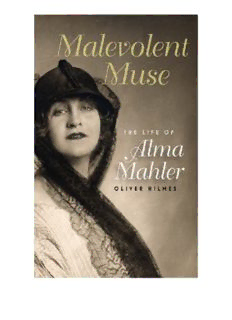
Table Of ContentOLIVER HILMES
Malevolent Muse
THE LIFE OF Alma Mahler
TRANSLATED BY DONALD ARTHUR
NORTHEASTERN UNIVERSITY PRESS
BOSTON
Northeastern University Press
An imprint of University Press of New England
www.upne.com
© 2015 Northeastern University
Originally published as Witwe im Wahn: Das Leben der Alma Mahler-Werfel, by Oliver Hilmes © 2004 by Siedler Verlag, a
division of Verlagsgruppe Random House GmbH, Munich, Germany
All rights reserved
For permission to reproduce any of the material in this book, contact Permissions, University Press of New England, One Court
Street, Suite 250, Lebanon NH 03766; or visit www.upne.com
Library of Congress Cataloging-in-Publication Data
Hilmes, Oliver, author.
[Witwe im Wahn. English]
Malevolent muse: the life of Alma Mahler / Oliver Hilmes: translated by Donald Arthur.
pages cm
“Originally published as Witwe im Wahn: Das Leben der Alma Mahler-Werfel. Munich, Germany: Siedler Verlag, [2014].”
Includes bibliographical references and index.
Summary: “The legendary life of the muse of geniuses, Alma Mahler-Gropius-Werfel”—Provided by publisher.
ISBN 978-1-55553-789-0 (cloth: alkaline paper)—ISBN 978-1-55553-845-3 (e-book)
1. Mahler, Alma, 1879–1964. 2. Vienna (Austria)—Biography. 3. Wives—Biography. 4. Mahler, Gustav, 1860–1911. 5. Gropius,
Walter, 1883–1969. 6. Werfel, Franz, 1890–1945. 7. Arts—Austria—History—20th century.
I. Arthur, Donald, translator. II. Title.
DB844.M34H5513 2004
780.92—dc23 [B] 2014038724
I should like to do a great deed.
ALMA SCHINDLER, 1898
CONTENTS
Prologue
1 Childhood and Youth
1879–1901
2 Mahler
1901–1911
3 Excesses
1911–1915
4 Marriage at a Distance
1915–1917
5 Love-Hate
1917–1930
6 Radicalization
1931–1938
7 The Involuntary Escape
1938–1940
8 In Safety—and Unhappy
1940– 1945
9 Last Refrain
1945–1964
Epilogue
Acknowledgments
Notes
Bibliography
Image Credits
Name Index
PROLOGUE
Alma Maria, née Schindler, widow of Mahler, divorced from Gropius, widow of Werfel, was,
from early youth, an extraordinary woman, one who remains highly controversial to this day.
For one camp she is the muse of the four arts; for the other an utterly domineering and sex-
crazed Circe, who exploited her prominent husbands exclusively for her own purposes. How
can one person provoke such paeans of love on the one hand and such tirades of loathing on the
other? Was she a muse for her partners, an inspiration for their works? Doubtless that is how
she would have liked to see herself. But will this self-portrait stand up to closer scrutiny? In
1995, in the Frankfurter Allgemeine Zeitung, the translator, author, and psychoanalyst Hans
Wollschläger called for a fundamental reassessment of this femme fatale from Vienna, “so that
she can be filed away once and for all. So many female companions remain silent in the
shadows of the great men in their lives, unjustifiably inconspicuous, inadequately
acknowledged; it’s time this vain, repulsive, brazen creature went in there, too.”1
Wollschläger, in his condemnation of Alma, could have referred to many judgments that
were no less negative on the part of her prominent contemporaries. For Theodor W. Adorno—
but never put in writing—she was “the monster”;2 the composer Richard Strauss diagnosed in
her “the inferiority complexes of a dissolute female.”3
The author Claire Goll wrote: “Having Alma Mahler for a wife is a death sentence,”4 an
allusion to the early demise of two of her husbands. Gina Kaus declared in an interview: “She
was the worst human being I ever knew.”5 At another point she found Alma simply “conceited
and stupid,”6 and Elias Canetti saw in her “a rather large woman, overflowing in all
directions, outfitted with a saccharine smile and bright, wide-open, glassy eyes.”7 Alma’s
fondness for drink—elegantly implied by Canetti—was likewise noted by Claire Goll: “To
compensate for her dwindling charms, she wore gigantic hats festooned with ostrich feathers: it
was impossible to know whether she was trying to impersonate a funeral horse pulling a
hearse or a new d’Artagnan. On top of that she was painted, powdered, pomaded, perfumed
and polluted. That oversized Valkyrie drank like a drainpipe.”8 No wonder, then, that this
misshapen Alma, “thanks to her exaggerated makeup and her curly-topped coiffure,”
occasionally reminded her of “a majestic transvestite.”9 Anna Mahler, Alma and Gustav
Mahler’s daughter, had a lifelong ambivalent relationship with her mother. “Mommy was a big
animal. I used to call her Tiger-Mommy. And now and then she was magnificent. And now and
then she was absolutely abominable.”10 Marietta Torberg, Friedrich Torberg’s wife, got right
to the heart of this dichotomy: “She was a grande dame and at the same time a cesspool.”11
But it is just as much a part of the phenomenon called Alma Mahler-Werfel that besides
these not exactly flattering appraisals, a number of enthusiastic, downright rapturous statements
are also on record. For her admirers, of which there were quite a few, the youthful Alma
Schindler was “the loveliest girl in Vienna.” “Alma is beautiful, is smart, quick-witted,”
Gustav Klimt rhapsodized to Alma’s stepfather. “She has everything a discerning man could
possibly ask for from a woman, in ample measure; I believe wherever she goes and casts an
eye into the masculine world, she is the sovereign lady, the ruler.”12 Oskar Kokoschka, who
entered Alma’s life a few years later, was enchanted by her. “How beautiful she was, how
seductive behind her mourning veil!”13 The biologist Paul Kammerer wrote Alma love-
besotted letters. “Your flaws are endless kindnesses, your weaknesses are incomprehensible
beauties, your languors are never-satiating sweetnesses.”14 To Franz Werfel she appeared
simply as “giver of life, keeper of the flame,”15 and Werfel’s mother allegedly called her
daughter-in-law “the only true queen or sovereign of our time.”16 The elderly writer Ludwig
Karpath assured Alma a few years before his death that, one day, “I shall take the warmest
memories of you with me to the grave.”17 Carl Zuckmayer and Friedrich Torberg admired in
Alma a “puzzling mixture of philanthropist and proprietress of a maison de rendez-vous—‘a
magnificent madame,’ as Gerhart Hauptmann once called her while admiringly shaking his
head.”18 Alma’s capacity for liquid refreshment, which many found repulsive, commanded the
high respect, on the other hand, of the no-less-capacious tippler Erich Maria Remarque: “the
woman, a wild, blond wench, violent, boozing.”19
Who was this woman, who for decades managed to fascinate or revolt so many more or
less famous people? The list of contemporaries—husbands, lovers, hangers-on, and satellites
—who crossed paths with Alma Mahler-Werfel over the course of her eighty-five years on
earth is long and reads like a “Who’s Who in the Twentieth Century.” Here is just a selection:
Eugen d’Albert, pianist and composer; Peter Altenberg, author; Gustave O. Arlt, German
philologist; Hermann Bahr, author; Ludwig Bemelmans, painter; Alban Berg, composer;
Leonard Bernstein, conductor and composer; Julius Bittner, composer: Franz Blei, author;
Benjamin Britten, composer; Max Burckhard, theater director; Elias Canetti, author; Franz
Theodor Csokor, author; Erich Cyhlar, legislator; Theodor Däubler, author; Ernst Deutsch,
actor; Engelbert Dollfuss, Austrian chancellor; Lion Feuchtwanger, author; Joseph Fraenkel,
physician; Egon Friedell, author; Wilhelm Furtwängler, conductor; Claire Goll, author; Walter
Gropius, architect; Willy Haas, author; Anton Hanak, sculptor; Gerhart Hauptmann, author;
August Hess, butler; Josef Hoffmann, architect; Hugo von Hofmannsthal, author; Johannnes
Hollnsteiner, priest; Paul Kammerer, biologist; Wassily Kandinsky, painter; Gina Kaus, author;
Otto Klemperer, conductor; Gustav Klimt, painter; Oskar Kokoschka, painter; Erich Wolfgang
Korngold, composer; Ernst Krenek, composer; Josef Labor, composer; Gustav Mahler,
composer and conductor; Golo Mann, author and historian; Heinrich Mann, author; Thomas
Mann, author; Willem Mengelberg, conductor; Darius Milhaud, composer; Georg Moenius,
priest; Soma Morgenstern, author; Kolo Moser, painter; Siegfried Ochs, conductor; Joseph
Maria Olbrich, architect; Eugene Ormandy, conductor; Hans Pernter, legislator; Hans Pfitzner,
composer; Maurice Ravel, composer; Max Reinhardt, director; Erich Maria Remarque, author;
Anton Rintelen, government official; Richard Schmitz, legislator; Arthur Schnitzler, author;
Arnold Schönberg, composer; Franz Schreker, composer; Kurt von Schuschnigg, Austrian
chancellor; Ernst Rüdiger von Starhemberg, legislator; Richard Strauss, composer; Igor
Stravinsky, composer; Julius Tandler, physician and politician; Friedrich Torberg, author;
Bruno Walter, conductor; Franz Werfel, author; Fritz Wotruba, sculptor; Alexander von
Zemlinsky, composer; Paul von Zsolnay, publisher; Carl Zuckmayer, author.
A woman who, throughout her life, was acquainted with so many important people, to all of
whom she had something to give, even though—impressively enough—they were as different
in character as Hans Pfitzner and Arnold Schönberg, Thomas Mann and Erich Maria
Remarque, or Walter Gropius and Oskar Kokoschka. As such, she was simply destined to
become a literary cult figure. Hilde Berger wrote a novel on the relationship between Alma
Mahler and Oskar Kokoschka, and Alma fans can refer to a few older biographies as sources
of background information. It may seem surprising at first that so many writers have concerned
themselves with this woman. Unlike the men in her life, Alma has not left behind any great
artworks that might prompt us to concern ourselves with her—no symphonies, no paintings, no
buildings, no poems or novels. Clout without creativity? She may have composed some pretty
little songs as a young girl, but she has only recently been perceived as a composer.
What remains of Alma Mahler-Werfel? Is it her tempestuous life with all its ups and
downs, triumphs and tragedies, pinnacles of glory and chasms of despair? Was Alma an
authentic “life-artist,” someone who laid hands on her own story and turned it into an artwork?
Or is all that remains of her that “bit of pelvis,” as Hans Wollschläger derided her? How can
one best do justice to this woman? By letting the most intimate fount of information in existence
bubble up: and that can be found in her uncensored diary entries.
My own investigation of Alma Mahler-Werfel started out with Mein Leben—that best-
seller, which is still available at bookshops, and which left its mark on our image of Alma for
generations. The protagonist appears there as a muse and bringer of joy to her men, one who
always had to give more than she took, and a helpmate who with wise foresight chose not to
have an artistic career of her own and lived totally to support the work of her partners. These
memoirs were hailed at their release as an uninhibited confession, to which the author’s sexual
prodigality made a sizable contibution. Forty years later they strike me as being loosely
patched together and occasionally scatterbrained; worse yet, the text seems somewhat
disjointed. Conspicuously, the book is not even divided into chapters. Besides this, some
episodes are given specific dates, while others are only vaguely attributed seasonal
descriptions like “in autumn” or “at a later time.” The reader is thus not in a position to delve
into a specific point in Alma’s life; time and space blur into a diffuse generality. Interestingly,
there are no entries in the index for Adolf Hitler or Benito Mussolini, although they are
mentioned several times in the text. On the other hand, people mentioned only once are
included in the index. An oversight? Or did the author possibly have something to hide? The
sequence of compactly worded reflections followed by banal everyday lore seems to suggest
that some portions of the text were not intended for publication. On closer inspection, this
mosaic character lends the book a somewhat unintentional comical quality. Overall, I had the
impression that Alma’s confession is a diary with subsequently inserted comments. Might Mein
Leben perhaps be a version of diaries long believed to have been lost to posterity?
“If you were planning to use my mother’s memoirs as a basis for your research, then you
should forget the whole project right here and now,”20 Anna Mahler advised Franz Werfel’s
biographer Peter Stephan Jungk. The main problem of an Alma Mahler-Werfel biography lies
in the more than confusing source materials. When Alma died in New York in December 1964,
she left behind a good five thousand letters written to her, countless postcards and photographs,
as well as several manuscripts. Through the intercession of Franz Werfel’s longtime friend and
publisher, Adolf D. Klarmann, this legacy went, four years after her death, to the Van Pelt
Library at the University of Pennsylvania in Philadelphia, where it remains stored to this day—
largely untouched—in forty-six archive boxes. The university quarter, on parklike grounds, is
only a stone’s throw from downtown Philadelphia. Many of the buildings on campus exude the
charm of long-forgotten times, with their typical country house architecture. Others, such as the
rather unadorned Van Pelt Library, are less inviting, utilitarian edifices. Anyone pursuing
studies of the humanities in Philadelphia is sooner or later destined to land in Van Pelt; a good
two and a half million volumes are housed in this library on Walnut Street, in addition to which
there are some thirteen thousand current newspapers and magazines from virtually every
country in the world. The quest for Alma Mahler-Werfel begins at the handwritten documents
department, which, strangely enough, is furnished differently from the rest of the library. While
the library’s façade, entrance, and catalog areas, as well as the countless magazine floors, have
the cool atmosphere of the 1960s, the sixth floor of the building, where the so-called special
collections are stored, is distinguished by massive wooden furnishings. I paid my first visit
there in the summer of 2000. I sat down at one of the tables in the reading room and waited for
the custodian of the Mahler-Werfel Collection. Diagonally across from me I discovered a bust
of Franz Werfel—a work by his stepdaughter Anna Mahler. The longer I contemplated the
artwork, the more intensely I was reminded of Elias Canetti’s not exactly flattering description
of Werfel’s “froggy eyes.” “It occurred to me,” Canetti wrote, “that his mouth resembled a
carp’s, and how well his very googly eyes fit in with that.”21 A short time later, Mrs.
Shawcross, the keeper of the collection, arrived, a lady of hard-to-determine age, pleasant and
helpful, and—a rather astonishing factor in view of her activity here—with no knowledge of
the German language. The reference guide, she warned me, was unfortunately not very reliable.
The contents had been rather sketchily inventoried several years ago, but nobody ever got
beyond that. An initial glance into the black notebook, listing Alma’s legacy, confirmed her
warning. Many of the typed pages contained handwritten additions and corrections, others
were spotted with fingerprints and barely legible, and still others were coming loose from the
binding. It quickly became clear that this reference guide would provide scant orientation, and
I would have to go through the material itself archive box by archive box. I have now done this
twice in all—once in the summer of 2000 and three years later in the summer of 2003. During
the several weeks of my stay in these special collections at Van Pelt Library, high above the
campus, under the mistrustful eye of the Werfel bust, I immersed myself deeply in Alma
Mahler-Werfel’s life. Attentive custodians, as a rule students at the university, brought me, one
after another, the cardboard cartons bearing a striking resemblance to sarcophagi—enclosing
Alma’s written remains. Countless letters came into my hands, among them ones written by
Alban Berg, Leonard Bernstein, Lion Feuchtwanger, Wilhelm Furtwängler, Gerhart
Hauptmann, Hertha Pauli, Hans Pfitzner, Arnold Schönberg, Richard Strauss, Bruno Walter,
Anton von Webern, to mention but a few. Walter Gropius’s and Oskar Kokoschka’s letters to
Alma have been preserved only as copies—the recipient appears to have destroyed the
originals. Several boxes contain innumerable photos, while still others are stuffed full of
memorabilia. In one of the boxes, I discovered Franz Werfel’s glasses, a travel alarm clock, a
letter opener, calling cards, maudlin pictures of saints, calendars, passports, baptismal
certificates, a telephone directory, and, curiously enough, one of Werfel’s cigarette holders,
complete with tobacco remnants.
Description:Of all the colorful figures on the twentieth-century European cultural scene, hardly anyone has provoked more-polarized reactions than Alma Schindler Mahler Gropius Werfel (1879–1964). Mistress to a long succession of brilliant men, she married three of the best known: the composer Gustav Mahler,