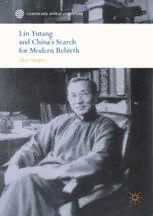
Table Of ContentCANON AND WORLD LITERATURE
Lin Yutang
and China’s Search
for Modern Rebirth
Qian Suoqiao
Canon and World Literature
Series editor
Zhang Longxi
City University of Hong Kong
Kowloon
Hong Kong
World literature is indeed the most exciting new phenomenon in liter-
ary studies today. It is on the rise as the economic, political, and demo-
graphic relationships and balances are changing rapidly in a globalized
world. A new concept of world literature is responding to such changes
and is advocating a more inclusive and truly global conceptualization
of canonical literature in the world’s different literary and cultural tra-
ditions. With a number of anthologies, monographs, companions, and
handbooks already published and available, there is a real need to have
a book series that convey to interested readers what the new concept of
world literature is or should be. To put it clearly, world literature is not
and cannot be the simple conglomeration of all the literary works writ-
ten in the world, but only the very best works from the world’s different
literatures, particularly literary traditions that have not been well stud-
ied beyond their native environment. That is to say, world literature still
needs to establish its canon by including great works of literature not just
from the major traditions of Western Europe, but also literary traditions
in other parts of the world as well as the “minor” or insufficiently stud-
ied literatures in Europe and North America.
More information about this series at
http://www.springer.com/series/15725
Qian Suoqiao
Lin Yutang and
China’s Search for
Modern Rebirth
Qian Suoqiao
Newcastle University
Newcastle upon Tyne, UK
Canon and World Literature
ISBN 978-981-10-4656-8 ISBN 978-981-10-4657-5 (eBook)
DOI 10.1007/978-981-10-4657-5
Library of Congress Control Number: 2017939888
© The Editor(s) (if applicable) and The Author(s) 2017
This work is subject to copyright. All rights are solely and exclusively licensed by the
Publisher, whether the whole or part of the material is concerned, specifically the rights
of translation, reprinting, reuse of illustrations, recitation, broadcasting, reproduction
on microfilms or in any other physical way, and transmission or information storage and
retrieval, electronic adaptation, computer software, or by similar or dissimilar methodology
now known or hereafter developed.
The use of general descriptive names, registered names, trademarks, service marks, etc. in this
publication does not imply, even in the absence of a specific statement, that such names are
exempt from the relevant protective laws and regulations and therefore free for general use.
The publisher, the authors and the editors are safe to assume that the advice and
information in this book are believed to be true and accurate at the date of publication.
Neither the publisher nor the authors or the editors give a warranty, express or implied,
with respect to the material contained herein or for any errors or omissions that may have
been made. The publisher remains neutral with regard to jurisdictional claims in published
maps and institutional affiliations.
Cover image: The Lin Yutang House, Taipei
Printed on acid-free paper
This Palgrave Macmillan imprint is published by Springer Nature
The registered company is Springer Nature Singapore Pte Ltd.
The registered company address is: 152 Beach Road, #21-01/04 Gateway East, Singapore
189721, Singapore
P
reface
This book is an intellectual biography of Lin Yutang, a study of China’s
search for modern cultural rebirth through the journey of an indi-
vidual. It came out of my own intellectual search for a “Father.” When
Chairman Mao died in 1976, I had just entered middle school. That
afternoon the whole school stopped to listen to The Central People’s
Radio for an important broadcast, and the whole class cried at the
melancholy announcement of the passing away of our “Dear Father”
Chairman Mao. I also cried and panicked at heart: what are we to do
now that we don’t have a Father? That was a most natural reaction
having grown up in the “iron house” of the proletariat dictatorship.
However, the post-Cultural Revolution Reform cracked some holes to
the “iron house” and some fish were able to leap out of the net. I am
one of the lucky fish. I made the first jump from a mundane southern
city to Beijing for college education, made the second jump out of the
suffocating capital to a new Special Economic Zone, and amazingly,
made the third jump to the other side of the Pacific—Berkeley. Once
overseas, or before that, my passion has always been about China, about
getting to the bottom of the question: why is it a fellow Chinese stu-
dent said to the Premier at Tiananmen Square in 1989: there is no hope
for China! Did China ever have hope? What was China? How did we
come to this situation? Undoubtedly, such obsession is very similar to
what C.T. Hsia dubbed as the “obsession of China” of the New Culture
and May Fourth generation of Chinese intellectuals, except my obses-
sion is on their generation who brought us the New China where I grew
v
vi PREFACE
up. On the other hand, carrying on the search “overseas” in the “free
world” allowed me to realize how much the West—the vanguard for
freedom and democracy—has been responsible for the making of the
“iron house,” not to mention the current “rise of China.”
I grew up in the “iron house” without hearing the name of Lin
Yutang until the late 1980s when the so-called “cultural craze” swirled
the nation. As if echoing the New Culture Movement in the early twen-
tieth century, the “culture craze” in the 1980s was a time calling for
“Westernization” and all kinds of “Western theory” were translated and
introduced to China—with an underlying urge to find alternative dis-
courses to the orthodox line of Marxism, Leninism, and Mao Zedong
Thought. As a fresh college graduate, I also participated in the cultural
enterprise by translating the ideas and work of Michel Foucault into
Chinese. And I also came across a book titled Zhongguoren, the Chinese
translation of My Country and My People, written in English by a Chinese
called Lin Yutang whom I had never heard of. I found a real fresh dis-
course therein on China and the Chinese but did not yet know what to
do about it. Besides, my interest was more in “Western theory,” which
I carried forward to Berkeley during the initial years. As my lived expe-
rience grew, however, I found it more and more difficult to combine
“Western theory” with a growing obsession with China at Berkeley.
There ought to be a “Chinese voice” in understanding modern China.
Upon my arrival at Berkeley, I had the good luck of finding a Teaching
Assistant job at the Ethnic Studies Department, teaching English
Reading and Composition classes using Asian American literary texts,
and there, I came across Lin Yutang again. Amazingly, in a standard text-
book on Asian American literature, Lin Yutang was considered as a pio-
neering “Chinese American” writer but denigrated at once not merely
for his un-American-ness but also apparently for his “political incorrect-
ness,” and the critical tone was not unlike that in the orthodox Marxist
line in modern Chinese literary historiography. I went to the Berkeley
library and checked out all of Lin Yutang’s books—some placed under
Asian Studies and some under American Studies categories. I thought I
had found a “Chinese voice” and was discovering what my father’s and
grandfather’s generations did to have brought about the New China.
That discovery, however, has taken more than two decades in
the making, and has brought some small fruits. My first book Liberal
Cosmopolitan: Lin Yutang and Middling Chinese Modernity (2011)
was an attempt to outline the “liberal cosmopolitan” discourse as an
PREFACE vii
alternative voice in Chinese modernity studies by highlighting the liter-
ary practices of Lin Yutang in the context of modern Chinese literary
and cultural criticism. It was more intended as a theory-oriented cross-
cultural critique, and certainly not as a biography. But before I had fin-
ished that book, I realized I must continue to write a biography of Lin
Yutang, this time as a personal case study in modern Chinese intellectual
history, which is the current book. In between, I have also successfully
organized an international conference on Lin Yutang study and edited
the conference volume The Cross-cultural Legacy of Lin Yutang: Critical
Perspectives (2015).
This intellectual search of mine, though a one man’s journey largely
against the academic fad of our times, has been most rewarding. Of
course, I have been told many times that the so-called “single-author
study” is out. Of course, I have seen how easily “Western theory” can
combine with speaking on behalf of contemporary China, the result of
which has produced a global alliance of the New Left once again domi-
nating contemporary Chinese intellectual scene unabashedly reclaiming
Chairman Mao as our “Dear Father.” But my discovery is my own lit-
tle treasure, and nothing is more rewarding for me to uncover a piece
of my own history. Moreover, individual as it is, my journey has been
blessed with many kinds of support from colleagues and friends—indeed
many friendships have come out of this journey. I have great pleasure to
acknowledge some of the kindness here.
As early as my dissertation years at UC Berkeley, Wen-hsin Yeh was
most generous in her support, and many years later when I visited her
at Berkeley in 2009, she was still more than generous in her encourage-
ment of my project. It was Yin Xiao-huang who first alerted me, when
I was a Mellon Fellow at Barnard College in 1997, to the existence of
the John Day Company archives at Princeton University which turned
out to be a turning point in my research, and I have benefited a great
deal from his kindness ever since. In New York in 1997, I also met Diran
John Sohigian who wrote the first Ph.D. dissertation on the life and
works of Lin Yutang in English, and our conversations have since carried
us to Taiwan and Hong Kong. In 2009 when I was a Fulbright Scholar
at Harvard University, I enjoyed delightful conversations on the life and
works of Lin Yutang with Charles Hayford, Jing Tsu, Chen Yong, and
Yu Maochun. Hsiang Ju Lin (Lin Xiangru, or Meimei Lin), Lin Yutang’s
third daughter, also kindly received me for an interview in her apartment
in Washington, DC. Shi-yee Liu at the Metropolitan Museum of Art also
viii PREFACE
warmly received me there and showed me the Lin Yutang family collec-
tion of Chinese paintings and calligraphy. And I won’t forget my delight
at seeing old The New York Times clippings of Lin Yutang’s articles hang-
ing on the wall of Chih-ping Chou’s office at Princeton University—I
knew I was in good company, and I appreciate very much the intellec-
tual companionship and encouragement Chou has kindly offered ever
since, particularly for the opportunity to present my work in progress at
Princeton University in 2014.
During my years at City University of Hong Kong, I enjoyed numer-
ous conversations with Chen Jianhua who was most generous in his
encouragement on the project. I also enjoyed conversations with Yang
Liu whose dissertation on Lin Yutang’s religious life was a major contri-
bution to the field. My project received two university strategic grants
with which my colleague Louisa Shi-yu Wei and I were able to trace Lin
Yutang’s global journey from China to the USA and Europe in a docu-
mentary. In 2011, thanks to the generous support by the City University
of Hong Kong, I successfully organized an international conference on
the cross-cultural legacy of Lin Yutang in China and the USA. It was a
most joyous occasion when more than a dozen Lin Yutang study scholars
around the world gathered and exchanged ideas that resulted in a criti-
cal volume. I benefited a great deal from these exchanges and would like
to thank all the participants including Wolfgang Kubin, Chen Zishan,
Charles Laughlin, Fang Lu, and Peng Chunlin. Most of all, I owe deep
gratitude to my senior colleague Zhang Longxi for his generous and
continuous support for my project.
My research has brought me several trips to Taiwan where I also met
tremendous kindness. It was very kind of Qin Xianci, the noted scholar
in Taiwan on Lin Yutang, to share the most valuable source materials
related to Lin Yutang. It was my great fortune to be a colleague with
Lung Ying-tai when she was a visiting scholar at City University of Hong
Kong, who kindly invited me to be a resident-scholar at The Lin Yutang
House in Taipei for a month. I have visited The Lin Yutang House
several times over the years, and I would like to thank Chia-fang Tsai
and other staff there for their warm hospitality and professional help.
Acknowledgement is due for the permissions to use some of the photos
of Lin Yutang from the The Lin Yutang House.
While this project started long before I moved to Newcastle
University in the UK, I was able to complete it here. I have made sev-
eral presentations on my ongoing work at Newcastle University, Durham
PREFACE ix
University, and University of Leeds, and would like to thank new col-
leagues and friends for their comments and encouragement. I also want
to thank the School of Modern Languages at Newcastle University for
the School Research Contingency Fund that covered the professional
editing service for this manuscript.
Acknowledgements are also due to Hong Kong University Press and
Institute of East Asian Studies, University of California, Berkeley, for
granting permissions for reprinting my previously published articles as
follows:
Chapter 4 “From ‘Little Critic’ to ‘Master of Humor’” is a revised
version of my article “Discovering Humor in Modern China: The
Launching of the Analects Fortnightly Journal and the ‘Year of Humor’
(1933)” previously published as a chapter in Humour in Chinese Life
and Letters (Hong Kong University Press 2011). The discussion on the
China League for Civil Rights therein has been rewritten and included in
Chap. 5 here.
Chapter 6 “‘My China’: The East Speaks to the West” is a slightly
revised version of my previously published “The Genesis and Reception
of My Country and My People,” Chap. 8 in The Cross-cultural Legacy
of Lin Yutang: Critical Perspectives (Institute of East Asian Studies,
University of California, Berkeley 2015).
Newcastle upon Tyne, UK Qian Suoqiao