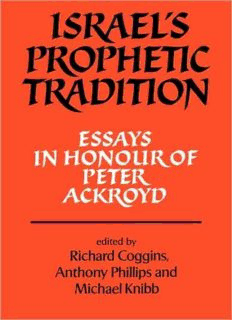
Table Of ContentIsrael's Prophetic Tradition
Israel's Prophetic Tradition
Essays in Honour of Peter R. Ackroyd
edited by
RICHARD COGGINS,
ANTHONY PHILLIPS
AND
MICHAEL KNIBB
The right of the
University of Cambridge
to print and sell
all manner of books
was granted by
Henry VIII in 1534.
The University has printed
and published continuously
since 1584.
CAMBRIDGE UNIVERSITY PRESS
Cambridge
New York New Rochelle
Melbourne Sydney
CAMBRIDGE UNIVERSITY PRESS
Cambridge, New York, Melbourne, Madrid, Cape Town, Singapore, Sao Paulo, Delhi
Cambridge University Press
The Edinburgh Building, Cambridge CB2 8RU, UK
Published in the United States of America by Cambridge University Press, New York
www.cambridge.org
Information on this title: www.cambridge.org/9780521242233
© Cambridge University Press 1982
This publication is in copyright. Subject to statutory exception
and to the provisions of relevant collective licensing agreements,
no reproduction of any part may take place without the written
permission of Cambridge University Press.
First published 1982
First paperback edition 1984
Reprinted 1988
Re-issued in this digitally printed version 2008
A catalogue record for this publication is available from the British Library
Library of Congress Catalogue Card Number: 81-17065
ISBN 978-0-521-24223-3 hardback
ISBN 978-0-521-31886-0 paperback
Contents
Preface page vii
Biographical note xi
Abbreviations xvii
Note xxi
Prophecy in the ancient Near East 1
HELMER RINGGREN, Professor of Old Testament Interpretation,
University of Uppsala
The origins of prophecy in Israel 12
J. R. PORTER, Professor of Theology, University of Exeter
Three classical prophets: Amos, Hosea and Micah 32
A. S. VAN DER WOUDE, Professor of Old Testament, University of
Qroningen
The Isaiah tradition 58
JOHN EATON, Senior Lecturer in Theology, University of Birmingham
An alternative prophetic tradition? 77
RICHARD COGGINS, Senior Lecturer in Old Testament Studies,
King's College London
Visionary experience in Jeremiah 95
WALTHER ZIMMERLI, Emeritus Professor of Old Testament,
University of Gottingen
The Ezekiel tradition: prophecy in a time of crisis 119
R. E. CLEMENTS, Lecturer in Divinity, University of Cambridge
The prophets of the restoration 137
REX MASON, Lecturer in Hebrew and Old Testament Studies, Regent's
Park College, Oxford
Prophecy and the emergence of the Jewish apocalypses 155
MICHAEL A. KNIBB, Lecturer in Old Testament Studies, King's
College London
Prophecy and wisdom 181
R. N.WHYBRAY, Professor of Hebrew and Old Testament Studies,
University of Hull
Prophecy and the cult 200
ROBERT MURRAY, Lecturer in Biblical Studies, Heythrop College,
University of London
Contents
Prophecy and law page 217
ANTHONY PHILLIPS, Chaplain and Fellow of St Johns College
Oxford
A change of emphasis in the study of the prophets 233
JOHN F. A. SAWYER, Reader in Religious Studies, University
of Newcastle-upon- Tyne
Martin Buber and the interpretation of the prophets 250
ULRICH E. SIMON, lately Dean of King's College London
Index of Biblical References 263
VI
Preface
Scholarly advance in the humanities often depends less upon sensational
new discoveries than upon the questioning and re-evaluation of what
had become unquestioned assumptions, and it is in this latter area that
Peter Ackroyd's especial contribution to Old Testament scholarship
will probably be judged to rest. From his doctoral thesis on the proper
criteria for Maccabean dating of the Psalms, through his questioning of
the accepted view of the exile and restoration and his dominant role in
bringing about a fresh evaluation of the achievement of the Chronicler,
he has insisted on asking the awkward questions and has perceived that
the underlying truth is always liable to be more complex than is allowed
for by any neat generalisation. The range of his Old Testament interests
is amply demonstrated by the bibliography of his published works
included in this volume; the one gap is that he has not yet had oppor-
tunity to write a major commentary, and his many friends will hope
that his retirement will provide such an opportunity. The Torch com-
mentary on Chronicles-Ezra-Nehemiah and the Cambridge pair on 1
and 2 Samuel give some indication of the riches that might be expected.
The world of Old Testament scholarship at large will make its own
assessment of Peter Ackroyd's achievement; the present editors owe
him a further debt as teacher and colleague. It is a recurring source of
amused satisfaction to observe undergraduate students, at first be-
wildered by the way in which his lectures make them question their
simple certainties, gradually being led to see depths they had not
previously imagined. Always an exacting teacher, he has responded
warmly and generously to the ideas of his pupils, whether in a student
essay or in the shaping of a thesis, and the seminar he has run at King's
College has long been a source of stimulation both for close colleagues
and for a stream of always warmly welcomed visitors.
His colleagues at King's have rightly valued his contribution to the
life of the college. He was the first elected Dean of the Faculty of
vn
Preface
Theology in its present form, and he has been a valued counsellor both
in the college as a whole and in the University of London, of whose
Senate and Academic Council he was a member from 1971 to 1980. A
host of other academic and administrative duties have come his way,
and these he has always carried out with skill and efficiency, though
perhaps not with unalloyed pleasure, for he has never been one of those
professors who seem to welcome opportunities to leave the subject they
profess to engage in administrative chores.
This note of appreciation would be sadly incomplete without some
brief reference to the personal friendship and hospitality that have
always characterised him. Students and colleagues alike have enjoyed a
series of agreeable occasions formerly at Herne Hill and more recently
in Westminster or in the family country retreat in Suffolk, and have
admired the closely-knit but always outward-looking family - Evelyn
engaged in the thankless tasks of a councillor in the London Borough
of Southwark, the five children now all over the country and gaining
distinction in the law and medicine and other professions. In wishing
Peter a long and happy retirement, we know that he will value the
additional leisure to see more of his family and to pursue his many other
interests but we know also that his mind will not be idle and that Old
Testament scholarship can look forward to many more challenging and
thought-provoking contributions.
A brief note on the background of the present volume may be helpful.
Too many Festschriften illustrate the variety of interests of their honor-
ands without any corresponding unity, and editors and publishers were
agreed from the outset that it would be important to produce a volume
that related to one recognisable theme. This decision may help to explain
the absence from the list of contributors of some whose interests have
lain in other fields. Furthermore, it was not feasible to invite any
American scholar to contribute and this has been a matter for some
regret; Peter Ackroyd's reputation in the United States is very high, as
the constant flow of invitations to lecture there which he has received
bears testimony. All these omissions still left the editors with an embarras
de richesse of scholars who might properly have been invited to con-
tribute to the present project, and they are most grateful for the ready
co-operation of those who have taken part. The contributions were all
completed by April 1980.
Finally, thanks are due to all those who have helped to produce this
volume: the contributors, all of whom produced their copy by the
viii
Preface
date requested, Mrs Lome Cox and Miss Catherine Chisholm of King's
College for secretarial assistance, the Syndics and stafFof the Cambridge
University Press for the ready way in which they have helped forward
the production of what, it is hoped, will prove a worthy tribute to a
distinguished scholar.
IX