Table Of Contentto
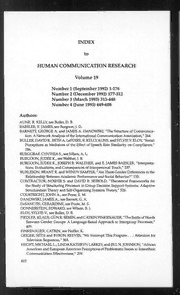
HUMAN COMMUNICATION RESEARCH
Volume 19
Number 1 (September 1992) 1-176
Number 2 (December 1992) 177-312
Number 3 (March 1993) 313-448
Number 4 (June 1993) 449-608
Authors:
AUNE, R. KELLY, see Buller, D. B.
BAESLER, E. JAMES, see Burgoon, J. D.
BARNETT, GEORGE A. and JAMES A. DANOWSKI, “The Structure of Communica-
tion: A Network Analysis of the International Communication Association,” 264.
BULLER, DAVID B., BETH A. LePOIRE, R. KELLY AUNE, and SYLVIE V. ELOY, “Social
Perceptions as Mediators of the Effect of Speech Rate Similarity on Compliance,”
286.
BURGGRAF, CYNTHIA S., see Sillars, A. L.
BURGOON, JUDEE K., see Walther, J. B.
BURGOON, JUDEE K., JOSEPH B. WALTHER, and E. JAMES BAESLER, “Interpreta-
tions, Evaluations, and Consequences of Interpersonal Touch,” 237.
BURLESON, BRANT R. and WENDY SAMTER, “Are There Gender Differences in the
Relationship Between Academic Performance and Social Behavior?” 155.
CONTRACTOR, NOSHIR S. and DAVID R. SEIBOLD, “Theoretical Frameworks for
the Study of Structuring Processes in Group Decision Support Systems: Adaptive
Structuration Theory and Self-Organizing Systems Theory,” 528.
COURTRIGHT, JOHN A., see Perse, E. M.
DANOWSKI, JAMES A., see Barnett, G. A.
DeSANCTIS, GERARDINE, see Poole, M. S.
DONNERSTEIN, EDWARD, see Wilson, B. J.
ELOY, SYLVIE V., see Buller, D. B.
FIEDLER, KLAUS, GUN R. SEMIN, and CATRIN FINKENAUER, “The Battle of Words
Between Gender Groups: A Language-Based Approach to Intergroup Processes,”
409.
FINKENAUER, CATRIN, see Fiedler, K.
GEIGER, SETH and BYRON REEVES, “We Interrupt This Program . . .: Attention for
Television Sequences,” 368.
HECHT, MICHAEL L., LINDA KATHRYN LARKEY, and JILL N. JOHNSON, “African
American and European American Perceptions of Problematic Issues in Interethnic
Communication Effectiveness,” 209.
602
to
HUMAN COMMUNICATION RESEARCH
Volume 19
Number 1 (September 1992) 1-176
Number 2 (December 1992) 177-312
Number 3 (March 1993) 313-448
Number 4 (June 1993) 449-608
Authors:
AUNE, R. KELLY, see Buller, D. B.
BAESLER, E. JAMES, see Burgoon, J. D.
BARNETT, GEORGE A. and JAMES A. DANOWSKI, “The Structure of Communica-
tion: A Network Analysis of the International Communication Association,” 264.
BULLER, DAVID B., BETH A. LePOIRE, R. KELLY AUNE, and SYLVIE V. ELOY, “Social
Perceptions as Mediators of the Effect of Speech Rate Similarity on Compliance,”
286.
BURGGRAF, CYNTHIA S., see Sillars, A. L.
BURGOON, JUDEE K., see Walther, J. B.
BURGOON, JUDEE K., JOSEPH B. WALTHER, and E. JAMES BAESLER, “Interpreta-
tions, Evaluations, and Consequences of Interpersonal Touch,” 237.
BURLESON, BRANT R. and WENDY SAMTER, “Are There Gender Differences in the
Relationship Between Academic Performance and Social Behavior?” 155.
CONTRACTOR, NOSHIR S. and DAVID R. SEIBOLD, “Theoretical Frameworks for
the Study of Structuring Processes in Group Decision Support Systems: Adaptive
Structuration Theory and Self-Organizing Systems Theory,” 528.
COURTRIGHT, JOHN A., see Perse, E. M.
DANOWSKI, JAMES A., see Barnett, G. A.
DeSANCTIS, GERARDINE, see Poole, M. S.
DONNERSTEIN, EDWARD, see Wilson, B. J.
ELOY, SYLVIE V., see Buller, D. B.
FIEDLER, KLAUS, GUN R. SEMIN, and CATRIN FINKENAUER, “The Battle of Words
Between Gender Groups: A Language-Based Approach to Intergroup Processes,”
409.
FINKENAUER, CATRIN, see Fiedler, K.
GEIGER, SETH and BYRON REEVES, “We Interrupt This Program . . .: Attention for
Television Sequences,” 368.
HECHT, MICHAEL L., LINDA KATHRYN LARKEY, and JILL N. JOHNSON, “African
American and European American Perceptions of Problematic Issues in Interethnic
Communication Effectiveness,” 209.
602
INDEX 603
JOHNSON, J. DAVID and HENDRIKA MEISCHKE, “A Comprehensive Model of
Cancer-Related Information Seeking Applied to Magazines,” 343.
JOHNSON, JILL N., see Hecht, M. L.
LARKEY, LINDA KATHRYN, see Hecht, M. L.
LePOIRE, BETH A., see Buller, D. B.
LINZ, DANIEL, see Wilson, B. J.
MARCHE, TAMMY A. and CAROLE PETERSON, “The Development and Sex-Related
Use of Interruption Behavior,” 388.
MEISCHKE, HENDRIKA, see Johnson, J. D.
NASS, CLIFFORD and JONATHAN STEUER, “Voices, Boxes, and Sources of Messages:
Computers and Social Actors,” 504.
OLIVER, MARY BETH, “Exploring the Paradox of the Enjoyment of Sad Films,” 315.
PERSE, ELIZABETH M. and JOHN A. COURTRIGHT, “Normative Images of Commu-
nication Media: Mass and Interpersonal Channels in the New Media Environment,”
485.
PETERSON, CAROLE, see Marche, T. A.
POOLE, MARSHALL SCOTT and GERARDINE DeSANCTIS, “Microlevel Structura-
tion in Computer-Supported Group Decision Making,” 5.
POTTER, W. JAMES, “Cultivation Theory and Research: A Conceptua! Critique,” 564.
REEVES, BYRON, see Geiger, S.
RICE, RONALD E., “Media Appropriateness: Using Social Presence Theory to Com-
pare Traditional and New Organizational Media,” 451.
SAMTER, WENDY, see Burleson, B. R.
SEGRIN, CHRIS, “Specifying the Nature of Social Skill Deficits Associated With De-
pression,” 89.
SEIBOLD, DAVID R., see Contractor, N. S.
SEMIN, GUN R., see Fiedler, K.
SILLARS, ALAN L., CYNTHIAS. BURGGRAF, SUSAN YOST, and PAULH. ZIETLOW,
“Conversational Themes and Marital Relationship Definitions: Quantitative and
Qualitative Investigations,” 124.
STEUER, JONATHAN, see Nass, C.
STIPP, HORST, see Wilson, B. J.
WALTHER, JOSEPH B., see Burgoon, J. D.
WALTHER, JOSEPH B. and JUDEE K. BURGOON, “Relational Communication in
Computer-Mediated Interaction,” 50.
WILSON, BARBARA J., DANIEL LINZ, EDWARD DONNERSTEIN, and HORST
STIPP, “The Impact of Social Issue Television Programming on Attitudes Toward
Rape,” 179.
YOST, SUSAN, see Sillars, A. L.
ZIETLOW, PAUL H., see Sillars, A. L.
Articles:
“ African American and European American Perceptions of Problematic Issues in Inter-
ethnic Communication Effectiveness,” Hecht et al., 209.
“ Are There Gender Differences in the Relationship Between Academic Performance and
Social Behavior?” Burleson and Samter, 155.
“The Battle of Words Between Gender Groups: A Language-Based Approach to Inter-
group Processes,” Fiedler et al., 409.
604 HUMAN COMMUNICATION RESEARCH / June 1993
“A Comprehensive Model of Cancer-Related Information Seeking Applied to Maga-
zines,” Johnson and Meischke, 343.
“Conversational Themes and Marital Relationship Definitions: Quantitative and Qual-
itative Investigations,” Sillars et al., 124.
“Cultivation Theory and Research: A Conceptual Critique,” Potter, 564.
“The Development and Sex-Related Use of Interruption Behavior,” Marche and Peter-
son, 388.
“Exploring the Paradox of the Enjoyment of Sad Films,” Oliver, 315.
“The Impact of Social Issue Television Programming on Attitudes Toward Rape,”
Wilson et al., 179.
“Interpretations, Evaluations, and Consequences of Interpersonal Touch,” Burgoon et
al., 237.
“Media Appropriateness: Using Social Presence Theory to Compare Traditional and
New Organizational Media,” Rice, 451.
“Microlevel Structuration in Computer-Supported Group Decision Making,” Poole and
DeSanctis, 5.
“Normative Images of Communication Media: Mass and Interpersonal Channels in the
New Media Environment,” Perse and Courtright, 485.
“Relational Communication in Computer-Mediated Interaction,” Walther and Burgoon,
50.
“Social Perceptions as Mediators of the Effect of Speech Rate Similarity on Compliance,”
Buller et al., 286.
“Specifying the Nature of Social Skill Deficits Associated With Depression,” Segrin, 89.
“The Structure of Communication: A Network Analysis of the International Commu-
nication Association,” Barnett and Danowski, 264.
“Theoretical Frameworks for the Study of Structuring Processes in Group Decision
Support Systems: Adaptive Structuration Theory and Self-Organizing Systems The-
ory,” Contractor and Seibold, 528.
“Voices, Boxes, and Sources of Messages: Computers and Social Actors,” Nass and
Steuer, 504.
“We Interrupt This Program . . .: Attention for Television Sequences,” Geiger and
Reeves, 368.