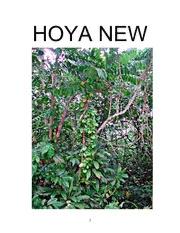
Table Of ContentNEW
HOYA
1
A
photo taken Samoa.
in
Oh
There
it is
!
A
pdf publication devoted to the Genus
Hoya ISSN 2329-7336
Volume
4 Issue 4
July 2015
Editor:
Dale Kloppenburg
Contents
When
a species is collected from the wild, I feel it is wise to identify
it, propagate it and name it. In this way it will eventually get it into
commercial channels, be distributed to all those interested in this genus and
thus be preserved. If in the future the species is lost through natural causes or
forest destruction it will still be here on earth in your collection.
Discussion: In New Hoya Vol. 3-1 two Hoya Section Eriostemma species were
transferred to the genus Eriostemma, this is a name change, the diagnosis and
descriptions do not change since they are the same plant only the name (Genus) has
changed.
The following new species are presented in PDF format with ISSN number.
Hoya uplandgrantensis Kloppenburg
1.
&
2. Hoya carandangiana Kloppenburg Siar
&
3. Hoya marananiae Kloppenburg, Siar, Cajano Carandang
2
Hoya uplandgrantensis Kloppenburg
ISSN 2329-7336
Hoya uplandgrantensis Kloppenburg sp. nova, holotypus 5965 (CAHUP) hie
designatus. Not eompletely like any existing Philippine hoya speeies although similar in
some respeets to several named speeies as mentioned below. Worked up 7/7/06. This new
hoya speeies is named for where it was eolleeted “UP Landgranf’ Determination: this is
not Hoya camphorifolia Warburg as labeled. Coronal lobes are here long and outer apex
aeute. Also the eoronal lobes here are horizontal not boat shaped. It appears elose to
Hoya merrillii Sehleehter 1904 in eorolla width and length and in the length ofthe eorona
lobes, however, the eoronal lobes appear not to be raised outward and the leaves are not
as wide; retinaeulum ratio to pollinium length is way off 1: 2.5 here vs. 1:5.3. 1 thought it
might be H. maegregorii Sehleehter 1906 as the ends of the eoronal lobes appear to be
blunt but the flower is too large; the outer eoronal lobes are not raised (they are
horizontal).
&
It appears not to be Hoya bicolensis Klopp. Siar although it is elose in some respeets
but way off in pollinarium and anther wing types.
Flower with no pedieel or ealyx. Flower yellow.
Inside surfaee of the eorolla enlarged about 8x.
Outer surfaee glabrous, inside pubeseent.
- em
Sinus sinus 0.24
- em
Sinus eenter 0.22
Sinus - apex 0.42 em
Apex - em
eenter 0.55
Widest 0.34 em
Inside view of flower enlarged about 8x.
Corona is horizontal. Inner lobe dentate outer
lobe aeute emarginate, glabrous.
Apex - apex 0.30 em
Apex - em
eenter 0.35
Widest 0.10 em
- em
Ret. ret. 0.08
- em
Ret. eenter 0.05
Aw. - aw. 0.16 em
Aw. - eenter 0.16 em
Anther wings protrude, dorsal seale eoneave with eentral longitudinal ridge.
3
Side view of a eoronal seale enlarged
about 16x. Anther wings are deeply seythe
shaped, inner lobe short and dentate, dorsal
horizontal, sides well rounded, outer apes
emarginate.
Bottom view of 2 eoronal seales, ehanneled to
thiekened eentral eolumn. Anther wings are thiek and
protrude from sinus.
Pollinarium enlarged
about 165x.
Pollinium
mm
length 0.46
mm
widest 0.18
Retinaculum
mm
length 0.14
mm
shoulder 0.10
mm
waist 0.05
mm
hip 0.08
mm
ext 0.06
Translator
mm
length 0.08
mm
depth 0.03
Caudicle
bulb diam. 0.05mm
Ratio Ret.- Poll.: 1:2.5
4
Translator/caudicle type: d/o
R
Pollinia ends:
Retinacula type: S
5
Hoya uplandgrantensis Kloppenburg cahup#5965
Labeled ineorreetly as Hoya eamphorifolia Warburg 1904
UfLII V.inint lli«nn'
jij.*. iw Ini FHlUPftNiai
^kH
6
Measurements from Herbarium sheet:
Foliage blade: 7.00 - 9.27 em long x 3.50 - 3.91 em wide and elliptie base euneate to
somewhat obtuse, apex aeute apieulate.
em
Petiole: 1.03 long
Peduncle: 2.23 em - 2.47 em long., nearly straight.
em - em
Internodes: 6.59 1 1.33 long with adventitious roots.
7
Hoya carandangiana Kloppenburg & Siar 2015
ISSN 1055-4564
&
Hoya carandangiana Kloppenburg Siar sp. nova, Typus 71845 (CAHUP) hie
designatus. Flores et pollinia parvulus, sed non viro in seeto Aeanthostemma nee seetion
mm
Otostemma. Corolla eomplanatus 0.84 em diametro et pollinia 0.21 longis.
Pedieellis globosus, glabrous, reetus 0.12 em. longis; ealyeis segmentis ovatus obtusis
glabris, subhyalina 0.12 em longis, ligulatis. Coronae foliolis apiee subreeurvo,
em
aseendentibus, dorso eoneavo, 0.15 longus et 0.07 latis, subtus longitudinaliter.
This hoya speeies is small in diameter (flattened) and with a small pollinia usually
assoeiated with some Seetion Aeanthostemma and Otostemma speeies but it is not in
these seetions. Colleetion number Quezon 3-105. This speeies is named to honor
UPLB
Jennelyn Carandang worker at the plant breeding program, Los Banos, Laguna,
Philippines. This new speeies is unique in having sueh a unusual pollinarium and is
unlike any other present Philippine hoya speeies.
Deseription details below:
Pedieel and ealyx enlarged ea. 18x.
Pedicel: strict, glabrous, terete, 1.20 cm long x 0.06 cm
in diameter.
Calyx: is small but apex of sepals reach the corolla
sinuses, avoid shape, ends obtuse, edges entire.
Calyx top view enlarged ca. 17x. Sepals are glabrous
inside and out, outside granulate; ligules present, 0.12 cm long
X 0. 10 cm at the widest.
cm
Ovaries: columnar, glabrous 0.09 tall; base pair 0.06
cm. wide.
8
Flower outside surfaee enlarged ea. 18x,
eorolla here is glabrous, deeply eut lobes, sepal
apiees just reaeh the eorolla sinuses.
em
Sinus- sinus 0.20
- em
Sinus eenter 0.15
Sinus - apex 0.30 em
Apex - eenter 0.42 em
Widest 0.25 em
Inside view of the flower enlarged ea. 12x. The
eorolla inside is puberulous. Coronal lobes just reaeh
the eorolla sinuses. Inner eoronal lobes toueh in eenter
are a little elongate round, dorsal is slightly eoneave
with a small umbo forward. Outer apex sub aeute
turned under slightly.
Corona: bottom (ventral) view enlarged ea.
50x. The lobes are ehanneled to near the elongated
eentral eolumn. Apex is turned down, anther wing
apiees are narrow, aeute and projeet slightly.
Apex - apex 0.15 em
Widest 0.07 em
em
Ret. -ret 0.05
- em
Ret. eenter 0.05
Aw. - aw. 0.10 em
Aw. - eenter 0.10 em
Side view of a eoronal lobe enlarged as above, outer lobe
is raised with apex reeurved, sides finely suleate. Inner lobes
meet in eenter or nearly so, dorsal eoneave with rounded edges
and small umbo forward.
9
Leaves: see measurements and pieture at end. Leaves are opposite, petiolate, elliptie,
apex aeuminate, base obtuse, plinerved with nerves visible above, surfaees glabrous,
petiole round.
* One reviewer felt this belonged to H. eamphorifolia but its flower does not fit any
eharaeter ofthat speeies.
Pollinaria enlarged about 190x. These are extremely small Pollinia. They were diffieult to
extraet, very loose in positions, the (elear) area in from pellueid edge is relatively wide,
pellueid edge extends to the inner apex. Translator/caudicle Type p/o
Pollinium Retinaculum
mm mm
length 0.21 length 0.07
mm mm
widest 0.09 shoulder 0.09
10