Table Of ContentLLECTION CONTEXT
IN
PARIS
IN
m
JUNE SEPTEMBER
1993
2 3 19,
-
"Hopper in Paris" is the first in a series of exhibitions featuring key works in the
Whitney Museum's Permanent Collection. The art presented in this series will
sometimes constitute well-known icons, sometimes underrecognized gems. We
hope that the intimate scale and thematic specificity of these exhibitions will
encourage concentrated viewing and reflection as well as offer the pleasure of
discovery.
The purpose of the series is not to isolate the works exhibited but rather to
set them in two different but related contexts: first, as products of their original
time and place; second, in terms of their relevance to contemporary critics and
today's audiences. For this reason, guest curators, artists, and critics will
participate in a number of the
exhibitions, providing fresh voices and
a variety of viewpoints that will help
resituate these works in the history of
twentieth-century American art.
"Hopper in Paris" is an appropriate
initiation for this series since Edward
Hopper 889-1 967) has long been
(1
identified with the Whitney Museum
and its collection. He had his first one-
artist exhibition in 1920 at the Whitney
Studio Club, a precursor to the Whitney
Museum, and his paintings were
included in the first Whitney Biennial
Exhibition and in numerous subsequent
Annuals and Biennials. Early Sunday
Mornin*g (1930) entered the collection
Paris, 1906
as part of a core group of works
purchased in advance of the Museum's opening in 1 93 1 . In 1 970 the Museum
received Hopper's entire artistic estate as a bequest from his widow, Josephine
Nivison Hopper. Consisting of more than 2,500 oils, watercolors, drawings, and
prints, ranging from Hopper's student days to his later years, it is the largest gift
in the history of the Museum.
"Hopper in Paris," highlighting the artist's first serious body of work, is one
of several "Collection in Context" exhibitions to be devoted to Hopper in coming
We
years. are grateful to Richard R. Brettell, consulting director of the Dallas
Museum of Art and noted scholar on Impressionism, for his fresh appraisal
of Hopper's little-known Parisian work.
Adam D. Weinberg
Curator, Permanent Collection
This exhibition is sponsored by the Lobby Gallery Associates
Edward Hopper tried later in his life to downplay the significance of his early
travels to Paris, and many "Americanists" have joined him in this stubborn and
independent provincialism. Yet, for any "Europeanist," the Paris trips of
906-07 and 909 were of critical importance, not just for what he made
1 1
(which was of considerable quality and originality), but also for what he saw,
read, heard, and experienced. Indeed, Hopper's entire aesthetic of urban
alienation and isolation as well as his virtual obsession with architecture might
very well have stemmed from the time he lived essentially alone in the great
French capital, with only marginal spoken French, and without a cadre of
sympathetic friends.
When he arrived in Paris in October 1906, Paul Cezanne had just died, and
the great Salon d'Automne—with its three full-scale retrospectives devoted to
Gustave Courbet, Eugene Carriere, and Paul Gauguin, respectively—was in full
tilt. Luckily, Hopper had a place to stay with a French family on the rue de Lille
in a quiet Left Bank neighborhood known for its art shops, galleries, old streets,
and studios. The Louvre was a five-minute walk across the Seine, and the
Musee du Luxembourg, with displays of pompous contemporary art, was only
a little further in the opposite direction. The huge exhibition galleries of the
Grand Palais were fifteen minutes to the west, and Hopper undoubtedly went
there immediately to see the Salon d'Automne.
We can only imagine how overwhelmed Hopper must have been by that
exhibition. The chance to see more than a hundred works each by Courbet and
Gauguin would in itself have been worth the long ocean crossing. Yet the
simultaneous encounter with numerous paintings by Henri Matisse, Andre
Derain, Albert Marquet, Henri Manguin, Maurice Vlaminck, and other young
Fauve landscape painters must have been a kind of visual assault on the young
American.
Hopper's own first works show a real resistance both to Fauve painting and
to its most important source, the aesthetics of color exaggeration practiced by
Gauguin. In fact, the first paintings Hopper produced are virtually
monochromatic studies of the constricted streets and staircases where he lived.
They are painted on small panels and none contains figures or even signs of life.
Indeed, they look more like the stark interiors of the Danish painter Vilhelm
Hammershoi than anything he saw at the Salon d'Automne!
Like all expatriates, Hopper was introduced to Paris by fellow countrymen.
His friend Guy Pene du Bois, with whom he had studied at the New York School
of Art, had arrived the previous year. There is little doubt that the bilingual
Pene du Bois was the one who had encouraged Hopper to go to Paris and, once
there, provided him with advice and perhaps even introductions.
But it was the presence in Paris of another friend from his New York classes,
Patrick Henry Bruce, that gave the shy Hopper direct access to all the private
galleries as well as to the most adventurous collectors in Paris. Indeed, all
evidence indicates that Patrick Henry Bruce himself was making his entrance
into the brilliant international society around Gertrude and Leo Stein during the
early part of 1 907, just months after Hopper arrived in France. Compared to
Hopper, Bruce was a perfect expatriate—wealthy, recently married, easy with
the language, and socially adaptable. Hopper, by contrast, was resolutely
middle class, uneasy in French, and reticent. Despite Bruce and Pene du Bois,
Hopper's time in Paris must have been typical of that of many foreigners who
live alone, wander on their own, and become oddly comfortable both with their
own nationality and with their alienation from France.
Most of the superb paintings Hopper did on the 906-07 trip were made
1
on the quais along the Seine near his apartment. Unlike the Fauve painters who
surveyed the Seine from above as part of an urban panorama, Hopper either
couldn't afford or was unable to find a river bank studio. As a result, his
paintings are earthbound, clinging to the quais, the city looming above or
spreading laterally. His viewers look up at the bridges, and his barges and boats
crowd the foreground, pushing toward the viewer and blocking access to the
middle ground. In Bridge in Paris, the best of the small panel paintings of the
autumn of 906, Hopper crowds a bridge onto the pictorial surface. He located
1
himself on the edge of its deep, recessive arch and staked the entire picture on
the interplay between the dark gray-browns of the bridge and the brilliant red
circle of a newly installed stop sign for boats. cannot think of a single French
I
riverscape that dares so much on a single pictorial decision—and succeeds.
As if in partial response to the Salon d'Automne and to the many other
exhibitions in Paris, Hopper's canvases of late 1906 and early 1907 became
larger, lighter in tonality, and more confidently painted than the small 1906
panels. The sludgy yellow-green water of the Seine dominates most of the
foregrounds, and the city itself is arranged across the pictorial surface with a
simple, geometric clarity unseen in French cityscapes until Matisse's later Paris
views of 1 91 1 -1 2. Hopper was also almost aggressive in his avoidance of the
brilliant palettes of the young French painters. Indeed, only the controlled,
restricted palettes and simple pictorial organizations of Marquet, whose work
Hopper saw not only at the Salon d'Automne, but also in a large one-artist show
at the Druet Gallery in February 1907, seem to have appealed to the young
American.
The spring of 907 apparently liberated Hopper's brush. His productivity
1
and the size of his paintings increased, as did their force. The starkest of them,
Le Pare de Saint-Cloud, cannot be connected with the work of any of the
Fauves. Only in certain Cezannes of the 870s does one feel a comparably
1
rigorous composition. None of these, however, was exhibited in the first great
Cezanne retrospective at the Salon des Independants in March-April 907.
1
In fact, Hopper's painting is so startlingly bold and original that art historians
struggle to find prototypes. It is easier to link this geometric pictorial ordering
with much later images by Fairfield Porter and Richard Diebenkorn than it is to
find parallels in any earlier or contemporary French paintings.
Are Hopper's paintings therefore "American"? The answer is most probably
yes. No Frenchman was quite so easily capable of perceiving Paris in so
structured or diagrammatic a way; and no matter how orderly and "abstract"
certain Nabis and Fauve paintings of Paris seem to be, they always somehow
register as "Parisian." By contrast, Hopper's paintings are "Paris" without being
in the least "Parisian."
Perhaps the most startling demonstration of this ambivalence is Le Bistro
of 909. Here, Hopper represents the Quai Voltaire looking west down the
1
Seine toward the Pont Royal. Various Fauve artists had painted this area
of Paris, but none of them approach Hopper's defiant rejection of the beauties
and subtleties of the great capital. A young man and a woman sit alone at a
table in what surely must be the Cafe Voltaire. The table seems almost to sit on
the street, which is empty of any vehicular or pedestrian traffic and shines
blindingly white in midday light. The buildings themselves are in deep shadow,
in contrast to those further down
river, which face the same
direction but are lit as if by a
solar search light. What viewer
who had never been to Paris
would recognize this place, would
know that no trees remotely like
these oddly Tuscan tubes could
ever have grown there? And
who would imagine that the pale
purplish-blue lozenge just above
the bridge to the right is, in fact,
Le Pavilion de Flore, 1 909 the glorious rows of trees in the
Tuileries Gardens?
Upon his return to America, Hopper is reported to have said that "it seemed
awfully crude and raw here when I got back. It took me ten years to get over
Europe." One wonders just what he meant when he implied that he needed to
"get over Europe." And why ten years. Oddly, 1919 was the end of World War
I,
a war centered in Europe and experienced safely by Hopper in the United
States. Moreover, all evidence indicates that Hopper was not "over Europe"
even in 1919. In fact, his first one-artist show of 1920 included sixteen
paintings, eleven of which had been painted at least a decade earlier in France!
And a beautiful Christmas drawing made in 1 923 for his future wife, Josephine
Nivison, represents a couple at a large window contemplating a twilight
panorama of Paris dominated by the towers of Notre Dame. Below the drawing
is an evocative quotation from the French Symbolist poet Stephane Mallarme.
There is little doubt that much of Hopper's aesthetic was forged as an
expatriate in France. His letters home, with their vivid descriptions of Paris
streets, carnivals, and cafes ("The people here seem to live in the streets, which
are alive from morning to night..."; "everyone goes to the Grands Boulevards
and lets themselves loose..."), contrast so utterly with his paintings of urban
emptiness that one must remember that the missives were meant to reassure
his mother. Decades later, Hopper spoke with the critic Brian O'Doherty:
"Whom did I meet in Paris? Nobody....I used to go to the cafes at night and
sit and watch. went to the theater a little. Paris had no great or immediate
I
impact on me."
Yet the paintings indicate the opposite. Virtually every aspect of Hopper's
later oeuvre finds its roots in Paris, and the surviving student work done in
New York before his Parisian experience seems today almost as the work of
another artist. Like many expatriate painters, Hopper could become himself
in Paris because he had the time alone to think and paint and because he
did that thinking and painting in
such a challenging environment.
Very few great American painters
of the twentieth century were
able to see as much important
French art in so short a time as
Hopper, and virtually everything
Hopper himself said about art
in later years evolved from French
aesthetics of the Impressionist
and Post-Impressionist periods.
In 945, he wrote a short essay
1
Notre Dome, No. 2, 1 907 that defined his painting. "My
aim in painting," it begins, "has always been the most exact transcription
possible of my most intimate impressions of nature." A little later in the essay,
he said that "great painters, with their intellect as master, have attempted to
force this unwilling medium of paint and canvas into a record of their emotions."
Either of these sentences could have been written by Pissarro or Cezanne or
even Matisse!
It is time now to look afresh—and in a truly international way—at Hopper's
Paris years, to read and reread his letters, to attempt a better chronological
arrangement of the paintings than the one we have now, to better analyze the
exhibitions he saw, and to consider the ways in which Hopper himself exhibited
and "used" these works later in his career. Indeed, Paris was perhaps more
important for American art in the years before the Great War than it had ever
been, and Hopper, for one, became a great American artist in Paris.
Richard R. Brettell
Works in the Exhibition Cunard Sailor, 1906-07 Le Pont des Arts, 1907
Watercolor on composition Oil on canvas,
Dimensions are in inches; board, 14 13/16x105/8 23 1/16 x 28 1/16
height precedes width. Josephine N. Hopper Josephine N. Hopper
All works are from the Bequest 70.1335 Bequest 70.1 181
Permanent Collection
of the Whitney Museum FilledeJoie, 1906-07 Pont du Carrousel in the Fog,
of American Art. Watercolor on composition 1907
board, 11 13/16x9 7/16 Oil on canvas,
Bridge and Embankment, Josephine N. Hopper 23 1/4 x 28 1/4
1906 Bequest 70.1324 Josephine N. Hopper
Oil on wood, 13x9 1/4 Bequest 70.1245
Josephine N. Hopper Parisian with Wine Bottle and
Bequest 70.1298 LoafofBread, 1906-07 Tugboat at BoulevardSaint
Watercolor and graphite on Michel, 1907
Bridge in Paris, 906 composition board, Oil on canvas,
Oil on wood, 9 51/8 x 13 15x101/2 23 3/4 x 28 5/8
Josephine N. Hopper Josephine N. Hopper Josephine N. Hopper
Bequest 70.1329 Bequest 70.1250
Bequest 70.1305
Interior Courtyard at 48 rue Canal at Charenton, 1 907 Le Bistro or The Wine Shop,
de Lille, Paris, 1 906 Oil on canvas, 1909
Oil on wood, 13x95/8 23 1/4 x 28 1/4 Oil on canvas,
Josephine N. Hopper Josephine N. Hopper 23 3/8 x 28 1/2
Bequest 70.1304 Bequest 70.1246 Josephine N. Hopper
Bequest 70.1 187
Paris Street, 906 Gateway and Fence,
1
Oil on wood, 13x93/8 Saint-Cloud, 1907 Ecluse de la Monnaie, 1 909
Josephine N. Hopper Oil on canvas, 23 x 28 Oil on canvas, 23 1/4 x 28
Bequest 70.1296 Josephine N. Hopper Josephine N. Hopper
Bequest 70.1231 Bequest 70.1 78
1
Stairway at 48 rue de Lille,
Paris, 1906 Louvre and Boat Landing, Le Pavilion de Flore, 1 909
Oil on wood, 13x9 1/4 1907 Oil on canvas,
Josephine N. Hopper Oil on canvas, 23 x 28 1/4 23 1/2 x 28 1/2
Bequest 70.1295 Josephine N. Hopper Josephine N. Hopper
Bequest 70.1249 Bequest 70.1 174
Statue Near the Louvre, 906
Oil on wood, 13x9 1/4 1 Notre Dame de Paris, 1 907 Le Quai des Grands
Josephine N. Hopper Oil on canvas, Augustins, 1909
Bequest 70.1306 23 1/2 x 28 1/2 Oil on canvas,
Josephine N. Hopper 23 1/2 x 28 1/2
Steps in Paris, 1 906 Bequest 70.1 1 79 Josephine N. Hopper
Oil on wood, 13x9 1/4 Bequest 70.1 1 73
Josephine N. Hopper Notre Dame, No. 2, 1 907
Bequest 70.1297 Oil on canvas, 23 x 28 1/2 River Boat, 1909
Josephine N. Hopper Oil on canvas,
Two Figures at Top ofSteps Bequest 70.1222 37 15/16 x 48 1/8
in Paris, 1 906 Josephine N. Hopper
Oil on wood, 13x9 1/4 Le Pare de Saint-Cloud, 1 907 Bequest 70.1 190
Josephine N. Hopper Oil on canvas,
Bequest 70.1299 23 1/2 x 28 1/2
Josephine N. Hopper
Bequest 70.1 180
fD
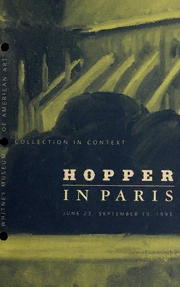
Cover: Notre Dame, No. 2, 1 907 (detail) <§'
© 993 WHITNEY MUSEUM OF AMERICAN ART %
1
945 Madison Avenue New York, N.Y. 002 ='
1 1
7D
a>
t/i
fD
0)