Table Of ContentALSO BY CANDICE MILLARD
Destiny of the Republic:
A Tale of Madness, Medicine and the Murder of a President
The River of Doubt:
Theodore Roosevelt’s Darkest Journey
Copyright © 2016 by Candice Millard All rights reserved. Published in the United States by Doubleday, a
division of Penguin Random House LLC, New York, and distributed in Canada by Random House of
Canada, a division of Penguin Random House Canada Ltd., Toronto.
www.doubleday.com
DOUBLEDAY and the portrayal of an anchor with a dolphin are registered trademarks of Penguin Random
House LLC.
Book design by Maria Carella
Title page and part opener photograph © SZ Photo/Scherl/Bridgeman Images Maps designed by Jeffrey L.
Ward
Cover design by John Fontana
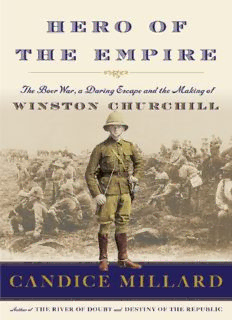
Cover images: (foreground photograph) Winston S. Churchill by English photographer. Private Collection.
Photograph © Christie’s Images / Bridgeman Images; (background photograph) Officers watching the
Battle of Colenso from General Redvers Buller’s headquarters on Naval Gun Hill, Second Boer War, c.
1899.
Library of Congress Cataloging-in-Publication Data Names: Millard, Candice, author.
Title: Hero of the empire : the Boer war, a daring escape and the making of Winston Churchill / Candice
Millard.
Description: First edition. New York : Doubleday, a division of Penguin Random House LLC, 2016.
Identifiers: LCCN 2015049806 ISBN 9780385535731 (hardcover) ISBN 9780385535748 (ebook)
Subjects: LCSH: Churchill, Winston, 1874–1965—Military leadership. South African War, 1899–1902—
Participation, British. South African War, 1899–1902—Prisoners and prisons, British.
Classification: LCC DA566.9.C5 M54 2016 DDC 968.04831092—dc23
LC record available at http://lccn.loc.gov/2015049806
Ebook ISBN 9780385535748
First Edition
v4.1
a
For Kelly
CONTENTS
Cover
Also by Candice Millard
Title Page
Copyright
Dedication
PROLOGUE
PART ONE
PUSHFUL, THE YOUNGER
CHAPTER 1: Death by Inches
CHAPTER 2: The Graven Palm
CHAPTER 3: The Scion
CHAPTER 4: Blowing the Trumpet
PART TWO
INTO AFRICA
CHAPTER 5: “Send Her Victorious”
CHAPTER 6: “We Have Now Gone Far Enough”
CHAPTER 7: The Blackest of All Days
CHAPTER 8: Land of Stone and Scrub
PART THREE
CHANCE
CHAPTER 9: The Death Trap
CHAPTER 10: A Pity and a Blunder
CHAPTER 11: Into the Lion’s Jaws
CHAPTER 12: Grim Sullen Death
PART FOUR
PRISONERS OF WAR
CHAPTER 13: To Submit, to Obey, to Endure
CHAPTER 14: “I Regret to Inform You”
CHAPTER 15: A City of the Dead
CHAPTER 16: Black Week
CHAPTER 17: A Scheme of Desperate and Magnificent Audacity
CHAPTER 18: “I Shall Go On Alone”
PART FIVE
IN THE HEART OF THE ENEMY’S COUNTRY
CHAPTER 19: Toujours de l’Audace
CHAPTER 20: “To Take My Leave”
CHAPTER 21: Alone
CHAPTER 22: “Wie Is Daar?”
CHAPTER 23: An Invisible Enemy
CHAPTER 24: The Light of Hope
CHAPTER 25: The Plan
CHAPTER 26: The Red and the Blue
EPILOGUE
Acknowledgments
Notes
Selected Bibliography
Illustration Credits
About the Author
Illustrations
PROLOGUE
Crouching in darkness outside the prison fence in wartime southern Africa,
Winston Churchill could still hear the voices of the guards on the other side.
Seizing his chance an hour earlier, the twenty-five-year-old had scaled the high,
corrugated-iron paling that enclosed the prison yard. But now he was trapped in
a new dilemma. He could not remain where he was. At any moment, he could be
discovered and shot by the guards or by the soldiers who patrolled the dark,
surrounding streets of Pretoria, the capital of the enemy Boer republic. Yet
neither could he run. His hopes for survival depended on two other prisoners,
who were still inside the wall. In the long minutes since he had dropped down
into the darkness, they had not appeared.
From the moment he had been taken as a prisoner of war, Churchill had
dreamed of reclaiming his freedom, hatching scheme after scheme, each more
elaborate than the last. In the end, however, the plan that had actually brought
him over the fence was not his own. The two other English prisoners had plotted
the escape, and agreed only with great reluctance to bring him along. They also
carried the provisions that were supposed to sustain all three of them as they
tried to cross nearly three hundred miles of enemy territory. Unable even to
climb back into his hated captivity, Churchill found himself alone, hiding in the
low, ragged shrubs that lined the fence, with no idea what to do next.
Although he was still a very young man, Churchill was no stranger to
situations of great personal peril. He had already taken part in four wars on three
different continents, and had come close to death in each one. He had felt bullets
whistling by his head in Cuba, seen friends hacked to death in British India, been
separated from his regiment in the deserts of the Sudan and, just a month earlier,
in November 1899, at the start of the Boer War, led the resistance against a
devastating attack on an armored train. Several men had died in that attack,
blown to pieces by shells and a deafening barrage of bullets, many more had
been horribly wounded, and Churchill had barely escaped with his life. To his
fury and deep frustration, however, he had not eluded capture. He, along with
dozens of British officers and soldiers, had been taken prisoner by the Boers—
the tough, largely Dutch-speaking settlers who had been living in southern
Africa for centuries and were not about to let the British Empire take their land
without a fight.
When the Boers had realized that they had captured the son of Lord Randolph
Churchill, a former Chancellor of the Exchequer and a member of the highest
ranks of the British aristocracy, they had been thrilled. Churchill had been
quickly transported to a POW camp in Pretoria, the Boer capital, where he had
been imprisoned with about a hundred other men. Since that day, he had been
able to think of nothing but escape, and returning to the war.
The Boer War had turned out to be far more difficult and more devastating
than the amusing colonial war the British had expected. Their army, one of the
most admired and feared fighting forces in the world, was astonished to find
itself struggling to hold its own against a little-known republic on a continent
that most Europeans considered to be theirs for the taking. Already, the British
had learned more from this war than almost any other. Slowly, they were real
izing that they had entered a new age of warfare. The days of gallant young
soldiers wearing bright red coats had suddenly disappeared, leaving the vaunted
British army to face an invisible enemy with weapons so powerful they could
wreak carnage without ever getting close enough to look their victims in the eye.
Long before it was over, the war would also change the empire in another,
equally indelible way: It would bring to the attention of a rapt British public a
young man named Winston Churchill. Although he had tried again and again, in
war after war, to win glory, Churchill had returned home every time without the
medals that mattered, no more distinguished or famous than he had been when
he set out. The Boer War, he believed, was his best chance to change that, to
prove that he was not just the son of a famous man. He was special, even
extraordinary, and he was meant not just to fight for his country but one day lead
it. Although he believed this without question, he still had to convince everyone
else, something he would never be able to do from a POW camp in Pretoria.
When Churchill had scrambled over the prison fence, seizing his chance after
a nearby guard had turned his back, he felt elated. Now, as he kneeled in the
shrubs just outside, waiting helplessly for the other men, his desperation
Description:From New York Times bestselling author of Destiny of the Republic and The River of Doubt, a thrilling narrative of Winston Churchill's extraordinary and little-known exploits during the Boer War At age twenty-four, Winston Churchill was utterly convinced it was his destiny to become prime minister