Table Of ContentHARMFUL
ALGAL BLOOM
RESEARCH INITIATIVE
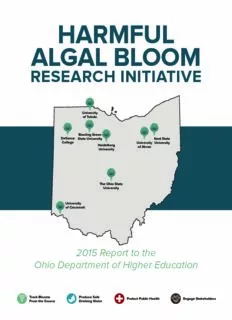
University
of Toledo
Bowling Green
Defiance State University Kent State
College University University
Heidelberg
of Akron
University
The Ohio State
University
University
of Cincinnati
2015 Report to the
Ohio Department of Higher Education
Track Blooms Produce Safe
Protect Public Health Engage Stakeholders
From the Source Drinking Water
Chancellor John Carey
Ohio Department of Higher Education
March 23, 2016
On behalf of the current consortium of Ohio universities engaged in the Ohio
Department of Higher Education Harmful Algal Bloom Research Initiative
(HABRI), we are pleased to submit the initial progress report for the research
activities funded in Round 1, covering year one of these two-year projects.
As shown in the report, the 18 Round 1 projects are already providing
needed answers that help water treatment operators, regulators, farmers
and legislators deal with harmful algal blooms in the present, better predict
the situation for the coming years, and lay the foundation for longer-term
mitigation and prevention activities.
Whereas Round 1 requirements were primarily driven by OEPA inputs, we are
pleased to note the current HABRI advisory board has active representation
from OEPA, ODNR, ODH, ODA and the Lake Erie Commission and that they
played a key role in setting research priorities and selecting the 13 new
projects just funded in Round 2 in February 2016.
We anticipate sharing even more actionable research solutions from the
combined efforts of both research cohorts in our next annual report as well as
in periodic updates to ODHE. At present, ten Ohio research universities are
engaged in HABRI.
We would like to recognize the Ohio Sea Grant team for their management of
HABRI projects from start to finish and for preparing this report on behalf of
the HABRI university consortium.
And finally, it is fitting that we submit this report to the Ohio Department of
Higher Education during the week of World Water Day in light of ODHE’s
visionary support for creating a sustainable water future for the state through
university research, education and outreach/engagement. Thank you.
Thomas Bridgeman Bruce McPheron
University of Toledo The Ohio State University
Consortium Co-Chairs
Introduction After the Toledo water crisis in August 2014, Input from partners such as the Ohio
the Ohio Department of Higher Education Environmental Protection Agency, Ohio
(then the Ohio Board of Regents) allocated Department of Natural Resources and the
$2 million to Ohio universities for research to Lake Erie Commission (Appendix I) ensures
solve the harmful algal bloom problem in Lake that projects complement state agency efforts
Erie. The funding was matched by participating to protect Ohio’s fresh water and that results
universities for a total of more than $4 million. address known management needs to ensure
sustainable water for future generations.
Led by representatives from The Ohio State
University and the University of Toledo, HABRI used Ohio Sea Grant’s proposal
and managed by Ohio Sea Grant, the first development system to streamline project
round of the Harmful Algal Bloom Research proposals, project management and public
Initiative (HABRI) includes 18 projects involving engagement, capitalizing on Sea Grant’s strong
researchers from seven Ohio universities and reputation among various stakeholder groups
partners as far-flung as South Dakota and Japan. including the research community.
The initiative also provides invaluable training This report describes the process of HABRI’s
for Ohio students, from undergraduate to first cohort of 18 funded two-year projects and
doctoral candidates, which distinguishes offers an overview of the goals of the initiative
university research from other scientific in the year to come as researchers seek
institutions and gives taxpayers a double return innovative solutions for harmful algal blooms.
on their investment.
Background A harmful algal bloom (HAB) is any large factors including drought, severe weather and
increased density of algae that is capable of average temperatures.
Information
producing toxins. In freshwater, such as Lake
Erie, those algae tend to be cyanobacteria — Many HABRI projects seek to understand
more commonly known as blue-green algae both how phosphorus and other elements like
— which grow excessively in warm water with a nitrogen affect algal blooms, and how runoff
high phosphorus concentration. can be reduced without negative impacts on
farmers and other industries. Other projects
Phosphorus enters the water from agriculture, focus on the public health impacts of toxic algal
suburban and urban sources, and likelihood blooms, ranging from drinking water issues to
of runoff is strongly affected by climatic food contamination.
Category Track Blooms From the Source Protect Public Health
Projects aim to improve existing Projects in this focus area examine
Definitions
technologies and develop new the effects of the algal toxin
methods to track algal blooms microcystin on people and animals
as they develop and move, giving lakeshore and study whether microcystin is found in
residents and state agencies quicker and more produce irrigated with algal-contaminated
effective tools to understand whether algal water.
blooms might cause a hazard.
Engage Stakeholders
Produce Safe Drinking Water Research in this focus area
In addition to monitoring bloom analyzes the decisions that
locations, researchers are stakeholders have to make—
developing new treatment methods from nutrient management to dealing with
for drinking water to remove algal algal blooms—and develops tools to make
particles and toxins. these decisions more clear, systematic, and
supported by the latest science.
Harmful Algal Bloom Research Initiative 2015 Annual Report 3
Track Blooms From the Source
Projects in this focus area aim to improve use of existing technologies as well as develop
new methods to detect, prevent and mitigate harmful algal blooms and their impacts. This
will help to ensure drinking water safety and a healthy environment for lakeshore residents
by scientifically connecting many of the potential causes and effects of harmful algal blooms,
from the runoff that fuels them to the toxins that contaminate water supplies.
Early-Warning Systems for Lake Erie Algal Blooms
Two complementary projects in at the primary water intake for Combining data from river
this focus area are developing Sandusky’s Big Island Water Works. sensors, lake buoys and existing
warning networks for Lake Erie’s While the rise in algae happened climate models will refine
western basin, where harmful algal too quickly to keep the water predictive tools that will give
blooms are most common. Tailored from entering the treatment plant, water managers more time to
specifically for Maumee Bay and operators had enough warning react to developing bloom events
Sandusky Bay, the networks to adjust treatment to prevent a in the near future, and ultimately
provide basin-wide data coverage temporary water shutdown for more will lead to a better understanding
of bloom-affected areas by than 100,000 residents. of how to prevent harmful algal
streaming data from water quality blooms altogether.
buoys and sensors positioned near A related project focuses
water treatment plant intakes to an upstream of Lake Erie, monitoring
online database. both nutrient amounts and their
sources (fertilizer, manure, human
The early warning system or wild animal waste) in the rivers
in Sandusky Bay already and streams flowing to Lake
demonstrated its potential during Erie. This project integrates and
the 2015 season. A rapid increase in augments an existing array of river
chlorophyll, a green plant pigment, monitoring stations maintained by
was detected on July 17, 2015, a combination of federal, state and
indicating that algae were present university partners.
Projects in this Focus Area
A new early warning system for
ALGAL BLOOMS
HAB Detection, Mapping and Warning Network:
Maumee Bay Area
in Sandusky Bay protected
Lead: University of Toledo
the water supply for
HAB Detection, Mapping and Warning Network:
100,000
Sandusky Bay
Lead: Bowling Green State University
Identifying the Best Strategy to Reduce Phosphorus
residents from algal toxins
Loads to Lake Erie From Agricultural Watersheds
Lead: Heidelberg University in July 2015.
4 Harmful Algal Bloom Research Initiative 2015 Annual Report
Produce Safe Drinking Water
One of the most direct public impacts of algal blooms was seen in August 2014, when a
harmful algal bloom in Toledo caused a “Do Not Drink” order to be issued for more than
two days, an impact felt by residents and businesses alike. With direct guidance from
state agencies at the front lines of Toledo and related algal drinking water crises, HABRI
researchers are developing new treatment methods that will give public health and water
treatment professionals the tools they need to make informed decisions when water
supplies are threatened by algal blooms.
Treating Drinking Water to Remove Toxins
Researchers are developing new experiments are in process to plant procedures. A range of filter
methods to remove the algal toxin achieve similar results at ozone membranes are also showing
microcystin from drinking water, concentrations and treatment promising results, removing up to
using various filtration methods as times that work with treatment 96.9% of microcystin from tested
well as ozone gas. The laboratory solutions in the lab experiments.
models can eventually be scaled
up for use at water treatment Once these separate experiments
plants that deal with harmful algal are completed, combinations of
blooms in their water supply ozone and filter membranes will
so they can better ensure their be examined to determine the
customers’ drinking water is safe best pairing for toxin removal and
to use. cost effectiveness. The ultimate
goal is to provide water treatment
Lab results so far have shown that plant managers with a series of
bubbling ozone into a microcystin strategies to remove toxins.
solution can lead to 100%
destruction of the toxin. Further
Projects in this Focus Area
Preliminary results
Treatment of Cyanotoxins by Advanced Prevention of Cyanobacterial Bloom have shown
Oxidation Techniques Formation Using Cyanophages
Lead: University of Cincinnati Lead: The Ohio State University 100%
Development of Microcystin Detoxifying Identifying Bacterial Isolates for
Water Biofilters Bioremediation of Microcystin-
Lead: University of Toledo Contaminated Waters
Lead: Kent State University
Investigation of ELISA and Interferences
destruction of microcystin
for the Detection of Cyanotoxins Investigation of Water Treatment
Lead: University of Toledo Alternatives in the Removal of when contaminated water is
Microcystin-LR
Guidance for Powdered Activated Lead: University of Toledo treated with high ozone
Carbon Use to Remove Cyanotoxins
Lead: The Ohio State University Transport and Fate of Cyanotoxins in gas concentrations.
Drinking Water Distribution Systems
Lead: University of Toledo
Harmful Algal Bloom Research Initiative 2015 Annual Report 5
Protect Public Health
While safe drinking water is a major focus for public health officials and researchers,
scientists are also working on other health impacts of harmful algal blooms and the
associated toxins. The algal toxin microcystin affects the liver, nervous system and skin,
and potentially causes cancer in humans. Projects in this focus area examine those effects,
develop techniques to detect the toxin in biological samples, and study whether microcystin
is found in fish or produce grown in algae-contaminated water.
What’s On Your Lettuce?
Water affected by harmful algal watered both above- and below- contained more microcystin than
blooms doesn’t just end up in ground. Preliminary results show the same crops watered near
residential sinks, it also travels that all three vegetables had the roots, while others showed
through agricultural irrigation low levels of microcystin in their the opposite pattern. Adjusting
systems that water fields of tissues, but that concentrations watering methods based on
lettuce, carrots and other varied depending on irrigation this data may help reduce the
vegetables. The recent increase method and type of vegetable: occurrence of microcystin in crops
in harmful algal blooms in the some crops watered from above destined for human consumption.
region means there is a need to
determine whether this produce Microcystin in the water used
is a possible source of human for irrigation also slowed
exposure to microcystin, how crop growth of all vegetables
that contamination occurs, when compared to water not
and how it could best be containing the toxin. This
prevented. was especially significant in
the tomato plants, and adds yet
So far, researchers at The Ohio another checkmark to the long list
State University have examined of economic impacts stemming
microcystin concentrations in from harmful algal blooms.
lettuce, tomatoes and carrots
Projects in this Focus Area
Water containing microcystin
Method Development for Detecting Evaluation of Cyanobacteria and SLOWS
Toxins in Biological Samples Their Toxins in a Two-Staged Model of
Lead: University of Toledo Hepatocarcinogenesis
Lead: The Ohio State University CROP
Fish Flesh and Fresh Produce as
Sources of Microcystin Exposure
to Humans GROWTH
Lead: The Ohio State University
compared to toxin-free water.
6 Harmful Algal Bloom Research Initiative 2015 Annual Report
Engage Stakeholders
All the research in the world won’t be able to solve the harmful algal bloom problem if
results and recommendations aren’t passed on to the people who need them. Researchers
in this focus area are developing ways to disseminate information more effectively, by
establishing how information moves through existing networks of people and using those
networks – such as Extension and farmer partnerships – to distribute new information
about harmful algal blooms.
Sampling Networks Involve Farmers Right From the Start
Fifty-six farmers in the western downstream harmful algal blooms, ensuring that watershed
Lake Erie basin are working with the farmers’ participation allows managers, state agencies and
HABRI researchers to collect for tight feedback loops that can legislators to have the most
data about their own fields and inform their choices directly as current information when making
the effects that their cropping, they make business and land decisions about how best to
irrigation, and soil management stewardship decisions. deal with freshwater harmful
practices have on downstream algal blooms without negatively
factors like nutrient runoff. Led Ultimately, the information can be impacting other economic sectors
by Ohio State Extension, these used to test model predictions, such as agriculture.
farmers collected information
about conditions in 80 fields
throughout the 2015 field season
with more expected to join in
2016.
While the farmers’ data will be
used to better understand the
effects of variables such as
farm practices, climate, and soil
type on the development of
Projects in this Focus Area
56
Maumee Basin Lake Erie HABs Nutrient Maumee Basin Lake Erie HABs
Management Options Comparative Stakeholder Informed Decision-
farmers
Analysis Making Support System
Lead: The Ohio State University Lead: University of Toledo
Farmer/Farm Advisor Water Quality Social Network Analysis of Lake Erie
in western Lake Erie are providing
Sampling Network HABs Stakeholder Groups
Lead: The Ohio State University Lead: Kent State University nutrient and weather data from
80 fields to researchers studying
Lake Erie algal blooms.
Harmful Algal Bloom Research Initiative 2015 Annual Report 7
Appendix I
CORE HABRI PARTNERS
Universities
Heidelberg University
University of Toledo
Bowling Green State University
The Ohio State University
Kent State University
University of Cincinnati
University of Kentucky
USDA-ARS
Agency Advisory Board
Lake Erie Commission
Ohio Department of Agriculture
Ohio Department of Health
Ohio Department of Natural Resources (ODNR)
ODNR Division of Wildlife
Ohio Environmental Protection Agency
Ohio Sea Grant College Program
External Partners Affiliated With Individual Projects
ABS Materials Kyoto University
Al Szuch Live Bait NASA Glenn Research Center
Bay’s Edge Bait and Tackle NASA Marshall Space Flight Center
Big Island Water Works ODNR Division of Wildlife
Biosortia Pharmaceuticals River Marine Supply
Blanchard River Watershed Partnership Seneca Conservation District
City of Toledo South Dakota State University
City of Oregon Toledo Water Treatment Plant
Erie Hopper Sportfishing Charters US Geological Survey (USGS)
Great Lakes Water Quality Agreement USGS Lake Erie Biological Station
8 Harmful Algal Bloom Research Initiative 2015 Annual Report
Appendix II
TRACK BLOOMS FROM THE SOURCE
HAB Detection, Mapping and Warning Network:
Maumee Bay Area
Principal Investigator
Thomas Bridgeman, University of Toledo
Partners: The Ohio State University
PROJECT SUMMARY Response: A major goal of the project is to increase
advance warning times for public water utilities in order
Harmful algal blooms often produce toxins that need to be
to give them more time to adjust water treatment levels
filtered out of the water before it is safe to drink. Currently,
to neutralize HAB toxins. This was accomplished by
water treatment plants such as in Toledo, Ohio only detect
deploying a water quality buoy in an area near the Toledo
these toxins in Lake Erie water when they’re already
and Oregon intakes that is prone to the development
pulling the water into the plant. Since that’s not enough
of high toxin concentrations and by frequent sampling
time to switch treatment techniques, they have to use
using the University of Toledo research boat. We are also
expensive, non-specific techniques to ensure clean water
improving the capability of tracking HABs near water
for customers.
intakes using sensors mounted on aircraft. Data from the
buoys was made available in real-time to plant operators
A team led by Thomas Bridgeman, an associate professor
and the public. Toxin concentration data was forwarded to
of environmental sciences at the University of Toledo, is
our partnering plant operators and researchers.
developing a warning system for water treatment plants
that gives them 12-24 hours of lead time before water
Results: The results of our project helped to ensure timely
reaches the intake in Lake Erie, allowing them to adjust
and efficient toxin removal and treatment of drinking
treatment protocols accordingly.
water for the cities of Toledo and Oregon during the HAB
season of 2015. Economic return may have resulted from
By combining water quality sensors with environmental
the advance warning allowing water utilities to match
monitoring, this early warning system can be thought of as
treatment to need, thus avoiding costly overtreatment
working toward a “weather radar” for harmful algal blooms,
– although this is difficult to measure. The success of
which could reduce water treatment costs during the
our project along with the cities’ efforts ensured safe
bloom season.
drinking water in 2015 and returned a measure of public
confidence in the water supply. The model of a network of
THE BOTTOM LINE water quality buoys and frequent vessel and aircraft-based
monitoring trips is now expanding to other intakes and
Clean drinking water for communities and money
locations in Lake Erie.
savings for water plants that will be able to apply
powdered activated carbon in a more targeted fashion.
Recap: In the summer of 2015, we successfully employed
a HAB early-warning system consisting of a water
SYNOPSIS OF YEAR 1 quality buoy and weekly vessel and aircraft-based HAB
monitoring trips to provide important HAB information to
Relevance: This project was undertaken in response to
water plant managers, other researchers and the public.
the Toledo water crisis of 2014. Part of the reason for
A repeat of the Toledo water crisis of 2014 was avoided
the water crisis was inadequate advance warning of high
and a measure of public confidence in the water supply
concentrations of algal toxins approaching the Toledo
was restored.
water intake on Lake Erie.
Harmful Algal Bloom Research Initiative 2015 Annual Report 9
Appendix II
TRACK BLOOMS FROM THE SOURCE
HAB Detection, Mapping, and Warning Network:
Sandusky Bay
Principal Investigator
George Bullerjahn, Bowling Green State University
Partners: Kent State University, The Ohio State University
PROJECT SUMMARY Response: An early warning system of water quality
sensors (sondes) was installed at the City of Sandusky’s
Harmful algal blooms often produce toxins that need to
water treatment plant to alert personnel to bloom events
be filtered out of the water before it can be safe to drink.
at the water intakes. Bloom biomass and toxin production
Currently, these toxins are detected at the water intake
was assessed during 2015 in concert with chemical and
for the water plant in Sandusky, Ohio, requiring potential
physical measures in Sandusky Bay and surrounding Lake
overtreatment of incoming water to ensure toxins are
Erie coastal waters.
eliminated before water is delivered to customers.
A research team led by George Bullerjahn of Bowling Results: The warning system was successfully linked
to an online network of water quality sondes. Increases
Green State University is developing a warning system for
in algae were detected at Sandusky and allowed for
the water plants that extends early warning capacity to
modifications in water treatment protocols in real time
12-24 hours before water reaches the water intake in Lake
that prevented a potential shutdown in early August.
Erie, allowing water plants to adjust treatment protocols
Analysis of nutrient dynamics in Sandusky Bay indicates
before water reaches the intake.
a nitrogen-limited environment suitable for Planktothrix
success, and that management of nitrogen as well as
By combining water quality sensors with environmental
phosphorus is appropriate to mitigate bloom events
conditions monitoring (e.g., wind speed and direction), this
in the bay. However, total chlorophyll does not predict
early warning system could allow researchers to develop
toxigenicity. Field samples collected during the course of
models that can predict the scenarios under which
the summer when coupled with MODIS remote sensing
harmful algal bloom toxicity could present an imminent
data enabled the development of maps of potentially toxic
health concern.
and nontoxic algae for Sandusky Bay and the Western
Basin of Lake Erie at 1km resolution. We are in the process
THE BOTTOM LINE of applying this same algal identification method to
NASA’s hyperspectral sensor system, which will enable us
Clean drinking water for Ohio residents and reduced
to further differentiate the algal composition from the air at
costs for municipalities, using a system that can be
1m rather than 1km resolution.
expanded to other communities.
Recap: A system to alert Sandusky of cyanobacterial
SYNOPSIS OF YEAR 1 blooms was successfully deployed and used. Toxic
Planktothrix dominates in Sandusky Bay likely due to
Relevance: Sandusky Bay is plagued by a toxic
active nitrogen cycling, warranting management of
Planktothrix (cyanobacterial) bloom that threatens
nitrogen and phosphorus. A new method to identify algae
drinkable and recreational waters used by residents and
from airborne and spaceborne sensors was refined and
more than 3 million tourists each year. The need exists
implemented.
to provide information to users on the extent, movement,
intensity and toxic potential of the bloom.
10 Harmful Algal Bloom Research Initiative 2015 Annual Report
Description:Department of Higher Education Harmful Algal Bloom Research Initiative We anticipate sharing even more actionable research solutions from the . develop techniques to detect the toxin in biological samples, and study whether microcystin . Analysis of nutrient dynamics in Sandusky Bay indicates.