Table Of Content..: :. ::
--:tfZ..
(ID
. 6':>13
~DOO
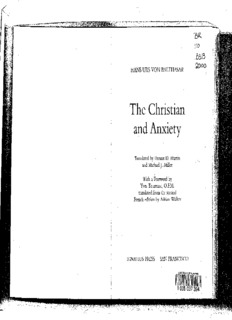
HANS URS VON BALTHASAR
The Christian
apd Anxiety
Translated by Dennis D. Martin
and Michael J. Miller
\
With a Foreword by
Yves Tourenne, O.F.M.
translated from the second
French edition by Adrian Walker
IGNATIUS PRESS SAN FRANCISCO
Originally published as Der Christ und die Angst (1952)
Reissued in the series "Christ heute", 2d series, volume 3 CONTENTS
© 1989 Johannes Verlag, Einsiedeln, Trier
Foreword by Yves Tourenne; O.F.M.,
taken from the 2d French edition,
Le Chretien et l'angoisse Foreword to the Sixth German Edition . 7
© 1994 Desclee de Brouwer, Paris
Translator's Note 9
Translated and used by pennission
Foreword, by Yves Tourenne, O.F.M. II
Introduction 1 . . . . . . · · · · 31
I. God's Word and Anxiety . . . . . . . . . . . 39
II. The Christian and Anxiety . Sr
III. The Essence of Anxiety . . . II5
Cover design by Roxanne Mei Lum
© 2000 Ignatius Press, San Francisco
All rights reserved
ISBN o-8987o-ss7-8
Library of Congress catalogue number 96-8363 7
Printed in the United States of America@
5
-
--------~
FOREWORD TO THE
SIXTH GERMAN EDITION
(1989)
In response to many requests from our readers, we
venture to issue this small book again, shortly after
the death of its author.
"Following upon philosophical and psychological
studies of the topic, this is the first strictly theological
study of anxiety. Taking Sacre(cid:71) Scripture as its point of
departure, it seeks to grasp the general Christian laws
that determine the meaning and limits of anxiety, so
as to establish finally its essence in a speculative way.''
That is how the book was introduced to its readers in
1953(cid:17) Since that time, through a lively exchange with
the steadily advancing insights and observations of psy-
chology and psychiatry, anxiety has become a burning
issue in theology as well. The author had intended to
complete his earlierwork by incorporating into it the
fruits of this interdisciplinary dialogue. It was a great
disappointment for many that he did not have the op-
portunity to do so. The theological foundation that is
laid in this first study, though, may well continue to
J stimulate further work.
7
'- . ---.,~~ ____ ....._" .._-~ "'"·~·=-----· --------
TRANSLATOR'S NOTE
Angst has entered into the English language on a popu-
lar level, usually conveying psychological overtones. Al-
though neither "anxiety" nor "anguish", "insecurity"
nor "fear" by itself fully captures the range of conno-
tations of the German word, "anxiety" and "anguish"
have generally been employed for direct translation of
Angst. Since the entire book seeks to explain the range
of meaninh of Angst, it seems unlikely that the rich-
ness and variety of "anxiety" will be lost on the reader.
Depending on the context, Geist in German ca.!l
mean "mind", "ghost" or "spirit". In this book, which
is a response to Kierkegaard's analysis of anxiety and -""'
the repercussions that it had in German Catholic and
Lutheran theology, the term is used in contradistinc-
tion to Seele, "soul", and often denotes the human fac-
ulty of "intellect" in.the Aristotelian sense. Therefore
Geist has been translated as ''mind'' (cf Geistesgeschichte,
intellectual history),
Unless otherwise noted, Scripture quotations have
been taken from the Revised Standard Version, Cath-
olic edition.
Michael J. Miller
"·
9
/ ( I
FOREWORD
A Theology of Anxiety?
The Christian and Anxiety' is a demanding book. Its
dense philosophical analyses, its frequent dramatic pas-
sages, and its commentaries on numerous biblical texts
can easily deter the prospective reader. In order to
glimpse the greatness of Hans Urs von Balthasar's work
through this thicket of difficulties, we need to get a
good handle on the method he adopts in it.
Balthasar never separates method from content. The
object itself entails a certain way of conceiving and
approaching it, just as method is already a matter of ~,, ,
content. That having been said, it is nonetheless good
to distinguish the two. levels.
An outline of the book helps to bring its method
into relief. The work opens with a reflection on the
Bible; at the beginning of chapter 2, Balthasar tells us
that, throughout the remainder of the discussion, we
must keep in mind what the Word of God alone ( CA,
81ff.) is able to teach us about anxiety [angst]. The first,
scriptural part of the book is meant to portray both the
contemporary situation and the then current accounts
of anxiety, Freudiah or philosophical. Although the in-
troduction reflects the situation of the time in which
'
1 Henceforth abbreviated as CA in references.
II
12 THE CHRISTIAN AND ANXIETY FOREWORD 13
the book was written, Balthasar insists (C A, 3 5) on revelation takes account of the anthropological phe-
the need to take distance from it, lest the analysis of nomenon of anxiety. 3 On the other hand, philosophy,
anxiety prove to be yet another expression of it. at least in the modern period (Hegel, Kierkegaard,
The reader should approach the second chapter of Heidegger, Sartre), has seen anxiety as a fundamen-
the work, which could be called its center (it has the tal dimension of man's existence (CA, II9)- Hence
same title as the book), only in terms of the first. Yet Balthasar's search for a point of contact, an intrin-
even when he does so, he will encounter certain sur- sic link, between reflection on revelation and reflec-
prisingly abrupt statements. These statements can be tion on human existence. The object of philosophy is
accounted for by the fact that it is the Word of God always more than philosophical (C A, I I 5); it stands
that puts human anxiety (of which the Christian is at out against an original horizon, as Merleau-Ponty and
once the victim-like every man-and the conqueror) Levinas, following Husserl, have shown. From the
in its proper perspective. Balthasar's method, which Catholic point of view, the concrete world on which
makes the Word of God both the starting point and philosophy reflects is never a pure natura but is always
the permanent basis of reflection, may be reminiscent the world that is sustained and penetrated by grace.
of Karl Barth's "verticalism". In truth, Balthasar shows Theology, for its part, precisely because it reflects on
''"<
that the necessary distance mentioned above, by a kind God's self-revelation in man's history and speech (Is-
of incidental side effect (CA, 36), results in a capacity rael, Jesus, the Church), necessarily entails ontological
to go to the very heart of contemporary anxiety. reflection: revelation m~ets and illuminates man's sit-
For this reason, The Christian. and Anxiety ends with uation in the world at an undreamed-of depth.
a third part, which initially can be described as philo- In this way, Balthas~ the theologian, speaking as he
sophical. The Catholic thinker cannot remain content does to the men of his time, quite naturally picks up
with a kind of sola scriptura or even with a purely theo-
logical account of anxiety. If theology is going to reach
plative prayer (c£ II discorso di Hans Urs von Balthasar. In: Hans Urs
contemporary man, it has to integrate philosophical re-
von Balthasar, Premio Internazionale Paolo VI [Brescia: Instituto Paolo
flection. VI, 1984] 27-28), on the one hand, and a theology not intimately
Balthasar thus proceeds to link philosophy and theo- connected with philosophy (cf. The Glory of the Lord: A Theological
Aesthetics, vol. 1: Seeing the'Form [San Francisco: Ignatius Press, 1982],
logy.2 This link has a twofold basis. On the one hand,
143-47), on the other. According to Balthasar, the Renaissance and
the Reformation conspired to co~ummate this d<:mble dissociation.
2 Balthasar consistently refused a theology dissociated from contem- 3 CA, 39 ("Das Wort Gottes ke~t keine Angst vor der Angst").
FOREWORD 15
I4 THE CHRISTIAN AND ANXIETY
just one of its manifestations-the morbidity of our
themes and accents of contemporary thought: Kierke-
gaard, Heidegger, existentialism. ... We could there- f: time-as its ultimate meaning (CA, 36).
The Christian and Anxiety centers on an elucidation
fore say, using Balthasar's own terminology, that there
is both a distance and a mutual reflection [ricochet] be- of man's anxiety in the light of Christ and the Trinity.
Anxiety, with its emptiness and darkness, with its en-
tween attentive listening to revelation (chapter I) and
tanglement in sin (which is more than just man's fini-
ontological reflection (chapter 3).
tude), is redeemed. Anxiety finds its ultimate mean-
Finally, Balthasar goes on to forge an original ac-
count of the link between the Old and New Tes- ing in the fact that the Word of God has taken it upon
himsel£ Anxiety thus has a christological meaning, which
taments. Although both together make up the one
revelation, 4 a profound transformation occurs in the concerns nothing less than the authenticity of God's
passage from the former to the latter. The New Tes- incarnatiop. in Jesus as defined by Chalcedon (45I),
tament marks a break; it radically intensifies the reve- Lateran I (649), and Constantinople III (68I). For his
lation of anxiety. At Gethsemani and on the Cross, all part, Balthasar writes that "God could not become man
in any other way than by coming to know human fear
possible anxiety, both of the just and of the guilty, is
concentrated upon the Redeemer-and this very con- and by taking it upon himself" (CA, 74). ~
But the christological meaning of anxiety reveals in .
centration is the absolute revelation of grace, the escha-
tological gift of peace, the victory, at once promised turn the mystery ofth~ Trinity. The Word of God made
and already granted, over all anxiety ( CA, 8 If£). flesh discloses the divine secrets: "In standing outside
~ [Hinausstehen] of eternity and entering into time, the
Son of Man has knoWn anxiety and therein, as in ev-
erything he was, did, and suffered, he has translated
Man's Anxiety, God's Anxiety 5
something incomprehensible and divine into human
language (that is, after all, what revelation is): God's
The purpose of Balthasar's method is to legitimate the
fear and trembling [Bangen und Beben] for the world,
work's central project of giving a Christian interpre-
for his creation, which is on the verge of being lost"
tation of anxiety, or rather, of clearing a path to the
(CA, I46; c£ 74).
root meaning of anxiety by refusing to take what is
The revelation of the Trinity in the economy of
salvation opens a window onto an abyss at which
4 Cf. CA, 36: "a comprehensive perspective".
Balthasar merely hints here but which he discusses
5 CA, 81ff. and 73; c£ 146.
FOREWORD 17
16 THE CHRISTIAN AND ANXIETY
Turning from the Bible and theology, Balthasar goes
more amply in later works:6 the infinite distance be-
on to examine the nature or essence [ das Wesen] of anx-
tween the Persons within the eternal and indivisible
iety by means of a philosophical analysis that builds on
Trinity. It is this distance that grounds the possibility
Kierkegaard and other contemporary thinkers.
of creation, history, the drama of redemption, and the
believer's leap [saut] of faith, hope, and charity. If man
experiences anxiety as a void, the possibility of this
Open Readings
void lies in "the everlasting trinitarian ecstasy". 7
This Christology and trinitarian theology underlie
Other writers, philosophers, and theologians appear
the soteriological meaning of anxiety. The Christian and
throughout The Christian and Anxiety. A typically Bal-
Anxiety contains reflections on one of the key themes
thasarian attitude is at work here. Himself a transla-
in Balthasar's work: substitution [Stellvertretung]. The
tor and puhlisher, Balthasar was a reader, and his own
whole of human anxiety, concentrated in a single mass,
thought, while highly personal, always contains echoes
closes in upon Christ, who alone can say Yes to God
of other intellectual systems, with which he maintains a
the Father in place of the sinner's resolute No. But living bond symbolized by the proper names he cites. 8
this act is the condition upon which the fulfillment of
One way to enter into Balthasar's thought process
God's saving plan depends. Human anxiety thus be-
is to note the proper names he cites, to compile an
comes the material, as it were, by which Jesus restores
index, and to try to understand why certain names
the fallen creation to his Father and imparts to it God's
appear in certain passages or alongside certain other
'I
absolution. Balthasar thus resists any tendency to wal-
names. Among such names, two seem to be particu-
low in, or consent to, morbid anxiety; "adamantly and
larly important for the present work: Kierkegaard and
trenchantly" (CA, 88), he reininds us that Christ ad-
Bernanos.
monishes his disciples against anxiety.
Although Balthasar has a certain kinship with Kier-
of
kegaard, the author of The Concept Anxiety (1844)
6 In Theo-Drama: Theological Dramatic Theory, vol. 4: The Action
8 Hence Balthasar's presentation of numerous authors, for exam-
(San Francisco: Ignatius Press, 1994), and vol. 5: The Last Act (San
ple in the two volumes of The Glory of the Lord entitled Studies in
Francisco: Ignatius Press, 1998), 91-95. .
Theological Style, Clerical'Styles (vol. 2) and Lay Styles (vol. 3) (San
7 CA, 148; c£ 145. See also Theo-Drama, 4:319-20, on the abso-
Francisco: Ignatius Press, 1984 and 1986, respectively). For Balthasar,
lute distance between the Persons in the eternal Trinity and their "pri-
''true history is made up of the 'di.stillation of countless biographies'',
mal drama"; Theo-Drama, 5:81-84. See also Mysterium Paschale (Grand
Rapids: Eerdrnans, 1990). Theo-Drama, 3:282, n. 13.
,;_
18 THE CHRISTIAN AND ANXIETY FOREWORD I9
also represents an option that Balthasar will reject: a with the approbation with which one cites an author-
purely psychological and philosophical analysis of anx- ity (CA, 113 and 124, n. 1). One also notes a cer-
iety inspired by German Idealism (which, however, tain affinity between the two thinkers when Balthasar,
Kierkegaard also criticizes) and Lutheran dogmatics in order to define the locus of anxiety, insists on the
(CA, 136-39). Bernanos, on the other hand, is a mine "indispensable" ( CA, II 6) role of philosophy in theo-
of invaluable characters and themes, which Balthasar logy and on the "reciprocal relationship" and "suspen-
aims to develop into a theology. sion" between transcendence and contingency in the
There are, however, discreet presences to which we human mind. 12 Thus, despite their different theological
must also be attentive. We note, for example, the naine sensibilities, Balthasar and Rahner maintained a certain
of Henri de Lubac (CA, 139-40), who, as is well closeness before their disagreement at the time of The
known, was akin to Balthasar in spirit. 9 For Balthasar, Moment of Christian Witness [Cordula] (1966) and the
anxiety, by its very nature, has to be understood within fourth volume of Thea-Drama (1980).
the paradox of the finite spirit, 10 whose acts of knowl-
edge and freedom, while always focusing on some par-
From First Glance to Systematic Rereading
ticular object, are open to the infinite. There is, it
"·
seems to me, a deep kinship between The Christian
'
For those approaching the book for the first time;
and Anxiety, especially in the last part of the book,
and the work of de Lubac. 11 The Christian and Anxiety is best read through once,
without lingering over any one part or passage. They
We can also detect the even more discreet presence
of Karl Rahner. Rahner is mentioned twice, each time 12 C£ CA, 124. "Reciprocal relationship" is a typically Rahner-
ian expression, at least from the time of the publication of Geist
9 AletterfromBalthasarto de Lubac dating from July 1950 (printed in Welt in 1939 (to which Balthasar refers explicitly in the note on
in H. de Lubac, Theology in History [San Francisco: Ignatius Press, ) page 124). In saying that man's cognition is structurally "suspended"
1996], 597) reveals the friendship uniting the two theologians. [schwebend] (CA, 126-27) between the two pOles ofbeing and the ex-
1° C£ CA, 123. An important term in de Lubac, likewise in Balthasar. istent, Balthasar refers to a motif also present in Rahner (from L'Esprit
On p. 150 he uses the expression "paradox of the Church", which is dans le monde [French trans. 1968], 72ff.; English trans.: Spirit in the
reminiscent of the title of one of de Lubac's later works: Paradoxe et World [New York: Herder and Herder, .1968] to Traitefondamental de
mystere de I'Eglise (r967). lafoi [French trans. 1983], 88ff.; English trans.: Foundations of Chris-
11 Cf. H. de Lubac, Surnaturel, Paradoxes; c£ de Lubac's approach tian Faith [New York: Crossroad, 1970]), which he, Balthasar, had
to anxiety, "whose psychological substitutes can never be sufficiently already underscored in his 1939,review of Geist in Welt (in Zeitschrift
decried", in Surles chemins de Dieu (Paris: Aubier, 1956), 212-13. fu Katholische Theologie [Innsbru~k, 1939]: 378).
lm='M"P $1! ,,
__ ,_ _ .... .. ~ ·• ·n • ·&• a• e• rtf • 0 1. I {';ulr. "..- Jl-"t~l'~'"~'''-' '-:-' ,,,
20 THE CHRISTIAN AND ANXIETY FOREWORD 21
should try, in other words, to see the unity of the grace. Genuine Christian anxiety is a function of joy
work through the connection, and the tension, be- and a gift of God. Balthasar concurs with Nietzsche,
tween its scriptural, theological, and ontological dimen- albeit for an entirely different reason: It is the strong
sions. Having done so, they can return to the text for who help the weak, it is the spiritually healthy who
a rereading. I would like to suggest four points to look are compassionate, but without "a cringing Christian-
for here. ity's" (Bernanos, CA, 86-88) indulgence of contem-
Balthasar lays down two prindples, one negative and· one porary anxiety.
positive, concerning the nature cf anxiety. On the one hand, This position also has implications for theology.
the Christian neither can nor should have firsthand Theology must not share in the ambiguities and dark-
knowledge of anxiety, for by his Passion and death ness of its time, above all if it wants to be present to
Christ has assumed and conquered it. On the other its contemporaries. Balthasar thus lays the theological
hand, the Christian receives from Christ a participa- groundwork for Christian anxiety, which, while being
tion in his redemptive anxiety. radically different from contemporary anxiety, refuses
These two assertions appear to be sharply contradic- to distance itself pharisaically from it. 13
tory. In themselves, they are the elements that make up
Balthasar's specifically Christian and theological judg- "'""'-
"Catholic Anxiety"
ment on the situation of his time. From the introduc-
tion on (CA, 34ff.), Balthasar insists on the need for
"Catholic anxiety"-this is at the center of the book
a certain distance from the two false attitudes that the
(CA, 92; cf. 93, 96). The term catholic is an essential
above-mentioned principles are meant to counter: se-
duction by the morbid anxiety that surrounds us, on 13 Having said this, we can concentrate our attention on the three
the one hand, and "a serene theology of irrelevance", laws of Christian anxiety .(CA, 96, ros-6, II4). Balthasar radically
distinguishes morbid, psychological ("existentialist") anxiety, which
on the other (CA, 35).
is self-preoccupied, from the anxiety that is the fruit of the Christian's
Balthasar's two theses are thus to be grasped like
appropriation in the Holy Spirit of Jesus' redemptive anxiety In so
the two ends of a chain. But there is still need for a doing he radically distinguishes the disciple's anxiety from the Lord's.
mediation between them. This mediation is· joy, the There are no other redeemers; no one is on the same level as the
one and only Son; the baptized person who shares in the Redeemer's
truly personal appropriation of the objective redemp-
anxiety remains a man and a sinner (CA, 104-5). Balthasar thus does
tion. The Christian can be called to participate in the
justice in a Catholic manner to t~e Protestant insistence on the abso-
anxiety of the Cross only because he has first received lute uniqueness of the redemptive' act and on ·sofa gratia.
''·
Description:Angst. Since the entire book seeks to explain the range of meaninh of Angst, . ''true history is made up of the 'di.stillation of countless biographies'',.