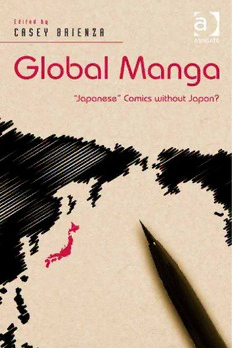
Table Of ContentGlobal ManGa
For Laura
Global Manga
“Japanese” Comics without Japan?
Edited by
CasEy briEnza
City University London, UK
© Casey brienza and the contributors 2015
all rights reserved. no part of this publication may be reproduced, stored in a retrieval system
or transmitted in any form or by any means, electronic, mechanical, photocopying, recording or
otherwise without the prior permission of the publisher.
Casey brienza has asserted her right under the Copyright, Designs and Patents act, 1988, to be
identified as the editor of this work.
Published by
ashgate Publishing limited ashgate Publishing Company
Wey Court East 110 Cherry street
Union road suite 3-1
Farnham burlington, VT 05401-3818
surrey, GU9 7PT Usa
England
www.ashgate.com
British Library Cataloguing in Publication Data
A catalogue record for this book is available from the British Library.
The Library of Congress has cataloged the printed edition as follows:
brienza, Casey.
Global Manga : “Japanese” comics without Japan? / by Casey brienza.
pages cm
includes bibliographical references and index.
ISBN 978-1-4724-3543-9 (hardback)—ISBN 978-1-4724-3544-6 (ebook)—ISBN 978-1-4724-
3545-3 (epub) 1. Comic books, strips, etc.—History and criticism. 2. Graphic novels—History
and criticism. i. Title.
PN6710.B69 2015
741.5’9—dc23
2014046295
ISBN: 9781472435439 (hbk)
ISBN: 9781472435446 (ebk – PDF)
ISBN: 9781472435453 (ebk – ePUB)
Printed in the United Kingdom by Henry Ling Limited,
at the Dorset Press, Dorchester, DT1 1HD
Contents
List of Figures vii
Notes on Contributors ix
Acknowledgments xiii
Glossary xv
Introduction: Manga without Japan? 1
Casey Brienza
1 The Western Sailor Moon Generation: North American Women
and Feminine-Friendly Global Manga 23
Magda Erik-Soussi
2 The Manga Style in Brazil 45
Roberto Elísio dos Santos, Waldomiro Vergueiro, and Victor Wanderley
Corrêa
3 Scott Pilgrim vs. MANGAMAN: Two Approaches to the
Negotiation of Cultural Difference 55
Aaron Pedinotti
4 Euromanga: Hybrid Styles and Stories in Transcultural Manga
Production 75
Nicolle Lamerichs
5 “Manga is Not Pizza”: The Performance of Ethno-racial
Authenticity and the Politics of American Anime and Manga
Fandom in Svetlana Chmakova’s Dramacon 95
Casey Brienza
6 On Everyday Life: Frédéric Boilet and the Nouvelle Manga
Movement 115
Tiago Canário
Global ManGa
7 An American Manga Artist’s Journey Down a Road Less Drawn 133
David Blanchard
8 Sporting the Gothic Look: Refashioning the Gothic Mode in
German Manga Trends 147
Antonija Cavcic
9 Constructing the Mangaverse: Narrative Patterns in Marvel’s
Appropriation of Manga Products 167
Manuel Hernández-Pérez
10 Pinoy Manga in Philippine Komiks 185
Karl Ian Uy Cheng Chua and Kristine Michelle Santos
Index 201
vi
List of Figures
1.1 Sparkler Monthly online digital magazine, published by Chromatic
Press. Cover illustration by rem 42
3.1 The first appearance of the Katayanagi twins. From Scott Pilgrim
vs. the Universe (2009) 62
4.1 Oost West (2009). Cover illustration by Marissa Delbressine 82
4.2 Minzpyjama, “Octavian,” Lemon Law, Volume 5 (2012, 124) 87
4.3 Anne Delseit and Sai Nan, “China Blue,” Lemon Law,
Volume 4 (2011, 37) 88
7.1 Hitokiri Volume 1, by David Blanchard 136
9.1 The Hulk’s transcreation in Mangaverse makes an explicit
reference to tokusatsu cinema products such as the film Godzilla
(1954). From Mangaverse: Eternity Twilight (2002) © Marvel 178
9.2 Hank Pym’s transcreation in Mangaverse resembles the most
iconic of Akira Toriyama’s characters Goku, from Dragon Ball
(1984–95). From Mangaverse: Eternity Twilight (2002) © Marvel 180
10.1 Elmer Damaso, “One Day Isang Diwa,” Culture Crash, Volume 1,
Issue #6 (2001) 191
10.2 Enjelicious, “Looking for a Better Boyfriend,” Oh No! Manga
(April 2012) 196
This page has been left blank intentionally
Notes on Contributors
David Blanchard has over 13 years of experience in the global manga field.
While still a student he founded his own independent studio and publishing
house, Perfect Commando Productions, which over the years he has built up
from an amateur operation into a business with international distribution and
sales. Self-published titles include Hitokiri (2010) and Éirinn Go Brách (2013).
Casey Brienza is a sociologist specializing in the study of the culture industries
and transnational cultural production. Over the past several years, her research
has progressed along two parallel streams. The first of these is an investigation
of the social organization and transnational influence of the culture industries,
using manga publishing in the United States as a case study. The second stream
is related to the digital technologies of publishing and reading which have
emerged at the beginning of the twenty-first century. She joined City University
London’s Department of Culture and Creative Industries as Lecturer in
Publishing and Digital Media in March 2013.
Tiago Canário is a Brazilian journalist with a master’s degree in Communication
and Contemporary Culture, focused on analysis of media products and
languages. Currently, he is based in Busan, South Korea, as part of the Korean
Government Scholarship Program, to do PhD research in Visual Culture. His
academic interests are cinema, criticism, and graphic narrative issues related
to everyday life experiences. He is part of two research groups, the Grupo
de Pesquisa Recepção e Crítica da Imagem (GRIM) and the Laboratório de
Análise Fílmica (Nanook), both of them in the Universidade Federal da Bahia
(Ufba), Brazil.
Antonija Cavcic is a PhD candidate at Murdoch University who has lived and
worked extensively in Japan. Her research interests lie in Japanese boys’ love
manga (BL) fandom and doujinshi practices, as well as Asian queer studies.
Karl Ian Uy Cheng Chua received his PhD from Hitotsubashi University,
Tokyo in 2010. He is an Assistant Professor at the Department of History and
Japanese Studies Program, Ateneo de Manila University, Philippines. He has
published articles in Philippines Studies and book chapters in Japan and Southeast
Asia: Continuity and Change in Modern Times (Ateneo de Manila University Press),