Table Of ContentFlint Knapping:
Making Specific Point
Types
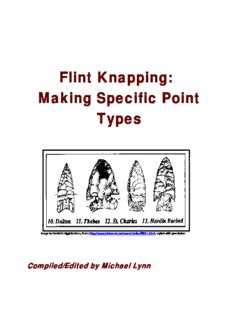
Image by Daniel K Higginbottom, from: http://www.tcinternet.net/users/cbailey/lithic1.html, copied with permission
Compiled/Edited by Michael Lynn
Photo of Tim Dillard teaching me at the
Center for American Archaeology in Kampsville, IL
Dedicated to all those who have taught someone else about the art of
flint knapping, especially to my primary teachers – Bruce Boda, Tim
Dillard, Mike McGrath and Steve Nissly. This is my attempt to pay
forward.
© Michael Lynn, 2011
Although the copyrights to the individual articles and tutorials in this e-book belong to the
authors, I have copyrighted this collection. It may be freely printed, copied, posted on the
internet and otherwise distributed as long as said distribution is free and appropriate credit is
given to me and the authors. This e-book may not be sold for profit.
1
Flint Knapping: Making Specific Point Types
Making the Adena 3
by Lucas Nicholson (aka goose) at www.paleoplanet.net
Making an Agee Point 6
by Jim Miller at www.flintknappers.com/oldsite
Making a Calf Creek 9
by Mike Tylznski (aka Idaho Clovisman) at www.paleoplanet.net
Clovis Projectile Point Manufacture 13
by Juliet Morrow at http://www.clt.astate.edu/jmorrow/clovis.pdf
Crowfield Points 34
by Mike McGrath at www.susquehanna-wd.com
Decaturs: How to do the Base 39
by Curtis Smith at www.paleoplanet.net
Making an Eden (with miscellaneous related posts) 41
by Woody Blackwell at www.paleoplanet.net
Folsum Point Manufacture 57
by Tony Baker at www.ele.net/chanflak.htm
How to Make Your Own “Gunther” Style Arrowhead 81
by F. Scott Crawford at www.arrowhead-makeyourown.com
Making the Mighty Susquehanna Point 93
by Michael E. McGrath at www.susquehanna-wd.com
2
Making the Adena
By Lucas W. Nicholson (aka goose)
Here is a new (not resharpened) Adena made from Knife River by Marty Reuter. I will state
what I know about the style, but I'm sure many others know something about this point style as
well and I encourage them to share that knowledge with us. After all, the ultimate goal here is to
properly replicate to such a degree that the only thing being different from this point and one
made in ancient times is age itself. We are not after a cookie-cutter shape, template or profile but
rather the smaller details of which authenticators would look for, other than age to type the point
correctly.
Fortunately for this type there doesn't really seem to be a whole lot to it. The included pics show
an edge view for thickness variation, and a side view for pattern dissection. This was finished
with antler raw but hammerstone was probably the tool of choice then followed with antler
pressure. Just remove the deltas and high spots shaping as you go, making sure not to obliterate
the percussion scars. Marty tells me about how they may have possibly used a skinny narrow
hammerstone for the notch area which tends to be kind of steep and thick. Also, variants of this
type will exist over a very wide region so something like shorter tails could be a correct variant,
depending on region of course.
I would recommend working any available piece of rock to practice this point style with.
Remember practice comes before mastery!
I think I'm going to use hammerstones for all percussion on raw Burlington or maybe Root
Beer. I may finish it with antler pressure or maybe indirect punch.....not sure yet. I want to get
the feel of some others' thoughts before I dive completely in.
Of course copper will be the tool of choice for the modern knappers who participate and I hope
they will!
Good Luck and post em up!
3
Obviously, as many have stated there are several different varieties of Adena's. I will add some
things that have come to me after viewing several of the pictures posted.
A thinner edge is a better more efficient tool than a thick edge....just like any knife blade. I don't
think everyone knows the difference though, so I've posted a pic of a drawing to try to show the
difference. The real difference can be seen better with the point in the hand. Both cross sections
have the same w/t ratio. The one with the thicker edge usually is created by over pressuring the
piece after percussion. I think a lot of people including myself try to make the blade as
symmetrical as possible after percussion so we pressure flake until it has perfect
symmetry.......this is how the thick edge is created. Thin edges can be achieved by pressure but
they have got to produce longer, more straight in flakes. When any flake is taken a bulb is
produced, and the deepest part of the bulb will be the thinnest area of the edge. This is why so
many originals have very little pressure flaking over percussion. Thin edges are what the old
ones were after.
I didn't draw a pic showing the cross section from tip to base....I forgot. But it would show the
thickest area for this point style to be just above the shoulders, which is typical for many point
types. This only makes sense, because the hafting area should be thin for ease in hafting. The
base ultimately would have a nice even taper to it. Also the base of the adena wouldn't be
pressure flaked in, but percussioned in instead. Some of the small flakes that look like pressure
aren't pressure at all. They could be little hammerstone flakes or punch flakes. Even the
notch's/shoulders can be made correctly without pressure at all. That is not to say that at the very
end a person couldn't use a little pressure to finish and refine the hafting area.....this would be
okay too.
4
From: http://paleoplanet69529.yuku.com/topic/33244, accessed 10-11-10, copied with
permission
5
Making an Agee Point
by Jim Miller
The Overstreet Indian Arrowheads Identification and Price Guide describes the Agee Point as
“The finest, most exquisite arrow point made in the United States.” This step-by-step tutorial
demonstrates how to make one.
The first step is to make a relatively thin percussion preform (a sawed slab works fine too) in the general
shape shown below. It is particularly important that the basal area be thin, for later notching. The
preform below is made out of Arkansas novaculite and is about 2.2 inches long.
The next step is to thin the preform and develop a symmetrical teardrop shape with pressure flaking of
both faces. After preparing a continuous platform all the way around the preform, I start at the base and
run a series of flakes all the way around one side, ending again at the base. Then I shear the edge, switch
to the other side, prepare a continuous pressure flaking platform, and repeat the same process. After
the first pass of pressure flaking, the preform should look something like the one below.
The notches on Agee Points are relatively deep and narrow. It’s best to do the notching before doing
further edgework. I mark the intended notch locations on both sides of the preform with a pencil, so
that I produce the notch symmetry that I’m trying to achieve.
6
Next, finish the notching. I use a copper-tipped pressure flaker with the copper filed flat, so that
the copper can enter the notches without touching the sides of the notches. Notching is one of the
two riskiest parts of making an Agee Point. Be sure to have a good platform set up for each
successive notching flake, so that the flakes don’t stall out or expand to remove part of the stem
or ear.
7
After notching, make a second pass of pressure flaking on each side to shape the edges into the
general outline of an Agee Point.
The final step is to take a third (or fourth, if necessary) pass of pressure flaking on both sides to
produce the classic shape of an Agee Point. This is the second risky part of making an Agee
Point. As the blade gets narrower, it’s easy to snap it in half while pressure flaking. Be sure not
to put too much downward pressure in the central portion of the narrow blade to reduce risk of
breakage. The final product should look something like the point below.
This novaculite was translucent, producing a very dramatic point with backlighting…
_______________________
from: http://flintknappers.com/oldsite/agee.html, accessed 10-12-10, copied with permission
8
Making a Calf Creek
By Mike Tylzynski (aka Idaho Clovisman)
Well being new here not sure what all has been covered but i was thinking why not start a point
type thread where we post not only pictures of the point type but also hints and tips for making
the point type. So i am going to start off with one of my favorites lately the Calf Creek...What
Little i know about making this point type I owe to Jim Redfern. He is a good teacher...
Ok the main thing is the preform has to be thin and the center line well established (this will
come into play later when Notching..) the best way I have found to really get em thin 7 to 1 or up
to 10 to 1 is do the base first taking flakes off just like a flute on a clovis .By holding the point
against your leg and then striking off the flakes like flutes.1st flake from either corner towards
the center then the other corner then last the center.(Make sure your center line is low to the side
you are striking ,spanking any point on the rear end is dangerous). Then go around the point
taking thinning flakes that go over half way accross (keeping the preform flat and thin) blending
them into the flakes taken from the base.repeat on the other side untill you get as thin as you
either dare or want. Then go all around the edge with a presure flaker straighting the edge
preparing for notching.
Notching: to mark where the two notches will go take a ink pen and mark the center on the
bottom of the preform making sure it is in alignment with the tip (look from tip to base in a
straight line then mark the middle on the base at the edge). Then go half way from the center (the
mark you just made) to the outside edge on each side and make a mark again on the base. So
now you have three marks on the very bottom of the base one in the middle and one on each side
in between the middle mark and the outside edge of the point these last two marks are where
your notches will go. whatever way you prefer to notch then proceed and here is the hard part
you MUST make sure before each notching flake that the platform is below CENTER LINE or
you WILL break or split the piece.....do not worry about big C flakes take your time the object is
to get deep and you are in no hurry if you get tired take a break. Good luck...
9
Description:Flint Knapping: Making Specific Point Types. Making the Adena.by Lucas Nicholson (aka goose) at www.paleoplanet.net.Making an Agee Point.by Jim Miller at www.flintknappers.com/oldsite.Making a Calf Creek.by Mike Tylznski (aka Idaho Clovisman) at www.paleoplanet.net.Clovis Projectile Point Manufactur