
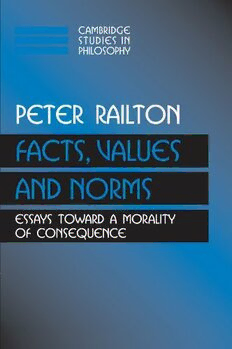
Download Facts, Values, and Norms: Essays toward a Morality of Consequence PDF Free - Full Version
Download Facts, Values, and Norms: Essays toward a Morality of Consequence by Peter Railton in PDF format completely FREE. No registration required, no payment needed. Get instant access to this valuable resource on PDFdrive.to!
About Facts, Values, and Norms: Essays toward a Morality of Consequence
This volume is great reading for any philosopher or student of philosophy who, like me, firmly believes that (1) a systematic inquiry into how we ought to live and what we owe to each other should be integrated with (2) an understanding of ourselves as thoroughly natural, social creatures whose behavior is explainable using standard scientific methods. More concretely, Railton gives a great account of how to understand (1) the explanations we give for the patterns of change within societies' moral attitudes concerning different kinds of behavior, character traits, and/or public institutions as (2a) objective, natural explanations of the historical developments in question, rather than (2b)the product of subjective "projections" of value onto bare, valueless factual descriptions of how societies' moral norms evolve. For example, we explain (1) the fact that widespread intellectual opposition to slavery first appeared within the 18th Century empires of Britain and France as the product of (2a) the fact that slavery was "morally worse" in these countries' colonies during that period than in any other place or time in history and (2b) the fact people's moral sensibilities evolved in causal response to this natural moral fact (this is a crude schema, but Railton puts a quite a bit more meat on the causal mechanisms in question).Railton's essays are much different than most ventures in "naturalized ethics," which read like a catalogue of inelegant applications of the data and explanatory models of the behavioral sciences to ethical questions. In contrast, Railton's own essays are concerned with elucidating deep philosophical questions about (1) how to live and what we owe to each other within (2) an intellectual framework that is systematic and continuous with the natural sciences, while nevertheless alive to the detail and complexities of real moral practice, moral discourse, and human value. Railton shows how facts about what is morally right and wrong can interact with natural facts about the interests and capacities we have as animals with peculiar forms of sociability.Among the highlights of volume are:(1) The development in the essay "Moral Realism" of a "wants/interests mechanism" that sketches how individuals and societies can get causal feedback from the world in a way that regulates their moral views and reliably steers their "subjective wants" towards a state of equilibrium with their "objective interests."(2)An analysis of classicallly Marxist-Humanist themes like "alienation" and "ideological critique" within the context of a very sophisticated view of practical rationality, human well-being, and consequentialist ethical theory. Railton develops a version of consequentialist ethics that takes into account the formation of non-alienated desires and principles as the most efficient means for a achieving pluralistic vision of well-being (where well-being is a weighted mix of things like knowledge, experiences of beauty, meaningful personal relationships, socioeconomic security, health, etc.). Whereas Leftists of a certain stripe often take instrumental rationality and consequentialist thought itself to be the cause of modernist alientation or mere ideological superstructures of bourgeois society, Railton shows how the analytical separation of the deliberative and affective aspects of practical reason on which these critiques depend is already a symptom of alienated thinking (a theme that actually echoes some of the work by Frankfurt School theorists on social rationality, as well as other Continental philosophers).
Detailed Information
| Author: | Peter Railton |
|---|---|
| Publication Year: | 2003 |
| ISBN: | 9780511065415 |
| Pages: | 410 |
| Language: | English |
| File Size: | 2.128 |
| Format: | |
| Price: | FREE |
Safe & Secure Download - No registration required
Why Choose PDFdrive for Your Free Facts, Values, and Norms: Essays toward a Morality of Consequence Download?
- 100% Free: No hidden fees or subscriptions required for one book every day.
- No Registration: Immediate access is available without creating accounts for one book every day.
- Safe and Secure: Clean downloads without malware or viruses
- Multiple Formats: PDF, MOBI, Mpub,... optimized for all devices
- Educational Resource: Supporting knowledge sharing and learning
Frequently Asked Questions
Is it really free to download Facts, Values, and Norms: Essays toward a Morality of Consequence PDF?
Yes, on https://PDFdrive.to you can download Facts, Values, and Norms: Essays toward a Morality of Consequence by Peter Railton completely free. We don't require any payment, subscription, or registration to access this PDF file. For 3 books every day.
How can I read Facts, Values, and Norms: Essays toward a Morality of Consequence on my mobile device?
After downloading Facts, Values, and Norms: Essays toward a Morality of Consequence PDF, you can open it with any PDF reader app on your phone or tablet. We recommend using Adobe Acrobat Reader, Apple Books, or Google Play Books for the best reading experience.
Is this the full version of Facts, Values, and Norms: Essays toward a Morality of Consequence?
Yes, this is the complete PDF version of Facts, Values, and Norms: Essays toward a Morality of Consequence by Peter Railton. You will be able to read the entire content as in the printed version without missing any pages.
Is it legal to download Facts, Values, and Norms: Essays toward a Morality of Consequence PDF for free?
https://PDFdrive.to provides links to free educational resources available online. We do not store any files on our servers. Please be aware of copyright laws in your country before downloading.
The materials shared are intended for research, educational, and personal use in accordance with fair use principles.

