Table Of ContentWilsonharris.qxd 7/29/2003 4:21 PM Page i
Exploring
the Palace of
the Peacock
Wilsonharris.qxd 7/29/2003 4:21 PM Page ii
Joyce Sparer Adler
Wilsonharris.qxd 7/29/2003 4:21 PM Page iii
Exploring
the Palace of
the Peacock
Essays on
Wilson Harris
Joyce Sparer Adler
Edited by Irving Adler
Foreword by Janet Jagan
UNIVERSITY OF THE WEST INDIES PRESS
Jamaica Barbados Trinidad & Tobago
Wilsonharris.qxd 7/29/2003 4:21 PM Page iv
University of the West Indies Press
1A Aqueduct Flats Mona
Kingston 7 Jamaica
© 2003by The University of the West Indies Press
All rights reserved. Published 2003
07 06 05 04 03 5 4 3 2 1
CATALOGUING IN PUBLICATION DATA
Adler, Joyce Sparer
Exploring the palace of the peacock: essays on Wilson Harris /
Joyce Sparer Adler; edited by Irving Adler; foreword by Janet Jagan.
p. cm.
Includes bibliographical references.
ISBN: 976-640-140-3
1. Harris, Wilson – Criticism and interpretation. 2. Harris,
Wilson. The Palace of the peacock. I. Adler, Irving.
PR9320.9.H3 P334 2003 813.2
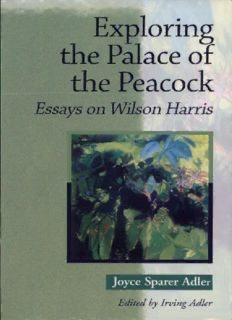
Cover illustration:Isaiah James Boodhoo, Foliage(1988).
Collection of the University of the West Indies.
Book and cover design by Robert Harris.
Set in Adobe Garamond 11/15x 27
Printed in Canada.
Wilsonharris.qxd 7/29/2003 4:21 PM Page v
Contents
Foreword / vi
Wilson Harris: An Autobiographical Essay / viii
Biographical Sketch of Joyce Sparer Adler / xxxv
Acknowledgements / xl
Chapter 1 Wilson Harris: The Ideal of Unity / 1
Chapter 2 The Art of Wilson Harris / 12
Chapter 3 Tumatumari and the Imagination of
Wilson Harris / 22
Chapter 4 Wilson Harris and Twentieth-Century Man / 36
Chapter 5 Melville and Harris: Poetic Imaginations
Related in Their Response to the
Modern World / 49
Chapter 6 Wilson Harris’s The Womb of Space:
The Cross-Cultural Imagination / 60
Chapter 7 The Evolution of Female Figures and Imagery
in Wilson Harris’s Novels / 69
Chapter 8 Wilson Harris’s Cross-Cultural Dialogue
with Melville / 82
Chapter 9 Wilson Harris: An Introduction / 91
Notes / 95
Bibliography / 100
v
Wilsonharris.qxd 7/29/2003 4:21 PM Page vi
Foreword
Janet Jagan
I was most happy to receive a request from Irving Adler to write a few words
for the book he is publishing of Joyce Sparer Adler’s essays on Wilson Harris.
I have known both Joyce Sparer and Wilson Harris; my acquaintance
with Mr Harris goes back more than fifty years. It was during the exhilarat-
ing period of the 1940s and early 1950s when my late husband, Cheddi Jagan,
and I and others were gathering forces and ideas and building ideals to begin
the long struggle for independence of the then British Guiana.
At our home in Laluni Street, Georgetown, a few years after Cheddi’s
return from dental studies in the United States and my arrival after our mar-
riage in 1943, we met many young Guyanese and used to have frequent talks,
exchanges of views and books, all leading to revolutionary thoughts and
preparations for action.
Wilson Harris, the surveyor and poet, and Martin Carter, another bud-
ding poet, came over in the evenings to Laluni Street and read their poems
to us. These were heady days full of activity, passion and resolve. (Martin
Carter later became Guyana’s national poet.)
Wilson invited me to join his surveying team in the interior, which I
accepted. It was then that I understood that the beauty, mystery and pro-
found quiet of the interior greatly influenced what was to be his life as a
writer. It was already creating the poet in him, which would later lead to his
creative powers as a novelist.
Joyce Sparer came to Guyana at another important and most difficult
period in the struggles of the People’s Progressive Party led by Cheddi Jagan
vi
Wilsonharris.qxd 7/29/2003 4:21 PM Page vii
Foreword
for independence and the betterment of its people. The 1960s were haz-
ardous times. The Central Intelligence Agency was interfering in the inter-
nal affairs of British Guiana and participating in a dangerous campaign to
destabilize the elected government of Premier Cheddi Jagan.
Dr Jagan, in his vision of a free Guyana, sought to establish a university.
With few resources and a hostile opposition, re-enforced by the Central
Intelligence Agency, he went ahead and started the university at Queen’s
College, the premier high school, using the building after hours. Joyce Sparer
was one of the courageous, self-sacrificing persons who joined the faculty of
the newly inaugurated University of Guyana. She stayed in Guyana for five
years, teaching at the university and living through the very difficult times,
never losing her cool or her deep interest in the country, which finally
achieved independence in 1966. It was during this time that she became
interested in the works of Wilson Harris who had gone to live in England,
where he still resides.
Wilson Harris has to his name a number of books which have been rec-
ognized for their depth and penetration to the core of the meaning of his
homeland. That Joyce Sparer reviewed and closely examined his works is a
credit to her discernment, as Wilson Harris has never been a popular writer,
too intellectual, much too deep, too profound for his novels to be bestsellers.
Joyce Sparer made a positive contribution to Guyana, first in helping to
establish the University of Guyana, then as a teacher and later in recogniz-
ing the worth of one of Guyana’s leading writers.
vii
Wilsonharris.qxd 7/29/2003 4:21 PM Page viii
Wilson Harris
An Autobiographical Essay
I live now in Essex with my wife Margaret. It is some thirty-odd years since
I emigrated from Guyana, South America, to the United Kingdom. I was
thirty-eight when I left British Guiana (as Guyana was then called) in 1959.
An English friend tells me that the marvellous glow one sees sometimes –
particularly at the end of the day – across the rolling Essex countryside is
known as the East Anglian light. He claims that this radiance is due to a pat-
tern of rainfall that is adequate but not excessive in this corner of England
and also to the open vistas and skyscape that run from the sea miles away on
the distant East Anglian coast of Norfolk.
All this is of great interest to me for landscape/skyscape/riverscape/
seascape (and their intermingled bearing on each other which transcends
immediate locality) have been a living text – if I may so put it – in the way
I read and reread the elements (as if the elements were a book) when I lived
in South America and travelled from the Atlantic coastlands into the heart-
land of the Guyanas.
Now I sometimes find that the rolling Essex countryside reminds me of
an aspect of the savannahs of the Guyanas. I dream of the survey expeditions
I led there and into the rainforests as a young man for fifteen years or so.
Peculiar as it may seem, those expeditions through the coastlands into the
rainforests have enriched my appreciation of the northern world. Likewise
my experience of East Anglian light gives to memory’s return to the Guyanas
a rhythm and counterpoint, a spatiality, that affects, for instance, the narra-
viii
Wilsonharris.qxd 7/29/2003 4:21 PM Page ix
Wilson Harris
tive shape and imageries in the passage below that comes from my latest pub-
lished novel The Four Banks of the River of Space, which appeared in 1990.
Our guide was signalling to us. The mouth of the trail had been cleared and we
climbed and entered the Bush. The fantastic, planetary greenheart trees rose into
marvellous silvery columns on every hand. Clothed in water-music. The trail was
narrow. We walked in single file. The cracked silvery veil of greenheart possessed the
texture of slow-motion rain falling within the huge Bell of a still Waterfall in which
whispering leaves of fluid sound ran up into veil within veil of Shadow-organ gloom
towards the highest reaches of the Forest and the slit of the Sky far above. Subtle fire-
music.
I had never before seen the shining bark of greenheart columns in this slow-
motion raining light (nor the Sky clothed in frail ribbons of fire-music within the
lofty gloom of a Bell) in all my remembered Dream of Forests I had travelled in my
youth. How young was I, how old was I? We had entered it seemed – the Macusi
guide first, Penelope second, Ross third, I last – an innermost chamber of the magi-
cal Waterfall beneath god-rock. It encompassed the globe, the ancient world, the
modern world. As if the Waterfall had been uplifted from the river and transferred
within us in the music of space, around us in Shadow-organ imperceptible (not
wholly imperceptible for we were aware of it) dance of genesis. (From The Four
Banks of the River of Space, pp. 132–33)
There was a large black trunk in my mother’s bedroom which she opened
for the first time in my presence on the day the news came that my step-
father had disappeared (presumed drowned) in the rivers and rainforests of
Guyana. The year was 1929. I was eight years old.
My stepfather’s death or disappearance was the second crucial bereave-
ment my mother suffered in six years. My father had died suddenly in 1923,
and my memories of him were therefore quite naturally void or hollow,
though on seeing the contents of the large open trunk he seemed strangely
alive in my aroused imagination because of books of his my mother held up,
a photograph to which she pointed in which he stood between two com-
panions, and a horse carven from a greenheart tree.
A subconscious thread or connection was woven then with the South
American heartland of the Guyanas into which I was to lead many survey
expeditions as a young man. The impact of the forests and savannahs on
ix