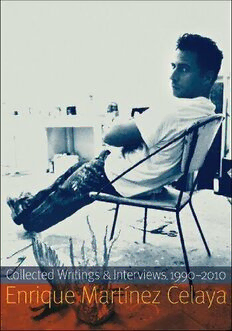
Table Of ContentEnrique Martínez Celaya
Enrique Martínez Celaya
Collected Writings and Interviews, 1990–2010
enrique martínez celaya | introduction by
klaus ottmann | foreword by james b. milliken
university of nebraska press | lincoln and london
© 2010 by Enrique Martínez Celaya. Introduction
© 2010 by Klaus Ottmann. Foreword © 2010 by
the Board of Regents of the University of Nebraska.
Acknowledgments for the use of copyrighted
material appear as footnotes on chapter openers,
which constitute extensions of the copyright page.
All rights reserved. Manufactured in the United
States of America.
Library of Congress Cataloging-in-Publication Data
Martínez Celaya, Enrique, 1964–
Enrique Martínez Celaya : collected writings and
interviews, 1990–2010 / Enrique Martínez Celaya;
introduction by Klaus Ottmann ; foreword by
James B. Milliken.
p. cm. Includes bibliographical references.
isbn 978-0-8032-3474-1 (pbk. : alk. paper)
1. Martínez Celaya, Enrique, 1964– —Written
works. 2. Martínez Celaya, Enrique, 1964–
—Interviews. 3. Artists—United States—Interviews.
I. Title.
n6537.m3935a35 2010
709.2—dc22 2010019379
Set in Meta and Minion Pro by Bob Reitz.
Designed by A. Shahan.
For Edilia
ix Foreword by James B. Milliken
xi Introduction by Klaus Ottmann
1 Notes, 1990
4 Notes, 1991
5 Notes, 1992
9 Notes, 1993
12 A Manifesto, 1994
17 Notes, 1994
18 Notes, 1996
Contents
22 From an Interview with Christopher Miles, 1997
27 Notes, 1997
28 From an Interview with M. A. Greenstein, 1998
36 Notes, 1998
37 Berlin, 1998
38 From a Conversation with Donald Baechler, 1999
42 Notes to Anne Trueblood Brodzky, 1999
46 From a Conversation with Amnon Yariv, 1999
50 From an Interview with Howard N. Fox, 1999
55 Notes, 2000
57 Notes, 2001
58 Making and Meaning, 2001
62 From a Lecture at the Orange County Museum of Art, 2001
66 Notes, 2002
67 From a Letter to Daniel A. Siedell, 2002
70 From an Interview with L. Kent Wolgamott, 2003
77 From Twelve Th oughts on Th e October Cycle, 2003
81 Letter of Resignation, 2003
84 From a Letter to Lisa Tamiris Becker, 2003
87 From a Conversation with Roald Hoff mann, 2003
97 Schneebett, 2004
100 Notes, 2004
103 Letter to Leon Golub, 2004
104 From an Interview with Richard Whittaker, 2004
111 From a Lecture at the Berliner Philharmonie, 2004
117 Notes, 2005
118 Letter to the Editor of the New York Times, 2005
120 Th e Fuzzy Boundary: Science and Art, 2005
124 Shaping Language, 2006
129 Notes, 2006
130 Introductions to Projects, 2006
141 Photography as Grief, 2007
149 From Th e Blog: Bad Time for Poetry, 2007
Sunday, August 26. Adorno as Cliché 149
Saturday, September 1. Th e Road 150
Wednesday, September 5. Th e end is important
in all things (II) 151
Th ursday, September 6. Criticism and Imitation 151
Saturday, September 8. A New Body of Work 152
Wednesday, September 12. In Favor of Speaking Up 153
Sunday, September 16. Complexity and Tidy Packages 154
Th ursday, September 27. Refl ections on a Return 155
Tuesday, December 4. Tall Words 156
157 A Personal Note on Art and Compassion, 2007
161 Notes, 2007
169 From Considering Painting and Meaning, 2007
172 Boy Raising His Arm, 2007
173 From Th e Blog: Bad Time for Poetry, 2008
Th ursday, February 7. Santa Monica Studio 173
Tuesday, February 12. Soul Searching 174
Monday, March 17. A Witty Age 174
Th ursday, May 13. Being Cuban 175
Th ursday, June 12. On Looking at the Work Done 176
Wednesday, July 16. Th e Hand 177
Tuesday, October 14. Unreasonable Pursuits: Moby-Dick 178
Tuesday, October 21. A Sentimental Education 179
Tuesday, December 2. Radical Doubting 180
Tuesday, November 11, 2008; Wednesday, December 17, 2008;
Tuesday, December 23, 2008; Friday, January 9, 2009.
Painting and Structure 181
184 Art and Museums, 2008
192 From an Interview with Gillian Serisier, 2008
196 Systems, Time, and Daybreak, 2008
203 From an Interview with Greg McComb, 2008
208 From an Interview with Prue Gibson, 2009
211 From Th e Blog: Bad Time for Poetry, 2009
Friday, January 23; Friday, January 30. Failure 211
Tuesday, February 3. Meltingly sweet, in autumn 212
Th ursday, February 5. Innocent Fraud 213
Tuesday, April 28. You and the Kindle 214
Tuesday, May 12; Wednesday, May 13. Get Rid of Your Excuse 216
219 Art and the University, 2009
227 Notes, 2009
231 Th e Prophet, 2009
240 On Painting, 2010
James B. Milliken, President of University of Nebraska
Foreword
Th e University of Nebraska’s relationship with Enrique Martínez Celaya
began through the university’s outstanding Sheldon Museum of Art, which
acquired several of Enrique’s works. Former Sheldon curator and now Uni-
versity of Nebraska at Omaha professor Dan Siedell has continued to col-
laborate with Enrique. Th e University of Nebraska Press, in a wise decision
made years ago, agreed to distribute the publications of Enrique’s press,
Whale & Star, which include beautiful productions of his own writings and
catalogs, as well as the work of some of the writers he most admires.
I fi rst met Enrique fi ve years ago in connection with the installation
at the Sheldon of his work Coming Home. I encountered an engaging,
articulate, and disarmingly polite man with an unusual academic back-
ground—in physics—and an intriguing personal history. He was comfort-
able with conversation on any topic, especially—and, it seemed at the time,
diplomatically—issues involving higher education and the University of
Nebraska. We continued our conversation on art, ideas, and the modern
university in many locations, including at his studios in Los Angeles and
Florida and on the campuses of the University of Nebraska.
I would be happy to take credit for the decision to deepen the univer-
sity’s relationship with Enrique by naming him to a Visiting Presiden-
tial Professorship, but I have come to realize that the idea was at least
as much his as mine. He saw special qualities at the university that he
found promising, and the plan for his successful visiting professorship,
with its many valuable dimensions, almost entirely his. Th e essential role
and responsibility of universities in the exploration of ideas has informed
Enrique’s interest in and approach to his relationship with the University
of Nebraska. At each step, he has looked for ways to challenge himself
and us to think more deeply about this role we play with our students,
our faculty, and the larger community. In a culture that oft en expects so
little of substance from its artists, Enrique is a bracing breath of fresh air.
ix