
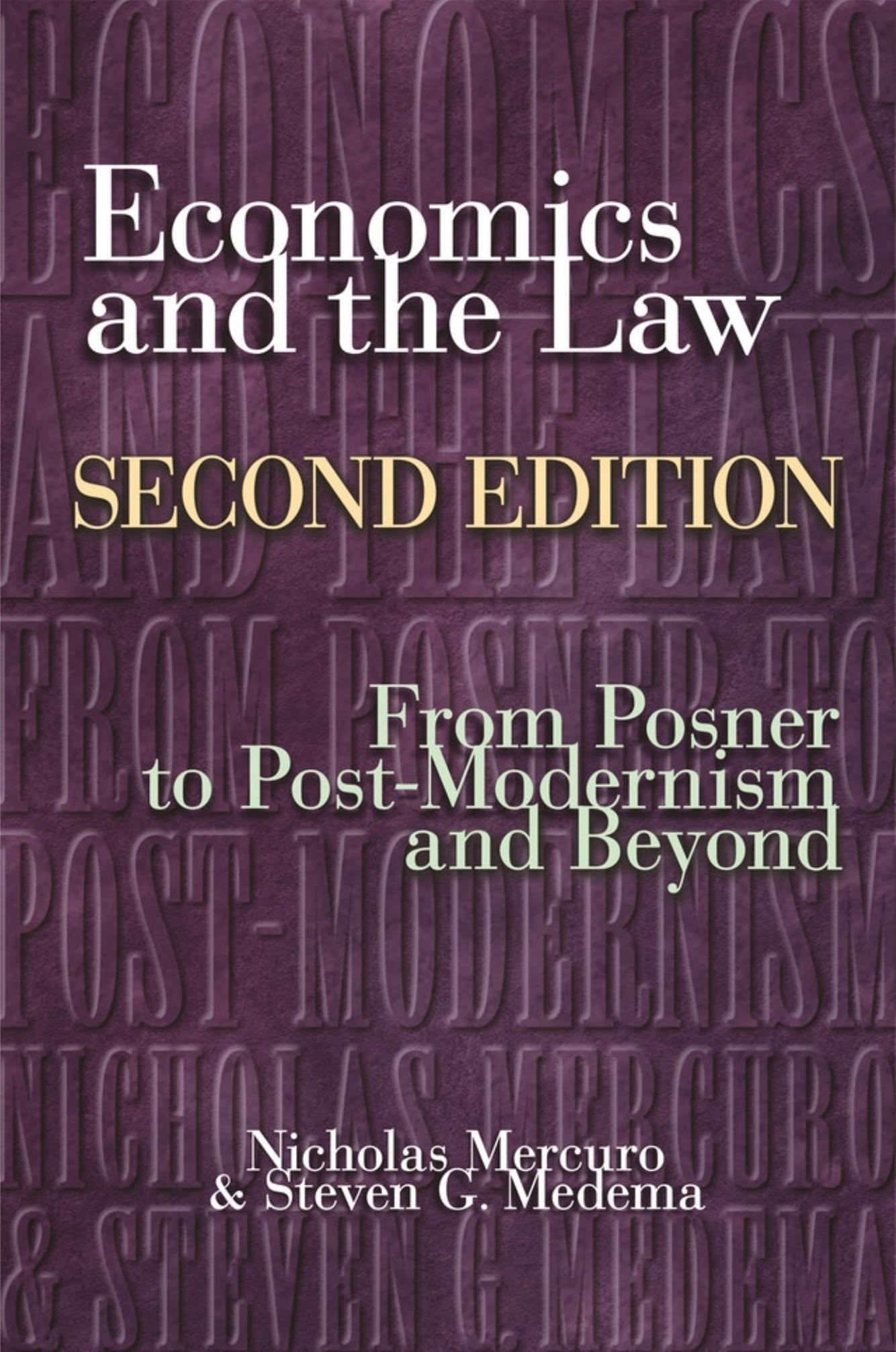
Download Economics and the Law: From Posner to Post-Modernism PDF Free - Full Version
Download Economics and the Law: From Posner to Post-Modernism by Nicholas Mercuro & Steven G. Medema in PDF format completely FREE. No registration required, no payment needed. Get instant access to this valuable resource on PDFdrive.to!
About Economics and the Law: From Posner to Post-Modernism
The last several decades have witnessed the development of diverse approaches to the evolving field of Law and Economics. Each school of thought within Law and Economics has helped both to redefine the study of law and to expose the important economic implications of the legal environment. Here, Nicholas Mercuro and Steven Medema present a valuable, concise overview of the current perspectives and varied traditions that constitute the field. The authors make clear that Law and Economics is not a homogeneous movement by deftly illuminating the several competing and yet complementary traditions, including the Chicago School of Law and Economics, Public Choice Theory, Institutional and Neo-Institutional Law and Economics, the New Haven School, and Modern Civic Republicanism, as well as the challenge to Law and Economics posed by Critical Legal Studies. By providing readers with a noncritical description of the broad contours of each school of thought, Mercuro and Medema convey a strong sense of the important elements of each of these interrelated yet varied traditions.The authors define Law and Economics broadly to include the application of economic theory (primarily microeconomics and the basic concepts of welfare economics) to the formation, structure, processes, and economic impact of law and legal institutions. Because the law and the economy interact across a variety of fronts, the fundamental insights of this burgeoning field have important implications, not only for economics and the law, but also for those in contiguous disciplines such as political science, public administration, and sociology.
Detailed Information
| Author: | Nicholas Mercuro & Steven G. Medema |
|---|---|
| Publication Year: | 1999 |
| Language: | other |
| File Size: | 4.3858 |
| Format: | |
| Price: | FREE |
Safe & Secure Download - No registration required
Why Choose PDFdrive for Your Free Economics and the Law: From Posner to Post-Modernism Download?
- 100% Free: No hidden fees or subscriptions required for one book every day.
- No Registration: Immediate access is available without creating accounts for one book every day.
- Safe and Secure: Clean downloads without malware or viruses
- Multiple Formats: PDF, MOBI, Mpub,... optimized for all devices
- Educational Resource: Supporting knowledge sharing and learning
Frequently Asked Questions
Is it really free to download Economics and the Law: From Posner to Post-Modernism PDF?
Yes, on https://PDFdrive.to you can download Economics and the Law: From Posner to Post-Modernism by Nicholas Mercuro & Steven G. Medema completely free. We don't require any payment, subscription, or registration to access this PDF file. For 3 books every day.
How can I read Economics and the Law: From Posner to Post-Modernism on my mobile device?
After downloading Economics and the Law: From Posner to Post-Modernism PDF, you can open it with any PDF reader app on your phone or tablet. We recommend using Adobe Acrobat Reader, Apple Books, or Google Play Books for the best reading experience.
Is this the full version of Economics and the Law: From Posner to Post-Modernism?
Yes, this is the complete PDF version of Economics and the Law: From Posner to Post-Modernism by Nicholas Mercuro & Steven G. Medema. You will be able to read the entire content as in the printed version without missing any pages.
Is it legal to download Economics and the Law: From Posner to Post-Modernism PDF for free?
https://PDFdrive.to provides links to free educational resources available online. We do not store any files on our servers. Please be aware of copyright laws in your country before downloading.
The materials shared are intended for research, educational, and personal use in accordance with fair use principles.

