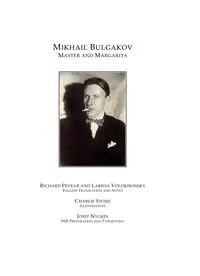
Table Of ContentMIKHAIL BULGAKOV
MASTER AND MARGARITA
RICHARD PEVEAR AND LARISSA VOLOKHONSKY
ENGLISH TRANSLATION AND NOTES
CHARLIE STONE
ILLUSTRATIONS
JOSEF NYGRIN
PDF PREPARATION AND TYPESETTING
MIKHAIL BULGAKOV
Master and Margarita
MASTER AND MARGARITA
Released under Creative Commons Attribution-Noncommercial Licence.
http://creativecommons.org/licenses/by-nc/3.0/us/
You are free:
to share – to copy, distribute, display, and perform the work;
to remix - to make derivative works.
Under the following conditions:
attribution – you must attribute the work in the manner specified by the author
or licensor (but not in any way that suggests that they endorse you or your use
of the work);
noncommercial – you may not use this work for commercial purposes.
Any of the above conditions can be waived if you get permission from
the copyright holder.
English translation by Richard Pevear and Larissa Volokhonsky. This
translation published in PENGUIN BOOKS, 1997.
Illustrations by Charlie Stone.
MIKTEX LATEX typesetting by Josef Nygrin, in March 2008.
http://www.paskvil.com/
Some rights reserved c⃝ 2008 Josef Nygrin
Contents
Introduction
1
Note and Acknowledgements
13
Book I.
15
1
Never Talk with Strangers
17
2
Pontius Pilate
30
3
The Seventh Proof
54
4
The Chase
59
5
There were Doings at Griboedov’s
67
6
Schizophrenia, as was Said
79
7
A Naughty Apartment
87
8
The Combat between the Professor and the Poet
98
9
Koroviev’s Stunts
106
10 News From Yalta
115
11 Ivan Splits in Two
126
12 Black Magic and Its Exposure
130
13 The Hero Enters
144
14 Glory to the Cock!
162
15 Nikanor Ivanovich’s Dream
170
16 The Execution
182
17 An Unquiet Day
194
18 Hapless Visitors
206
Book II.
227
19 Margarita
229
20 Azazello’s Cream
242
21 Flight
247
22 By Candlelight
260
23 The Great Ball at Satan’s
273
24 The Extraction of the Master
288
25 How the Procurator Tried to Save Judas of Kiriath
309
26 The Burial
319
27 The End of Apartment No.50
340
28 The Last Adventures of Koroviev and Behemoth
355
29 The Fate of the Master and Margarita is Decided
367
30 It’s Time! It’s Time!
372
31 On Sparrow Hills
383
32 Forgiveness and Eternal Refuge
387
Epilogue
393
Mikhail Afanasievich Bulgakov
405
Epigraph
FAUST:
Nun gut, wer bist du denn?
MEPHISTOPHELES:
Ein Teil von jener Kraft,
Die stets das B¨ose will und stets das Gute schafft.
—
FAUST:
Who then art thou?
MEPHISTOPHELES:
Part of that power which still
Produceth good, whilst ever scheming ill. 1
1The epigraph comes from the scene entitled ‘Faust’s Study’ in the first part of the
drama Faust by Johann Wolfgang von Goethe (1749–1842). The question is asked by
Faust; the answer comes from the demon Mephistopheles.
Bulgakov originally considered including the epigraph from Goethe’s Faust in the origi-
nal German. The line comes shortly after Mephistopheles appears in Faust’s study, hav-
ing followed him in as a black poodle.
Mikhail Bulgakov – Master and Margarita
Introduction
Mikhail Bulgakov worked on this luminous book throughout one of the
darkest decades of the century. His last revisions were dictated to his wife
a few weeks before his death in 1940 at the age of forty-nine. For him,
there was never any question of publishing the novel. The mere existence
of the manuscript, had it come to the knowledge of Stalin’s police, would
almost certainly have led to the permanent disappearance of its author.
Yet the book was of great importance to him, and he clearly believed that
a time would come when it could be published. Another twenty-six years
had to pass before events bore out that belief and The Master and Margarita,
by what seems a surprising oversight in Soviet literary politics, finally ap-
peared in print. The effect was electrifying.
The monthly magazine Moskva, otherwise a rather cautious and quiet
publication, carried the first part of The Master and Margarita in its Novem-
ber 1966 issue. The 150,000 copies sold out within hours. In the weeks that
followed, group readings were held, people meeting each other would
quote and compare favourite passages, there was talk of little else. Cer-
tain sentences from the novel immediately became proverbial. The very
language of the novel was a contradiction of everything wooden, official,
imposed. It was a joy to speak.
When the second part appeared in the January 1967 issue of Moskva,
it was greeted with the same enthusiasm. Yet this was not the excitement
caused by the emergence of a new writer, as when Aleksandr Solzhenit-
syn’s One Day in the Life of Ivan Denisovich appeared in the magazine Novy
Mir in 1962. Bulgakov was neither unknown nor forgotten. His plays had
begun to be revived in theatres during the late fifties and were published
in 1962. His superb Life of Monsieur de Moliere came out in that same year.
His early stories were reprinted. Then, in 1965, came the Theatrical Novel,
based on his years of experience with Stanislavsky’s renowned Moscow
Art Theatre. And finally in 1966 a volume of Selected Prose was published,
containing the complete text of Bulgakov’s first novel. The White Guard,
written in the twenties and dealing with nearly contemporary events of
1
2
Mikhail Bulgakov
the Russian civil war in his native Kiev and the Ukraine, a book which in
its clear-sighted portrayal of human courage and weakness ranks among
the truest depictions of war in all of literature.
Bulgakov was known well enough, then. But, outside a very small
group, the existence of The Master and Margarita was completely unsus-
pected. That certainly accounts for some of the amazement caused by its
publication. It was thought that virtually all of Bulgakov had found its
way into print. And here was not some minor literary remains but a major
novel, the author’s crowning work. Then there were the qualities of the
novel itself– its formal originality, its devastating satire of Soviet life, and
of Soviet literary life in particular, its ‘theatrical’ rendering of the Great
Terror of the thirties, the audacity of its portrayal of Jesus Christ and Pon-
tius Pilate, not to mention Satan. But, above all, the novel breathed an
air of freedom, artistic and spiritual, which had become rare indeed, not
only in Soviet Russia. We sense it in the special tone of Bulgakov’s writ-
ing, a combination of laughter (satire, caricature, buffoonery) and the most
unguarded vulnerability. Two aphorisms detachable from the novel may
suggest something of the complex nature of this freedom and how it may
have struck the novel’s first readers. One is the much-quoted ‘Manuscripts
don’t burn’, which seems to express an absolute trust in the triumph of
poetry, imagination, the free word, over terror and oppression, and could
thus become a watchword of the intelligentsia. The publication of The
Master and Margarita was taken as a proof of the assertion. In fact, during a
moment of fear early in his work on the novel, Bulgakov did burn what he
had written. And yet, as we see, it refused to stay burned. This moment of
fear, however, brings me to the second aphorism - ‘Cowardice is the most
terrible of vices’ - which is repeated with slight variations several times
in the novel. More penetrating than the defiant ‘Manuscripts don’t burn’,
this word touched the inner experience of generations of Russians. To por-
tray that experience with such candour required another sort of freedom
and a love for something more than ‘culture’. Gratitude for such perfect
expression of this other, deeper freedom must surely have been part of the
enthusiastic response of readers to the novel’s first appearance.
And then there was the sheer unlikeliness of its publication. By 1966
the ‘thaw’ that had followed Stalin’s death was over and a new freeze was
coming. The hopes awakened by the publication of One Day in the Life of
Ivan Denisovich, the first public acknowledgement of the existence of the
Gulag, had been disappointed. In 1964 came the notorious trial of the poet
Joseph Brodsky, and a year later the trial of the writers Andrei Sinyavsky
and Yuli Daniel, both sentenced to terms in that same Gulag. Solzhenitsyn
saw a new Stalinization approaching, made worse by the terrible sense of
Master and Margarita
3
repetition, stagnation and helplessness. Such was the monotonously grim
atmosphere of the Brezhnev era. And in the midst of it there suddenly
burst The Master and Margarita, not only an anomaly but an impossibility, a
sort of cosmic error, evidence of some hidden but fatal crack in the system
of Soviet power. People kept asking, how could they have let it happen?
Bulgakov began work on the first version of the novel early in 1929, or
possibly at the end of 1928. It was abandoned, taken up again, burned,
resurrected, recast and revised many times.
It accompanied Bulgakov
through the period of greatest suffering for his people – the period of
forced collectivization and the first five-year plan, which decimated Rus-
sia’s peasantry and destroyed her agriculture, the period of expansion of
the system of ‘corrective labour camps’, of the penetration of the secret
police into all areas of life, of the liquidation of the intelligentsia, of vast
party purges and the Moscow ‘show trials’. In literature the same strug-
gle went on in miniature, and with the same results. Bulgakov was not
arrested, but by 1930 he found himself so far excluded that he could no
longer publish or produce his work. In an extraordinarily forthright let-
ter to the central government, he asked for permission to emigrate, since
the hostility of the literary powers made it impossible for him to live. If
emigration was not permitted, ‘and if I am condemned to keep silent in
the Soviet Union for the rest of my days, then I ask the Soviet government
to give me a job in my speciality and assign me to a theatre as a titular
director.’ Stalin himself answered this letter by telephone on 17 April, and
shortly afterwards the Moscow Art Theatre hired Bulgakov as an assis-
tant director and literary consultant. However, during the thirties only his
stage adaptations of Gogol’s Dead Souls and Cervantes’ Don Quixote were
granted a normal run. His own plays either were not staged at all or were
quickly withdrawn, and his Life of Monsieur de Moliere, written in 1932–5
for the collection Lives of Illustrious Men, was rejected by the publisher.
These circumstances are everywhere present in The Master and Margarita,
which was in part Bulgakov’s challenge to the rule of terror in literature.
The successive stages of his work on the novel, his changing evaluations
of the nature of the book and its characters, reflect events in his life and his
deepening grasp of what was at stake in the struggle. I will briefly sketch
what the study of his archives has made known of this process.
The novel in its definitive version is composed of two distinct but in-
terwoven parts, one set in contemporary Moscow, the other in ancient
Jerusalem (called Yershalaim). Its central characters are Woland (Satan)
and his retinue, the poet Ivan Homeless, Pontius Pilate, an unnamed writer
known as ‘the master’, and Margarita. The Pilate story is condensed into
four chapters and focused on four or five large-scale figures. The Moscow
4
Mikhail Bulgakov
story includes a whole array of minor characters. The Pilate story, which
passes through a succession of narrators, finally joins the Moscow story
at the end, when the fates of Pilate and the master are simultaneously
decided. The earliest version, narrated by a first-person ‘chronicler’ and
entitled The Engineer’s Hoof, was written in the first few months of 1929.
It contained no trace of Margarita and only a faint hint of the master in a
minor character representing the old intelligentsia. The Pilate story was
confined to a single chapter. This version included the essentials of the
Moscow satire, which afterwards underwent only minor revisions and re-
arrangements. It began in much the same way as the definitive version,
with a dialogue between a people’s poet and an editor (here of an anti-
religious magazine. The Godless) on the correct portrayal of Christ as an
exploiter of the proletariat. A stranger (Woland) appears and, surprised at
their unbelief, astounds them with an eyewitness account of Christ’s cru-
cifixion. This account forms the second chapter, entitled ‘The Gospel of
Woland’.
Clearly, what first spurred Bulgakov to write the novel was his outrage
at the portrayals of Christ in Soviet anti-religious propaganda (The Godless
was an actual monthly magazine of atheism, published from 1922 to 1940).
His response was based on a simple reversal – a vivid circumstantial nar-
rative of what was thought to be a ‘myth’ invented by the ruling class, and
a breaking down of the self-evident reality of Moscow life by the intrusion
of the ‘stranger’. This device, fundamental to the novel, would be more
fully elaborated in its final form. Literary satire was also present from the
start. The fifth chapter of the definitive version, entitled There were Do-
ings at Griboedov’s’, already appeared intact in this earliest draft, where it
was entitled ‘Mania Furibunda’. In May of 1929, Bulgakov sent this chap-
ter to a publisher, who rejected it. This was his only attempt to publish
anything from the novel.
The second version, from later in the same year, was a reworking of the
first four chapters, filling out certain episodes and adding the death of Ju-
das to the second chapter, which also began to detach itself from Woland
and become a more autonomous narrative.
According to the author’s
wife, Elena Sergeevna, Bulgakov partially destroyed these two versions
in the spring of 1930 – ‘threw them in the fire’, in the writer’s own words.
What survived were two large notebooks with many pages torn out. This
was at the height of the attacks on Bulgakov . in the press, the moment of
his letter to the government.
After that came some scattered notes in two notebooks, kept intermit-
tently over the next two years, which was a very difficult time for Bul-
gakov. In the upper-right-hand corner of the second, he wrote:
Master and Margarita
5
‘Lord, help me to finish my novel, 1931.’
In a fragment of a later chapter, entitled ‘Woland’s Flight’, there is a
reference to someone addressed familiarly as ty, who is told that he ‘will
meet with Schubert and clear mornings’. This is obviously the master,
though he is not called so. There is also the first mention of the name of
Margarita. In Bulgakov’s mind, the main outlines of a new conception of
the novel were evidently already clear.
This new version he began to write in earnest in October of 1932, dur-
ing a visit to Leningrad with Elena Sergeevna, whom he had just married.
(The ‘model’ for Margarita, who had now entered the composition, she
was previously married to a high-ranking military official, who for some
time opposed her wish to leave him for the writer, leading Bulgakov to
think he would never see her again.) His wife was surprised that he could
set to work without having any notes or earlier drafts with him, but Bul-
gakov explained, ’I know it by heart.’ He continued working, not without
long interruptions, until 1936. Various new tides occurred to him, all still
referring to Satan as the central figure – The Great Chancellor, Satan, Here
I Am, The Black Theologian, He Has Come, The Hoofed Consultant. As in the
earliest version, the time of the action is 24– 5 June, the feast of St John,
traditionally a time of magic enchantments (later it was moved to the time
of the spring full moon). The nameless friend of Margarita is called ‘Faust’
in some notes, though not in the text itself. He is also called ‘the poet’,
and is made the author of a novel which corresponds to the ‘Gospel of
Woland’ from the first drafts. This historical section is now broken up and
moved to a later place in the novel, coming closer to what would be the
arrangement in the final version.
Bulgakov laboured especially over the conclusion of the novel and
what reward to give the master. The ending appears for the first time in
a chapter entitled ‘Last Flight’, dating from July 1956. It differs little from
the final version. In it, however, the master is told explicitly and directly:
The house on Sadovaya and the horrible Bosoy will vanish
from your memory, but with them will go Ha-Nozri and the
forgiven hegemon. These things are not for your spirit. You
will never raise yourself higher, you will not see Yeshua, you
will never leave your refuge.
In an earlier note, Bulgakov had written even more tellingly: ‘You will
not hear the liturgy. But you will listen to the romantics...’ These words,
which do not appear in the definitive text, tell us how painfully Bulgakov