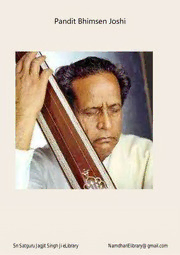
Table Of ContentPandit Bhimsen Joshi
Sri Satguru Jagjit Singh Ji eLibrary [email protected]
Sri Satguru Jagjit Singh Ji eLibrary [email protected]
On Pandit Bhimsen Joshi's birth centenary,
doyens of music recall the magic of his voice
Krishnaraj Iyengar
The powerful throw of the towering voice of Pandit Bhimsen Joshi
(1922-2011) shook the audiences.
photo courtesy: Mukta Monish Mehta
GOD, would you do this for us?” asks an emotional Pandit
Hariprasad Chaurasia, pausing to clear his throat. “Make an
exception,” he continues, “...a special provision for saints like Pandit
Bhimsen Joshi to return to the earthly realm every once in a while,
spread their magic, enlighten us yet again and then you can take
them back.” India is commemorating the birth centenary of the
music legend who was born on February 4, 1922.
Sri Satguru Jagjit Singh Ji eLibrary [email protected]
Sri Satguru Jagjit Singh Ji eLibrary [email protected]
Pandit Bhimsen Joshi visited Punjab in 1934 to learn from Dhrupad
singer Pandit Mangatram.
Panditji’s rendering was beyond comparison. His ‘taans’ in Raag
Miyan Malhar would recreate a monsoon storm sweeping across
the ocean raging under a blanket of grey clouds; his early morning
Raag Ahir Bhairav and Raag Ramkali would awaken the ‘chakras’
with meditative composure. His rendition of Raag Darbari Kanada
resounded with gilt-edged grandeur; his passionate Marathi
‘abhanga’ renditions could transport the listener to the sanctorum
of Pandharpur and the spiritual revelry of Maharashtra’s devout.
This versatile colossus still drenches the souls of music lovers
throughout the globe.
Beyond the powerful throw of his towering voice and the sheer
volcano of cosmic energy that shook audiences with each ‘antara’
of his renditions of various ‘raags’, there lay a heart-melting
gentleness at the very core of his ‘gayaki’, an unpretentious
childlike innocence and yearning.
Sri Satguru Jagjit Singh Ji eLibrary [email protected]
Sri Satguru Jagjit Singh Ji eLibrary [email protected]
Bhim Anna to the Kannadigas, Panditji was born in Gadag in
Karnataka’s Dharwad district. Named after his paternal
grandfather, he would often chuckle about how he was aptly
named ‘Bhimsen’ since even heftily built ladies would find the
sturdy and unusually heavy infant difficult to lift!
As much a Maharashtrian as he was a Kannadiga, his music, India’s
national classical treasure, is central to both states.
Dawn of a doyen
“My father was infatuated with music since his childhood. As a
child, he would hang out at a local gramophone records shop that
would often play recordings of great legends,” says Jayant Joshi,
Pandit Bhimsen Joshi’s elder son.
It was here that he listened to an archival recording of the
legendary Kirana Gharana’s doyen Khansaheb Abdul Karim Khan.
“He was around eight or nine. It was Khansaheb’s rendition of the
ethereal ‘thumri’ in Raag Jhinjhoti, ‘Piya bin nahin aavat chain’, that
inspired him to become a singer,” he continues.
In his quest for a guru, he travelled far and wide across India and
spent time learning from some of the leading stalwarts of the time.
He would often joke about how while other youngsters ran away
from home for ‘other reasons’, he ‘ran away’ in search of a guru!
Jayant says, “My father had a passion for assimilating diverse
influences. When he was working at All India Radio, Lucknow, he
would often travel to Benaras to listen to renowned ‘thumri’ singer
Siddheshwari Devi.” Bhimsenji, according to him, created his own
‘rasaayan’, which became his uniquely individualistic style.
Sri Satguru Jagjit Singh Ji eLibrary [email protected]
He finally found his guru right near him and his ‘taleem’ in the
Kirana tradition began taking shape. Pandit Rambhau Kundgolkar,
better known as Sawai Gandharva, incidentally a direct disciple of
Khansaheb Abdul Karim Khan whom young Bhimsen idolised,
resided in Kundgol, not far from his village. “Sawai Gandharva
initially tested my father’s sincere resolve. Only then began his
serious ‘taleem’ in the ‘gurukul’ system. My father lived with his
guru, performed household chores and took care of his mentally
challenged son,” Jayant shares.
I vividly remember my father’s concert at Mumbai’s famed classical
venue
Parle Tilak Vidyalaya, where he sang a stunning Raag Vrindavani
Sarang to a packed auditorium. After he finished, the audience that
was in raptures actually forgot to applaud. There was silence after
the concert until he mentioned that he had finished. Jayant Joshi,
Pandit Bhimsen joshi’s son
A singer cannot be born without the indispensible stamp of
Bhimsenji. Pandit Hariprasad Chaurasia, flute maestro
Passionate about driving, there was a time when Panditji would
drive to his concerts across India. Once while traversing the
Chambal valley, he was stopped by dacoits. When they got to know
that he was a singer, they demanded that he sing like their
favourite vocalist, Bhimsen Joshi. After an enthralling spontaneous
performance, when they finally asked his name, the overjoyed
dacoits, with utmost reverence, escorted him to safety. Pandit
Nayan Ghosh, sitar and tabla maestro
Around 20 years ago, Panditji had a slip disc and was advised total
rest. I was blessed to be sitting by his bedside and singing. When I
Sri Satguru Jagjit Singh Ji eLibrary [email protected]
began Ustad Abdul Karim Khansaheb’s famous Bhairavi thumri
‘Jamuna ke Teer’ with an unusual murki decoration, he almost
jumped out of the bed and exclaimed, ‘Wah! Yeh baat hai!’ I can
never forget that blessed moment. Pandit Jayteerth Mevundi,
vocalist
Punjab connection
In Bhimsenji’s powerful voice, ‘Changey nainan waaliyan kudiyan
Sadarang nu daindiyaan sainat’ in the serious morning Raag Todi
sounded more prophetic than romantic. This Punjabi ‘bandish’,
depicting composer Niamat Khan Sadarang’s infatuation with
pretty-eyed damsels, was given to him by tabla maestro Ustad
Allarakha. The ‘bandish’, an attempt at the language by the
composer and the singer, both non-native speakers, is worth a
hear. His connection with the region, however, goes beyond it.
Bhimsenji’s Punjab visit in 1934 was the turning point of his life.
Here, he took lessons from Dhrupad singer Pandit Mangatram and
accompanied eminent singers on the tanpura during their
concerts. “It was in Jalandhar during the famous Harivallabh
Sangeet Sammelan that Gwalior Gharana stalwart Pandit
Vinayakrao Patwardhan suggested that the young Bhimsen,
instead of travelling all the way to North India, return to his own
hometown in Karnataka where his future mentor Sawai Gandharva
lived,” smiles Jayant.
Performer par excellence
Sri Satguru Jagjit Singh Ji eLibrary [email protected]
“After legends like Ustad Bade Ghulam Ali Khan and Ustad Amir
Khan, Pandit Bhimsen Joshi is considered India’s most iconic
vocalist who enjoyed tremendous popularity among masses and
music connoisseurs alike. He successfully propagated Indian music
worldwide, and even in India’s remotest areas. My father, Pandit
Nikhil Ghosh, actively supported Bhimsenji during the latter’s early
struggling years,” says sitar and tabla maestro Pandit Nayan Ghosh.
Pandit Ghosh says that Bhimsenji had developed his own
individualistic style and brought a unique dimension to the Kirana
‘gayaki’ with his robust and highly tuneful voice. “Panditji studied
under several masters, including sarod maestro Ustad Hafiz Ali
Khan, Rampur Seheswan stalwart Ustad Mushtaq Hussain Khan, to
name a few, and several masters in Kolkata. His singing was a
melting pot of diverse influences, yet distinctly individualistic.
Today, a whole generation follows his style, be it ‘khayal’, ‘thumri’,
‘abhanga’ or ‘santvaani’,” he adds.
Many maestros reminisce about his powerful stage presence and
inexhaustible energy. “I have witnessed him singing for nearly five
hours continuously,” Pandit Ghosh remembers. Veteran flautist
Pandit Nityanand Haldipur agrees: “Bhimsenji was a giant of a
musician, a product of tremendous ‘sadhana’ and stamina. He
never seemed to tire and it reflected in his energetic
performances.” Jayant adds, “When he took to stage, an
inexplicable ‘tej’ overtook him.”
Pandit Venkatesh Kumar, a renowned vocalist and Bhimsenji’s
ardent follower, is still surprised at how even during his early
recordings, the master would encompass an entire ‘avartan’ cycle
in a slow-paced ‘bada khayal’ with speedy ‘taans’ alone, truly a
superhuman feat!
Sri Satguru Jagjit Singh Ji eLibrary [email protected]