Table Of ContentNature/PlaNts
BASIC
BASIC A
ILLUSTRATED
ILLUSTRATED
FALCON
GUIDE®
Medicinal Plants Medicinal
Plants
Richly illustrated and information-packed tools for
the novice or handy reference for the veteran, BASIC
ILLUSTRATED books distill years of knowledge into afford-
able and visual guides. Whether you’re planning a trip or B
A
thumbing for facts in the field, the BASIC ILLUSTRATED S
I
C
series shows you what you need to know. I
L
L
U
S
T
BASIC ILLUSTRATED Medicinal Plants R
A
T
E
Discover how to: D
M
• Finding and identifying over 100 wild medicinal
E
D
plants I
C
I
• Treating common ailments and illnesses N
A
L
• Preparing infusions, decoctions, tinctures, P
L
fomentations, poultices and percolations A
N
• Identifying which plant parts to use and when for T
S
optimum health
Jim Meuninck is a biologist and counselor who, for more than thirty
years, has studied the use of wild plants as food and medicine in North
America, Europe, Central America, Japan, and China. He is the author
of Medicinal Plants of North America and Basic Illustrated Edible Wild
Plants and Useful Herbs (both FalconGuides). He lives on the shores of
Eagle Lake in Edwardsburg, Michigan.
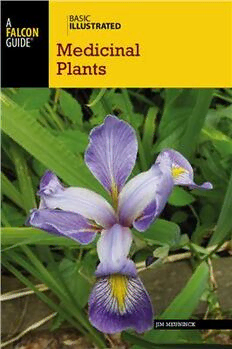
Front cover photo by Jim Meuninck
FALCON
GUIDES®
Distributed by is an imprint of JIM MEUNINCK
NATIONAL BOOK NETWORK Rowman & Littlefield
800-462-6420 falcon.com
Basic illustrated
MEDICINAL PLANTS
BI_Medicinal_Plants_3ppCS55.indd 1 8/29/14 12:56 PM
BI_Medicinal_Plants_3ppCS55.indd 2 8/29/14 12:56 PM
Basic illustrated
MEDICINAL PLANTS
Jim Meuninck
BI_Medicinal_Plants_3ppCS55.indd 3 8/29/14 12:56 PM
FALCONGGUUIIDDEESS®
An imprint of Rowman & Littlefield
Falcon, FalconGuides, and Outfit Your Mind are registered trademarks of Rowman & Littlefield.
Distributed by NATIONAL BOOK NETWORK
Copyright © 2014 by Rowman & Littlefield
All rights reserved. No part of this book may be reproduced in any form or by any electronic or mechanical
means, including information storage and retrieval systems, without written permission from the
publisher, except by a reviewer who may quote passages in a review.
British Library Cataloguing-in-Publication Information available
Library of Congress Cataloging-in-Publication Data
Meuninck, Jim, 1942- author.
Basic illustrated medicinal plants / Jim Meuninck.
pages cm — (Basic illustrated series)
ISBN 978-0-7627-9191-0 (paperback)
1. Medicinal plants—United States—Identification. 2. Medicinal plants—United States—Pictorial works.
I. Title.
QK98.5.U6M484 2014
581.6'34—dc23
2014027446
The paper used in this publication meets the minimum requirements of American National Standard
for Information Sciences—Permanence of Paper for Printed Library Materials, ANSI/NISO Z39.48-1992.
The author and Rowman & Littlefield assume no liability for accidents happening to, or injuries
sustained by, readers who engage in the activities described in this book.
BI_Medicinal_Plants_3ppCS55.indd 4 9/9/14 9:59 AM
This book is a work of reference and is not intended to supply medical advice
to any particular individual. Readers should always consult their personal
physicians for medial advice and treatment. The author, editors, and publisher
of this work have checked with sources believed to be reliable in their efforts
to confirm the accuracy and completeness of the information presented herein
and that the information is in accordance with the standard practices accepted
at the time of publication. However, neither the author, editors, and publisher,
nor any other party involved in the creation and publication of this work
warrants that the information is in every respect accurate and complete, and
they are not responsible for errors or omissions or for any consequences from
the application of the information in this book. In light of ongoing research
and changes in clinical experience and in governmental regulations, readers
are encouraged to confirm the information contained herein with additional
sources, in particular as it pertains to drug dosage and usage. This book does not
purport to be a complete presentation of all poisonous plants, and the genera,
species, and cultivars discussed or pictured herein are but a small fraction of
the plants known to have caused poisonings to humans and animals that might
be found in the wild, in an urban or suburban landscape, or in a home. Given
the global movement of plants, we would expect continual introduction of
species having toxic properties to the regions discussed in this book. We have
made every attempt to be botanically accurate, but regional variations in plant
names, growing conditions, and availability may affect the accuracy of the
information provided. A positive identification of an individual plant is most
likely when a freshly collected part of the plant containing leaves and flowers or
fruits is presented to a knowledgeable botanist or horticulturist. Poison control
centers generally have relationships with the botanical community should the
need for plant identification arise. Medicine is an ever-changing science and
subject to interpretation. We have attempted to provide accurate medical
descriptions of clinical management strategies, but there is no substitute for
direct interaction with an expert clinician for assisting in patient care as well as
a trained botanist or horticulturist for plant identification. In cases of exposure
or ingestion, contact the American Association of Poison Control Centers (800-
222-1222), a medical toxicologist, another appropriate health-care provider, or
an appropriate reference resource.
BI_Medicinal_Plants_3ppCS55.indd 5 8/29/14 12:56 PM
BI_Medicinal_Plants_3ppCS55.indd 6 8/29/14 12:56 PM
CoNTENTS
Introduction .......................................................... ix
How to Use This Guide .................................................x
Kitchen Science: General Principles of Preparing Medicinal Plants .....x
Safety and Efficacy Documents .....................................xii
Medicinal and Edible Plants ........................................xii
Chapter one: Medicinal Plants of the West ............................1
Chapter Two: Medicinal Plants of Forests East and West ..............15
Chapter Three: Medicinal Plants of Wetlands .........................29
Chapter Four: Medicinal Plants of Yards, Prairies, Roadsides, and
Meadows .............................................................47
Appendix A: My Top Eleven Edible Garden Herbs .....................73
Appendix B: Helpful Websites ........................................74
Appendix C: References and Resources ...............................75
Index ..................................................................81
About the Author .....................................................84
BI_Medicinal_Plants_3ppCS55.indd 7 8/29/14 12:56 PM
ACkNoWLEDGMENTS
I want to thank Dr. James Duke for his ground breaking references found online,
in field guides and medicinal plants handbooks presenting user friendly and
innovative advice. Thanks also go to Jill, my steadfast companion, best friend, and
spouse. A special nod to daughter Rebecca, who has accomplished so much for
all of us through her hard work at the Ann Arbor Ecology Center, and once again, I
thank my ancestors and yours for their contributions to the vast amount of botanical
knowledge that improves our diet and engenders good health.
This book would not be possible without all the efforts and insights of the
FalconGuides team to include my gracious, creative, intelligent, and hard-working
editor, David LeGere. Accolades galore for Staci Zacharski, editor-extraordinaire who
hammered home this book’s form and guided it to completion. And thanks to both
copyeditor, Kathy Brook and proofreader, Paulette Baker, and to layout artist, Melissa
Evarts for her wonderful creativity.
viii
BI_Medicinal_Plants_3ppCS55.indd 8 8/29/14 12:56 PM
INTRoDUCTIoN
Robust health and longevity require a judicious and objective approach to medicinal
herbs and plant nutrition. Our ancestors found a medicinal use for every plant, and
those foraging skills link our history on the planet. Borrowing from their evolutionary
wisdom, a successful forager can select what is needed and what to eliminate. The
purpose of this book is to provide you with the knowledge to make informed choices
about what works and what does not. But here’s the problem: Many herbalists and
herb purveyors use a reductionist approach to disease treatment. Like modern
allopathic medicine, they target illness with a single plant chemical or an arsenal
of potent chemicals in combination. There is a place for this; that place too often is
in the late stages of disease. What I advocate is prevention: Eat good-quality whole
foods, drink pure water, exercise daily—and add selected medicinal plants to your
diet. This healthy regimen prevents disease by nipping it in the bud. Bear in mind,
however, when using the term medicinal herb I am most likely talking about an edible
wild plant, too—they are often the same thing. This fact lends credence to the old
saw: You are what you eat. You are a plant with wheels because, either directly or
indirectly, all of your chemistry comes from plant chemistry—therefore plants are
your food and medicine.
Understand, also, a healthy person eats the foods that are in season—the plants
of spring, summer, autumn, and winter. These seasonal plants provide what is right
for that time of year. Spring provides the immune-enhancing tonic greens: nettles,
alliums, watercress, and dock. Summer provides the antioxidant-rich cancer-fighting
fruits and berries, and autumn, the fiber-rich pomes, seeds, and polysaccharides that
give us energy and strength to thrive through the cold months of winter. Formed in
the breast of nature, these natural foods and plant medicines are free and available
to those who know. With this book you will become one of those who know.
My nutritional beliefs are the accumulation of knowledge from numerous
sources: from experience, science, undergraduate and graduate school, hundreds of
books, other experts, gardening, foraging, and personal use. A broad base of whole
plant foods and herbs make the foundation of healthy diet and pave the road to
longevity.
With all that said, I am delighted to share these pages, my humble contribution
to the human experience. Let’s go walk the planet, pull some weeds, and have fun!
ix
BI_Medicinal_Plants_3ppCS55.indd 9 8/29/14 12:56 PM