Table Of Content{v^-i--
S. Hrg. 104-351, Pt. 1
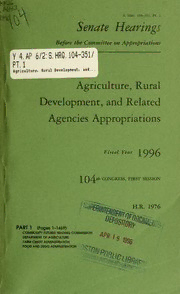
Senate Hearings
t
Before the Committee on Appropriations
Y 4,AP 6/2; S. H RG. 104-351/
Agriculture! Rural Developnent, an«. . .
Agriculture, Rural
Development, and Related
Agencies Appropriations
1996
Fiscal Year
1 0 4'^ CONGRESS, FIRST SESSION
H.R. 1976
^^&m&
PART 1 (Pages 1-1469)
COMMODITY FUTURES TRADING COMMISSION A p^
DEPARTMENT OF AGRICULTURE ^"fl / Q ^
FARM CREDIT ADMINISTRATION '^9$
FOOD AND DRUG ADMINISTRATION ''0T/|«
S. Hrg. 104-351, Pt. 1
AGRICULTURE, RURAL DEVELOPMENT, AND RE-
UTED AGENCIES APPROPRIATIONS FOR HS-
CAL YEAR 1996
HEARINGS
BEFORE A
SUBCOMMITTEE OP^ THE
COMMITTEE ON APPROPRIATIONS
UNITED STATES SENATE
ONE HUNDRED FOURTH CONGRESS
FIRST SESSION
ON
H.R. 1976
AN ACT MAKING APPROPRLATIONS FOR AGRICULTURE, RURAL DEVEL-
OPMENT, FOOD AND DRUG ADMINISTRATION, AND RELATED AGEN-
CIES PROGRAMS FOR THE FISCAL YEAR ENDING SEPTEMBER 30, 1996,
AND FOR OTHER PURPOSES
PART 1 (Pages 1-1469)
Commodity Futures Trading Commission
Department of Agriculture
Farm Credit Administration
Food and Drug Administration
Printed for the use of the Committee on Appropriations
U.S. GOVERNMENT PRINTING OFFICE
WASHINGTON : 1996
For sale by the U.S. Government Printing Office
Superintendent of Documents, Congressional Sales Office, Washington, DC 20402
ISBN 0-16-052338-9
COMMITTEE ON APPROPRIATIONS
MARK O. HATFIELD, Oregon, Chairman
TED STEVENS, Alaska ROBERT C. BYRD, West Virginia
THAD COCHRAN, Mississippi DANIEL K. INOUYE, Hawaii
ARLEN SPECTER, Pennsylvania ERNEST F. HOLLINGS, South Carolina
PETE V. DOMENICI, New Mexico J, BENNETT JOHNSTON, Louisiana
PHIL GRAMM, Texas PATRICK J. LEAHY, Vermont
CHRISTOPHER S. BOND, Missouri DALE BUMPERS, Arkansas
SLADE GORTON, Washington FRANK R. LAUTENBERG, New Jersey
MITCH McCONNELL, Kentucky TOM HARKIN, Iowa
CONNIE MACK, Florida BARBARA A. MIKULSKI, Maryland
CONRAD BURNS, Montana HARRY REID, Nevada
RICHARD C. SHELBY, Alabama J. ROBERT KERREY, Nebraska
JAMES M. JEFFORDS, Vermont HERB KOHL, Wisconsin
JUDD GREGG, New Hampshire PATTY MURRAY, Washington
ROBERT F. BENNETT, Utah
J. Keith Kennedy, Staff Director
Mark Van de Water, Deputy Staff Director
James H. English, Minority Staff Director
Subcommittee on Agriculture, Rural Development, and Related Agencies
THAD COCHRAN, Mississippi, Chairman
ARLEN SPECTER, Pennsylvania DALE BUMPERS, Arkansas
CHRISTOPHER S. BOND, Missouri TOM HARKIN, Iowa
SLADE GORTON, Washington J. ROBERT KERREY, Nebraska
MITCH McCONNELL, Kentucky J. BENNETT JOHNSTON, Louisiana
CONRAD BURNS, Montana HERB KOHL, Wisconsin
MARK O. HATFIELD, Oregon ROBERT C. BYRD, West Virginia
ex officio ex officio
Professional Staff
Rebecca Davies
Hunt Shipman
Galen Fountain (Minority)
Administrative Support
James B. Reynolds
(ID
CONTENTS
Wednesday, March l, 1995
Page
Commodity Futures Trading Commission 1
Farm Credit Administration 35
Department of Health and Human Services: Food and Drug Administration ... 49
Wednesday, March 8, 1995
Department of Agriculture:
Rural Utilities Service 359
Rural Housing and Community Development Service 359
Rural Business and Cooperative Development Service 359
Wednesday, March 15, 1995
Department of Agriculture:
Consolidated Farm Service Agency 457
Foreign Agricultural Service 457
Wednesday, March 22, 1995
Department of Agriculture: Natural Resources Conservation Service 579
Wednesday, March 29, 1995
Department of Agriculture:
Food Safety and Inspection Service 651
Animal and Plant Health Inspection Service 670
Grain Inspection, Packers and Stockyards Administration 670
Agricultural Marketing Service 670
Wednesday, April 5, 1995
Department of Agriculture:
Agricultural Research Service 751
Cooperative State Research, Education, and Extension Service 751
Economic Research Service 751
National Agricultural Statistics Service 751
Wednesday, May 3, 1995
Department of Agriculture: Office of the Secretary 1139
Wednesday, May 10, 1995
Department of Agriculture: Food and Consumer Service 1253
Material Submitted by Agencies Not Appearing for Formal Hearings
Department of Agriculture:
National Appeals Division 1397
Office of the Chief Financial Officer 1400
Office of the General Counsel 1415
Office of Inspector General 1426
Office of the Secretary and Departmental Administration 1453
(III)
AGRICULTURE, RURAL DEVELOPMENT, AND
RELATED AGENCIES APPROPRIATIONS FOR
FISCAL YEAR 1996
WEDNESDAY, MARCH 1, 1995
U.S. Senate,
Subcommittee of the Committee on Appropriations,
Washington, DC.
The subcommittee met at 10:25 a.m., in room SD-138, Dirksen
Senate Office Building, Hon. Thad Cochran (chairman) presiding.
Present: Senator Cochran.
COMMODITY FUTURES TRADING COMMISSION
STATEMENT OF MARY SCHAPIRO, CHAIRMAN
OPENING REMARKS
Senator CoCHRAN. The meeting of the subcommittee will come to
order.
Today we begin our hearings on the budget submitted by the ad-
ministration for f iscal year 1996 with those agencies which fall
within the jurisdictional responsibilities of this committee.
This morning, at our first hearing of the year, we will be review-
ing the budget requests of the Commodity Futures Trading Com-
mission, the Farm Credit Administration, and the Food and Drug
Administration.
The Commodity Futures Trading Commission proposes a 21.5-
percent increase in its budget for fiscal year 1996, compared to the
fiscal year 1995 level. This is to permit an increase in staffing and
to allow the CFTC to meet its other responsibilities.
We are happy to have Ms. Mary Schapiro, who is Chairman of
the Commodity Futures Trading Commission, here to present the
budget and discuss it with the committee.
We have a copy of your statement, Ms. Schapiro. We will put it
in the record in full and invite you to make any comments on the
subject that you care to. Please proceed.
STATEMENT OF MARY SCHAPIRO
Ms. Schapiro. Thank you very much, Mr. Chairman. It is a
pleasure to be here today, and I have a brief oral statement.
I appreciate the opportunity to discuss with you the President's
fiscal year 1996 budget request for the Commodity Futures Trading
Commission.
As you have said, the President has requested $59,711,000 with
a staff ceiling of 627. This is a modest increase over the appropria-
(1)
tions levels of the last several years, a time when markets have
grown dramatically while CFTC resources have declined signifi-
cantly.
I want to share with you very briefly some statistics that high-
light how the explosive growth in futures and options markets
challenge the Commission's ability to carry out its oversight re-
sponsibilities.
As you know, Mr. Chairman, exchange futures and options trad-
ing volume has grown over 200 percent in the last 10 years, while
the CFTC staff has increased only 6 percent.
CFTC market surveillance staff has been reduced by 25 percent
since 1980, while the number of contracts that we must actively
monitor has increased by 126 percent.
Funds that are committed to professional management in the fu-
tures industry have grown from $750 million in 1980 to $25 billion
today. Yet we have only seven FTE's devoted to oversight of this
activity.
In just the last 3 years, exchange trading volume has grown by
more than 42 percent while our staff has in fact decreased by 8
percent.
In contrast, the budgets of the other financial service regulators
have increased substantially. Since 1992, the SEC's budget has in-
creased 35 p ercent. Funds dedicated to the Comptroller of the Cur-
rency and the Federal Reserve Board have increased by 28 and 33
percent. The CFTC's funding level grew by only 4 percent, less
than the rate of inflation.
The decline in resources and staff has hampered the CFTC in
carrying out its vital duties, including those created by the Futures
Trading Practices Act of 1992. This legislation, as you know, gave
the CFTC new regulatory tools to ensure market integrity and au-
thority to e xempt certain transactions from regulation. The act also
directed the Commission to undertake 12 rulemakings and six
studies within very tight timeframes, all of which were accom-
plished without additional resources that had, in fact, been antici-
pated when those duties were assigned.
In addition to meeting the challenges posed by regulation of the
organized exchanges, the Commission also has been increasingly
involved in reviewing the developments in the over-the-counter
markets. The Commission has promoted market certainty by ex-
empting swaps and certain other derivatives from the Commodity
Exchange Act while preserving, most importantly, our ability to in-
vestigate and prosecute fraud. The Commission is also a member,
along with the Treasury, the Federal Reserve, and the SEC, of the
President's Working Group on Financial Markets. Through this ve-
hicle and others, we are considering a wide range of OTC issues.
The Commission's concerns necessarily extend beyond domestic
exchange and OTC markets. The global financial marketplace is
becoming increasingly interlinked as world demand drives the
growth of exchange derivative markets. U.S. markets are forging
trading and other links with their foreign counterparts. Brokerage
firms, subject to our regulation, are becoming increasingly multi-
national. To e nsure adequate enforcement of market, customer, and
financial protections, the Commission must carefully monitor inter-
national developments, such as the recent failure of Barings, the
British merchant bank. And as an aside, I should tell you that the
energy and resources of the staff at the CFTC over the last several
days have been almost totally consumed by the collapse of Barings
Bank. The events surrounding the collapse of Barings demonstrate
the increasingly global nature of the marketplace and how inter-
nationalization has c hallenged all regulators, including the CFTC,
to adapt our regulatory systems and to cooperate in responding to
market developments.
Finally, I want to emphasize that the Commission is not support-
ing increased funding without making every effort to cut costs in-
ternally. Over $2 million in controllable budget activities were ei-
ther reduced or eliminated in our fiscal years 1993 and 1994 oper-
ating budgets, and we continue to look for additional savings.
We are also committed, as you know, to regulatory reform, con-
sistent with the objectives of more efficient and streamlined Gov-
ernment. We are undertaking a comprehensive review of ways to
simplify both regulatory and internal rules. Soon after my arrival,
I asked all the exchanges and trade associations to identify for us
issues of major importance to them that arise from our regulatory
system. We meet on a quarterly basis, at least. And we will be con-
vening a s eries of public roundtables beginning in April to consider
changes to the Commission's regulatory framework.
In this complex, rapidly changing financial marketplace, the
Commission's role as a strong, independent regulator has never
been more important. The Commission cannot effectively imple-
ment the responsibilities that Congress has given it and assume
the duties imposed by marketplace developments without more re-
sources.
Under these circumstances, we believe the increase proposed in
the President's budget is both modest and fully justified.
Thank you, and I will of course be happy to answer your ques-
tions.
PREPARED STATEMENT
Senator Cochran. Thank you very much for your statement and
for your cooperation with the Committee. We have your complete
statement and it will be made part of the record.
[The statement follows:]
4
PREPARED STATEMENT OF MARY L. SCHAPIRO
Mr. Chairman and Members of the Subcommittee:
I appreciate the opportunity to discuss with you the
President's fiscal year 1996 budget request for the Commodity
Futures Trading Commission ("Commission" or "CFTC"). As you
know, the President's fiscal year 1996 budget request for the
CFTC is $59,711,000 with a staff ceiling of 627. This request
represents a modest increase over the appropriations levels of
the last several years, a time during which the markets have
grown dramatically while CFTC resources have declined
signif icantly .
The Commission recognizes that the Subcommittee and the
Congress face particularly difficult appropriations decisions in
this year's budget environment. Nevertheless, the requested
increase is not only justified but essential if the Commission is
to carry out fully and effectively the mandate assigned by the
Congress. The Commission has met the challenge of shrinking
resources for each of the past three years. With operating
budgets slashed, a number of functions transferred to industry
self - regulators and staff stretched to the limit, without
additional funding we will not be able to provide the oversight
or enforcement presence that market users depend upon.
The CFTC was created in 1975 because Congress recognized the
need for an expert, independent agency to protect the important
national interests that are served by commodity futures and
options markets and to ensure market integrity through oversight
of the exchanges and the thousands of intermediaries who invest
individual, pension and corporate funds in these markets. The
price discovery and risk shifting functions of these markets,
long utilized by agricultural producers and processors, are now
essential to the economic well-being of virtually every sector of
the U.S. economy. Today, while the safety and integrity of the
futures markets are as important as ever to processors.