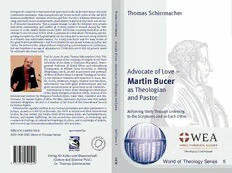
Table Of ContentEvangelicals comprise a movement that spans practically all denominations and even T Thomas Schirrmacher
h
confessions worldwide. Now Evangelicals are found on both sides of the old ditch o
m
between established, mainline churches and free churches, between Reformed the- a
s
ology and more recent developments, and between traditional structures and all sor- S
ts of revivalist movements. That is reason enough to take the Reformer who already c
h
embodied, represented, and unified all of these trends in himself during the 16th ir
r
m
century as a role model. Martin Bucer (1491-1551) was a leading illustration of the
a
attempt to use Scripture to find what is common at a time when Christianity was be- c
h
ginning to experience the fragmentation we see today and to win back erring brothers e
r
itnh ea g frreieant dPlryo taensdta snut sRteafionrambelers m. Bauntn ienr .h Fiso lri fae tliomneg htiem wea Bs uacse wr ewlla-sk ntohwe nle aass tL uktnhoewr na nodf A
d
Calvin. He achieved this status without establishing a denomination or confession, v
o
but was forgotten in an age of separatism in Christianity which did not provide space c
a
for reformers who loved unity. te
o
Prof. Dr. theol. Dr. phil. Thomas Schirrmacher, PhD, ThD, f L
o
DD, is professor of the sociology of religion at the State v
e
University of the West in Timisoara (Romania), Distin- –
guished Professor of Global Ethics and International M
a
Development at William Carey University in Shillong rt Advocate of Love –
(Meghalaya, India), as well as president and professor in
B
of ethics at Martin Bucer European Theological Semina- u
ry and Research Institutes with branches in Bonn, Ber- ce Martin Bucer
r
lin, Zurich, Innsbruck, Prague, Istanbul and Sao Paolo. a
s
Schirrmacher has held guest professorships and has T
given special lectures at universities on all continents. he as Theologian
Schirrmacher is chair of the Theological Commission olo
of the World Evangelical Alliance (WEA), director of the g
International Institute for Religious Freedom (Bonn, Cape Town, Colombo) and Am- ian and Pastor
bassador for Human Rights of WEA; the WEA represents churches with 600 million a
n
members altogether. He also is a member of the board of the International Society d
P
for Human Rights. a
s
Schirrmacher regularly testifies in the German parliament and other parliaments in t
o
Europe, as well as in the EU in Brussels, the OSCE in Vienna and other international r Achieving Unity Through Listening
bodies. His has written 102 books; three of his newest books are Fundamentalism,
to the Scriptures and to Each Other
Racism, and Human Trafficking. He has earned four doctorates, in missiology and
ecumenical theology, in cultural anthropology, in ethics, and in sociology of religion,
and received two honorary doctorates from the USA and India.
ISBN 978-3-86269-058-9 sponsored by: W
o
T
ISSN 1436-0292 (World of Theology Series) S
e
r
ie
s
5
Verlag für Kultur und Wissenschaft
V
(Culture and Science Publ.) K World of Theology Series 5
Dr. Thomas Schirrmacher W
Thomas Schirrmacher
Advocate of Love –
Martin Bucer
as Theologian and Pastor
“World of Theology Series”
Studies published by the Theological Commission
of the World Evangelical Alliance
Vol 5
Theologisches Lehr- und Studienmaterial
(Martin Bucer Seminar)
Vol 30
Vol 1 Stefano Cotrozzi – Exegetischer Führer zum Titus- und Philemonbrief
Vol 2 Thomas Schirrmacher – Gottesdienst ist mehr: Plädoyer für eine liturgische Gottesdienst-
gestaltung
Vol 3 Philip M. Steyne – Schritt halten mit dem Gott der Völker
Vol 4 Henry Krabbendam – Sovereignty and Responsibility
Vol 5 Thomas Schirrmacher – Die Vielfalt biblischer Sprache
Vol 6 Frank Koppelin – Gott sucht den Menschen: Eine Einführung in die Theologie des AT
Vol 7 Cambron Teupe – Einführung in die Exegese des Alten Testamentes
Vol 8 Christine Schirrmacher – TFU-Kurs ‚Der Islam‘
Vol 9 Henry Krabbendam – James: A Practical Commentary
Vol 10 Titus Vogt – Stichworte zur Dogmengeschichte
Vol 11 John Warwick Montgomery – Tractatus Logico-Theologicus
Vol 12 Alfred Kuen – Der Gottesdienst in Bibel und Geschichte
Vol 13/14 Thomas Kinker – Die Bibel verstehen und auslegen
Vol 15 Clair Davis – Wenn der Glaube Gestalt gewinnt
Vol 16 Jürgen Gruhler – JHWH oder Ahab?
Vol 17 Thomas Schirrmacher (Hg.) – Der Evangelische Glaube kompakt
Vol 18 Johannes Calvin – Institutio (in Vorbereitung)
Vol 19 Eduard Böhl – Dogmatik
Vol 20 Thomas Schirrmacher – Scham- oder Schuldgefühl?
Vol 21 Cambron Teupe – Einführung in das neutestamentliche Griechisch
Vol 22 David Garrison – Gemeindegründungs-Bewegungen
Vol 23 Carsten Friedrich – Die Schatten der himmlischen Dinge: Typologie im Hebräerbrief
Vol 24 Franz Graf-Stuhlhofer – „Das Ende naht!“
Vol 25 Bodo Heller – Das Reich Gottes zwischne Annahme und Ablehnung
Vol 26 Franz Graf-Stuhlhofer – Christliche Bücher kritisch lesen
Vol 27 Margarita Heller – ‚Er offenbarte seine Herrlichkeit‘: Kommentar zu Johannes 1-4
Vol 28 Christoph Jung – Da waren’s nur noch neun ... Das Sabbatgebot und die Christen
Vol 29 Wayne Grudem – Biblische Dogmatik
Vol 30 Thomas Schirrmacher – Advocate of Love – Martin Bucer as Theologian and Pastor
Vol 31 Daniel Dangendorf – Musikethik in der Gemeinde
Vol 32: Titus Vogt – Von Ewigkeit erwählt?!
Vol 33: Fortsetzung folgt: Die Fortschreibung des Heidelberger Katechismus durch die Christli-
che Kirche aus Nordmitteljava.
Thomas Schirrmacher
Advocate of Love –
Martin Bucer
as Theologian and Pastor
Achieving Unity through Listening
to the Scriptures and to Each Other
Martin Bucer’s Theological and Practical
Agenda as a Challenge to Evangelicals Today
Translated by Richard McClary
Edited by Thomas K. Johnson
Verlag für Kultur und Wissenschaft
Culture and Science Publ.
Bonn 2013
Bibliographic information published by the Deutsche Nationalbib-
liothek
The Deutsche Nationalbibliothek lists this publication in the Deutsche
Nationalbibliografie; detailed bibliographic data are available in the Inter-
net at http://dnb.d-nb.de
© Copyright 2013 by
Verlag für Kultur und Wissenschaft
(Culture and Science Publ.)
Prof. Dr. Thomas Schirrmacher
Friedrichstraße 38, D-53111 Bonn
Fax +49 / 228 / 9650389
www.vkwonline.de / [email protected]
ISSN 2197-9057
ISSN 1436-0292
ISBN 978-3-86269-058-9
Printed in Germany
coverdesign and manufacturing:
BoD Verlagsservice Beese, Friedensallee 44, 22765 Hamburg
www.rvbeese.de / [email protected]
Publishing Distribution Center:
IC-Medienhaus
D-71087 Holzgerlingen, Tel. 07031/7414-177 Fax -119
www.icmedienhaus.de
catalog for book stoores:
www.vkwonline.de/gesamtprospekt
Private costumers: in each book stoore or at www.vkwonline.de
Contents
Bucer and Evangelicals .................................................................................... 9
The unknown Bucer ......................................................................................... 9
Martin Bucer (resumé in tabular form) .......................................................... 12
Building Christ’s Kingdom ............................................................................ 20
Theologian of the Holy Spirit ........................................................................ 21
The Inspiration of God’s Word ...................................................................... 22
Ethics as Sanctification Arising Out of Justification ..................................... 23
Bucer and the Law ......................................................................................... 26
Learning from the Anabaptists ....................................................................... 27
Confirmation .................................................................................................. 31
Pastoral Care as a Sign of Jesus’ Church ....................................................... 33
Church Discipline .......................................................................................... 35
Lay Elders ...................................................................................................... 37
Christian Communities .................................................................................. 38
The Meaning of the Family in the Church Community ................................. 43
Apologetics and the Priesthood of Believers ................................................. 44
The Pietist among the Reformers ................................................................... 45
The Puritan among the Reformers ................................................................. 47
Bucer wanted Christian Unity ........................................................................ 48
Unity through Truth ....................................................................................... 51
Thoughts about Election ................................................................................ 53
Domiciled in the Reformed Camp ................................................................. 54
Calvin became a Calvinist through Bucer ...................................................... 55
Exegesis Is Prior to Dogmatics ...................................................................... 58
A Theology of Love ....................................................................................... 58
Unity and the Lord’s Supper .......................................................................... 59
The Cologne Reformation .............................................................................. 61
The Role of the Church Fathers ..................................................................... 63
Bucer Was Internationally Active .................................................................. 64
A Proponent of World Missions Not Befitting His Time .............................. 66
The Influence of His Liturgy ......................................................................... 67
Bucer’s Social Ethic ....................................................................................... 69
A Critical Partner of the State ........................................................................ 70
Groundbreaking and Innovative Ethics in Detail ........................................... 74
Marriage Is a Love Partnership ...................................................................... 74
A New View of Divorce ................................................................................ 76
The Tragedy of the Bigamy of Philipp von Hessen ....................................... 78
Bucer as a Role Model for Our Time ............................................................. 80
A Discussion of Three New Important Dissertations on Martin Bucer ......... 80
About the Author ........................................................................................... 89
“Bucer? That slick rogue (what a treat) . . .” (Martin Luther on Martin
Bucer)1
“In the true knowledge of God one only knows as much as one can bring
to expression in his own life.”2
(Martin Bucer)
“No one wants to learn. Everyone [wants] to teach.”3
“Every person should accept the speech of another as if it was spoken to
promote the truth, to then think about which truth could be in such
speech, as faithfully as one can, so that what is said becomes real.”4
(Martin Bucer on conversations among Christians)
“If one wants to immediately judge someone as deserted by the Spirit of
Christ just because an individual does not judge the same as oneself, and
if one is prepared to go after someone as an enemy of the truth because
that person might hold something false for true, then whom can one still
look upon as a brother? I have personally never seen two people who
think exactly the same thing. And that also applies to theology.”
(Martin Bucer, 1530, in the preface to his commentary on the Gospels)
“The former Dominican monk Martin Bucer (1491-1551) . . . deserves a
place next to the great Reformers such as Luther and Calvin for the
strength of his thought and action.”5
“During this time [1534] he became . . . one of the leading, if not the
central figure, at least within German Protestantism.”6
“Bucer is of great importance for institutions of the Evangelical church.
He achieved this via the documents he composed for various German
territories and imperial cities concerning church order. As they were
communicated by Calvin, they shaped the entirety of Reformed Protes-
tantism. Beyond that, he was indefatigable as he endeavored to achieve
understanding among Protestants as well as understanding with the
Catholic Church, such that his writings are of interest for present day
1 Quoted from Gottfried Hammann. Martin Bucer. Gestalten des Protestantismus
von gestern und heute. Christliches Verlags-Haus: Stuttgart, 1989. p. 25.
2 Martin Bucer, quoted by Marijn de Kroon. Martin Bucer und Johannes Calvin.
Vandenhoeck & Ruprecht: Göttingen, 1991. p. 242.
3 Martin Bucer, quoted ibid., p. 238.
4 Martin Bucer, quoted ibid., p. 239.
5 Bernard Cottret. Calvin: Eine Biographie. Quell: Stuttgart, 1998. p. 165.
6 Martin Greschat. Martin Bucer: Ein Reformator und seine Zeit. C. H. Beck: Mün-
chen, 1990. p. 143.
8 Advocate of Love – Martin Bucer as Theologian and Pastor
ecumenical discussions. He even took the inquiries from representatives
of the so-called ‘left wing’ of the Reformation seriously. His efforts re-
lating to the introduction of confirmation and church discipline were
widely accepted. And he made basic contributions having to do with the
relationship between church and state. On the one hand, he represented
the freedom of the church and free church considerations. On the other
hand, however, during his activities in Cambridge he laid the foundation
for the English state church.”7
“Under the conviction that ‘being a Christian’ always has to be lived in
community, Bucer strove after sanctification, so that Christ was recog-
nized in individual life as well as corporate life as Lord and Master.”8
“In the process he was inexhaustibly active, regularly and indefatigably
as a matter of course until deep into the night. The humanist and theolo-
gian Petrus Martyr Vermigli (1500-1562), who was driven out of Italy
and who lived several years in Strasbourg, wrote in 1542: ‘I have never
seen Bucer inactive, either he is preaching or he is involved in organiz-
ing and leading the church [. . .]. After he has spent the day with such
pursuits, he turns around and spends the night in study and prayer. Sel-
dom have I ever awakened to find that he himself was not still awake.’”9
7 Introduction on Bucer by the European Bucer research center at the University of
Heidelberg (quoted on www.uni-heidelberg.de/institute/sonst/adw/bucer/vita.html
– 29.9.2001).
8 Reinhold Friedrich. „Martin Bucer“. pp. 85-101 in: Christian Möller (ed.). Ge-
schichte der Seelsorge in Einzelporträts. vol. 2. Von Martin Luther bis Matthias
Claudius. Vandenhoeck & Ruprecht: Göttingen, 1995. p. 87.
9 Martin Greschat. Martin Bucer. op. cit., p. 211.
Bucer and Evangelicals 9
Bucer and Evangelicals
Evangelicals comprise a worldwide movement that spans practically all
denominations and even most confessions. Evangelicals are found on both
sides of mainline, traditional churches and the newer small or revival
churches. Thus the evangelical alliance in Germany early bridged the deep
ditch between the German State Church and the free churches. Evangeli-
cals bridge Reformed theology and more recent theological developments
while also connecting traditional structures with all sorts of revivalist
movements.
That is reason enough to take the Reformer, who embodied all of this
already in the 16th century, as a role model: Martin Bucer from Strass-
bourg. This is not to make an Evangelical out of Bucer or to redirect his
stream towards the Evangelical mill, just as little as anyone should talk Bu-
cer up as the one exemplary Christian. Nevertheless, Bucer represents the
attempt to use Scripture to find what is common at a time when Christiani-
ty was experiencing fragmentation and to win back erring brothers in a
manner that was both friendly and serious.
For Martin Bucer European School of Theology and Research Insti-
tutes, the institution I lead and which made the following research possible,
Bucer is more than just someone who accidentally provides us with the
seminary’s name; for one and one-half years he preached and wrote in the
vicinity of our Bonn Study Center as the Reformation was initiated.
Reformed and reforming, yet open to hear all voices from within Chris-
tendom, whether it was in conversation with Lutherans, Baptists or spiritu-
alists, Bucer truly desired Christian unity. However, he did not want unity
at the cost of biblical theology or reduced conviction. Rather, Bucer per-
sued unity by working in a concerted manner with Scripture and by work-
ing on basic theological convictions.
In our opinion, that is the order of the day for Christians and Evangeli-
cals, and it is also the task of a theological seminary: to clearly work out
the non-negotiable basics anew and to defend them, to simultaneously
identify which questions are less important, and by listening to others to
always rethink things together with open Bibles.
The unknown Bucer
For a long time Bucer was the least known of the great Reformers. Hein-
rich Bornkamm calls Bucer, alongside Luther and Melanchthon, the ‘third