Table Of Content1 | Page
About Us
Culture matters. And it has to matter in India, with its diverse languages, dialects, regions and
communities; its rich range of voices from the mainstream and the peripheries.
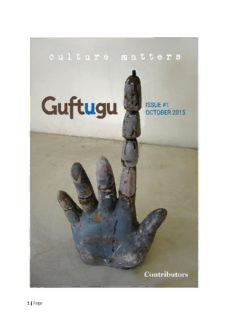
This was the starting point for Guftugu (www.guftugu.in), a quarterly e-journal of poetry, prose,
conversations, images and videos which the Indian Writers’ Forum runs as one of its programmes. The
aim of the journal is to publish, with universal access online, the best works by Indian cultural
practitioners in a place where they need not fear intimidation or irrational censorship, or be excluded by
the profit demands of the marketplace. Such an inclusive platform sparks lively dialogue on literary and
artistic issues that demand discussion and debate.
The guiding spirit of the journal is that culture must have many narratives from many different voices –
from the established to the marginal, from the conventional to the deeply experimental.
To sum up our vision:
Whatever our language, genre or medium, we will freely use our imagination to produce what we see as
meaningful for our times. We insist on our freedom to speak and debate without hindrance, both to
each other and to our readers and audience. Together, but in different voices, we will interpret and
reinterpret the past, our common legacy of contesting narratives; and debate on the present through
our creative work.
2 | Page
Our Team
Editors
K. Satchidanandan
Mala Dayal
Githa Hariharan
Associate Editor
Souradeep Roy
Editorial support
Parboni Bose
Nishad Bailey
Site
Shweta Jain
Design, art and layout
Chandan Gorana
Shoili Kanungo
Legal Consultant
Rishab Bailey
Contributing Editors
Antara Dev Sen
Gulammohammed Sheikh
N.S. Madhavan
Orijit Sen
Shohini Ghosh
Shubha Mudgal
T.P. Sabitha
Contributions: Guftugu welcomes contributions from writers, academics, artists, cartoonists, film
makers, performing artists and scientists. Please email us at [email protected] with your ideas
and / or work, and we will get back to you.
3 | Page
Contents
From the Editors 5
K. Sachidanandan: Pardon 7
Gulammohammed Sheikh: Man II 10
Perumal Murugan: The Narrow Room 11
Unny: Scrawl 13
Githa Hariharan in Conversation with T.M. Krishna 14
Orijit Sen: Sotto Voce 21
Malayalam Fiction Special: M. Mukundan, N.S. Madhavan and Anand 22
Vivek Narayanan: Chitra Kuta 41
Githa Hariharan-- Mishtakes 2015: Revisiting India with Manto 45
Robin S. Ngangom: A Civilized Monologue 56
Shashi Deshpande: The Writer as Activist 59
Pinky: Pinky’s Bed 65
T.P. Sabhitha: Stones 66
S. Vijayaraghavan: Between Two Edges 68
Zai Whitakar: Roots 70
Contributors 73
Terms and Conditions 75
Copyright 78
4 | Page
From the Editors
In the dark times
Will there also be singing?
Yes, there will also be singing.
About the dark times.
Bertolt Brecht reminds us that we can sing in the bad times too; we can sing about the bad times. This
Brechtian paradox is apt for the literatures and arts of the present time in India.
If singing and dancing, poetry and prose, film and painting have all been possible even in the most brutal
times history has witnessed, we can believe our situation today too cannot subdue what we can do with
artistic practice of all sorts, as well as education. Every day we see new evidence of authoritarianism in
India – the sort of tyranny that impinges on our cultural work, and on those who wish to partake of what
we imagine for them. Even the day-to-day cultural practices by the wide range of people who make up
India are vulnerable to the aggression of the “cultural police” in different guises. These policemen want
to tell us all what to eat, wear, read, speak, pray, think. They want to tell us how to live.
The writer is more important in times of siege, said the South African writer Andre Brink. He knew what
he was talking about; he was writing about apartheid South Africa. We know how cultural spaces are
shrinking in India. And we believe that writers – and any practitioner and partaker of culture – are more
important in the times we are living through. Writers, artists and educators may not be soldiers; but
they too have weapons, weapons that are often more effective.
We believe this. We believe in the transformative power of the word, the image and the class room. This
is why we have set up the Indian Writers’ Forum for all of us; and launched the Indian Cultural Forum
site as well as Guftugu, an e-journal of literature and art.
When setting up the Indian Writers’ Forum, we had said: “As committed readers and writers, we see
ourselves as part of a rich and plural literary heritage. In our own times, our dream is to build on this
heritage for a more just, egalitarian and humane society. We aspire to perceive, understand and
celebrate difference even while breaking down the barriers created by caste, class, religion, race and
language. But we are painfully aware of the ways in which our literary culture has been challenged in
recent times. It is critical, at the present juncture, to resist the range of threats faced by our culture of
free expression, exchange, dialogue and debate. It is crucial that we fight for ourselves as readers and
writers, and for all the readers and writers in our country. Whatever language and genre we write in, we
insist on our right to freely use our imagination to write what we perceive as meaningful for our times
and to speak and debate without hindrance, both to each other and to our readers. This includes our
right to interpret and reinterpret the past, and our common legacy of contesting narratives…”
Every word of this applies to Guftugu – a journal that will feature counter-cultural expressions in poetry,
prose and images. Guftugu aims to reflect and critique present-day aggression against culture; to
articulate creative resistance against the degeneration of democratic values and institutions; and to
achieve this by freely doing what we do best: writing, painting, imagining, speculating and debating.
The Indian Writers’ Forum and Guftugu are happy that so many writers, scholars and cultural
practitioners have expressed solidarity with our venture. One of our first supporters,
U.R. Ananthamurthy, is no longer with us. But we are confident that more writers, thinkers and readers
from every Indian language and region, and more artists from every medium, will join us to make what
5 | Page
the Malayalam poet Vyloppilly called “a golden opposition”.
K.Satchidanandan
Githa Hariharan
October 2015
6 | Page
K. Satchidanandan
Pardon
This poem is dedicated to the Tamil writer Perumal Murugan who was forced into silence by anti-social
communal outfits.
Pardon me
for what I have written,
for what I could not write,
for what I am likely to write
and for what I may never write.
Pardon me for the trees’ flowering,
for the flowers’ fruiting,
for having hoarded so much of
gold and water and spring
inside the earth.
Pardon me for the waning moon,
for the setting sun,
for the movement of the living,
for the stillness of the non-living.
Pardon me for filling the earth
with so much colour,
the blood with so much red,
the leaf with forest,
the rain with sky,
the sand with star
and my ink with dreams.
Pardon me for filling words
with so much meaning,
dates with so much history;
for having hidden today inside yesterday
and tomorrow inside today;
for creating the Creator
who fills gestures with dance
and nature with symbols.
Pardon me for the earthquake
and the tempest,
the wild fire and the raging sea.
The Earth is a damaged machine.
I am not someone who can repair it.
I am a king without a country,1
A god without a weapon,2
a life without a tongue.
7 | Page
Invent a god
Who doesn’t ask for your head.
Invent the fearless man.
Invent
language,
invent
the alphabet.
They
You are writing about love
and the vast emptiness that
precedes it.
They seize your paper
and tear your poem into pieces
before it is born, and say:
“This is treason; you have
lost your right to live.”
You are meditating over colours
surprised by the strange forms
they assume on your canvas.
They burn your
incomplete painting and
pronounce their judgment:
“This is heresy; you must
leave this country.”
You are narrating
the tales of Buddha’s kindness
to the children around you.
They crush your tender voice,
scare the kids with open knives
and shout at them:
“This guy is mad;
stone him to death.”
You are humming
a song of love and hope in tune with
the breeze, the brook and the bird.
They point their tridents
at your singing tongue, and scream:
“You are conspiring with nature
against man; yours is the destiny
of the traitor.”
You are praying for peace
silently to your formless god, alone,
or with your friends,
raising your fists for justice.
8 | Page
They come with swastikas
and flags of different hues, and ask:
“Which is your god? Your
religion, your country, your language?”
No, no kisses.
No prayers to other gods.
No truth-telling. Not a word
on non-violence. No talk about
the great light beyond
races and religions.
They put embers in your mouth,
gouge your eyes out.
They won’t be strangers:
your friends or neighbours,
your own brother or beloved,
or , who knows,
maybe you will find yourself among them.
Click here to read originals in Malayalam http://guftugu.in/k-satchidanandan/
Notes:
1. In the original ‘Perumal without a country’. ‘Perumal’ means ‘the Big Man’, the King.
2. In the original ‘Murugan without a vel’. Murugan is Lord Subrahmanya who travels on a peacock and
has a ‘vel’- a kind of spear- for his weapon. The two words together make the name of the writer.
© Poems and translations, K. Satchidanandan
9 | Page
Gulammohammed Sheikh
Man II
© Gulammohammed Sheikh
10 | Page
Description:Githa Hariharan in Conversation with T.M. Krishna .. need to be anointed into this religiosity if you want to understand the music. Door bolts did not fall properly and water taps leaked perpetually, as they always seem to do in.