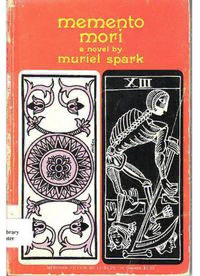
Table Of ContentMemento Mori
by MURIEL SPARK
available from New Directions:
THE ABBESS OF CREWE
ALL THE POEMS OF MURIEL SPARK
ALL THE STORIES OF MURIEL SPARK
THE BACHELORS
THE BALLAD OF PECKHAM RYE
THE COMFORTERS
THE DRIVER’S SEAT
A FAR CRY FROM KENSINGTON
THE GHOST STORIES
THE GIRLS OF SLENDER MEANS
LOITERING WITH INTENT
MEMENTO MORI
OPEN TO THE PUBLIC
THE PUBLIC IMAGE
ROBINSON
SYMPOSIUM
Muriel Spark
MEMENTO MORI
A NEW DIRECTIONS CLASSIC
Copyright © 1959 by Muriel Spark
All right reserved. Except for brief passages quoted in a newspaper, magazine,
radio, or television review, no part of this book may be reproduced in any form or
by any means, electronic or mechanical, including photocopying and recording, or
by any information storage and retrieval system, without permission in writing from
the Publisher.
First published as a New Directions Classic in 2000
Published by arrangement with Dame Muriel Spark, and her agent Georges
Borchardt, Inc., New York.
Library of Congress Cataloging in Publication Data
Spark, Muriel.
Memento Mori / Muriel Spark.
p. cm.—(New Directions classics)
ISBN: 978-0-8112-1438-4
1. Aged—England—London—Fiction. 2. Aged—Psychology—
Fiction. 3. Practical jokes—Fiction. 4. London (England)—Fiction. I. Title.
II. Series.
PR6037.P29 M4 2000
823’.914—dc21
99-058767
New Directions Books are published for James Laughlin
by New Directions Publishing Corporation,
80 Eighth Avenue, New York 10011
Memento Mori
What shall I do with this absurdity—
O heart, O troubled heart—this caricature,
Decrepit age that has been tied to me
As to a dog’s tail?
—W. B. YEATS, The Tower
O what venerable and reverent creatures did the aged seem!
Immortal Cherubims!
—THOMAS TRAHERNE,
Centuries of Meditation
Q. What are the four last things to be ever remembered?
A. The four last things to be ever remembered are Death, Judgment, Hell,
and Heaven.
—The Penny Catechism
Contents
Chapter One
Chapter Two
Chapter Three
Chapter Four
Chapter Five
Chapter Six
Chapter Seven
Chapter Eight
Chapter Nine
Chapter Ten
Chapter Eleven
Chapter Twelve
Chapter Thirteen
Chapter Fourteen
Chapter Fifteen
Chapter Sixteen
Chapter One
Dame Lettie Colston refilled her fountain pen and continued her letter:
One of these days I hope you will write as brilliantly on a
happier theme. In these days of cold war I do feel we should soar above
the murk & smog & get into the clear crystal.
The telephone rang. She lifted the receiver. As she had feared the man
spoke before she could say a word. When he had spoken the familiar sentence
she said, “Who is that speaking, who is it?”
But the voice, as on eight previous occasions, had rung off.
Dame Lettie telephoned to the Assistant Inspector as she had been
requested to do. “It has occurred again,” she said.
“I see. Did you notice the time?”
“It was only a moment ago.”
“The same thing?”
“Yes,” she said, “the same. Surely you have some means of tracing—”
“Yes, Dame Lettie, we will get him, of course.”
A few moments later Dame Lettie telephoned to her brother Godfrey.
“Godfrey, it has happened again.”
“I’ll come and fetch you, Lettie,” he said. “You must spend the night with
us.”
“Nonsense. There is no danger. It is merely a disturbance.”
“What did he say?”
“The same thing. And quite matter-of-fact, not really threatening. Of
course the man’s mad. I don’t know what the police are thinking of, they must be
sleeping. It’s been going on for six weeks now.”
“Just those words?”
“Just the same words—‘Remember you must die’—nothing more.”
“He must be a maniac,” said Godfrey.
Godfrey’s wife, Charmian, sat with her eyes closed, attempting to put
her thoughts into alphabetical order which Godfrey had told her was better than no
order at all, since she now had grasp of neither logic nor chronology. Charmian
was eighty-five. The other day a journalist from a weekly paper had been to see
her. Godfrey had subsequently read aloud to her the young man’s article:
…By the fire sat a frail old lady, a lady who once set the whole
of the literary world (if not the Thames) on fire…. Despite her age, this
legendary figure is still abundantly alive….
Charmian felt herself dropping off, and so she said to the maid, who
was arranging the magazines on the long oak table by the window, “Taylor, I am
dropping off to sleep for five minutes. Telephone to St. Mark’s and say I am
coming.”
Just at that moment Godfrey entered the room holding his hat and
wearing his outdoor coat. “What’s that you say?” he said.
“Oh, Godfrey, you made me start.”
“Taylor…” he repeated, “St. Mark’s…Don’t you realise there is no maid
in this room, and furthermore, you are not in Venice.”
“Come and get warm by the fire,” she said, “and take your coat off” for
she thought he had just come in from the street.
“I am about to go out,” he said. “I am going to fetch Lettie who is to stop
with us to-night. She has been troubled by another of those anonymous calls.”
“That was a pleasant young man who called the other day,” said
Charmian.
“Which young man?”
“From the paper. The one who wrote—”
“That was five years and two months ago,” said Godfrey.
“Why can’t one be kind to her?” he asked himself as he drove to
Lettie’s house in Hampstead. “Why can’t one be more gentle?” He himself was
eighty-seven, and in charge of all his faculties. Whenever he considered his own
behaviour he thought of himself not as “I” but as “one.”
“One has one’s difficulties with Charmian,” he told himself.
“Nonsense,” said Lettie. “I have no enemies.”
“Think,” said Godfrey. “Think hard.”
“The red lights,” said Lettie. “And don’t talk to me as if I were
Charmian.”
“Lettie, if you please, I do not need to be told how to drive. I observed
the lights.” He had braked hard, and Dame Lettie was jerked forward.
She gave a meaningful sigh which, when the green lights came on,
made him drive all the faster.
“You know, Godfrey,” she said, “you are wonderful for your age.”
“So everyone says.” His driving pace became moderate; her sigh of
relief was inaudible, her patting herself on the back invisible.
“In your position,” he said, “you must have enemies.”
“Nonsense.”
“I say yes.” He accelerated.
“Well, perhaps you’re right.” He slowed down again, but Dame Lettie
thought, I wish I hadn’t come.
They were at Knightsbridge. It was only a matter of keeping him happy
till they reached Kensington Church Street and turned into Vicarage Gardens
where Godfrey and Charmian lived.
“I have written to Eric,” she said, “about his book. Of course, he has
something of his mother’s former brilliance, but it did seem to me that the subject-
matter lacked the joy and hope which was the mark of a good novel in those days.”
“I couldn’t read the book,” said Godfrey. “I simply could not go on with it.
A motor salesman in Leeds and his wife spending a night in a hotel with that
communist librarian…Where does it all lead you?”
Eric was his son. Eric was fifty-six and had recently published his
second novel.
“He’ll never do as well as Charmian did,” Godfrey said. “Try as he may.”
“Well, I can’t quite agree with that,” said Lettie, seeing that they had now
pulled up in front of the house. “Eric has a hard streak of realism which Charmian
never—”
Godfrey had got out and slammed the door. Dame Lettie sighed and
followed him into the house, wishing she hadn’t come.
“Did you have a nice evening at the pictures, Taylor?” said Charmian.
“I am not Taylor,” said Dame Lettie, “and in any case, you always called
Taylor Jean during her last twenty or so years in your service.”
Mrs. Anthony, their daily housekeeper, brought in the milky coffee and
placed it on the breakfast table.
“Did you have a nice evening at the pictures, Taylor?” Charmian asked
her.
“Yes, thanks, Mrs. Colston,” said the housekeeper.
“Mrs. Anthony is not Taylor,” said Lettie. “There is no one by name of
Taylor here. And anyway you used to call her Jean latterly. It was only when you
were a girl that you called Taylor Taylor. And, in any event, Mrs. Anthony is not
Taylor.”
Godfrey came in. He kissed Charmian. She said, “Good morning, Eric.”
“He is not Eric,” said Dame Lettie.
Godfrey frowned at his sister. Her resemblance to himself irritated him.
He opened The Times.
“Are there lots of obituaries to-day?” said Charmian.
“Oh, don’t be gruesome,” said Lettie.
“Would you like me to read you the obituaries, dear?” Godfrey said,
turning the pages to find the place in defiance of his sister.
“Well, I should like the war news,” Charmian said.
“The war has been over since nineteen forty-five,” Dame Lettie said. “If
indeed it is the last war you are referring to. Perhaps, however, you mean the First
World War? The Crimean perhaps…?”
“Lettie, please,” said Godfrey. He noticed that Lettie’s hand was
unsteady as she raised her cup, and the twitch on her large left cheek was
pronounced. He thought in how much better form he himself was than his sister,
though she was the younger, only seventy-nine.
Mrs. Anthony looked round the door. “Someone on the phone for Dame
Lettie.”
“Oh, who is it?”
“Wouldn’t give a name.”
“Ask who it is, please.”
“Did ask. Wouldn’t give—”
“I’ll go,” said Godfrey.
Dame Lettie followed him to the telephone and overheard the male
voice. “Tell Dame Lettie,” it said, “to remember she must die.”
“Who’s there?” said Godfrey. But the man had hung up.
“We must have been followed,” said Lettie. “I told no one I was coming
over here last night.”
She telephoned to report the occurrence to the Assistant Inspector.
He said, “Sure you didn’t mention to anyone that you intended to stay at
your brother’s home?”
“Of course I’m sure.”
“Your brother actually heard the voice? Heard it himself?”
“Yes, as I say, he took the call.”
She told Godfrey, “I’m glad you took the call. It corroborates my story. I
have just realised that the police have been doubting it.”
“Doubting your word?”
“Well, I suppose they thought I might have imagined it. Now, perhaps,
they will be more active.”
Charmian said, “The police…What are you saying about the police?
Have we been robbed?”
“I am being molested,” said Dame Lettie.
Mrs. Anthony came in to clear the table.
“Ah, Taylor, how old are you?” said Charmian.
“Sixty-nine, Mrs. Colston,” said Mrs. Anthony.
“When will you be seventy?”
“Twenty-eighth November.”
“That will be splendid, Taylor. You will then be one of us,” said
Charmian.